
Executive Summary
Liquidity management has returned to the center of financial leadership, because cash is the one number that resists narrative. Earnings can flatter and adjusted metrics can soothe, but cash shows what moved and what did not. When rates rise and capital tightens, that honesty turns cash flow from a trailing reconciliation into a strategic signal.
This article treats liquidity as more than a budget line. It examines cash flow as a filter for accrual noise, working capital as a map of operational friction, liquidity as strategic optionality, and cash decisions as signals to markets. Finance leaders will find a practical framework for reading cash, defending reserves, and communicating liquidity choices with integrity.
Why Liquidity Management Matters When Noise Rises
For years, cheap capital pushed cash into the background. Leadership teams spoke in ARR multiples, net retention, and CAC payback, and treated liquidity as a given. Rate hikes, capital scarcity, and investor skepticism changed that, and cash returned as a clarifier.
Entropy, borrowed from thermodynamics, offers a useful lens here. In finance, disorder shows up as variance between plan and actual, accrual and reality, forecast and cash received. As product portfolios fragment and macro shocks multiply, financial signals decay, yet cash flow endures as the cleanest signal left. Plenty of companies carry beautiful P&Ls alongside broken balance sheets, with stress hidden in familiar places:
- Deferred revenue masking churn
- Capitalized costs masking margin erosion
- Headline growth obscuring customer concentration
- Late receivables, overstocked inventory, and compressed payables windows
A healthy cash conversion cycle means more than fast collection. It shows that demand, fulfillment, receivables, and payables move in rhythm, and stress appears wherever that rhythm breaks.
Cash Flow as the Truth Beneath Accrual Metrics
Accrual accounting is a civilizing invention that lets companies measure performance across time. It also demands judgment on revenue recognition, capitalization, and timing, and those judgments compound into noise. Cash acts as the counterweight, collapsing policy and intent into one question: did the money move?
When Accruals and Cash Diverge
Consider a growth-stage SaaS company reporting ARR up 40% with stable CAC. Beneath the surface, collections lag, deferred revenue sits flat, and burn accelerates. The gap between billed and collected keeps widening, which signals decay long before the P&L does. Turnaround situations show the same pattern, where margins rise on paper while vendor payments slip and quarter-end discounts inflate invoices.
A skilled CFO does not choose between accrual and cash measures. The gap between net income and free cash flow becomes the signal itself. That gap does not prove fraud or failure, but it shows interpretive stretch, and a wider gap demands closer scrutiny of every assumption.
The Cash Conversion Path
Hypergrowth raises this risk, since billing terms diversify, credit policies stretch, and implementation cycles vary. Every dashboard should therefore track a cash conversion ratio, showing how much operating income becomes cash and where it leaks.
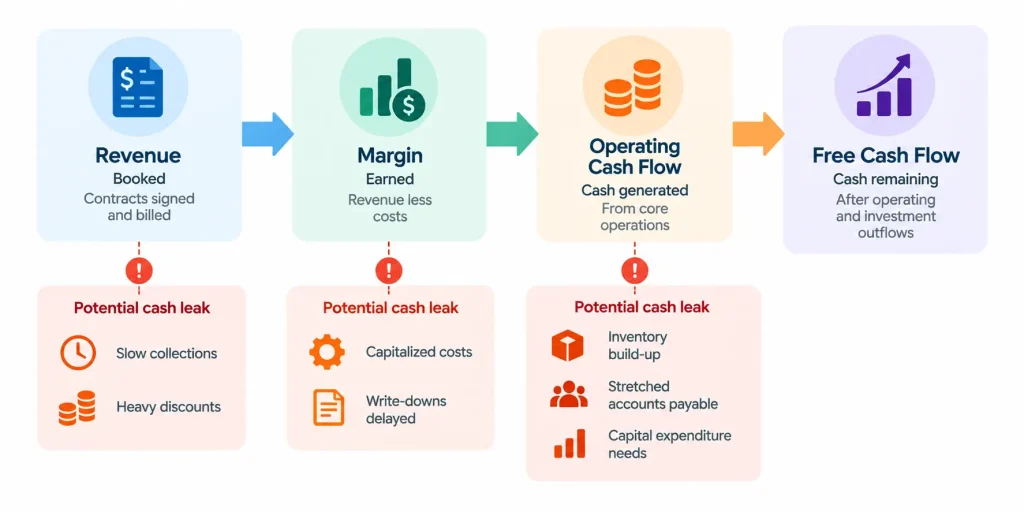
When cash flows cleanly from revenue through margin to free cash flow, the system is synchronized. When it pools or slips without explanation, entropy is rising, and even an elegant forecast may already be invalid.
Working Capital and Liquidity Management: Reading the Heat Signature
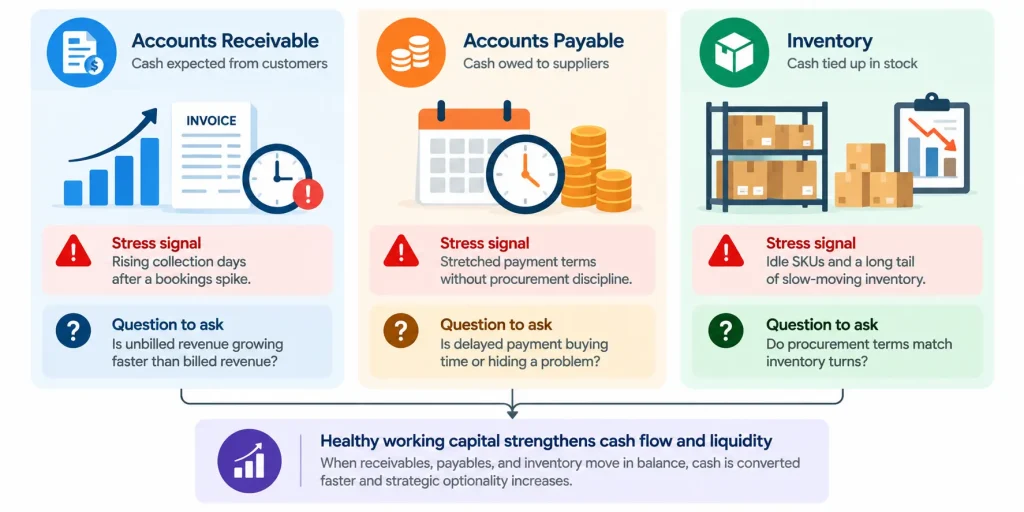
Working capital lacks the glamour of revenue beats, yet it captures the moment when story meets friction. Receivables, payables, and inventory each reveal a different form of operational strain.
What Each Working Capital Component Reveals
| Component | Stress Signal | What It Often Reveals | Question to Ask |
| Accounts receivable | Rising DSO after a bookings spike | Weak onboarding, unclear billing, or customers sold before they were ready | Is unbilled revenue growing faster than billed? |
| Accounts payable | Stretched terms without procurement discipline | Buying without clarity, and eroding vendor trust | Is AP stretch buying time or hiding failure? |
| Inventory | Idle SKUs and a long tail | Forecast error, procurement misalignment, or production rigidity | Do procurement terms match inventory turns? |
At a $127M global consumer products company, demand planning and SKU rationalization lifted inventory turns from 3x to 7x. That shift released trapped working capital and transformed cash conversion without new financing.
Working Capital Truthfulness as a Governance Norm
Under stress, the temptation grows to pull billings forward, delay payments, or skip inventory accruals. Clustered tactics, such as holding supplier payments, shifting payroll timing, and drawing credit lines, signal entropy management through delay. Each tactic costs vendor trust, employee morale, or pricing leverage. The CFO should protect the honesty of cash timing as carefully as revenue recognition. A single question guides this work: where is time pooling in the system? Wherever time pools, forecast error, customer dissatisfaction, and capital misallocation tend to follow.
Liquidity as Strategic Optionality
Liquidity is more than a buffer against risk, because it buys time to learn before committing capital. A company with $100M in cash and no urgent use for it can absorb shocks, fund pivots, pursue acquisitions, or choose not to act. Warren Buffett captured this when he said cash combined with courage in a crisis is priceless.
In peacetime, boards challenge idle cash and activists decry conservative balance sheets. In a low-rate world, holding cash looks like opportunity cost, but in a volatile one it works like an option premium. Liquidity management, then, is about signal timing more than yield optimization. At an early-stage email marketing technology company, a turnaround cut monthly burn from $800K to $200K and bought the runway to stabilize.
One growth-stage company, flush after a Series C, accelerated into adjacent markets while its core market softened. Within a year liquidity fell 60%, growth slowed, and retrenchment began. Preserving pace, if not dollars, would have kept the pivot open. Three questions help CFOs defend optionality in front of a skeptical board:
- Where is the company pretending to know more than it does?
- Which decisions can wait without irreversible cost?
- How can liquidity buy better signal, not only longer runway?
The Signals Liquidity Decisions Send
Cash does not move silently, because every liquidity decision is read as a statement of internal belief. Context decides how the same action lands with investors, lenders, and employees:
| Liquidity Action | Read as Strength | Read as Stress |
| Share buyback | Belief the market undervalues the firm | Narrative defense amid falling free cash flow |
| Accelerated vendor payments | Securing supply or preferred terms | Propping up a fragile ecosystem |
| Credit line drawdown | Prudence ahead of uncertainty | Panic in a liquidity squeeze |
| Hiring while burn rises | Confidence in demand | Disconnect from constraint |
| Marketing spend cuts | Discipline | Surrender |
The most damaging signals pretend at strength while masking confusion. Examples include a down round dressed as optional financing, a capex spree amid falling margins, or vendor financing presented as customer enablement. Securing $12M in growth financing for the consumer products business depended on lender trust built through consistent, legible cash behavior.
Cash works as a language, with verbs such as pay, defer, and invest, and grammar built from timing, magnitude, and sequence. Silence speaks too, whether that means skipping guidance or leaving burn unaddressed. The strongest signal is liquidity aligned to reality, with cash position, burn, and deployment pace matched to maturity and risk.
A Liquidity Management Framework for CFOs
The four themes above converge into a practical doctrine for finance leaders operating in volatile conditions.
Five Doctrines of Liquidity Management
| Doctrine | What It Requires |
| Honor cash flow as truthful signal | Use cash to validate belief and detect distortion, not only to reconcile |
| Read working capital as friction | Use AR, AP, and inventory to find where time and energy pool |
| Preserve liquidity as optionality | Frame unspent cash as deferred conviction and defend patience to the board |
| Align liquidity behavior with narrative | Ensure draws, payments, and raises match strategic posture |
| Embed liquidity in strategic design | Treat cash as a design variable for risk posture and forecast flexibility |
Three Key Takeaways
- Liquidity management starts with treating cash flow as a primary signal, using the gap between earnings and free cash flow to expose hidden stress.
- Working capital shows where time pools inside the business, so CFOs should govern its honesty as rigorously as they govern revenue recognition.
- Unspent cash preserves optionality, and every liquidity decision sends a message, so CFOs must make reserves defensible and cash behavior legible.
Disclaimer: This article is intended for informational purposes only and does not constitute legal, tax, or accounting advice. You should consult your own tax advisor or counsel for advice tailored to your specific situation.
Hindol Datta is a four-time CFO and senior finance executive with over 25 years of leadership experience across cybersecurity, SaaS, gaming, logistics, digital marketing, medical devices, consumer products, and nonprofit organizations. He has led more than $120M in fundraising and over $150M in M&A transactions while building the financial and operational systems that let complex businesses scale with confidence. He is the author of seven books in the Systems CFO Series and holds active CPA, CMA, and CIA credentials.
AI-assisted insights, supplemented by 25 years of finance leadership experience.