
Executive Summary
Learning how to monetize anything starts long before the first invoice, often at a stage when a startup has users but no revenue. Some of the most valuable companies in history began in that position. For them, a monetization strategy was a hypothesis and a narrative in formation, not a line in the P&L.
This article explains how pre-revenue founders design credible paths to revenue, test them cheaply and communicate them to investors. It also sets out the signals that show a monetization strategy is working and the quieter signals of failure. Reading both early lets founders pivot before capital or credibility runs out.
How to Monetize Anything: Start with Value, Not Price
A pre-revenue monetization strategy begins with a philosophical reckoning about what value the product creates, for whom, and why someone will eventually pay for it. That question calls for insight into human behavior more than financial engineering. Tomorrow’s revenue engine must already live inside today’s user behavior, growing from usage, engagement and trust instead of being bolted on later.
The path from value to revenue follows a recognizable sequence, shown in the flow below.
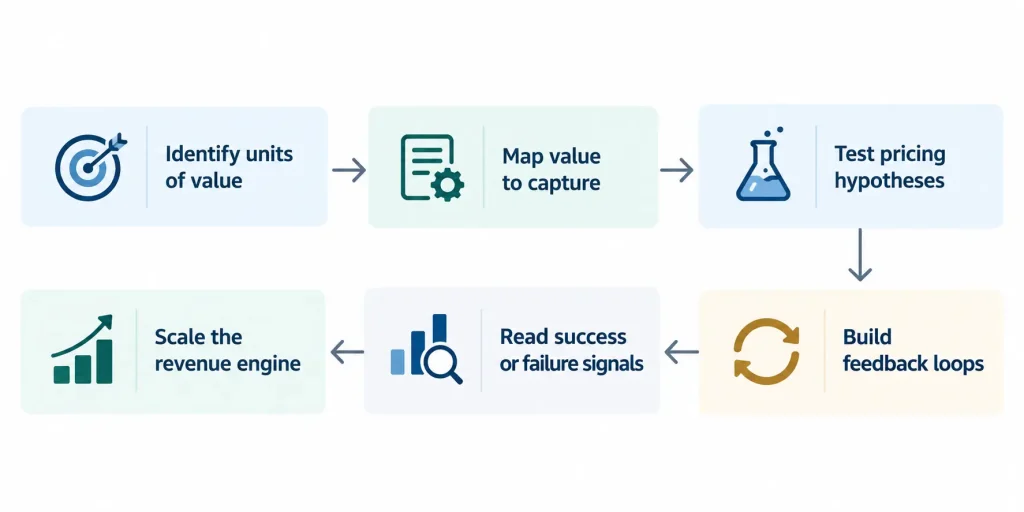
Six Foundations of Pre-Revenue Monetization
- Identify the units of value: time spent in a social network, workflow replacement in a SaaS tool or insight accuracy in a data platform.
- Map value creation to value capture: introduce payment at the right point in the user journey, since charging too early stalls adoption and charging too late habituates users to free.
- Study analogs: examine which monetization models succeeded or failed in adjacent spaces, without copying blindly.
- Present monetization as a system of options: investors do not need revenue yet, but they need a believable story about it grounded in behavior, unit economics and precedent.
- Signal discipline: understand CAC, LTV and margin architecture even before those figures exist in the actuals.
- Build feedback loops: use structured interviews, freemium conversion tests and fake-door pricing experiments to learn whether early adopters would pay, how much and for what.
One AI governance and assurance platform in its pre-Series A phase shows this discipline at work. Its finance backbone included a full operating model, multi-year scenario analyses and an investor narrative, all built before meaningful revenue existed. That scaffolding gave investors a coherent view of how value would convert into income, which is what a pre-revenue raise demands.
How to Monetize Anything in Practice Before Revenue Arrives
Once the conceptual basis is set, the work becomes tactical. Founders need to test, sequence and communicate monetization plans in ways that satisfy investors and prepare the organization for eventual revenue capture.
Testing Assumptions with Low-Risk Methods
Every monetization plan should begin as a testable assumption, such as “users will pay $10 a month for premium features” or “advertisers will pay a $20 CPM for targeted exposure.” Each hypothesis must rest on early signals, not hope. Product sprints should carry monetization experiments such as pricing pages, feature gating or partnership pilots. That way, revenue never becomes a distant phase on the roadmap.
Fake-door tests, where users click a paid feature that does not exist yet, offer cheap but directional data. Landing pages with live pricing and email surveys add more evidence. Founders should measure conversion behavior, not stated intent alone. What people do with a payment button tells a truer story than what they say in an interview.
Ten Practices That Make Monetization Real
| Practice | What It Looks Like in a Pre-Revenue Startup |
| Define testable assumptions | Price points and CPMs framed as hypotheses tied to early signals |
| Sequence milestones into the roadmap | Pricing pages, feature gates and pilots built into product sprints |
| Test with low-risk methods | Fake-door tests, priced landing pages and email surveys |
| Model unit economics | CAC, LTV, payback and margin simulated from comparable benchmarks |
| Build internal readiness | Billing, analytics, onboarding and support in place before launch |
| Collect qualitative feedback | Must-have versus nice-to-have features mapped by perceived value |
| Align monetization with mission | Revenue that strengthens core utility instead of undermining it |
| Match the narrative to the stage | Insight at pre-seed, early tests at seed, repeatable conversion at Series A |
| Maintain optionality | A primary thesis plus secondary paths such as usage or enterprise tiers |
| Make monetization cultural | Product, marketing and operations share responsibility for revenue |
Unit economics modeling deserves extra weight in any pre-revenue pitch. In one marketplace SaaS company’s $20M Series B, cohort and unit economics models anchored investor diligence and withstood scrutiny. The same logic applies earlier, since simulated economics show investors that the monetization story holds together before real data arrives.
Pre-revenue monetization is a rigorous, testable and evolving thesis, not vapor. The startups that succeed treat monetization as a capability they build over time, not a switch they flip on launch day.
Signals That a Monetization Strategy Is Working
Clarity in early-stage companies comes from directional evidence, not perfect data. Success signals often appear as patterns of behavior, feedback and conversion long before revenue reaches meaningful scale.
| Success Signal | What It Indicates |
| Willingness to pay emerges unprompted | Users ask about premium tiers or contracts on their own |
| Trial-to-paid conversion is consistent and rising | Above 5% in B2C or 15% in B2B, with an upward trend |
| Pricing experiments show elasticity | Stable conversion at higher tiers signals pricing power |
| Payback periods shrink | CAC payback under 12 months and improving LTV/CAC |
| Expansion revenue appears | Upgrades and add-ons lift net revenue retention |
| Revenue attribution is traceable | Campaigns, releases and pricing changes link to outcomes |
| Investors ask about scaling, not validity | The model has passed its existential test |
| Paying users retain better | Value and revenue move together |
| Prices align with market benchmarks | Buyers accept pricing in line with competitors |
| Payments run without friction | Few refunds, chargebacks or billing tickets |
| Sales pipelines show conversion velocity | Healthy cycle lengths and win rates |
| Partnerships form around revenue | Partners engage on monetization potential |
| Internal confidence solidifies | Projections rest on real monetization metrics |
None of these signals guarantees success, but together they form the scaffolding of a durable monetization engine. A venture-backed digital marketing company shows how these signals compound over time. It grew revenue from $9M to $180M in 24 months, with CAC, LTV and contribution margin discipline at the center of finance.
Indicators That Monetization Is Failing
Knowing how to monetize anything also means recognizing when monetization is not working. Failure seldom arrives as outright rejection; it arrives as indifference, a quiet erosion of belief, engagement and pricing elasticity. Spotting these indicators early allows founders to pivot while capital and credibility remain intact.
Fifteen Warning Signs to Watch
| Warning Sign | What It Reveals |
| No user-initiated interest in payment | The value proposition may be insufficient |
| Flat or declining free-to-paid conversion | Pricing is misaligned or the paywall lacks justification |
| Pushback on every pricing tier | The model does not match user expectations |
| Flat ARPU despite user growth | Monetization is not scaling with adoption |
| Unrecoverable CAC | Acquisition costs exceed monetizable value |
| Negative feedback on monetization flow | Gating or upsells feel like bait-and-switch |
| High churn after conversion | Trials, onboarding or value claims are broken |
| Extreme price sensitivity | Users buy on price, not merit |
| No expansion revenue | Customer value curves stay flat |
| Sales reps lose at the pricing stage | The revenue thesis breaks at payment |
| Marketplace take rates are rejected | Revenue sharing threatens ecosystem participation |
| Investors repeatedly challenge revenue logic | The market is signaling a flawed thesis |
| Internal misalignment on revenue priorities | Execution falters without shared belief |
| Users circumvent payment mechanisms | The monetization system lacks integrity |
| Pricing fatigue sets in | Iteration adds confusion instead of clarity |
Treating Failure as Design Feedback
Monetization failure is educational, but only when founders see it, name it and address it. An early-stage email marketing technology company offers a useful case in point. Once leadership confronted weak economics directly, an operational turnaround cut monthly burn from $800K to $200K. That reset bought the time needed to stabilize and rebuild on firmer ground.
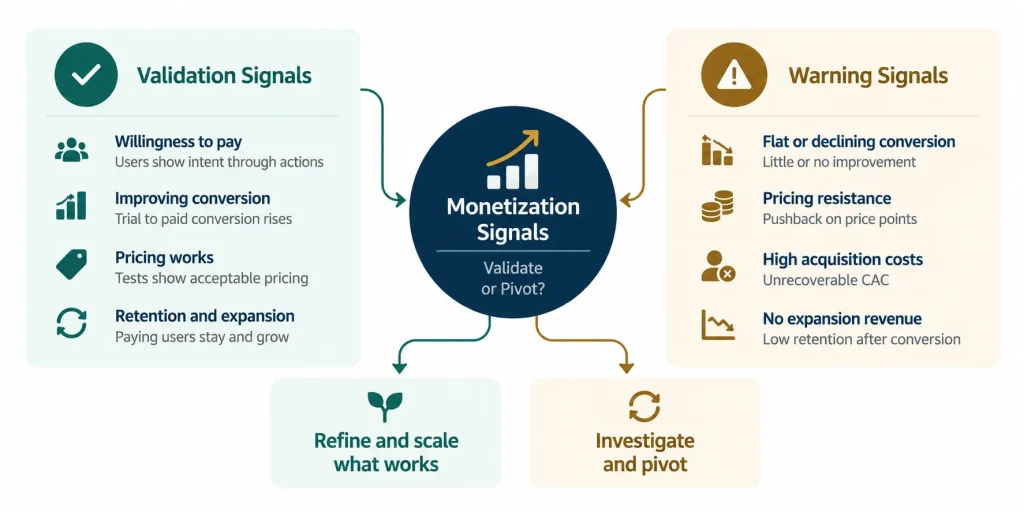
The goal of a monetization strategy is not instant revenue but a system that can produce revenue consistently and credibly. Like product-market fit, founders find monetization iteratively, not in the first payment but in the thousandth behavior that leads to it.
Three Key Takeaways
- Understanding how to monetize anything begins with identifying the units of value a product creates and mapping them to the right moment for payment, long before revenue appears.
- Pre-revenue founders earn investor conviction by framing monetization as testable hypotheses, validating them through fake-door tests and pricing experiments, and modeling unit economics from credible benchmarks.
- Success and failure signals both carry information, and founders who read them honestly can scale what works or pivot before capital and credibility run out.
Disclaimer: This article is intended for informational purposes only and does not constitute legal, tax, or accounting advice. You should consult your own tax advisor or counsel for advice tailored to your specific situation.
Hindol Datta is a four-time CFO and senior finance executive with over 25 years of leadership experience across cybersecurity, SaaS, gaming, logistics, digital marketing, medical devices, consumer products, and nonprofit organizations. He has led more than $120M in fundraising and over $150M in M&A transactions while building the financial and operational systems that let complex businesses scale with confidence. He is the author of seven books in the Systems CFO Series and holds active CPA, CMA, and CIA credentials.
AI-assisted insights, supplemented by 25 years of finance leadership experience.