
Executive Summary
A go-to-market strategy for startups is the plan that carries a value proposition from product to paying customer. It bridges product development and commercial execution, and in venture-backed companies it often decides whether a vision becomes a business.
This article covers what a GTM strategy contains, the first principles behind it and how it must evolve under venture pressure. It addresses segmentation, sales motions, pricing, channels, messaging, RevOps, experimentation and culture, with frameworks for each stage of growth.
What Is a Go-to-Market Strategy?
A GTM strategy is the methodical plan a company uses to deliver its value proposition and win a competitive advantage. At its fullest, a GTM strategy choreographs market entry, acceleration and customer intimacy.
Its foundational elements include market segmentation, value proposition, channel design, pricing and customer acquisition. Each must be internally consistent and resonate externally. The work starts with a simple question about who the customer is, then goes deeper:
- What problem does the customer experience most acutely?
- How does the customer describe that problem in their own words?
- Where does the customer look for solutions?
- Under what conditions will the customer act?
Answering these questions requires both data and insight. Market sizing, behavior analytics and competitive intelligence shape targeting. Customer interviews, ethnographic research and sales conversations add texture to messaging and positioning. Together they produce a value narrative that holds up in actual purchase decisions.
Marketing, Customer Success and the Feedback Loop
Marketing execution sits at the heart of the GTM engine, covering branding, demand generation, lead nurturing and conversion. Strong marketing builds awareness, educates prospects and shortens sales cycles, but only when tightly integrated with sales and product.
Customer success is the most overlooked part of GTM, since acquisition is only the first act. Retention, expansion and advocacy are what drive long-term growth. A GTM strategy that ignores post-sale engagement invites high churn and low lifetime value. For that reason, a well-calibrated GTM strategy works as a feedback loop, not a launch event, refining ICPs, messaging and motions as evidence arrives.
First Principles of a Go-to-Market Strategy for Startups
Venture-backed startups operate under capital expectations, competitive tempo and pressure to scale. In that setting, GTM is less a function than a philosophy about what a product means, to whom and why it becomes indispensable. At its core, a GTM strategy is a theory of customer behavior, a bet on how discovery leads to decision and decision leads to durable adoption.
Segmentation and the Ideal Customer Profile
No GTM succeeds without a clear Ideal Customer Profile. Founders captivated by total addressable market often pursue breadth too early. A scalable GTM starts with depth, in a narrow slice where pain is urgent, buyers are accessible and the use case repeats. That beachhead becomes the launch point for every later campaign.
Segmentation must be behavioral, because titles and firmographics alone are not enough. Founders need to know how customers buy, who influences their decisions and which budget line owns the spend. Those answers shape both the messaging and the motion.
Choosing the Right Sales Motion
GTM motions fall into three broad archetypes, each with its own trade-offs in CAC, time-to-close and scalability. Some SaaS companies blend them, sequencing motions by customer segment or product tier.
| Motion | How It Drives Growth | Key Requirement | Best Fit |
| Product-led | Freemium, viral loops and self-serve onboarding | Clear onboarding and fast activation | Low-ACV, easy-to-adopt products |
| Marketing-led | Content, brand and inbound demand | Consistent, trusted content engine | Mid-market and considered purchases |
| Sales-led | SDRs, AEs, demos and account management | Skilled, well-coordinated sales team | Complex, high-ACV enterprise deals |
The right motion follows alignment with the market, not fashion. A complex enterprise security product cannot scale through product-led growth alone, and a mobile productivity app should not burn capital on field sales. A cybersecurity and identity access management company at $30M ARR shows the point, since its enterprise buyers required revenue operations built around a sales-led, services-heavy motion.
Pricing as a Signal of Value
Pricing is often the least examined GTM lever, yet price signals positioning as much as it generates revenue. It shapes adoption curves and determines which sales channels are feasible.
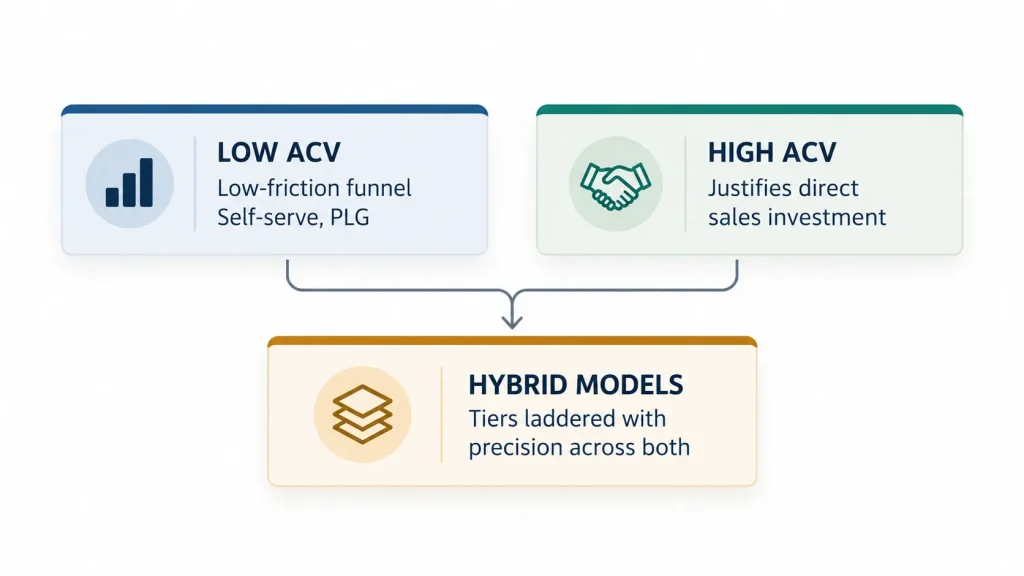
Pricing must also reflect how customers realize value. A usage-based product should tie price to outcome, while a subscription model must drive continuous engagement. Whatever the model, it must match the customer’s willingness to pay and the company’s unit economics.
Channels, Messaging and Measurement
Channels form the fourth pillar, whether direct or indirect, inbound or outbound, digital or analog. Each choice sets both capital allocation and operating tempo. Early-stage companies often sell direct to learn fast, then scale through partners. A $127M global consumer products company selling through DTC, Amazon and wholesale shows how each channel carries its own margin, cash and operating demands.
Messaging binds every element of the strategy together. It articulates pain, promise and proof across slides, conversations, landing pages and onboarding flows. Startups that find resonance do not just describe features, because they make the urgency vivid and frame the solution as inevitable.
Measurement completes the foundation, with CAC, LTV, funnel conversion, sales velocity and churn exposing friction and guiding iteration. A GTM strategy is never set once, since it must be tuned continuously.
Scaling a Go-to-Market Strategy Under Venture Pressure
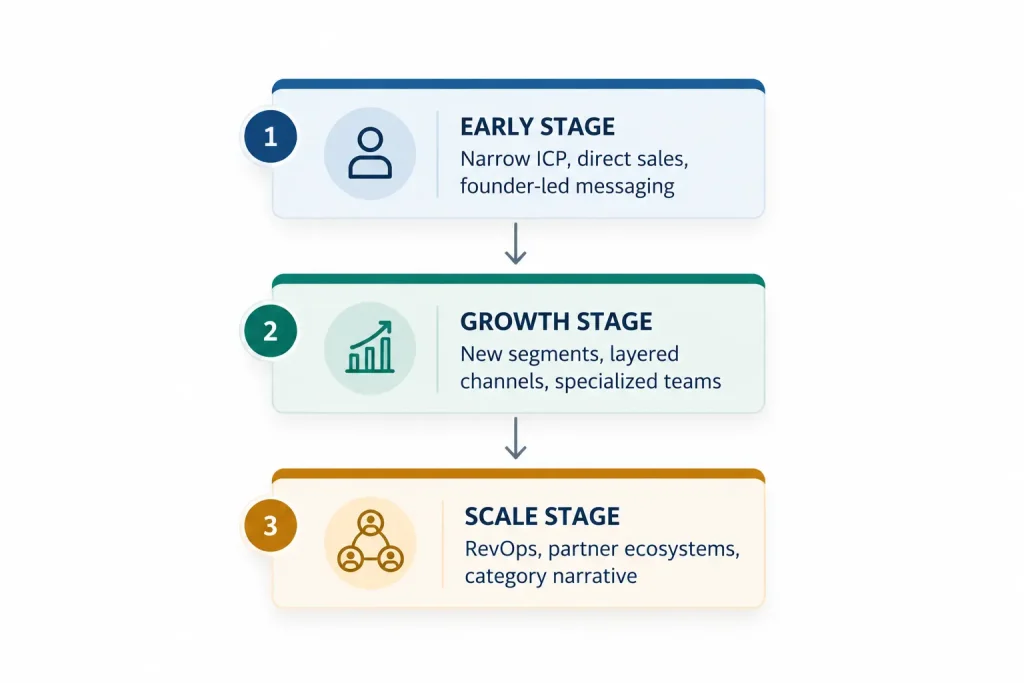
A GTM motion that works at $1M in ARR may collapse at $10M. Channels saturate, messaging fatigues and segments become crowded. The success of an early GTM can plant the seeds of its own obsolescence, so the strategy must evolve with the business. A GTM that never needs reinvention is either stagnant or lucky.
How GTM Evolves as a Startup Scales
Segment Shifts and Channel Expansion
Growth eventually requires new ICPs beyond the original beachhead. Moving from tech-forward SMBs to conservative mid-market firms, or from the US to international markets, adds complexity. Cultural nuance, compliance norms and buying behavior all change. Leading startups respond by studying win-loss data, customer interviews and competitor migrations to build tiered messaging and differentiated pricing.
Channel expansion follows a similar path as growth continues. A startup built on inbound may hit a wall as paid channels saturate, so it layers outbound sales or partner ecosystems. Attribution grows murkier and sales cycles lengthen, yet a well-run multi-channel GTM reduces growth risk. Specialization matters here, as SDRs differ from AEs and customer success must shift from reactive support to proactive expansion.
Product Evolution and RevOps
New segments demand new features, integrations and compliance capabilities. GTM insight therefore feeds the product roadmap, and the best product managers carry real customer empathy.
RevOps turns this convergence into practice by connecting marketing, sales and customer success through unified data. It reveals funnel leaks, cohort behavior and pricing efficiency, and without it GTM becomes guesswork. A professional services firm that scaled from $12M to $63M in revenue within eight months relied on pipeline analytics and utilization tracking built from scratch across five business units.
Experimentation and the Cadence of Venture Capital
GTM strategies should be tested like product features through A/B messaging, pilot channels and sandbox pricing. Those experiments need boundaries, because premature optimization kills signal and noise misleads. Founders must know when to experiment and when to commit.
Venture capital imposes its own cadence, as investors expect burn to buy learning and proof, not process. The GTM team must translate insight into ARR, not just dashboards. Speed without accuracy breeds churn, so the founder must balance tempo with truth.
Metrics That Anchor GTM Execution
Several KPIs tell the story beneath the headline numbers:
- CAC payback period
- Quota attainment and win rates
- Pipeline coverage
- Net revenue retention and churn
Each metric needs context before it drives a decision. A rising CAC in a high-LTV segment may be rational, while a flat pipeline in a saturated segment may signal time to pivot. A venture-backed digital marketing company that scaled from $9M to $180M in 24 months depended on CAC, LTV and contribution margin discipline to read those signals correctly.
Culture and Storytelling at Scale
Culture is the hidden variable in any GTM strategy. Teams under venture pressure face burnout, turf wars and mission drift. Founders should build a culture of learning, transparency and customer obsession through weekly standups, win-loss reviews and cross-functional rituals that serve as scaffolding.
Storytelling must mature alongside the company and its market. The early promise of solving a pain point becomes a promise of helping customers win. Category creation, analyst briefings and narrative PR shape investor confidence, talent attraction and partner leverage.
Conclusion: GTM as a Living Architecture
A go-to-market strategy for startups is not a single campaign but a living architecture. It is born in focus, tested in motion and proven at scale, blending science with story and discipline with improvisation. To go to market well is to meet customers with a hypothesis instead of hope, and to return with alignment, not applause.
Three Key Takeaways
- A go-to-market strategy for startups should begin with a narrow, behaviorally defined ICP and a sales motion that fits the product, the buyer and the price point.
- Pricing, channels and messaging must work as one system, because price signals value, channels set tempo and messaging turns urgency into purchase decisions.
- GTM must be rebuilt as the company scales, with RevOps, bounded experiments and contextualized metrics guiding each shift in segment, channel and narrative.
Disclaimer: This article is intended for informational purposes only and does not constitute legal, tax, or accounting advice. You should consult your own tax advisor or counsel for advice tailored to your specific situation.
Hindol Datta is a four-time CFO and senior finance executive with over 25 years of leadership experience across cybersecurity, SaaS, gaming, logistics, digital marketing, medical devices, consumer products, and nonprofit organizations. He has led more than $120M in fundraising and over $150M in M&A transactions while building the financial and operational systems that let complex businesses scale with confidence. He is the author of seven books in the Systems CFO Series and holds active CPA, CMA, and CIA credentials.
AI-assisted insights, supplemented by 25 years of finance leadership experience.