Executive Summary
Founder-market fit is often the strongest signal a seed investor has when product, metrics, and market size remain unproven. It describes how well a founder’s experience, insight, and perspective match the specific problem and market they intend to serve.
This article explains what founder-market fit is, why it shapes seed-stage investing decisions, and how VCs evaluate it beyond a resume. It also shows how founders can build, demonstrate, and evolve that fit into a durable edge.
What Founder-Market Fit Means in Seed-Stage Investing
Founder-market fit sits close to product-market fit, yet the two answer different questions. Product-market fit asks whether a solution resonates with demand. Founder-market fit asks whether this founder suits the terrain at all, and it covers context, temperament, history, and insight.
Separating the Signal from the Myth
Founder-market fit is not charisma, pedigree, or passion on its own. It is the accumulated experience, intuition, and perspective that equip one founder for one problem in one market. When that fit is strong, the founder looks less like a credible candidate and more like the natural person to build the company.
Three Common Forms of Founder-Market Fit
The fit tends to show up in a few recognizable ways. Each one gives the founder an advantage rooted in comprehension rather than capital.
- Domain expertise: a fintech founder who spent a decade inside the regulatory maze they now aim to simplify.
- Lived experience: a healthtech founder solving a problem that grew out of personal adversity.
- Network access: an enterprise SaaS founder with relationships that open procurement doors others cannot reach.
Founder-Market Fit vs Product-Market Fit
The two concepts work together, but seed investors weigh them differently. The comparison below shows where each one applies.
| Dimension | Founder-Market Fit | Product-Market Fit |
| Core question | Is this founder suited to this market? | Does this product meet real demand? |
| When it is visible | Before launch, often at pre-seed and seed | After launch, through usage and retention |
| Primary evidence | Insight, experience, learning speed, narrative coherence | Retention, revenue growth, referrals |
| Risk it reduces | Execution and learning risk | Demand and market risk |
Why Founder-Market Fit Carries So Much Weight in a Seed Round
Little Else to Underwrite at the Seed Stage
At the seed stage, the product is new, metrics are thin, and total addressable market is still a hypothesis. Investors have to lean on qualitative judgment and ask whether this person can make sense of the chaos ahead. They also ask whether the founder sees what others have missed.
Resilience and Learning Velocity
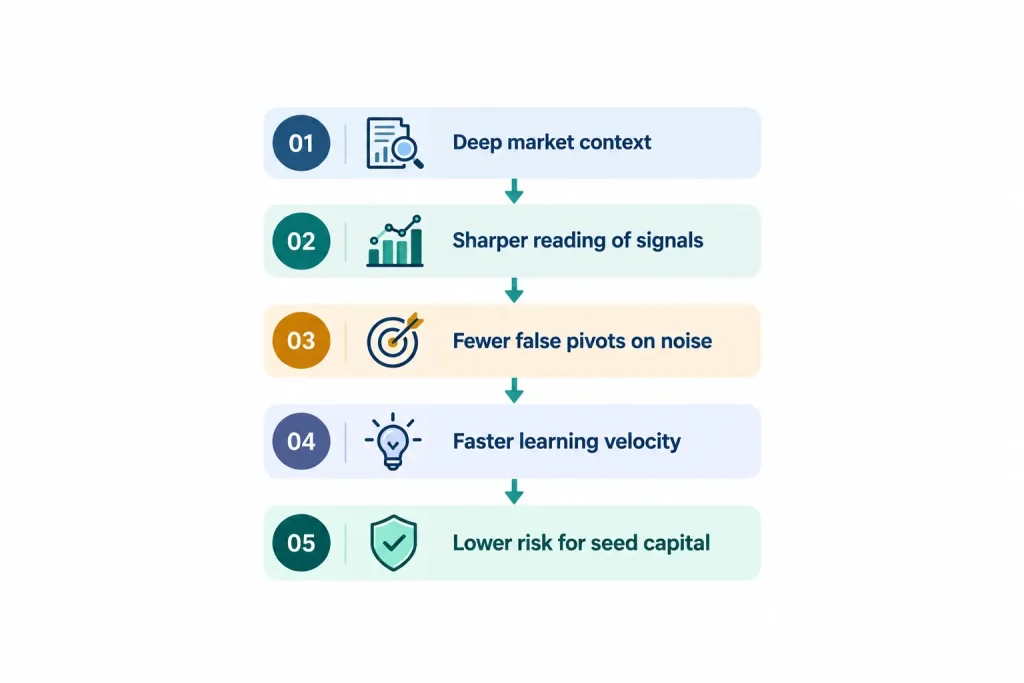
Startups climb through long stretches of ambiguity, and founders with deep context tend to adapt faster. They read market signals with more precision, so they pivot less often on noise and spot real inflection points sooner. In this sense, founder-market fit is less about starting strength and more about how quickly a team learns. A market rarely gives up its secrets easily, and those who already understand its language, power centers, and hidden costs begin the race ahead.
The Ripple Effect on Team, Customers, and Investors
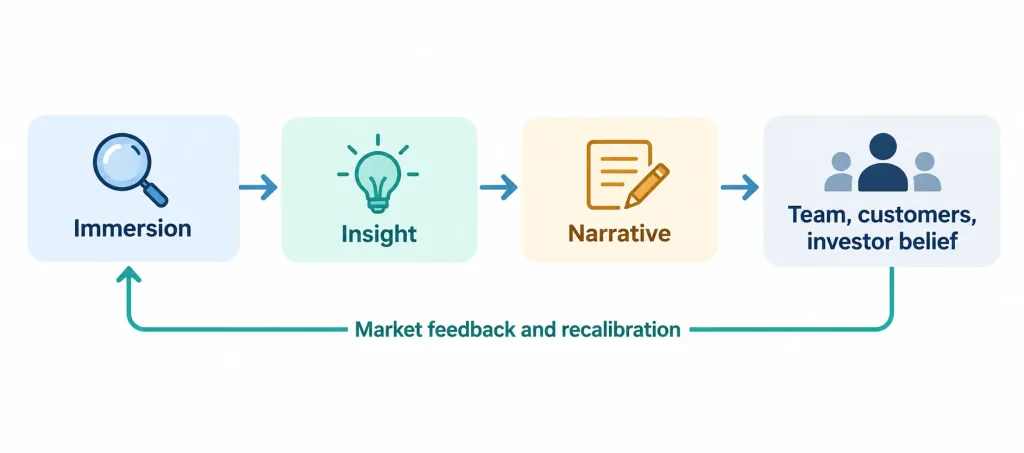
Founder-market fit shapes team recruitment, early customer trust, and investor conviction at the same time. A founder who speaks the market’s language gives every stakeholder a reason to believe, and that clarity pulls talent and capital toward the company.
When Expertise Hardens into Dogma
Deep knowledge carries its own risk, because familiarity can slowly turn into rigidity. Strong founders balance expertise with intellectual humility and stay willing to challenge assumptions, including those formed inside the industry. Insight still needs cross-checking against evidence, and passion works best when pragmatism keeps it grounded.
How VCs Evaluate Founder-Market Fit Beyond the Resume
Assessing founder-market fit takes more than a resume scan. Investors probe the founder’s journey through three questions that reveal how deep the alignment runs.
- Why this problem? What first-hand exposure or study led the founder here?
- Why now? What shift in technology, regulation, or behavior makes the timing right?
- Why them? What does this founder understand that a well-funded competitor does not?
The answers show how a founder thinks, learns, and executes. Investors also need to avoid lazy proxies, since an Ivy League degree or prestigious employer may correlate with performance without causing it. Strong fit often comes from unexpected places, such as an outsider who studied the market obsessively or an insider who rebelled against the status quo.
Fit as a Substitute for Missing Signals
Founder-market fit can also explain gaps that would otherwise worry investors. A founder with deep understanding of a nascent market may be early but not wrong, which makes thin traction easier to accept. Limited team depth or sparse financials become more forgivable when the founder shows intimate market knowledge and strategic clarity.
How Founders Build and Communicate Founder-Market Fit
Fit only creates value when others can see it, so founders must show it through choices, story, and early traction. Founder-market fit is revealed more than discovered, and deliberate effort strengthens it.
Cultivating Proximity Through Immersion
Not every founder starts with deep market roots, but founders can build proximity through steady, structured work. Those who approach the market with the rigor of a field researcher often reach insights that casual observers never find.
- Run deep customer interviews across buyer roles.
- Shadow potential users through their real workflows.
- Map the full value chain, including who pays and who decides.
- Co-develop early versions with industry insiders.
An HR technology venture built from conception to launch shows the value of this groundwork. Market research, competitive analysis, and user design came before production code and shaped later product and positioning choices.
Linking Biography to Market Insight in the Pitch
The most compelling seed pitches trace a straight line from lived experience to product vision. They explain what the company is building and why this founder is the one to build it. This is not theater; it is the alignment of identity and opportunity, and it should run through every slide, metric, and investor conversation.
At a pre-Series A AI governance platform, the capital strategy and investor narrative rested on a multi-year operating model tied to the founder’s view of the market. That coherence between story and numbers gave investors something concrete to test instead of a vision to accept on faith.
Team Signaling and Customer Development
A founder with authentic fit attracts early hires who share the mission. Engineers join because the founder sees around corners, and sales leaders join because the founder understands the buyer’s mindset.
A venture-backed performance marketing company that scaled from $9M to $180M in 24 months reflects this pattern. Leadership’s grasp of its buyers helped attract a finance team that grew from 1 to 12, and the same fluency supported the CAC, LTV, and contribution margin discipline behind the growth.
Customer development offers further proof of fit for founders and investors alike. Founders with fit turn early conversations into design partnerships, anticipate objections, and shorten sales cycles.
Handling Friction and Evolving the Fit
Markets push back through regulatory delays, customer inertia, and technical surprises. Founders with fit respond by recalibrating instead of panicking, and their reactions reveal embedded understanding. Fit must also evolve as new segments emerge and competitors redefine the terrain, so it works as dynamic calibration, not static alignment. That shift requires founders to listen as much as they lead.
Honest Framing over Inflated Expertise
VCs are pattern-recognition machines, and overstated expertise tends to backfire during diligence. A stronger approach frames the journey honestly by covering what the team has learned, how it earned proximity, and which gaps it is closing. Founder-market fit is a direction as much as a destination, and investors respect founders who show both.
Founder-Market Fit as Capital Efficiency and a Competitive Moat
Founder-market fit also improves capital efficiency, which matters to seed funds managing portfolios under time and budget limits. Founders with fit make smarter bets, avoid common pitfalls, and run fewer but deeper experiments.
During a $20M Series B for a marketplace SaaS platform, cohort and unit economics models held up under investor scrutiny because they reflected how the market behaved. Seed-stage evidence works the same way, because grounded understanding produces numbers that survive diligence.
In crowded markets, differentiation increasingly comes from insight more than features. Founder-market fit answers why you, why now, and why this, and that answer outlasts price wars and feature races. Competitors cannot clone it easily, which makes it the first moat of an early-stage company.
Founders are not only raising capital; they are selling belief. Seed investors underwrite evolution as much as execution, and founder-market fit predicts who will learn faster, hire better, and stay in the game. It deserves the same discipline that investors apply to CAC, LTV, and runway.
Three Key Takeaways
- Founder-market fit is often the strongest signal in a seed round, because product, metrics, and market size remain unproven. Investors who assess it well focus on insight, learning speed, and judgment over credentials.
- Founders can earn fit through immersion, customer development, and close work with insiders. They should demonstrate it through a coherent narrative, aligned early hires, and design partnerships instead of bare claims.
- The strongest fit stays dynamic and honest over time. Founders who update their assumptions and frame gaps openly build more durable trust with investors than those who overstate expertise.
Disclaimer: This article is intended for informational purposes only and does not constitute legal, tax, or accounting advice. You should consult your own tax advisor or counsel for advice tailored to your specific situation.
Hindol Datta is a four-time CFO and senior finance executive with over 25 years of leadership experience across cybersecurity, SaaS, gaming, logistics, digital marketing, medical devices, consumer products, and nonprofit organizations. He has led more than $120M in fundraising and over $150M in M&A transactions while building the financial and operational systems that let complex businesses scale with confidence. He is the author of seven books in the Systems CFO Series and holds active CPA, CMA, and CIA credentials.
AI-assisted insights, supplemented by 25 years of finance leadership experience.