
Executive Summary
The ethics of forecasting begins with a simple admission: every forecast is a belief held under uncertainty, and others will act on it. Budgets move, hiring plans shift, and investors update valuations based on numbers the finance team knows are provisional. That gap between how forecasts are built and how they are heard creates both strategic friction and moral weight.
This article examines forecasting and uncertainty through four lenses: Bayesian belief revision, the ethics of signaling, the cost of narrative rigidity, and forecasting as judgment. Finance leaders will find practical tools for naming assumptions, updating in proportion to evidence, and communicating ranges without losing credibility.
Why the Ethics of Forecasting Matters to Finance Leaders
A forecast can look crisp on the page while resting on a trembling assumption. Every clean spreadsheet hides a wager that the future will resemble the past. Outsiders read a forecast as a prediction, but practitioners know it as a conditional belief, bounded by time and evidence. Hedge too much and credibility fades, yet speak too confidently and truth suffers. That tension is the Bayesian burden, the duty to speak in probabilities while being heard in absolutes.
In many boardrooms, a forecast miss counts as a leadership failure instead of a model correction. Finance teams then delay revisions until the optics feel ready, and they lose credibility for being late, not for being wrong. With a surplus of data, the CFO must filter noise and refuse to confuse volatility with causality.
Good forecasting therefore needs philosophy as much as math. Three questions belong in every finance review: what is believed, why it is believed, and what evidence would change it. One board presentation opened with a single slide titled “Key Assumptions, and How They Might Fail.” The numbers stayed the same, but naming uncertainty earned credibility and shifted the discussion from performance to learning.
Bayesian Forecasting: Updating Belief Under Uncertainty
Every forecast starts with a prior, not a blank slate. Last quarter’s results, industry chatter, and the CEO’s tone all anchor the model before the first cell is filled. The Bayesian rule states that the posterior is proportional to the prior multiplied by the likelihood. In plain terms, current belief equals past belief, reweighted by how strongly new data supports or contradicts it.
Making Priors Visible
A prior often blends memory, instinct, and wishful thinking. A pricing model may assume 2% churn, and a go-to-market plan may assume 1.3x pipeline conversion, with neither assumption examined. Once codified, a prior disguises itself as fact and becomes the baseline for bonuses and strategy. Forecasts often collapse from a failure of epistemology, such as reusing last year’s efficiency for a new product with a different mix. Before any forecast is accepted, finance should ask these questions:
- Which historical period does this assumption rest on?
- Which dynamics have changed since then?
- Which assumptions are borrowed, unexamined, from elsewhere in the business?
Updating in Proportion to Surprise
Under the ethics of forecasting, not every fluctuation deserves a revision. Suppose a company expects churn to return to pre-pandemic levels, and one month shows a spike in cancellations. A Bayesian reviewer asks how likely that result would be if the churn rate had not changed. If normal variance explains it, belief stays anchored, but a truly surprising result calls for a stronger update.
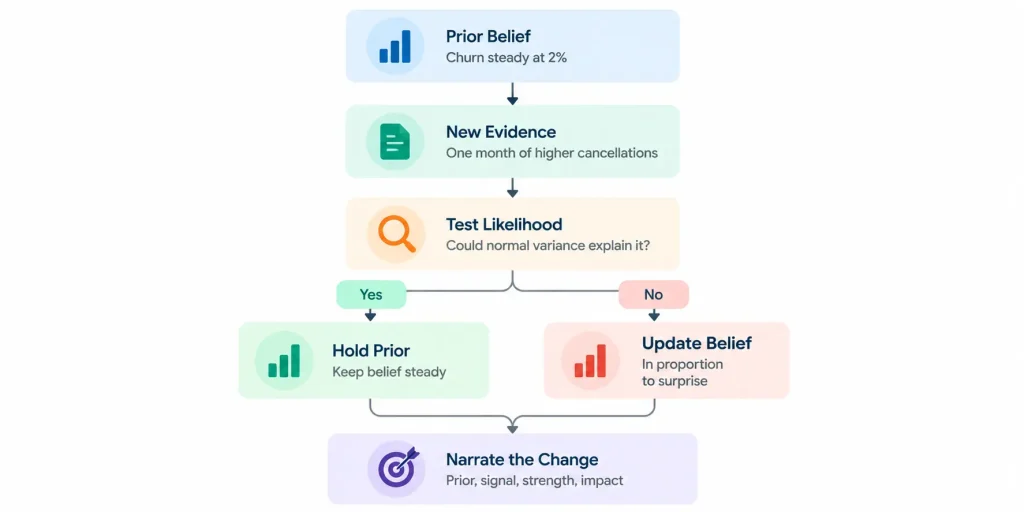
Updating too quickly spooks the organization, while updating too slowly deceives it. Transparency resolves this, with each revision stating the prior, the signal, and its impact.
Building Systems for Belief Revision
Teams trained in Bayesian logic stop overreacting to drift and stop treating reforecasts as defeat. Templates should separate assumptions from outputs, scenario tools should allow fast reweighting, and dashboards should track signal strength against expectation. At a cybersecurity company with roughly $30M in ARR, a driver-based forecasting engine held actuals within 5% of forecast for 8 consecutive quarters. One useful technique sets belief boundaries, such as 80% confidence that churn stays between 1.8% and 2.2% next quarter.
Forecasting and Uncertainty in the Signals CFOs Send
A forecast changes character once it leaves the finance team. Caveats and ranges fall away, and the number becomes a fixed coordinate. Sales hires to plan, marketing spends, and product teams sequence roadmaps around it. A forecast with a 60% confidence interval becomes destiny, and a 10% miss then disrupts hiring and morale.
Point Estimates Versus Conditional Forecasts
The answer is framing, not hedging, because hedging leads to paralysis. Compare these two ways of presenting the same quarter:
| Framing | Example | Effect on the Organization |
| Point estimate | “Q3 revenue will land at $48.5M.” | Gives a hard target but hides conditionality |
| Conditional forecast | “Base case is $48.5M, assuming stable churn, 1.3x conversion, and on-time onboarding, with an 80% range of $46M to $51M.” | Lets downstream teams plan around risk and adjust when assumptions move |
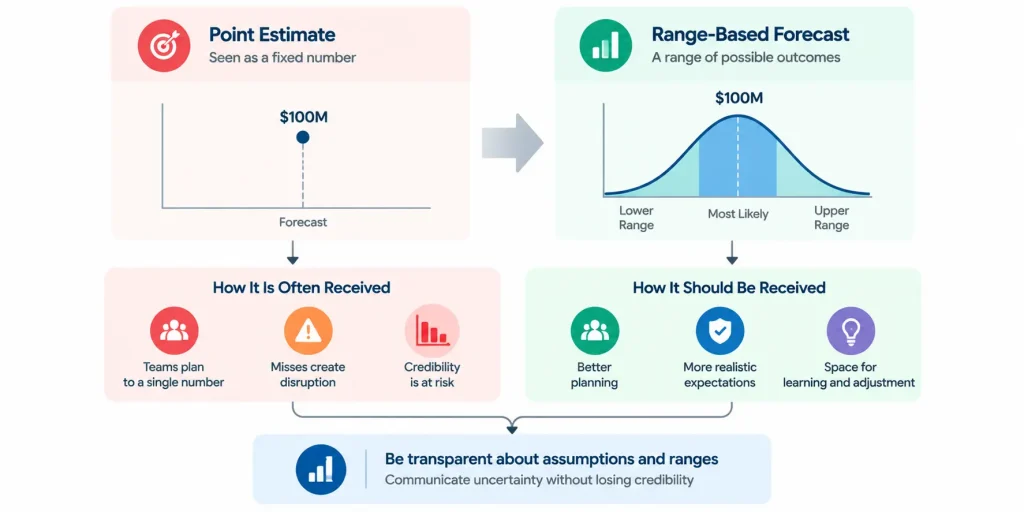
Forecasts shape reality as well as describe it. When a public company issues guidance, analysts recalibrate and trading shifts, so the forecast feeds the valuation of its own equity. At a Euronext Paris-listed gaming company with operations in five countries, board engagement made this observer effect impossible to ignore. Unowned influence drifts toward manipulation through padded forecasts, smoothed headwinds, or backlog leakage relabeled as pipeline.
Four Practices of Ethical Signaling
- Name uncertainty explicitly, and model risk openly instead of burying it in footnotes.
- Align incentives with calibration, so teams are not punished for revising in light of evidence.
- Build forecast hygiene into rituals, tracking actuals against ranges and rewarding early weak signals.
- Time-stamp convictions, so revisions read as principled adaptation instead of reversals.
Narrative Rigidity and the Cost of Delayed Updates
Bayesian thinking seeks coherence with data, while narrative certainty seeks consistency with past statements. Once a forecast is socialized and tied to incentives, revising it feels like a challenge to leadership credibility. One SaaS company committed to doubling ARR through geographic expansion. When lead generation fell short, it changed lead scoring, and when churn rose, it restructured customer success. Reality eventually won, but delay had multiplied the cost.
A founder-led company built its story around inevitable virality and read early niche traction as confirmation. When referrals slowed, the blame fell on marketing, until rising CAC and softer retention collapsed the thesis. The CFO had raised concerns too cautiously, and the board, enamored with the growth curve, reinforced the belief.
The CFO must disrupt this stasis through language. Phrases such as “assuming no further slowdown” or “pending results of the Q2 cohort” encode conditions without sacrificing clarity. A narrative that no evidence can shake has stopped being strategy and become ideology. Grounded cohort models held up far better during a $20M Series B raise for a marketplace SaaS platform. Strong finance leaders carry two stories at once, the aspiration and the shadow story of risk, and move between them as signal strength changes.
The Ethics of Forecasting as Moral Judgment
Once the regressions are run and the ranges drawn, the finance leader must still decide what to believe. The ethics of forecasting places judgment above precision, because each forecast decides which world the company plans for. A forecast that drives overhiring carries moral weight, and one that justifies layoffs deserves scrutiny for coherence with values. A mission-driven education institution offers a useful model, where multi-year scenarios under variable philanthropic funding made tradeoffs explicit before a $37M raise.
Under stress, the best finance leaders state what is known, what is not, and which path they are choosing. A veteran CFO once described a great forecast as one that gets the company moving in the right direction and quickly reveals when it is not. That candor builds epistemic safety, where being wrong is tolerated but being static is not, and it rests on four tenets:
- Transparency of assumption, so the organization sees what is believed and why
- Adaptation over accuracy, staying directionally coherent and non-defensive when the world moves
- Signal discipline, adjusting belief proportionally instead of performatively
- Narrative integrity, keeping forecasts falsifiable and tied to reality
A Practical Code for the Ethics of Forecasting
Practiced this way, forecasting becomes a compass for the future, not a promise to control it. The five principles below turn that idea into a working code for any finance team.
Five Principles of Ethical Forecasting
| Principle | What It Requires |
| Forecasts are beliefs, not facts | Reveal what is assumed, why, and how it might evolve |
| Update in proportion to surprise | Ignore noise, resist inertia, and move when evidence demands |
| Signal with clarity and conditionality | Use confidence intervals, named assumptions, and realistic scenarios |
| Prevent epistemic rigidity | Reward belief revision and normalize being usefully wrong |
| Own the moral weight of influence | Judge forecasts by the behavior they invite, not only their accuracy |
Three Key Takeaways
- The ethics of forecasting rests on treating every projection as a conditional belief, with its assumptions visible and open to challenge.
- Forecasting and uncertainty belong together, so CFOs should communicate ranges and conditions instead of point estimates that teams mistake for destiny.
- Organizations that reward timely, proportional revision outlearn those that defend past forecasts, because narrative rigidity compounds the cost of delay.
Disclaimer: This article is intended for informational purposes only and does not constitute legal, tax, or accounting advice. You should consult your own tax advisor or counsel for advice tailored to your specific situation.
Hindol Datta is a four-time CFO and senior finance executive with over 25 years of leadership experience across cybersecurity, SaaS, gaming, logistics, digital marketing, medical devices, consumer products, and nonprofit organizations. He has led more than $120M in fundraising and over $150M in M&A transactions while building the financial and operational systems that let complex businesses scale with confidence. He is the author of seven books in the Systems CFO Series and holds active CPA, CMA, and CIA credentials.
AI-assisted insights, supplemented by 25 years of finance leadership experience.