
Executive Summary
Choosing the right equity percentage to give away is one of the most consequential decisions a founder makes, because every grant shapes power, reward, and long-term direction. A cap table looks like a ledger, yet it records judgments about who builds, funds, and directs the company.
This article sets out a practical framework for equity allocation across the startup lifecycle. It covers early hires, option pools, financing rounds, control rights, and exit math. It also explains how founders can tell an investor they need to keep a meaningful ownership stake, and why a smaller slice of a larger company often wins.
Why Equity Percentage Is a Decision About Purpose and Power
Equity is a signal of belief in the future, and it decides who shares in the wealth that belief creates. It also confers incentive, alignment, and control, so no equity percentage should be set casually. In an early-stage startup, equity performs three distinct jobs:
- Compensation for people who accept below-market cash today.
- A reward for long-term commitment and measurable performance.
- An anchor that holds the founding team to a shared purpose.
Treating equity as a mere substitute for cash leads to bloated cap tables and brittle teams. Equity belongs with the people who join early, stay long, and shape the culture.
Reading the Cap Table as a Strategic Canvas
The capitalization table records every share ever issued, and it works as an x-ray of the company’s incentives and risk appetite. A healthy cap table balances three groups, each holding a different equity percentage for a different reason:
- Founders, who supply control and long-range strategic vision.
- The operating team, who drive execution and morale every day.
- Investors, who provide the capital that accelerates growth.
Each group deserves equity, though never in equal measure. Founders should keep majority ownership through the seed stage and plan later dilution deliberately.
Setting Equity Percentage for Early Hires and the Option Pool
Startups rarely pay market salaries, so equity becomes the currency that closes the gap. Early team members typically receive between 0.25% and 2%, depending on seniority, role criticality, company stage, and the risk each person assumes.
Engineers, product leads, and early go-to-market hires often command larger grants. Even so, a grant should reflect a contribution to a real inflection point, not the need to fill a seat. Standard vesting runs four years with a one-year cliff, so equity is earned over time.
Option pools usually sit between 10% and 20% of the cap table. A pool that is too large dilutes founders early, while a pool that is too small stalls recruiting when talent matters most.
How Much Equity Percentage to Give Investors at Each Round
External financing is the main source of founder dilution. Each round adds a new holder to the cap table, so the useful question is whether the dilution is accretive. Accretive dilution means the capital raised adds more value than the equity surrendered.
Typical Dilution Benchmarks by Funding Stage
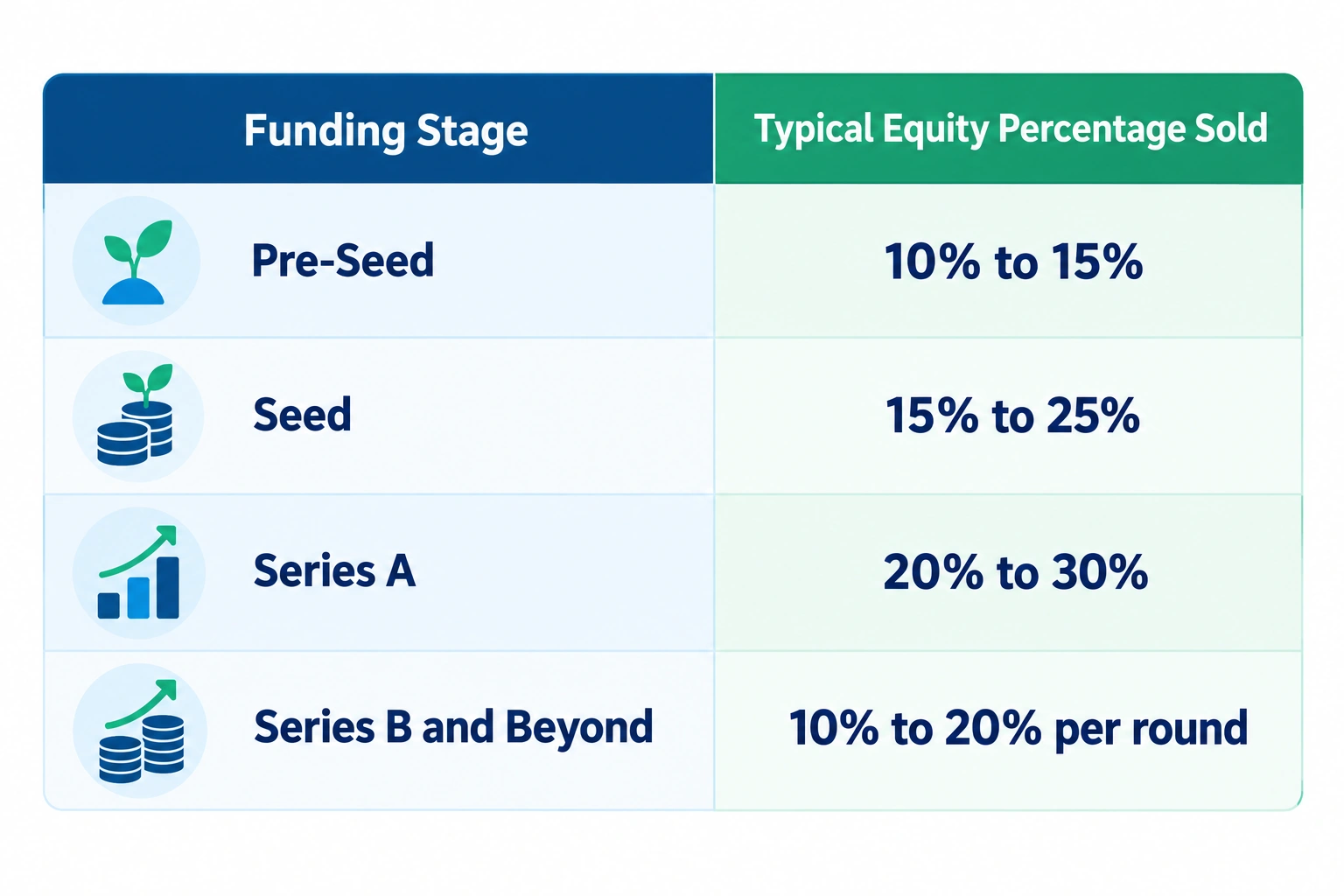
Founders should map their ownership path through these stages before the first term sheet arrives. Owning 60% after a seed round looks strong, yet 10% to 15% at exit is typical for a successful single founder. A venture-backed digital marketing company raised $36.5M across Series A through C while growing revenue from $9M to $180M in 24 months. Each round diluted the founders, but each one funded growth worth far more than the shares sold.
Equity for Advisors, Board Members, and Service Providers
Equity granted for services should stay small and tie directly to measurable contribution, since each grant is hard to reverse.
Typical Grants for Non-Financial Stakeholders
| Stakeholder | Typical Equity Grant |
| Advisors | 0.25% to 1%, vested over one to two years |
| Independent Board Members | A modest grant tied to governance duties |
| Legal and Financial Service Providers | Rarely more than 0.1% to 0.2% |
Founder Vesting and the Cost of Premature Generosity
Founders often resist vesting on their own shares, yet it protects the company from an early departure. Standard founder vesting mirrors employee terms of four years with a one-year cliff, keeping co-founder ownership tied to continued effort. Re-vesting may arise in a recapitalization or turnaround, and it should respect both past contribution and future alignment.
The most expensive mistakes tend to happen in the first year. Founders sometimes hand large stakes to friends, inactive advisors, or co-founders who contribute little. Equity once granted is nearly impossible to recover without legal and relational cost, so document every grant and revisit it as roles change.
Equity Percentage and Control Are Not the Same Thing
Founders often confuse ownership with control, and the two drift apart as a company matures. A founder holding 20% with a board majority can still steer strategy. Meanwhile, a 40% holder without governance rights may have little real influence. The main levers that decide control include the following:
- Voting rights, including super-voting share classes.
- Board composition and staggered terms for directors.
- Protective provisions and veto rights in the charter.
These tools can preserve founder authority through heavy dilution. Used without restraint, though, they can push away the partners the company needs.
How Founders Can Tell an Investor They Need an Ownership Stake
Investors respect founders who bring a model to the negotiation. Show a forward cap table and explain how much ownership the founding team needs to stay motivated through four or five rounds. Frame the request around the company’s outcome, not personal reward. A founder left with too little equity after Series A becomes a retention risk, and experienced investors know it. Offer trade-offs where possible, such as a smaller raise, a milestone-based tranche, or an option pool sized to a real hiring plan.
Modeling Founder Equity Percentage Across Funding Rounds
A sound forward model assumes four to five rounds, 15% to 25% dilution per round, and option pool refreshes after each raise. The path below shows a typical single founder’s ownership from inception to exit.
Founder Ownership Path from Inception to Exit
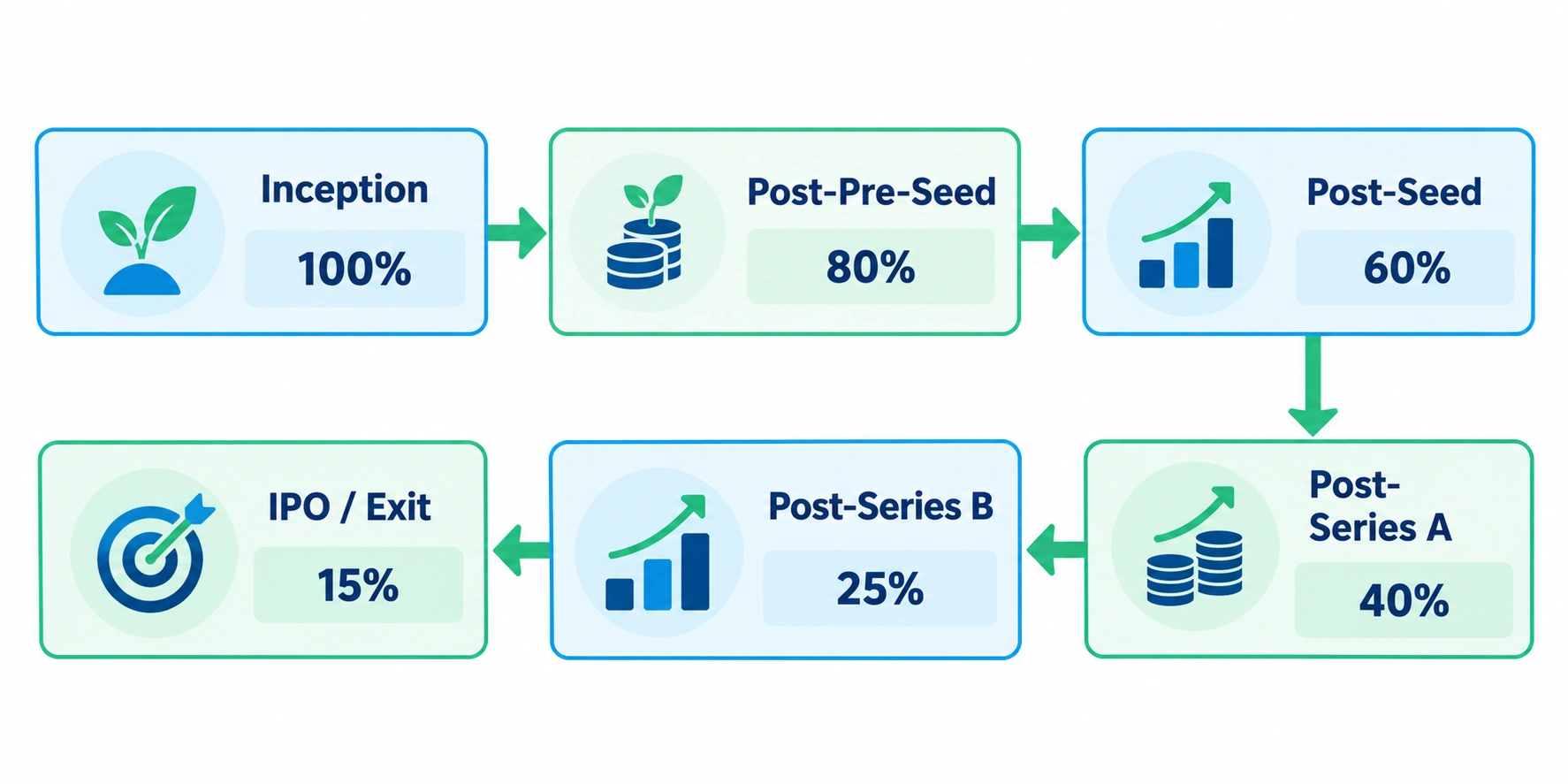
This trajectory reflects success, because a small piece of a large company is often worth more than a large piece of a small one.
Choosing Investors for the Quality of Their Capital
Every investor dilutes the founders, yet some add far more value than others. Tier-one venture firms bring follow-on capital, talent pipelines, and credibility with partners and acquirers. Accepting dilution for that signal is rational when it raises the company’s probability-adjusted value. A marketplace SaaS company raising a $20M Series B built cohort and unit economics models that held up under diligence. That rigor gave its founders room to choose partners instead of simply accepting terms.
Option Pool Refreshes and Founder Secondary Sales
The employee stock option pool must grow as the company scales. Series A and Series B hires need equity to align their incentives. Founders should manage the refresh in three ways:
- Refresh the pool without over-diluting existing holders.
- Use rolling grants to protect the company’s equity runway.
- Align vesting schedules with clear company milestones.
Where the pool sits, before or after the new money, often shapes the founder’s post-deal equity percentage more than the headline valuation.
Some founders also sell a portion of their shares in later rounds to reduce personal risk. Investors accept this when momentum is strong and the founder keeps a significant stake. The sale should also stay modest, at roughly 5% to 10%. Modest liquidity can improve decisions by reducing fear, while a large sale can signal disengagement.
Exit Math and the Psychology of Founder Ownership
Ownership determines return at exit, though exit value matters just as much. A founder holding 15% of a $500M exit earns $75M, while a founder holding 50% of a $50M exit earns $25M. Sound planning balances three goals: enough ownership to stay motivated, enough sharing to build a strong team, and investors who grow the whole pie.
Equity is also emotional, since it carries legacy, recognition, and status. Founders do best when they avoid ego traps, accept dilution as a cost of growth, and focus on absolute value over a headline equity percentage. Every point given away should earn ten back in enterprise value.
Three Key Takeaways
- The right equity percentage depends on what each grant buys, so tie every allocation to measurable contribution and model its effect across at least four rounds.
- Ownership and control are separate levers, and founders can protect strategic authority through board composition, voting rights, and protective provisions even after heavy dilution.
- Judge dilution by whether it is accretive, because 15% of a large outcome usually beats 50% of a small one, and capital quality matters as much as valuation.
Disclaimer: This article is intended for informational purposes only and does not constitute legal, tax, or accounting advice. You should consult your own tax advisor or counsel for advice tailored to your specific situation.
Hindol Datta is a four-time CFO and senior finance executive with over 25 years of leadership experience across cybersecurity, SaaS, gaming, logistics, digital marketing, medical devices, consumer products, and nonprofit organizations. He has led more than $120M in fundraising and over $150M in M&A transactions while building the financial and operational systems that let complex businesses scale with confidence. He is the author of seven books in the Systems CFO Series and holds active CPA, CMA, and CIA credentials.
AI-assisted insights, supplemented by 25 years of finance leadership experience.