
Executive Summary
Deal sourcing has moved from banker calls and quiet dinners to platforms that scan filings, hiring data, and product signals. That shift has made deal origination faster and broader, yet it has eroded the asymmetry behind proprietary deal flow. When every firm runs similar engines on similar data, visibility alone stops being an advantage.
This article traces the move from relationship networks to recommendation engines and examines how machine pattern recognition imports new bias. It then sets out a deal sourcing architecture built on clarity, feedback, and human judgment. Finance leaders and investors will find a practical framework for fewer, better opportunities instead of fuller pipelines.
How Deal Origination Moved from Relationships to Systems
The history of capital deployment has always been a history of access. From Amsterdam merchant syndicates to modern sovereign funds, the investor who sees a deal first and with clarity has outperformed the rest.
For decades, origination was intimate and deeply personal work. Deals surfaced through bankers, lawyers, and trusted referrals, filtered by years of credibility. A practitioner read the room and sensed when a founder was ready to sell. The model was slow and opaque, but its reward was asymmetry, those rare moments of seeing what others missed.
Scale, speed, and signal proliferation have now disrupted that intimacy. Algorithms scrape filings, track LinkedIn profiles, follow SKU velocity, and scan code repositories. CRM systems log every founder conversation, and outreach runs on automation. Deal origination is turning from a craft into an engine.
Abundance, however, creates a paradox of saturation in modern markets. When everyone sees everything, no one sees anything first, and noise overwhelms judgment. The edge now lives in pattern recognition, curation, and execution speed. Any serious deal sourcing strategy must answer three design questions:
- Reach versus meaning: can volume grow without diluting relevance?
- Speed versus substance: does fast outreach rest on real insight?
- Automation versus intuition: where do humans decide what matters?
From Rolodex to Recommendation Engine: The Rise of Platform Deal Sourcing
Modern platforms ingest web-scraped financials, hiring patterns, customer reviews, shipping manifests, app rankings, and patent citations. A single query can reveal acquisition candidates no banker has touched. The Rolodex has become a live graph of intent.
This transition compresses the gap between insight and outreach from months to hours. Founders who never considered selling now receive precise approaches from firms they have never met. Proprietary access, once rooted in network, now rests on infrastructure: data ingestion, CRM integration, and a clear taxonomy of sector signals.
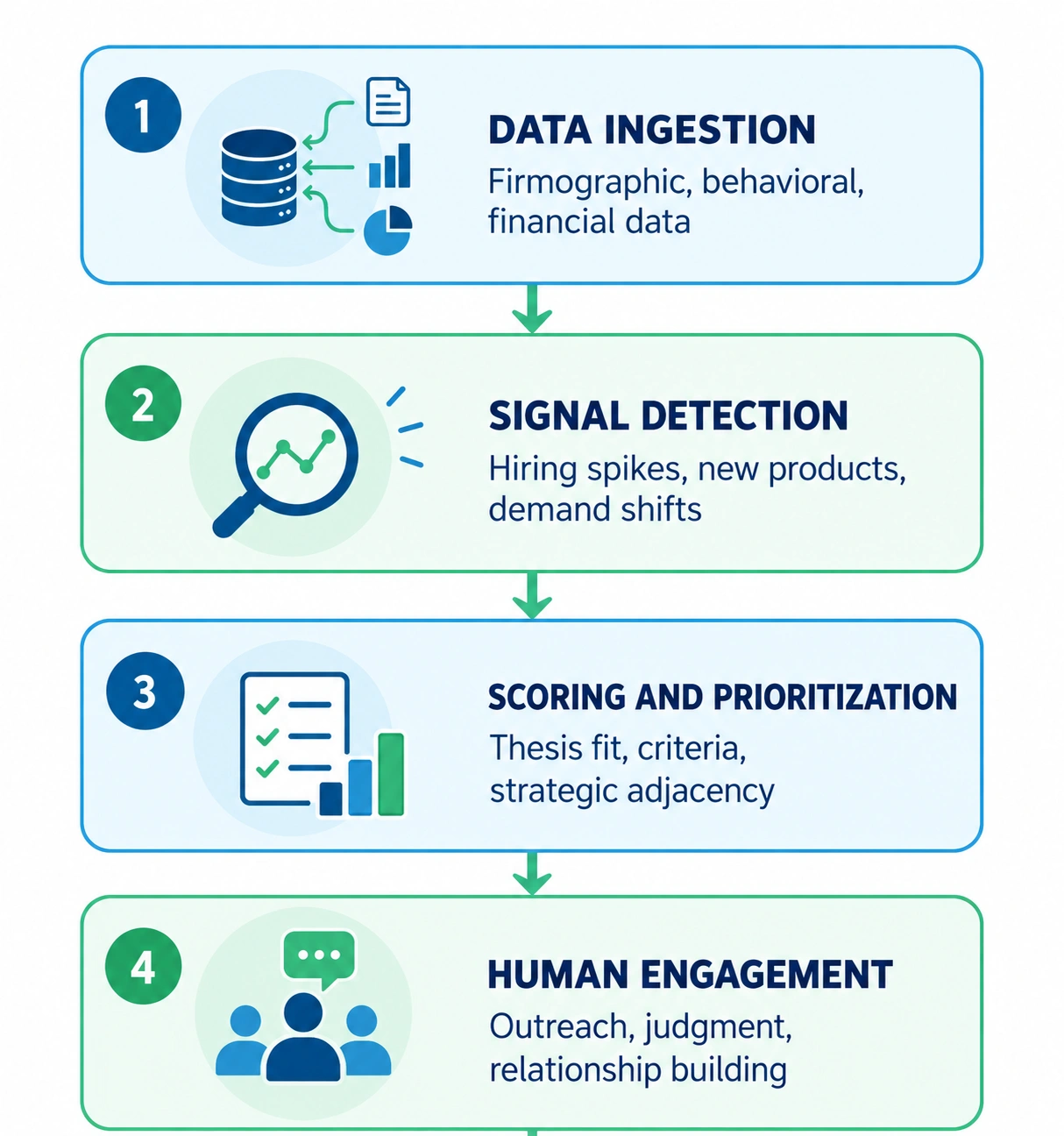
The Four Layers of a Modern Sourcing Platform
The modern model is layered and recursive, not point to point. Human engagement arrives only at the final stage, often through an automated message or a well-timed founder note.
Where Platform Sourcing Falls Short
Early adopters gained an edge because few firms could afford the talent and infrastructure. Those barriers have fallen, and any mid-market firm can now build a working platform. As adoption spreads, proprietary and public deal flow converge. Competition shifts from knowing about a deal to knowing what it means.
Platforms also surface what is legible and quietly exclude what is not. Algorithms trained on historical data may underweight unconventional models or misread underserved sectors. Several kinds of opportunity still evade automation entirely:
- Founders nearing burnout who have never spoken to a banker
- Family businesses facing a generational transition
- Misunderstood companies with messy financials but strong internal leverage
Trust, timing, and presence surface these deals, not dashboards. Digital deal sourcing should therefore sit on top of human practice. Feedback loops, tracking of missed deals, and room for an unprompted founder call keep the system honest.
Pattern Recognition in AI-Driven Deal Sourcing
Pattern recognition has always been the silent weapon of great investors. Senior partners once taught it through apprenticeship, explaining why a founder’s tone hinted at readiness to sell.
Machines now attempt to mimic that intuition, and the breakthrough is real. A sourcing engine can test thousands of correlations and flag companies with growth curves like past winners. It can spot a surge of developer activity long before bankers notice.
The trap lies in the quality of its priors. A model trained on a decade of growth-at-all-costs SaaS multiples will favor heavy burn profiles even when markets punish them. One tuned to reward marketing spend may surface businesses with fragile economics. In fast-scaling performance marketing businesses, top-line momentum often tells only half the story. Contribution margin, CAC, and LTV discipline reveal which growth is durable and which is purchased.
False Signals, Crowded Loops, and Overfitting
A Bayesian approach offers a useful corrective to machine bias. Investors begin with prior beliefs about markets, unit economics, and moats, then update them as signals arrive. Machines supply probabilities, but weighting them across shifting regimes remains human work. Three distortions deserve constant attention in AI deal sourcing:
- False positives and negatives: strict filters miss messy early breakouts, while loose filters flood the pipeline.
- Self-reinforcing loops: shared data feeds flag the same targets for many buyers, inflating valuations.
- Overfitting: models find patterns that are statistically significant but strategically meaningless.
Every machine-generated lead is a hypothesis to test, not a conclusion. Superior pattern recognition combines disciplined data architecture, Bayesian updating, and a human layer that reads founder psychology. Technology broadens the horizon, and judgment narrows the aperture to what matters.
The Illusion of Omniscience in the Digital Deal Funnel
Dashboards glow with leads and promise full transparency, tempting teams to believe nothing escapes the net. Yet wider visibility also widens the surface for misinterpretation, and three traps follow:
- False clarity: clean metrics hide messy reality, since headcount may include contractors and growth may be lumpy.
- Signal redundancy: many firms receive the same alert at once, mistaking synchronized attention for opportunity.
- Illusion of totality: lead lists feel exhaustive, yet companies without online presence never appear.
The gap between data surrogate and real company often surfaces during diligence. In a typical IT services acquisition, quality-of-earnings analysis can expose material EBITDA adjustments. Reported earnings may drift from economic reality, a gap no dashboard would reveal.
Building Feedback into the Funnel
Most sourcing engines surface leads but rarely learn from outcomes. They track outreach volume, not deal quality, so funnels grow in breadth without substance. Disciplined operators treat the platform as an evolving hypothesis and ask which companies it keeps missing.
Effective firms run blind spot audits and compare inbound with outbound results. They place digital teams beside traditional deal origination teams, pairing scale with nuance. Joint funnel reviews study misses as closely as hits, turning a flowchart into a learning system.
Designing a Deal Sourcing System for Clarity and Asymmetry
The classic linear funnel is tidy but deceptive. Deal flow behaves more like a networked ecosystem, with loops, drop-offs, and sudden re-entries. A company that passed six months ago may now be ready, and a reluctant founder may welcome liquidity.
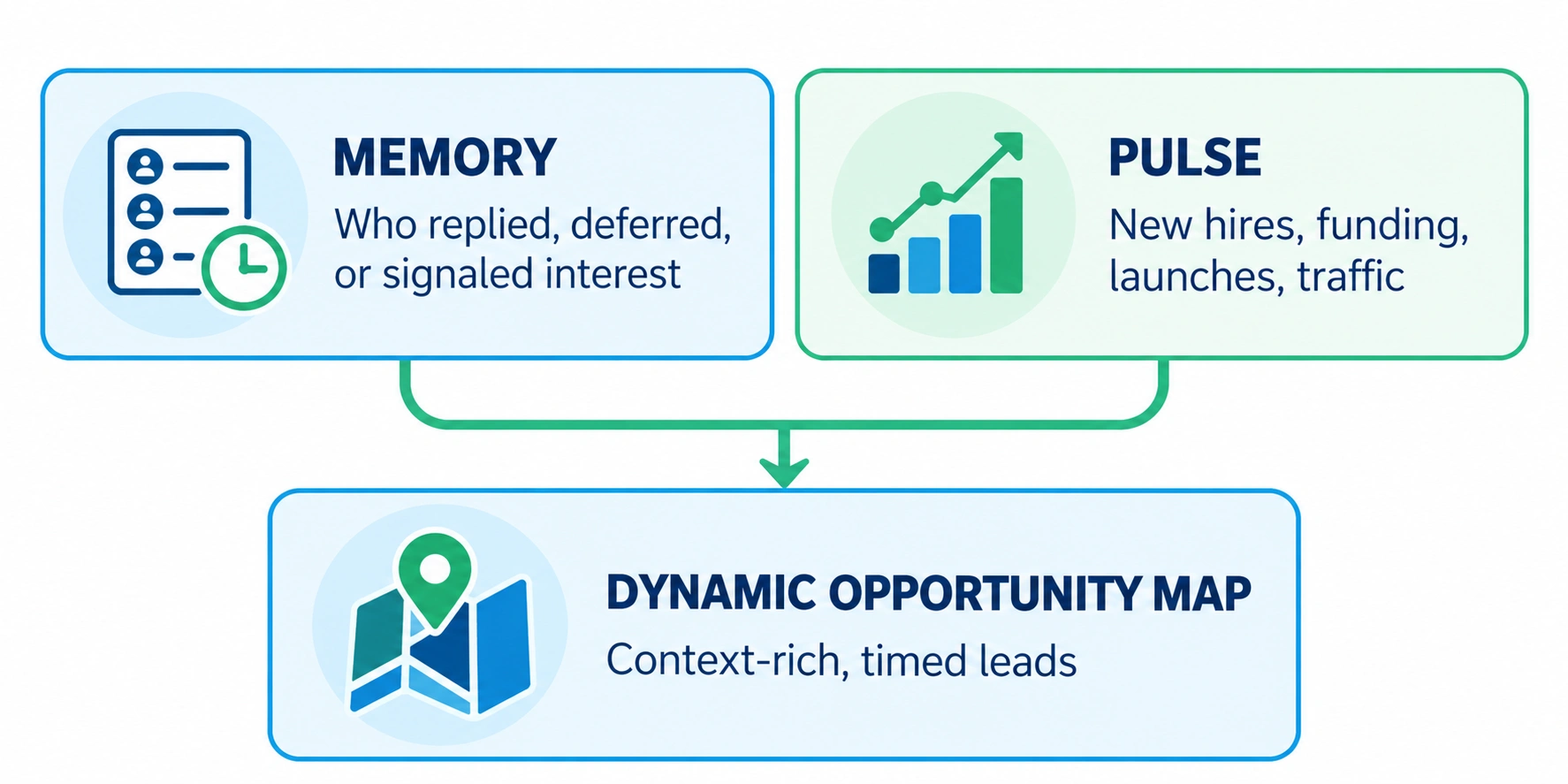
Memory and Pulse: From Static Lists to Dynamic Maps
A strong deal sourcing system needs both a memory and a pulse. Memory records past interactions as strategic signals, while the pulse tracks hires, funding rounds, launches, and traffic shifts.
Five Design Principles for Curated Deal Flow
Beyond memory and pulse, a curated funnel rests on five further principles:
- Balance fidelity with novelty: split the funnel between proven profiles and strategic experiments, like core and satellite bets.
- Encode firm-wide theses: express shared convictions in filters, scoring models, and outreach language.
- Protect narrative intelligence: capture founder notes and competitive nuance at key decision points.
- Structure for learning: hold regular retrospectives on passed deals, failed outreach, and filter errors.
- Respect time asymmetry: keep pre-authorized decision frameworks, reserve capacity, and clear escalation paths.
Financial forecasting offers a useful parallel for sourcing teams. A driver-based forecasting engine stays accurate only through steady feedback on every variance. The same learning habit sharpens a sourcing model over time.
Time asymmetry carries equal weight in competitive markets. In cross-border M&A, the winning deals tend to reward readiness over haste. Velocity means removing structural drag, not rushing judgment.
One firm with modest brand recognition closed a deal in an overlooked industrial software niche. The target had no public funding, little digital exhaust, and no banker. Its system tracked niche job forums, cross-referenced regulatory filings, and linked a product release to a dormant thesis. That deal arrived through design, not through sheer volume.
Three Key Takeaways
- Deal sourcing advantage no longer comes from seeing more companies, since most firms share the same data. It comes from interpreting signals differently and building a thesis around what common filters miss.
- Treat every machine-generated lead as a hypothesis to test, not a conclusion to act on. Pair algorithmic reach with Bayesian updating and human judgment about founders, culture, and timing.
- Judge a deal origination system by fidelity, not fullness. Regular retrospectives, blind spot audits, and tracking of missed deals keep the funnel learning instead of decaying into noise.
Disclaimer: This article is intended for informational purposes only and does not constitute legal, tax, or accounting advice. You should consult your own tax advisor or counsel for advice tailored to your specific situation.
Hindol Datta is a four-time CFO and senior finance executive with over 25 years of leadership experience across cybersecurity, SaaS, gaming, logistics, digital marketing, medical devices, consumer products, and nonprofit organizations. He has led more than $120M in fundraising and over $150M in M&A transactions while building the financial and operational systems that let complex businesses scale with confidence. He is the author of seven books in the Systems CFO Series and holds active CPA, CMA, and CIA credentials.
AI-assisted insights, supplemented by 25 years of finance leadership experience.