
Executive Summary
Many leaders treat cost accounting as a back-office sorting exercise. Yet it shapes how a growing firm reads margin, prices its offers, and funds its next move. When the cost model stays anchored to old assumptions, growth can hide erosion until the damage becomes expensive to reverse.
This article explains what cost accounting means for a modern enterprise and why inherited industrial models distort decisions. It then shows how to design and roll out an activity-based cost system that supports faster, safer growth.
What Is Cost Accounting, and Why Does It Shape Growth?
Cost accounting measures what it takes to make a product, deliver a service, or serve a customer. Statutory reports tell investors what happened in a period. A good cost model goes further, showing managers why it happened and what each unit of output consumed.
As firms scale, their cost structures change shape in quiet ways. Linear inputs become tiered bundles, variable costs turn semi-fixed, and local spending spreads across functions and time zones. The cost model, however, often stays tied to absorption rates designed for factories. Many firms end up growing broke, not for lack of revenue, but for want of cost clarity.
Cost Accounting as Leverage, Not Thrift
Good cost accounting has little to do with austerity or policing innovation. It reveals the marginal dollar, the hidden bottleneck, and the drag of a legacy SKU. With that view, pricing and channel choices become sharper, and decisions move from instinct toward judgment. Reaching this clarity demands cultural change, with the CFO acting as a cartographer of economic truth.
How Industrial Cost Accounting Distorts Modern Business
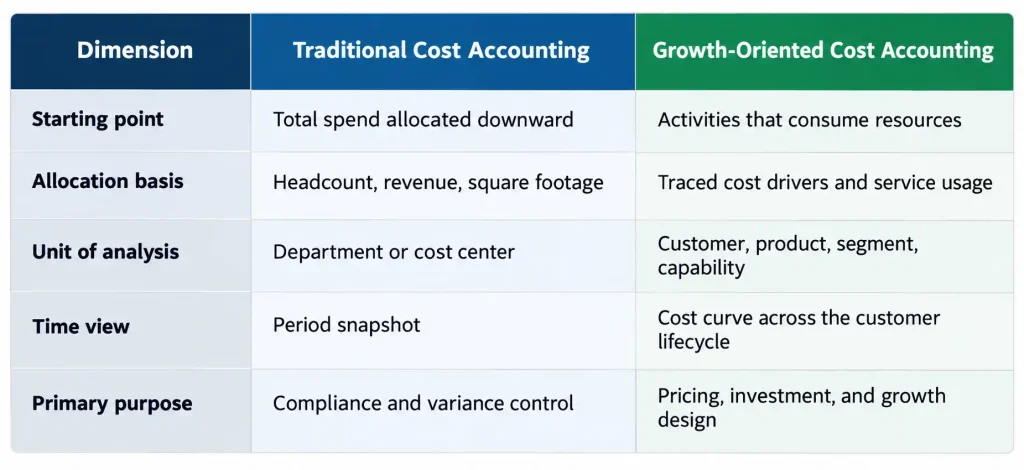
Traditional cost accounting grew up to measure efficiency under constraint. Steel mills, textile plants, and railroads relied on standard costing to assign overhead to labor hours and units produced. In a world of uniform products and linear production, that model controlled waste and tracked variances well.
Modern software and services firms run on platforms, subscriptions, cloud usage, and talent with uneven productivity. Such firms produce outcomes for customers instead of physical units. Yet many still allocate IT by headcount and spread overhead by revenue share. The resulting numbers look neat and auditable but sit far from strategic truth.
The Revenue-Based Overhead Allocation Trap
Consider a self-serve product line earning 30% of revenue with light support needs. Under revenue-based allocation, it absorbs 30% of an overhead pool it never consumed. A second product with 10% of revenue may demand complex implementations, yet it carries a small share. The cost system ends up subsidizing the wrong product and rewarding the wrong behavior.
Shared services suffer the same distortion when firms charge them back by FTE count or square footage. A division in hypergrowth may lean heavily on recruiting and IT, while a mature division needs little help. Flat per-capita charges teach managers to avoid cost visibility instead of seeking value.
Traditional vs. Growth-Oriented Cost Accounting
From Cost Allocation to Cost Interpretation
The deeper fix is philosophical in nature, not mathematical. Firms need to ask how each cost arises and what signal it sends about the business model. The Theory of Constraints helps by asking where throughput stalls and where cost consumes velocity. An activity that delays onboarding or ties up scarce expertise is a strategic signal, not just a cost center line. Ignoring these signals leads to eroding prices, segments that cannot scale, and investor doubt.
Designing Cost Accounting Systems Around Activities and Causes
Designing cost accounting for growth starts with the real unit of value in the business. Instead of dividing IT spend by headcount, a growth-minded system asks what it costs to provision a customer or close a ticket. This shift from allocation to causation is the foundation of activity-based costing.
Economically Significant Moments and Cost Drivers
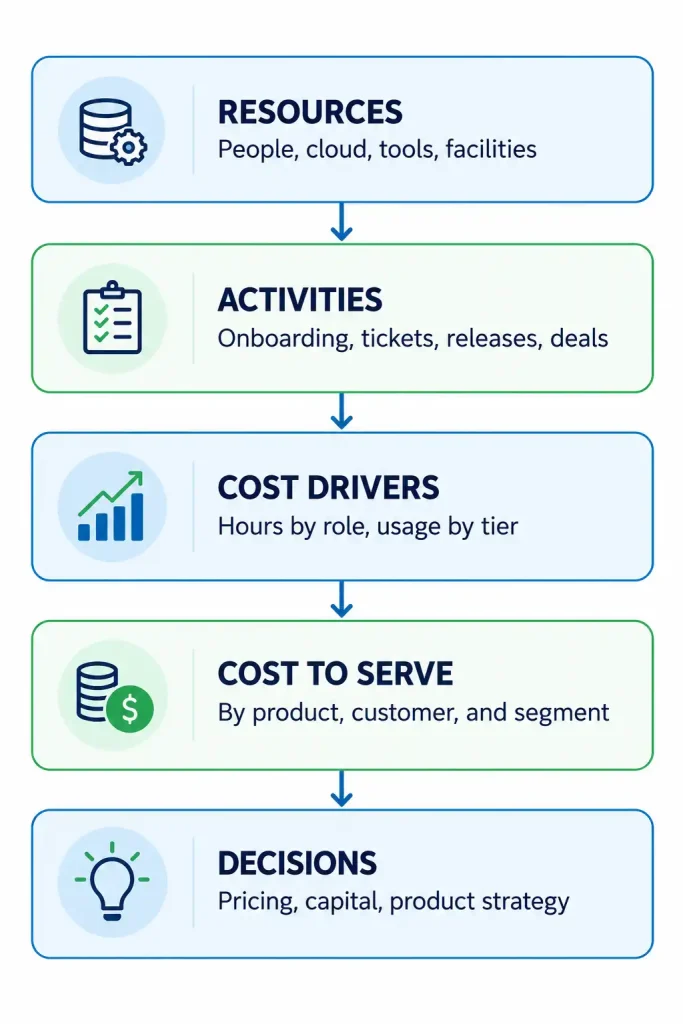
These units sit at economically significant moments, the points where a resource converts into an output. A booked deal moves a prospect from funnel to customer, while a code push moves work from backlog to product. Each moment carries time, infrastructure, coordination, and opportunity cost.
Cost drivers must trace cause, not mere correlation. In professional services, delivery cost follows service hours by role and complexity, not client count. In SaaS, infrastructure cost follows data usage by account tier.
How Cost Flows in an Activity-Based Model
The flow below shows how an activity-based approach links spending to the decisions it should inform.
Dynamic Cost Clusters and Shared Service Catalogs
The second shift moves from static cost centers to dynamic cost clusters built around capabilities. A product launch touches design, engineering, marketing, and customer success, so its cost belongs in one cluster. That view supports a clear contribution margin by segment. It shows which products subsidize others and which customers generate cash after support costs.
Shared services need a catalog that lists what each function delivers, to whom, and how often. If IT provisions 100 new accounts, cost follows that service, not headcount. A feature needing 40 hours of security review then shows its real cost next to one that reuses an approved component.
Time-Integrated Costing and Forward-Looking Dashboards
Growth unfolds in ramps and quarters, so cost should be read as a curve. Time-integrated costing shows the cost to acquire, serve, and renew a customer, exposing true CAC and retention economics. Dashboards should support what-if questions, such as adding a support agent or shifting customer mix.
Implementing a Modern Cost Accounting Function Without Disruption
Rolling out new cost accounting demands as much diplomacy as design. The work begins with storytelling, framing the change as a clearer map of how each team creates value. Leaders should join as co-creators of activity definitions and cost drivers, not as sign-off gatekeepers.
Data Choreography and Shared Definitions
Most ERP systems assume departments and periods, not workflows and customer journeys. Implementation teams must link CRM, ticketing, and project tools to the ledger. The harder problem is taxonomy, since a support case needs one consistent definition across systems.
Sequenced Rollout and Adoption
Adoption depends on how managers experience the output, and a rollout works best when it follows a deliberate sequence:
- Pilot in one or two business units with engaged leadership.
- Measure decision impact alongside data integrity.
- Build dashboards that load fast and explain each change at a glance.
- Use cost reports to prompt questions, not issue commands.
- Close loopholes through system design, not punishment.
- Revisit drivers whenever products, customers, or structures change.
Some teams will see transparency as a threat, so leaders must restate the intent often. Finance talent must evolve as well, from guardians of standards toward systems architects.
How Cost Accounting Accelerates Scalable Growth
Growth without cost clarity resembles a race car with a cracked dashboard, fast enough to win a lap but unlikely to finish. A well-built cost system does not slow growth with caution. It releases growth with confidence, because throughput compounds faster than savings.
Pricing, Product, and Customer Segmentation
Pricing becomes surgical when cost to serve is visible by segment, feature, and support burden. Product teams can prune legacy SKUs and features with no path to scale. Customer segmentation shifts from chasing logos to curating a base built for margin.
Capital Allocation, Risk, and Decision Velocity
Capital moves from a firehose to a scalpel when the system shows which investments lower marginal cost. Risk surfaces earlier through declining marginal output, giving growth-stage firms valuable lead time. Activity definitions drift over time, so the cost model needs governance and regular review.
Three Key Takeaways
- Replace revenue-based and headcount-based overhead allocation with activity-based cost drivers that trace cause, so each product and customer carries the cost it consumes.
- Treat implementation as cultural change, using shared definitions, pilot units, and decision-focused dashboards to earn trust before scaling the model.
- Use cost clarity to price by cost to serve, sequence capital, and spot bottlenecks early, since the payoff of cost accounting is smarter growth, not thrift.
Disclaimer: This article is intended for informational purposes only and does not constitute legal, tax, or accounting advice. You should consult your own tax advisor or counsel for advice tailored to your specific situation.
Hindol Datta is a four-time CFO and senior finance executive with over 25 years of leadership experience across cybersecurity, SaaS, gaming, logistics, digital marketing, medical devices, consumer products, and nonprofit organizations. He has led more than $120M in fundraising and over $150M in M&A transactions while building the financial and operational systems that let complex businesses scale with confidence. He is the author of seven books in the Systems CFO Series and holds active CPA, CMA, and CIA credentials.
AI-assisted insights, supplemented by 25 years of finance leadership experience.