
Executive Summary
CFO strategic patience is the discipline of acting when the cycle turns, not merely when the clock strikes. Markets, boards and dashboards all reward immediacy, yet many of the costliest capital mistakes are errors of timing rather than errors of math.
This article explains why organizations drift toward urgency, how a CFO or fractional CFO can build patience into balance sheets and incentives, and what Cisco, Apple, WeWork and Amazon reveal about timing. It closes with the ethical weight of deferring action when the organization expects motion.
Why CFO Strategic Patience Is Not the Same as Waiting
Patience is often treated as a soft virtue that wins agreement in principle but little use in practice. For a CFO, it has to mean something more operational than delay. Strategic patience is informed latency, an intentional interval in which information matures and options become clearer.
A Bayesian would describe it as the time allowed for evidence to reshape prior beliefs. A game theorist might call it a dominant strategy when the opponent is volatility itself. Either way, the goal is to choose what to wait for, then allocate time with the same rigor applied to cash.
Markets behave more like rivers than canals, meandering, reversing and overflowing without warning. A finance leader who confuses speed with progress can accelerate toward irrelevance. One who mistakes inaction for prudence can ossify before the cycle turns. The deeper risk in both cases is temporal miscalibration, and strategic patience is its remedy. Two forces push organizations toward that miscalibration:
- Narrative urgency, driven by quarterly guidance, tech valuations and the appetite for visible wins.
- The illusion of linearity, the belief that growth compounds in a straight line and that headcount should scale with revenue.
The Compression of Time: Incentives, Noise and the Tyranny of Now
Short Incentives and Present Bias
Most timing distortions begin with incentives, because when compensation horizons shrink to quarters, waiting becomes institutionally discouraged. An acquisition that lifts EPS this year can win approval even if it strains operations two years later.
Behavioral finance has a name for this pull toward the moment: present bias. Discounted cash flow models, used as forecasts rather than heuristics, give a spreadsheet false confidence about the future. The measurable moment gains weight simply because it is easier to count.
Separating Signal from Noise in Financial Leadership
Shannon’s information theory warns that entropy can masquerade as signal. In finance, this shows up as overreaction to earnings volatility, churn blips or a single soft month of bookings. Acting on noise as though it were a trend is closer to superstition than strategy.
KPI dashboards add to the problem when every measurable item starts to look urgent. A leadership team steering by the dashboard alone resembles a pilot overcorrecting for every gust. Effective CFO decision making applies temporal triage to each new data point:
- Does this signal require intervention now?
- Does it require closer observation over another cycle?
- Will systemic feedback resolve it without action?
Consider a $30M ARR cybersecurity SaaS company with operations across several countries. A driver-based forecasting engine, built from scratch, held actuals within five percent of forecast for 8 consecutive quarters. That stability let leadership treat monthly swings as noise rather than reasons to restructure.
Building the Architecture of Strategic Patience
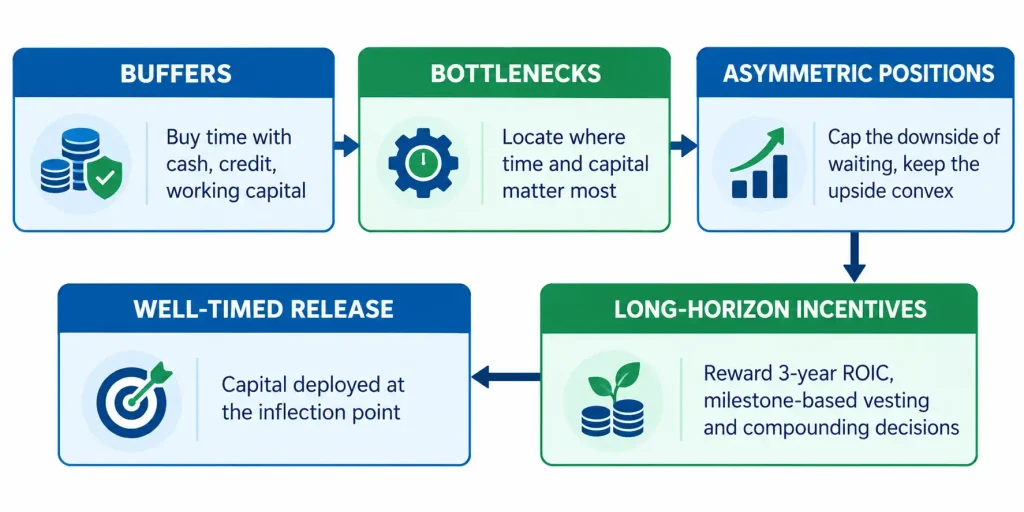
Patience in a volatile system has to be engineered, or it decays into paralysis. The architecture has four parts, and none of them works alone.
Buffers as Latent Leverage
Cash reserves and liquidity cushions are often criticized as idle capital. That reading misses their purpose, because a buffer is an instrument of optionality. Private equity firms that held dry powder through 2006 and deployed it in mid-2009 earned some of their strongest returns.
Working capital can play the same buffering role. One $127M global consumer products company raised inventory turns from 3x to 7x through demand planning and SKU rationalization. The released cash became a buffer that funded growth without forcing a rushed raise.
Finding the Bottleneck Before It Moves
The Theory of Constraints holds that throughput is governed by the limiting process, not average efficiency. In a business, that constraint might be working capital velocity, customer acquisition cost or engineering bandwidth. Patience provides the time to diagnose where the bottleneck sits and where it will migrate next. Common misallocations born of temporal panic include:
- Headcount scaled ahead of infrastructure.
- Go-to-market spend deployed well before the product was ready.
- Capital raised early in a favorable window, diluting later optionality.
Asymmetric Positioning and Optionality
Patience becomes powerful when the downside of waiting is capped and the upside of a well-timed move is convex. That can mean dormant channels ready to scale, capabilities acquired ahead of a pivot, or flexible instruments such as convertible debt and rolling facilities.
The best acquisitions often come from long courtships rather than frenzied auctions. A listed gaming company completed more than $100M in cross-border M&A. Its strongest deals came from relationships held in reserve until timing aligned.
Incentives That Reward Well-Timed Output
Patience cannot survive inside a purely quarterly reward system. Bonuses tied to three-year ROIC, equity that vests on milestones, and narratives that celebrate compounding all help. A trebuchet captures the idea well, storing tension and releasing it only when the arc aligns.
CFO Case Studies: Timing, Misjudgment and Lasting Leverage
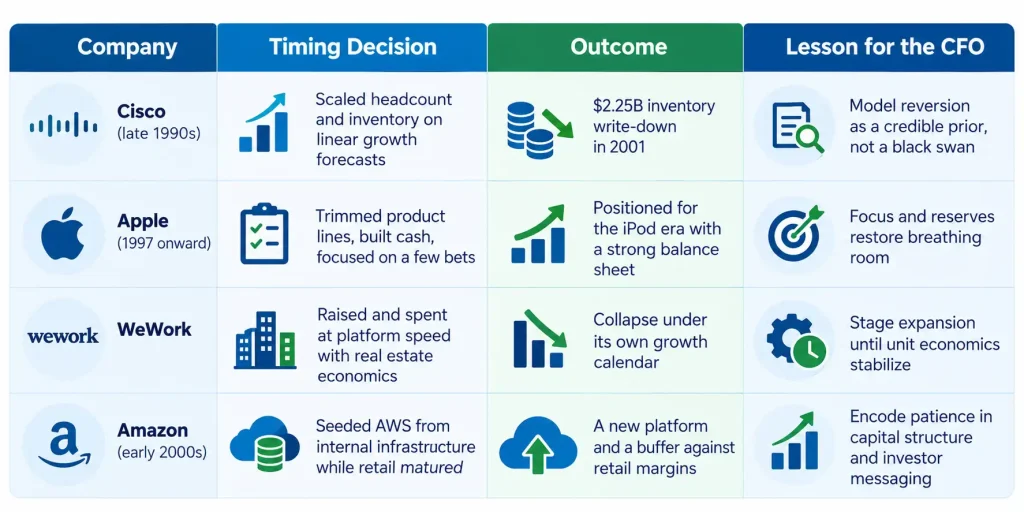
The same pattern repeats at a smaller scale inside individual companies. One software company delayed a product launch by six months to refine pricing and onboarding. Its conversion then beat projections by 60%. A manufacturer that expanded capacity on early demand signals watched a factory sit underused for four quarters.
During 2020, a mid-sized SaaS firm paused net new hiring to protect cohesion and reassess productivity per seat. It retained every employee, grew margins, and rehired by the fourth quarter with sharper role definitions.
Scale does not remove the need for patience; it raises the stakes. A venture-backed digital marketing company grew revenue from $9M to $180M in 24 months. That pace held only because CAC, LTV and contribution margin discipline governed when each dollar of growth spend was released.
How a Fractional CFO Brings Strategic Patience to Growth Companies
Early-stage and mid-market companies feel the pressure of urgency most acutely, yet many lack a full-time CFO. A fractional CFO can supply the scenario planning, buffer design and board narrative that patience requires, without the cost of a permanent executive.
The value of that discipline often appears first in a turnaround. One early-stage email marketing technology company cut monthly burn from $800K to $200K. That reset created the runway to make later decisions on evidence rather than short-term cash pressure.
For a pre-Series A AI governance platform, fractional CFO work centered on multi-year scenario analysis and capital strategy. Those models gave the founder a clear view of which moves could wait and which could not.
The Ethics and Epistemic Burden of the Patient CFO
Delaying for Clarity or Out of Fear
Patience asks a leader for conviction well before confirmation arrives. Holding capital back during a market frenzy is never neutral, because it shifts perception and invites skepticism. The CFO must therefore delay with reason and explain that delay with dignity.
Feedback loops keep principled restraint from becoming rigidity. A useful test includes three questions:
- Is the delay still justified by a real signal?
- Is the value of new information still compounding?
- Is the company buying genuine options or avoiding hard tradeoffs?
Acknowledging the Human Cost of Delay
Every act of patience reallocates urgency onto someone else. Pausing an international expansion can disrupt regional teams that prepared for it. Deferring a hire postpones a career opportunity, and conserving capital may delay work that serves a real good.
A mission-driven education and research institution, for example, must model funding scenarios across variable philanthropic and earned revenue. Leadership then has to weigh those timing choices against staff and program needs, not just the balance sheet. Owning that cost is what turns patience into accountable leadership.
Three Key Takeaways
- CFO strategic patience is informed latency, not inaction. It means expanding the observation window until the value of new information falls below the cost of waiting.
- Patience must be built into structure through buffers, bottleneck diagnosis, asymmetric positions and long-horizon incentives. Without that architecture, waiting simply becomes delay under another name.
- Whether full-time or fractional, a CFO must test every delay against evidence and acknowledge its human cost. That honesty is what separates disciplined timing from simple fear.
Disclaimer: This article is intended for informational purposes only and does not constitute legal, tax, or accounting advice. You should consult your own tax advisor or counsel for advice tailored to your specific situation.
Hindol Datta is a four-time CFO and senior finance executive with over 25 years of leadership experience across cybersecurity, SaaS, gaming, logistics, digital marketing, medical devices, consumer products, and nonprofit organizations. He has led more than $120M in fundraising and over $150M in M&A transactions while building the financial and operational systems that let complex businesses scale with confidence. He is the author of seven books in the Systems CFO Series and holds active CPA, CMA, and CIA credentials.
AI-assisted insights, supplemented by 25 years of finance leadership experience.