
Executive Summary
A strong CFO and CEO partnership is often the deciding factor in whether a business transformation succeeds or stalls. Most failed transformations have enough capital and ambition, but they lack alignment at the top. The CEO looks toward the horizon, while the CFO looks at constraint, consequence and risk.
This article examines four conditions that turn the CEO-CFO relationship from a transaction into a source of strategic advantage. These are the asymmetry of time and signal, constraint as a creative force, decision-making under ambiguity and the ethics of institutional truth. Each section offers practical structures, from shared forecasting forums to decision records that state what would prove a bet wrong.
Why Business Transformation Depends on the CFO and CEO Partnership
There are moments when the logic that built a company can no longer carry it forward. Growth flattens and customers change shape, so transformation becomes a condition of survival.
Too often, collaboration between the two most senior executives shrinks to a handoff. The CEO sets the vision and the CFO finds the funding. That division of labor works in stable conditions, but rules now shift faster than the models built to describe them, so the relationship must move from cooperation to co-creation.
When a CFO and CEO partnership works at this level, the language of ratios and the language of mission stop competing. That outcome depends less on personality than on structure, incentives and intellectual posture.
Aligning Time Horizons and Signals in the CEO-CFO Relationship
Two Clocks Running Inside One Enterprise
The CEO and CFO watch the same company through different clocks. One holds the five-year arc: where markets are heading, what the brand must mean and which capabilities must exist before the window closes. The other holds the current quarter, actual liquidity and the constraints that govern which options remain open.
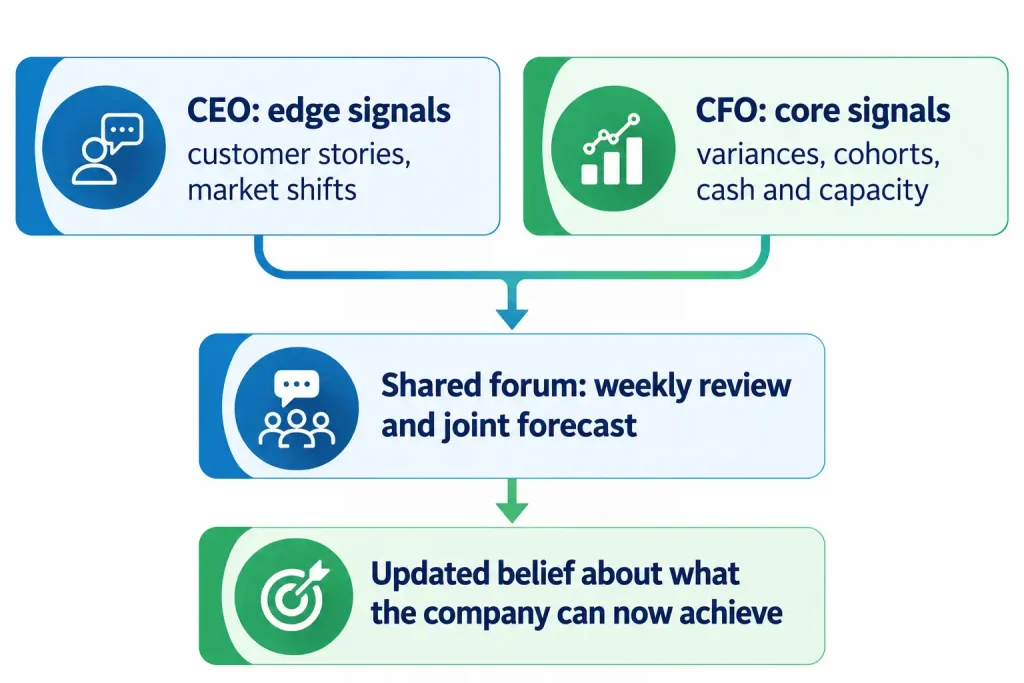
The signals each executive receives are different in kind as well. CEOs hear narrative from customers, competitors and product teams, often long before any metric moves. CFOs read formal signal, such as variances that repeat and patterns confirmed across several closes. Neither view is complete, and many transformations fracture when one is treated as superior.
Building a Shared Protocol for Signal
A CEO may return from customer visits convinced that a platform is losing its stickiness while retention still sits within normal bounds. The data may not support the claim for several quarters, yet the erosion often surfaces later, because the edge of a system moves before its core registers the change.
Finance can spot the shift first in other cases. At a cybersecurity and identity access management company with roughly $30M in ARR, a driver-based capacity model exposed a growing gap between bookings and implementation capacity. Finance turned that pattern into a strategic recommendation, and the same forecasting discipline held actuals within five percent of plan for 8 consecutive quarters.
High-performing pairs build structured forums where both kinds of signal meet:
- Weekly reviews that pair field narrative with the latest numeric evidence
- Joint forecasts owned by both executives, not handed between them
- War rooms during periods of stress, built on a single agreed fact base
- A standing question at every review: what does this mean for what leadership now believes is possible?
Constraint as a Creative Force in the CFO and CEO Partnership
Every transformation eventually faces a sobering question: not what the company could do, but what it must choose. Despite the durable myth that constraint kills innovation, constraint is the frame within which a vague ambition is compressed into an executable design.
Vision without limits has no shape, much like heat without a vessel. Finance should not serve as the permanent “no” but as the architect of realism, giving scale its dimensions and scope its logic.
Asking for the Most Elegant Version the Company Can Afford
At a $127M global consumer products company, inventory turned only three times a year and working capital sat trapped on shelves. Instead of cutting blindly, finance and the wider leadership team rationalized SKUs and rebuilt demand planning together. Inventory turns rose from 3x to 7x, releasing cash for the initiatives that mattered most.
The most common failure in transformation is over-initiating, not underfunding. Leadership teams with five good ideas often attempt all five, and each new dependency adds fragility. In a well-aligned CEO-CFO relationship, the constraint becomes a design variable instead of a veto. The CEO asks what speed could unlock, and the CFO asks what the company would surrender to pay for it.
The Budget as a Strategic Document
Under this approach, the budget stops being a containment device and becomes a record of choices that shows:
- Which beliefs the company chose to fund, and at what cost
- Which initiatives leadership deferred, and why
- Where headcount caps and vendor terms encode strategic priorities
- How much room remains for the next uncertain bet
Leading through constraint does not mean saying no to ambition; it means asking ambition to choose its shape.
Decision-Making Under Ambiguity
There comes a point in every transformation when the data runs out and markets shift before the shift is measurable. In this terrain, the CEO and CFO must act as co-navigators, not judges of each other’s assumptions.
From Prediction to Simulation of Exposure
In ambiguity, analysis yields plausibility instead of precision, and a good financial model becomes a simulation of exposure that answers questions such as these:
- What happens if revenue assumptions are wrong by 15%?
- What if adoption lags by two quarters?
- How does cash runway change if churn improves more slowly than planned?
At an AI governance platform in its pre-Series A phase, multi-year scenario analysis served this purpose. The scenarios were never meant to predict the future. They gave the founder and investors a shared map of risk that made the capital strategy easier to defend.
Turning Decisions into Experiments
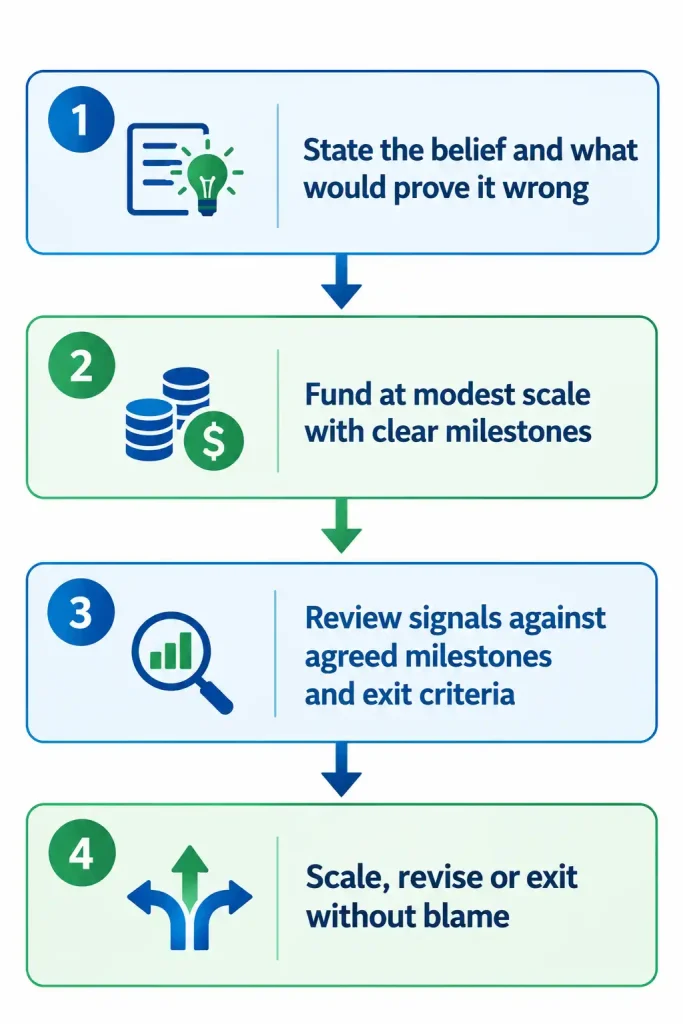
A mature CFO and CEO partnership treats an uncertain investment as a structured experiment. A premature product in an immature market may fail every traditional test, yet early entry at modest scale can create an option on future leadership.
The disciplined response is to fund the effort with clear milestones and exit criteria, and to document the beliefs behind it and what would prove them wrong. As signals emerge, leadership can revise its posture without embarrassment, because the aim is to learn faster than the market can punish the company.
The Ethics of Institutional Truth in the CFO and CEO Partnership
When a transformation fails, the post-mortem rarely finds a single fatal wound. It usually finds a pattern of deferred candor: truths softened, metrics reframed and bad news postponed for one more board deck.
Transformation generates distortion, as forecasts turn aspirational, risks get underplayed and teams revise narratives to preserve momentum. Without a counterweight, those distortions accumulate into epistemic debt, and the company begins to believe its own theater.
Surfacing Inconvenient Signals Before the Market Does
Board preparation during a transformation tests this discipline. Revenue may be up and engagement strong while churn accelerates in one core cohort, masked by expansion in another. Leaving that pattern out of the deck keeps the story clean, but stating it plainly tends to earn the respect of the board instead of its alarm.
The CEO plays a critical role in this discipline. The natural temptation is to protect morale with a simpler story, but simplification hardens into habit and habit into orthodoxy. CEOs must make room for inconvenient facts, and CFOs must deliver them as inquiry, not verdict. That posture produces four practical habits:
- Treating each plan as a hypothesis, not a promise
- Reading variance as signal from the edge of belief, not as failure
- Retiring initiatives before they become sacred cows
- Correcting course internally before the market forces a correction
Strategic value accrues to institutions that tell themselves the truth early, clearly and without shame. Where the CFO and CEO partnership holds that standard, transformation stops being a leap and becomes a path.
Three Key Takeaways
- The CEO and CFO read different signals on different clocks, and transformation succeeds when structured forums turn that asymmetry into shared foresight instead of friction.
- Constraint works best as a design variable, not a veto, and a budget built as a strategic document forces the focus that keeps a transformation from dissolving into too many initiatives.
- A strong CFO and CEO partnership treats uncertain bets as experiments with stated beliefs and exit criteria, and it protects institutional truth so the company corrects itself before the market does.
Disclaimer: This article is intended for informational purposes only and does not constitute legal, tax, or accounting advice. You should consult your own tax advisor or counsel for advice tailored to your specific situation.
Hindol Datta is a four-time CFO and senior finance executive with over 25 years of leadership experience across cybersecurity, SaaS, gaming, logistics, digital marketing, medical devices, consumer products, and nonprofit organizations. He has led more than $120M in fundraising and over $150M in M&A transactions while building the financial and operational systems that let complex businesses scale with confidence. He is the author of seven books in the Systems CFO Series and holds active CPA, CMA, and CIA credentials.
AI-assisted insights, supplemented by 25 years of finance leadership experience.