
Executive Summary
Strong CEO financial reporting does more than show the gap between forecast and actual results. Every forecast is a hypothesis about how the business will behave, and variance shows where that hypothesis broke. Treated as a compliance ritual, variance analysis produces bridge tables that few executives read. Treated as strategic signal, it becomes one of the most useful tools a CFO can offer a CEO.
This article explains how to read a forecast as a belief system and how to sort variance into five types. It then shows how to turn each variance into a decision frame. The final section covers the culture that keeps variance reporting honest, so the organization learns from each miss.
The Forecast as a Belief System in CEO Financial Reporting
No forecast is ever a neutral estimate of the future. Each one is an institutional wager, expressed in numbers, about how reality will unfold if the strategy holds. Revenue projections rest on beliefs about conversion rates and sales productivity, while expense forecasts encode choices about hiring velocity and product timelines.
Each cell in the model is a small theory of cause and effect. Teams make these judgments, leadership reviews them, and finance encodes them into the plan. The map, however, is not the territory, and the market has no interest in how elegant the model looks. The forecast anchors CEO financial reporting because it records what the company believed before reality answered.
Why Variance Is the Most Honest Critic of Executive Thinking
When actuals arrive, they test assumptions as much as performance. A variance does not simply say revenue missed by 8%. It says that a belief about how a variable behaves did not hold.
A $6M revenue shortfall against forecast in a single quarter shows the difference. A conventional bridge splits it across price, volume and mix, which is arithmetic, not insight. Better questions probe the mental model behind the number:
- Did the plan overestimate how fast sales could ramp into new segments?
- Did competitors behave differently than the model expected?
- Were assumptions about customer urgency too optimistic?
- Did the team miss a leading signal six weeks earlier and fail to act?
Answered honestly, these questions turn variance into a diagnostic tool instead of a scorecard. Forecasts built on soft assumptions or political pressure lead to capital misallocation and eroding trust.
A cybersecurity and identity access management business with roughly $30M in ARR offers a useful contrast. After a driver-based forecasting engine replaced intuition, actuals held within plus or minus 5% of forecast for 8 consecutive quarters.
Five Types of Variances in CEO Financial Reporting
Variance is a spectrum of misalignment, not a single phenomenon. A useful segmentation sorts variance by what it reveals about the firm’s logic, not by line item.
A Typology of Forecast Variance
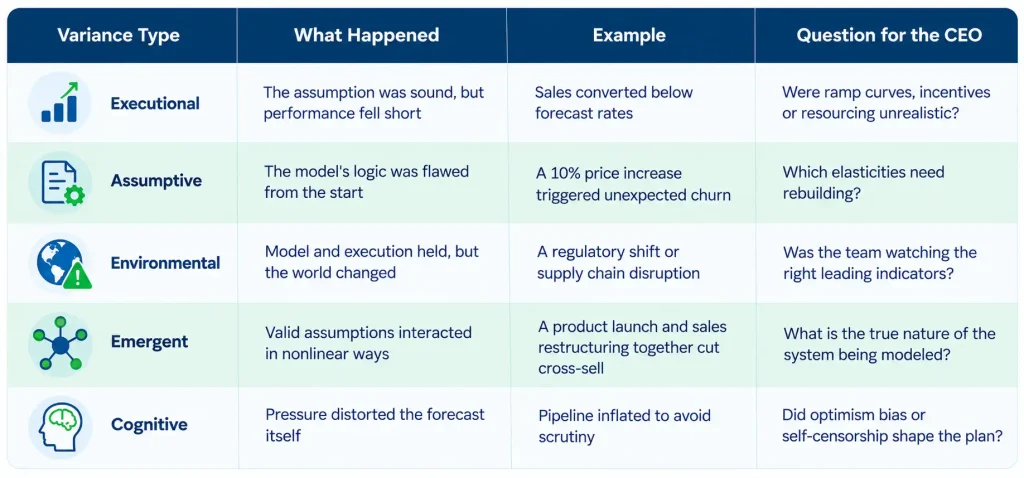
Assumptive variance is the most dangerous for CEO financial reporting, because it compounds in later forecasts and challenges pricing power. Emergent variance is the hardest to explain, since linear bridge models rarely capture second-order effects. Cognitive variance gets discussed least, yet it reveals whether an institution will face the truth.
A $127M global consumer products company shows how assumptive variance hides inside operations. The old plan assumed every SKU earned its place, and SKU-level variance proved otherwise. Inventory turns more than doubled from 3x to 7x once the team rebuilt demand planning and rationalized the range.
From Variance Tables to Strategic Provocations
The deliverable to the CEO should be a set of plain statements that convert numbers into narrative, such as these:
- The system responded differently than the plan assumed.
- A sales miss traced back to ramp assumptions built on a talent profile that no longer exists.
- Channel overperformance came from a temporary arbitrage that will not repeat.
- Two concurrent changes, each sound alone, combined to drive a churn spike.
- A cost miss reflected a number softened during the last reforecast.
Turning Variance into Decisions the CEO Can Act On
A CEO rarely needs another breakdown of deltas, but the CEO always needs a decision frame. Effective CEO financial reporting answers these questions with discipline:
- What shifted, and why did the organization not see it coming?
- What does it mean for the current strategy?
- Which options does it create or close off, and at what trade-off?
- Which new assumptions will govern the next move?
A 12% miss on net new logos is operational trivia in isolation. The CEO needs to know whether the miss is transient, symptomatic or structural. A deeper read asks whether the model leaned too hard on outbound or whether CAC rose in saturated segments.
One performance marketing company scaled revenue from $9M to $180M in 24 months with this kind of reading as routine. Its CAC, LTV and contribution margin discipline turned each acquisition-cost miss into a question about channel economics.
Pairing Each Variance with a Decision Hypothesis
| Variance | Hypothesis | Decision |
| Cost overrun in a newly automated process | The plan under-scoped integration lag | Re-phase the automation roadmap and tighten coordination |
| Positive margin variance in one product line | Pricing undervalued bundled buying behavior | Test bundling in adjacent SKUs |
| Churn spike among enterprise accounts | Service SLAs eroded under lasting staffing constraints | Deploy service recovery and model NRR under two scenarios |
The Variance-to-Decision Flow
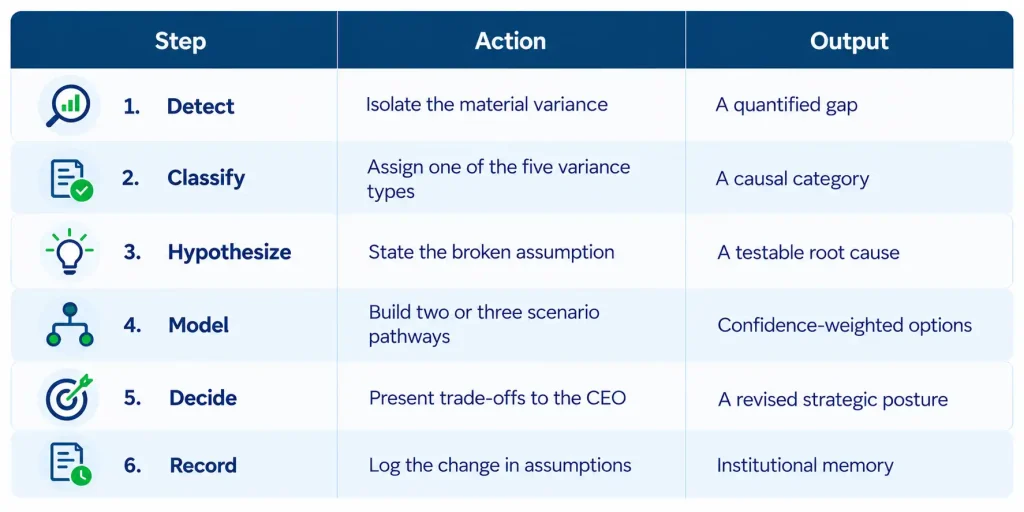
Embedding variance in scenario planning means the CEO sees a range of actions with clear trade-offs instead of a single prescribed step. Over time, the assumption ledger carries the most weight, because it tracks how beliefs change. After several cycles, the firm forecasts with learned humility.
Building a Culture Where CEO Financial Reporting Tells the Truth
Every company holds a quiet doctrine about what it means to miss a forecast, and the strongest organizations treat variance like fire: dangerous if misused, illuminating when studied.
Most corporate systems reward performance over candor, and admitting a wrong forecast can feel like admitting incompetence, which breeds sandbagging and padding. The CFO’s first cultural task is to decouple variance from shame by treating forecasts as hypotheses, not promises.
Running a Belief Audit Every Planning Cycle
Variance reviews should begin with the assumption, not the number. A useful opening might note that CAC was expected to stay below $600 because CPMs were stable. The review then works through four simple questions in order:
- What did the team believe?
- Why did the team believe it?
- What changed in the business or the market?
- What will the team believe differently now?
Repeated each quarter, this loop builds forecast maturity. It does not eliminate misses; it produces better misses that surface earlier and get corrected faster.
At one mission-driven education institution, board reporting worked best when variance commentary led with the assumption behind each number. Directors engaged with the reasoning instead of interrogating individuals. That candor held through a $37M capital raise across equity and venture debt.
Rituals That Protect Variance Dignity
Process alone does not change culture, because leaders change it in the moment a miss is reported. Punishing an honest but unflattering explanation drives the organization into silence. Curiosity in response signals that truth matters more than image. This principle, known as variance dignity, honors the reasoning behind a prediction while still testing its limits.
Several practical rituals reinforce this principle across the organization:
- Performance reviews that assess clarity of reasoning, not forecast hit rates.
- Dashboards that show forecast revisions over time.
- Variance reviews held as cross-functional dialogues across product, sales, marketing and finance.
These practices build institutional memory, the antidote to forecast amnesia. Over time, CEO financial reporting earns a different kind of trust, where an explanation of a miss reads as clarity, not spin.
Three Key Takeaways
- Every forecast works best as a set of testable beliefs, with variance serving as evidence of which ones broke.
- Classifying each variance by type and pairing it with a decision hypothesis gives the CEO more than any bridge table.
- Variance dignity, built through belief audits and assumption ledgers, keeps CEO financial reporting honest.
Disclaimer: This article is intended for informational purposes only and does not constitute legal, tax, or accounting advice. You should consult your own tax advisor or counsel for advice tailored to your specific situation.
Hindol Datta is a four-time CFO and senior finance executive with over 25 years of leadership experience across cybersecurity, SaaS, gaming, logistics, digital marketing, medical devices, consumer products, and nonprofit organizations. He has led more than $120M in fundraising and over $150M in M&A transactions while building the financial and operational systems that let complex businesses scale with confidence. He is the author of seven books in the Systems CFO Series and holds active CPA, CMA, and CIA credentials.
AI-assisted insights, supplemented by 25 years of finance leadership experience.