
Executive Summary
A sound capital allocation strategy depends on knowing where the next dollar earns its highest return, a question most planning cycles skip. Return on invested capital (ROIC) answers that question better than any other metric, yet most firms treat it as a compliance figure, calculated each quarter and forgotten until it disappoints.
ROIC should shape capital allocation strategy as a design constraint rather than a report card. The sections below trace how the metric lost its authority and set out a planning architecture built around it. They also show how finance leaders can embed ROIC into systems, incentives, and board governance without creating bureaucracy.
Why ROIC Belongs at the Center of Capital Allocation Strategy
ROIC looks like simple arithmetic, but it carries a whole philosophy of how a business should use its resources. The ratio divides net operating profit after taxes (NOPAT) by invested capital, and both halves deserve more respect than they usually receive.
Invested capital is not just a balance sheet line; it is the sum of every bet the firm has placed. It reflects capacity built, resources tied up, and opportunity cost absorbed. The return, in turn, is the visible outcome of thousands of pricing, customer, and operating choices. Treating either half as a single spreadsheet cell strips away the story behind the number.
Used well, ROIC forces leaders to confront marginal returns at scale. It shows where the slope flattens, where friction enters, and where duplication begins. That makes it a working argument against inertia and a natural anchor for any serious capital allocation strategy.
Two Pathologies That Distort Capital Decisions
When leaders misread ROIC, planning tends to drift toward one of two extremes. The table below sets both against a return-led approach.
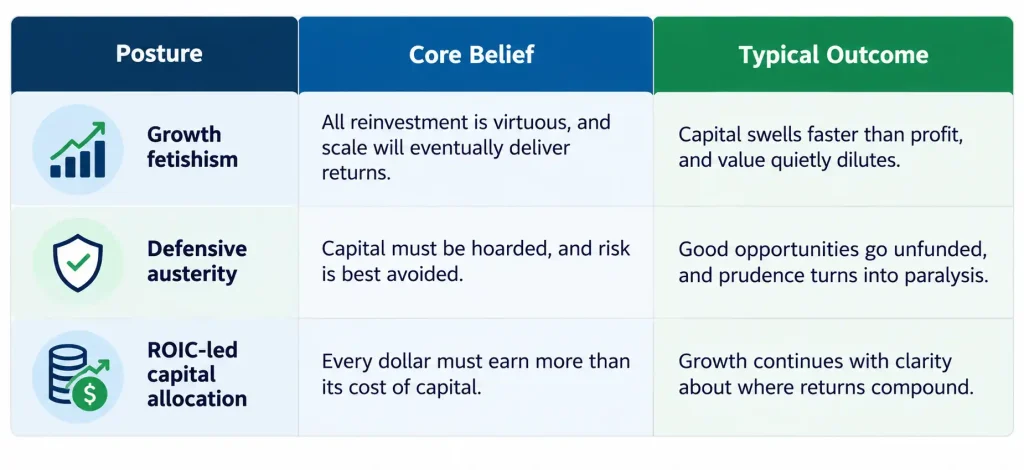
ROIC is not anti-growth; it is pro-clarity. It should inform product strategy, pricing, geographic expansion, capital budgeting, M&A integration, and organizational design.
How ROIC Lost Its Place in Corporate Planning
The ratio once carried real authority, serving boards and planners as the shared language of capital efficiency. Its elegance lay in neutrality, since it ignores how assets were funded. An ROIC above the cost of capital signals value creation. A falling ROIC warns of value destruction, regardless of top-line growth.
Cheap capital in the early 2000s changed the conversation. Investors rewarded revenue expansion and market share, and in high-growth sectors the denominator swelled without matching gains in profit. As capital allocation strategy drifted toward growth, long-term studies kept returning the same finding. Firms that compound shareholder value over decades show consistently high ROIC, not the fastest revenue growth.
Three Reasons the Metric Is Misunderstood
- Computational fragility: The treatment of R&D, goodwill, and leases can swing ROIC by hundreds of basis points.
- Timing asymmetry: Returns arrive years after growth decisions, so a backward-looking ROIC appears to punish investment.
- Uncomfortable truths: The metric exposes capital sinks and pet projects, making it politically easy to sideline.
The remedy is reclamation of the metric rather than its abandonment. Every investment discussion should ask what a decision does to return on capital in Year 1 and Year 5.
Building a Capital Allocation Strategy Anchored in ROIC
Too many planning cycles begin with a revenue target and work backward to justify costs and capital expenditure. The resulting plan balances in Excel but breaks in reality. A disciplined capital allocation strategy reverses that order and treats the firm as a system for return rather than a machine for growth.
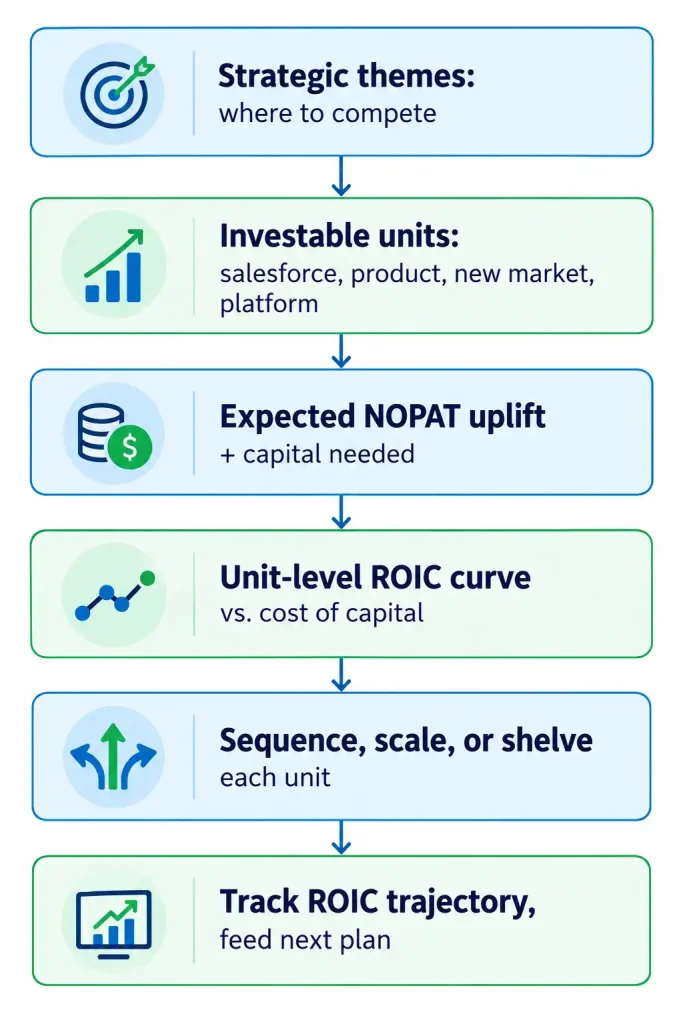
The ROIC Planning Loop
Investable Units and Granular Attribution
The first principle of an ROIC-based capital allocation strategy is modularity. A salesforce expansion is an investment in acquisition efficiency. A new product line is a wager on future margin and retention. Each unit needs a modeled NOPAT uplift, the capital required to support it, and an implied ROIC curve. Some units ramp slowly but endure, while others pay back fast and then plateau.
The second principle is granular attribution, because entity-level averages conceal the truth. A business unit earning 25% can quietly subsidize another earning 6%. At a professional services firm with five business units, engagement-level analytics finally showed leadership where margin was leaking. Such a map requires agreed rules for allocating shared infrastructure, working capital, and intangibles.
ROIC as a Dynamic Constraint and Risk Lens
Leaders also need ROIC fluency, and models must invite interaction rather than inspection. Scenario models should show how ROIC moves if customer acquisition doubles, churn improves by 2 points, or CapEx slips six months. Once a driver-based model made such questions routine, a $30M ARR cybersecurity SaaS company held actuals within five percent of forecast for 8 consecutive quarters.
Three further principles complete the architecture of the planning system:
- Treat ROIC as directional and comparative, never as a binary hurdle rate.
- Review the portfolio mix of core versus adjacent bets and growth versus efficiency.
- Pair return with risk by testing volatility, tail scenarios, and capital at risk.
Applied this way, ROIC supports well-reasoned approvals rather than serving as a reason to reject investment.
Embedding ROIC in Systems, Governance, and Culture
Embedding ROIC is an act of cultural engineering as much as a technical project. Budget templates must project capital employed alongside income. Investment memos should present capital-return profiles rather than simple cost-benefit cases. Scenario models should surface ROIC deltas along with the decisions behind them.
Governance must follow the same logic, or the new systems change nothing. A mature capital allocation strategy asks investment committees to judge discrete initiatives, not portfolio averages. Each initiative needs a clear capital logic covering how much it uses, how it compounds, and when it pays back.
Managerial behavior changes through context rather than through command. If performance reviews reward revenue alone, ROIC fades into the background. One venture-backed digital marketing company grew revenue from $9M to $180M in 24 months. Disciplined tracking of CAC, lifetime value, and contribution margin kept that growth economically sound. Incentives should therefore reward returns above the cost of capital, not just top-line delivery.
A few cautions keep the discipline healthy over time. ROIC should guide rather than veto, since some low-return bets buy strategic entry or optionality, and those exceptions deserve open acknowledgment. Intangible capital such as brand, data, and talent also needs a clear narrative, even where the balance sheet cannot capture it. Finally, ROIC works best as a trajectory that shows whether capital is becoming more productive or more burdensome over time.
ROIC as the Long Memory of Capital Allocation Strategy
Periods of fast growth often obscure the fact that capital carries a cost. Embedded properly, ROIC keeps that cost visible and requires every asset to justify its place on the balance sheet.
Without it, complexity accumulates quietly as business lines proliferate, overhead swells, and legacy assets escape challenge. A longitudinal view surfaces trapped capital and degrading returns. At a $127M global consumer products company, inventory turns rose from 3x to 7x. That shift released trapped working capital and shrank the denominator without starving growth.
ROIC also brings consistency across economic cycles, restraining euphoria in bull markets and challenging unjustified caution in downturns. The same lens teaches sequencing, showing which initiatives return early and which need gestation. Over time, it separates hope from evidence in long-running stories, such as the platform strategy that never quite pays back.
Beyond consistency, ROIC aligns functions that otherwise drift apart. It shows sales that not all revenue is worth winning and shows operations that efficiency must reach the margin. A capital allocation strategy built on ROIC gives boards better questions about how capital is aging and which bets are compounding. Because non-GAAP add-backs cannot easily disguise it, ROIC remains an honest ledger of judgment.
Three Key Takeaways
- A disciplined capital allocation strategy starts with ROIC rather than ending with it, so every plan begins by asking where the next dollar earns more than its cost of capital.
- An effective capital allocation strategy measures ROIC by business line, product, and initiative, because averages hide the units that destroy value.
- Lasting change depends on systems, incentives, and board conversations that treat ROIC as a trajectory to steer rather than a target to game.
Disclaimer: This article is intended for informational purposes only and does not constitute legal, tax, or accounting advice. You should consult your own tax advisor or counsel for advice tailored to your specific situation.
Hindol Datta is a four-time CFO and senior finance executive with over 25 years of leadership experience across cybersecurity, SaaS, gaming, logistics, digital marketing, medical devices, consumer products, and nonprofit organizations. He has led more than $120M in fundraising and over $150M in M&A transactions while building the financial and operational systems that let complex businesses scale with confidence. He is the author of seven books in the Systems CFO Series and holds active CPA, CMA, and CIA credentials.
AI-assisted insights, supplemented by 25 years of finance leadership experience.