
Executive Summary
Generative AI has set off a patchwork of rules across the world, and AI regulation strategies now sit squarely on the CFO’s desk. Each jurisdiction shapes its approach around its own political, cultural, and economic priorities. For finance leaders, AI compliance is no longer a narrow legal task but a question of where capital earns its best risk-adjusted return.
This article explains how regulatory asymmetries are forming and how boards can respond. It covers five design principles, three regimes, a practical playbook, and key board questions.
Why AI Regulation Strategies Belong in Capital Planning
Every wave of technology leaves a regulatory undertow behind it, and generative AI is no exception. Its power to reason, simulate, and produce human-like output at scale has prompted governments to act quickly and unevenly. As a result, regulatory arbitrage has returned, not as a way to dodge scrutiny, but as a design principle.
Revenue recognition standards and GDPR adaptations showed how jurisdictional nuance shapes data use and risk pricing. Generative AI brings a similar inflection point, yet the terrain is more fragmented and the margin for error is thinner.
Boards should now ask a new question in capital planning: where is AI most valuable, and where is it most viable? The point is not a race to the lowest bar. It is aligning data strategy, model architecture, and deployment roadmaps with emerging regional asymmetries.
Regulation as a Silent Determinant of Strategy
Governing standards often act as silent forces that define what is possible. In medical device manufacturing, cross-border safety and liability mandates routinely shape standard costs and product timelines. In AI, data pipelines, model training, and inference location play the same role as strategic levers.
Complexity theory shows that small initial design choices produce large downstream effects. Chaos theory adds that a surprise privacy ruling can carry outsized consequences. Network theory shows that jurisdictions connect through trade and data flows, so one region’s rule ripples into others.
CFOs and boards should therefore treat AI regulation as part of ROI, risk mitigation, and competitive advantage. A company that builds explainability, data sovereignty, and auditability into its AI stack early avoids later penalties, friction, and delay.
Five Principles for Regulation-Aware AI Governance
Because AI regulation keeps evolving, companies need adaptable systems built on five principles of regulatory resilience:
- Modular architecture and localized logic: Separating core model logic from region-specific rules lowers compliance cost and speeds adaptation. Multi-entity businesses already apply this pattern, keeping a common core with local layers for statutory and tax rules.
- Signal detection and early warning loops: Analytics should flag shifts in regulatory exposure, training data anomalies, and inference drift. A consumer products company sourcing from Asia cannot wait for monthly reviews when trade rules shift, and AI teams face the same pressure.
- Explainability and network traceability: Every edge in the network, from data source to training to inference, needs documentation so liability can be traced. Mission-driven institutions learn this early, since unclear data sources erode donor and board trust.
- Governance and human-in-the-loop oversight: Any complex system without feedback loops degrades, and human oversight is one such loop. Boards need policies for override, drift detection, audit trails, and versioning, built in from day one for high-risk sectors.
- Strategic regulatory mapping: Regulatory regimes form networks of their own. Companies that map the differences can launch AI features first in friendlier markets, then scale into stricter ones with a predictable design.
The Global AI Regulatory Landscape: Three Regimes
Effective AI regulation strategies start with knowing which regime governs each market. Today’s frameworks fall into three broad camps, each with its own philosophy and cost of entry.
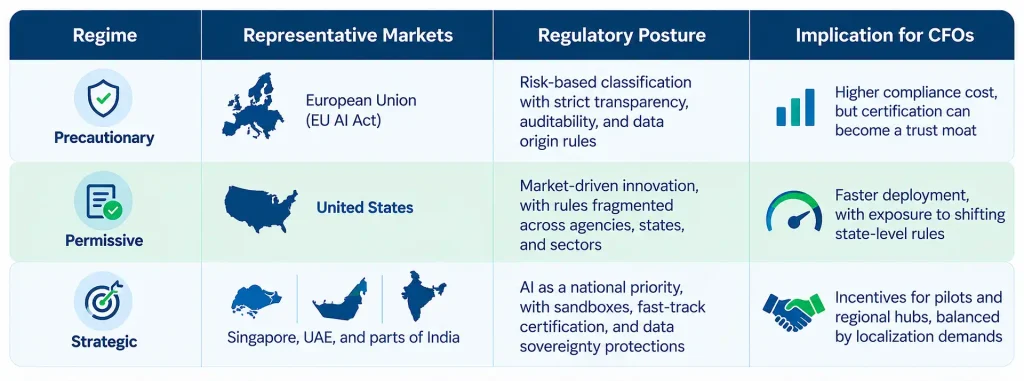
The EU shows how fluid the picture remains. Its 2026 Digital Omnibus agreement moved obligations for stand-alone high-risk systems, such as credit scoring and recruitment tools, from August 2026 to December 2027. A shift like that changes compliance budgets and launch sequencing almost overnight.
This fragmentation creates a temporary but real opportunity for boards. Companies that build geographic nuance into expansion plans can move faster where they can and deeper where they must.
Where AI Compliance Hits the Financial Model
Regulatory arbitrage shows up materially in three areas, and each one carries a cost the CFO must model:
- Training data compliance: Some jurisdictions require companies to disclose training data lineage. Training on copyrighted material without consent creates exposure in the EU, while U.S. fair use law remains unsettled, so startups may need regional training environments.
- Inference explainability: In finance, health, and employment, certain regions require AI outcomes to be explainable and auditable. Europe leads, with California and New York closing in, so an agent-driven pricing or underwriting engine must justify each conclusion in every region.
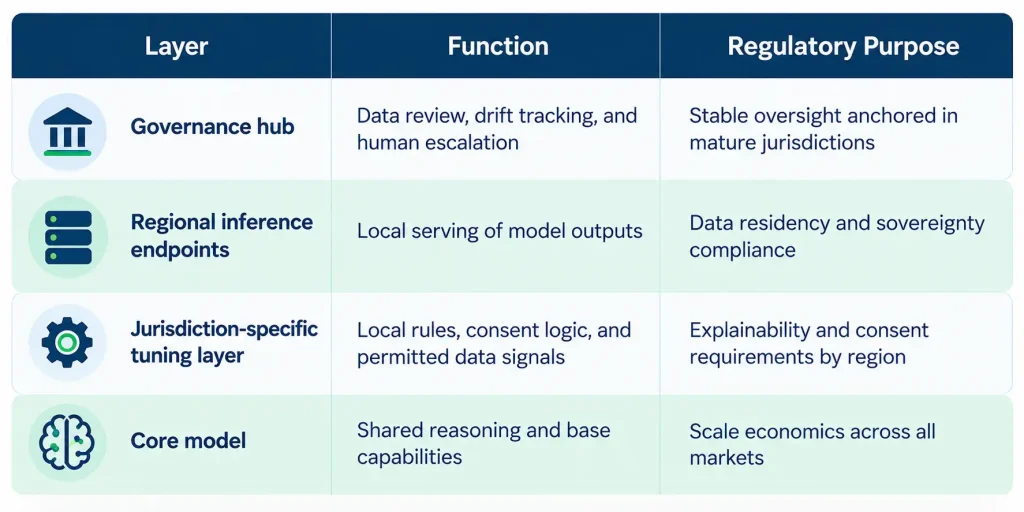
- Data sovereignty and model localization: India’s DPDP Act and China’s Cybersecurity Law govern where data sits and where inference occurs. A common response is one core model with jurisdiction-specific tuning layers, which adds cost but unlocks broader market access.
The Regulation-Aware AI Stack
The layered design below shows how these three vectors translate into a practical architecture.
Translating Complexity into Capital Allocation
The CFO’s role is to turn this complexity into capital allocation clarity, anchored by three questions:
- Where is the company overinvesting in compliance that will not drive advantage?
- How can it scale intelligently without overexposing the business?
- At what point does early compliance become a moat in its own right?
A Playbook for Turning Regulatory Gaps into Strategic Leverage
In the early cloud era, companies moved workloads to regions with favorable data rules and tax policies. The strongest AI regulation strategies apply the same thinking through four moves:
- Pilot in regulatory sandboxes: Singapore and the UK offer AI sandboxes where a healthcare startup could test diagnostic models before wider rollout.
- License models in compliance-first markets: EU conformity marking or an equivalent local certification can become a licensing moat. Explainability credentials may soon carry the sales leverage that SOC 2 once did.
- Modularize agent logic by region: A credit-scoring agent might use different data signals in Europe than in Latin America, a form of jurisdictional prompt engineering.
- Form governance hubs, not just development hubs: Base data review, drift tracking, and escalation teams in regions with stable liability and explainability rules.
Boards should view these choices as strategic alignment, not operational complexity. When regulators treat AI unevenly, the ability to navigate that unevenness becomes a form of capital efficiency.
Board-Level AI Regulation Strategies: Questions for Every Quarterly Review
Every quarterly review of AI investments should include a regulatory-readiness check aimed at clarity, not perfection:
- In which jurisdictions is the company training, deploying, or selling AI-powered products?
- Are the models trained on globally permissible data, or do they need regional partitions?
- Has the team mapped explainability and consent requirements by region?
- Do agent outputs meet the lowest common denominator of compliance, or risk localized shutdowns?
- Can finance quantify the cost of localization against the revenue it unlocks?
- Which regulatory frameworks are likely to harden in core markets within 12 months?
Just as GAAP shaped reporting systems, AI frameworks will shape how intelligence is packaged. In multinational groups reporting across several countries, one unified definition of revenue tends to sharpen every board conversation. A single map of AI obligations can do the same.
From Regulatory Arbitrage to Competitive Advantage
Regulatory arbitrage in the generative AI era is about strategic sequence, not evasion: train first, deploy first, scale, and seek defensibility first. Early movers in permissive regimes compound insight faster, while firms that build for auditability in precautionary regimes create trust moats others cannot breach.
This window will narrow as regulations converge, but for now geography is a strategy, not a line item. Sound AI regulation strategies push leaders to discuss compliance-adjusted margins and return on regulatory clarity alongside ARR. Advantage will depend less on who builds the smartest agent and more on who deploys it where, how, and under which rules.
Three Key Takeaways
- Treat AI regulation as a capital allocation input, not a compliance checkbox. Effective AI regulation strategies ask where AI is most valuable and most viable before committing capital.
- Build modular, explainable, and auditable AI systems from day one. A shared core with jurisdiction-specific layers lowers compliance cost across regimes.
- Make use of today’s regulatory asymmetries while they last. Sandboxes, compliance-first licensing, and well-placed governance hubs can create durable trust moats before global rules converge.
Disclaimer: This article is intended for informational purposes only and does not constitute legal, tax, or accounting advice. You should consult your own tax advisor or counsel for advice tailored to your specific situation.
Hindol Datta is a four-time CFO and senior finance executive with over 25 years of leadership experience across cybersecurity, SaaS, gaming, logistics, digital marketing, medical devices, consumer products, and nonprofit organizations. He has led more than $120M in fundraising and over $150M in M&A transactions while building the financial and operational systems that let complex businesses scale with confidence. He is the author of seven books in the Systems CFO Series and holds active CPA, CMA, and CIA credentials.
AI-assisted insights, supplemented by 25 years of finance leadership experience.