
Executive Summary
Accounting and memory share a tighter bond than most finance teams admit. A ledger does not simply record what happened. It decides which events an organization will remember. Every classification, accrual and reserve compresses a messy economic reality into a durable record. That record then shapes incentives, capital allocation and strategy.
This article explains how financial statements work as compressed institutional memory and how measurement changes behavior. It also shows how curated numbers drift into fiction. It closes with safeguards that keep financial reporting honest about what it omits.
The Ledger as a Selective Memory of the Enterprise
A ledger looks neutral, yet it reflects choices about what counts. A purchase becomes a capital asset, a risk becomes a footnote, and a long-term liability becomes short-term through reclassification. A depreciation schedule is an agreement with time rather than a law of physics. Recognition policy, contract framing and managerial intent shape even revenue. Once recorded, these choices become the formal memory of the business.
Compression and the Cost of Forgetting
In information theory, entropy measures disorder in a stream of events, while compression removes redundancy to preserve the signal. Financial reporting compresses constantly, and the process is never neutral since every reduction of uncertainty is a decision about meaning. A machine may stay productive for years after its book value reaches zero. In financial recall, though, it has already expired.
This compression costs the organization its memory, and lost context is the price. When a company writes off sunk costs, the emotional and strategic context behind them disappears. When it impairs goodwill, it formalizes the regret without capturing its source. A failed product launch may hold years of learning for the team. The ledger remembers it only as an R&D expense.
Layers of Financial Memory
The record grows in layers, and each layer adds its own filter.
- The journal holds time-stamped transactions.
- The general ledger categorizes and summarizes them into accounts.
- Financial statements offer three lenses on the same record, namely the balance sheet, income statement and cash flow report.
- Narrative supplements such as management discussion, footnotes and non-GAAP metrics tell the story.
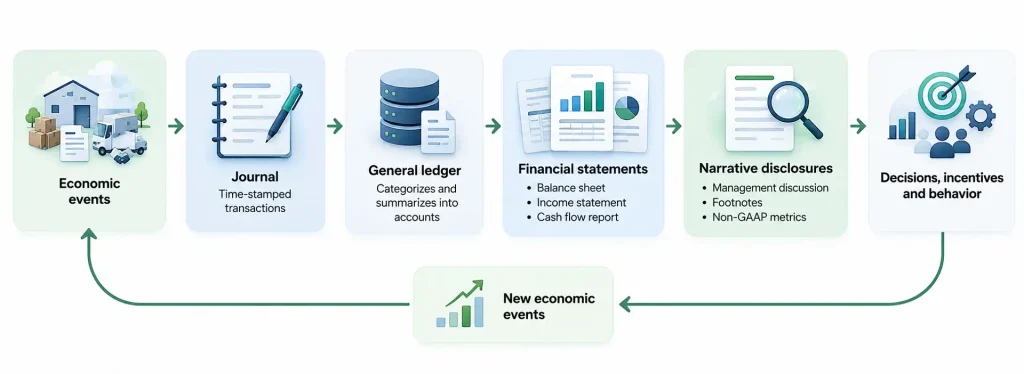
The diagram shows why financial memory behaves like a loop rather than an archive. The output of each cycle feeds the next one.
How Accounting and Memory Harden into Policy
Biological memory strengthens or weakens with use, whereas financial memory ossifies. Last year’s expense becomes this year’s benchmark, a justified adjustment becomes precedent, and precedent repeated becomes policy. In a cybersecurity SaaS company with roughly $30M in ARR, an ASC 606 revenue recognition framework with clear controls separated genuine exceptions from standing rules, and the same discipline held actuals within five percent of forecast for 8 consecutive quarters.
The ledger also remembers itself, which complicates the picture further. Restatements, prior-period adjustments and reconciliations revise the record, yet organizations rarely preserve the chain of judgment and context behind the original error. For that reason the CFO needs a dual posture, first as the designer of compression who writes policies that preserve essential signal, and second as the curator of forgotten noise who keeps contextual records and counter-narratives that maintain awareness of what the organization lost.
The Observer Effect in Financial Reporting
Once a metric is tied to compensation, reputation or resource allocation, it stops being a passive reflection and becomes an attractor that pulls behavior toward itself.
Goodhart’s Law and Metric Gaming
Gross margin looks simple, but when it becomes a target procurement may chase discounts over strategic sourcing, product teams may reclassify R&D inputs as infrastructure, and sales may push discounting out of view. The number improves while the system does not. This is Goodhart’s Law at work, which holds that a measure ceases to be a good measure once it becomes a target.
EBITDA shows the same double life, since it can serve as a compass for capital efficiency and reinvestment discipline, or it can become a shell game of normalizations and one-time exclusions when it is tied directly to executive bonuses. In a buy-side diligence engagement on an IT services target, quality-of-earnings work surfaced material EBITDA adjustments, which revealed how far reported earnings had drifted from economic reality.
Similar patterns appear in several common tactics.
- Deferred revenue strategies that exploit timing differences
- Contractor reclassification to dodge burn metrics
- Delayed vendor payments that inflate cash flow while eroding supplier trust
None of these are acts of malice, since they are rational responses to being observed, yet they erode culture when teams conclude that appearance outranks truth.
Dual Framing and Entropy Scanning
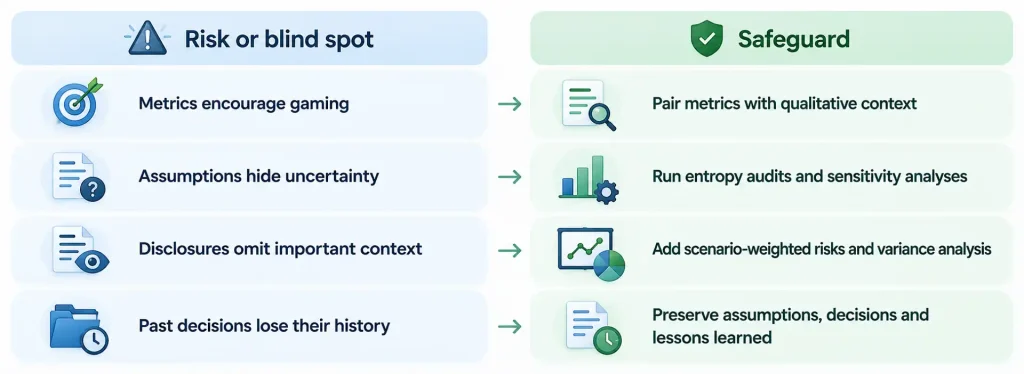
Metrics work best as conversations rather than commandments. Dual framing pairs every quantitative metric with qualitative context, so a stable churn rate is accompanied by the reasons behind it, and an improving CAC ratio is tested for durability once incentives change. In a venture-backed digital marketing company that grew from $9M to $180M in 24 months, a disciplined view of CAC, LTV and contribution margin kept growth honest because each ratio was read alongside the behavior that produced it.
Entropy scanning is the second tool, and it means deliberately looking for unmeasured behavior, such as work happening outside dashboards, interactions that escape formal KPIs and narratives that persist despite contrary numbers. These are listening exercises that reveal where new patterns form.
When Compression Becomes Fiction
The threshold between simplification and distortion is crossed through small steps, such as one reclassification, one softened disclosure, one aggressive accrual assumption. Few begin as fraud, and most start as coping mechanisms that harden into myth.
Lessons From Enron, Lehman and Valeant
Enron’s special purpose entities moved debt off the balance sheet while preserving profit recognition, and the form of independence was kept while its substance was lost. Management, auditors, counsel and rating agencies all saw what they needed to see, creating a closed loop in which internal assumptions validated external reporting. Lehman’s Repo 105 transactions temporarily reduced quarter-end leverage by treating short-term financing as sales, which obscured entropy with polish. Valeant leaned on adjusted EBITDA and non-GAAP earnings, which kept the story curated even though the numbers were auditable.
Quieter versions exist in ordinary companies. A SaaS business that counted multi-year prepayments with heavy cancellation rights in its unaudited ARR saw valuation climb, targets inflate and hiring plans expand, until early churn pulled the system back to reality. The common thread is epistemic fragility, a state in which the ledger has come loose from external constraints.
Antidotes That Preserve Reflexivity
Compression cannot be abandoned, so the answer is to build awareness of it into the process. Narrative layering pairs formal statements with scenario-weighted risk disclosures, expanded variance analysis and time-based metrics. Entropy audits review assumptions rather than numbers by asking where compression has become too tight and which footnotes are growing noisier. A public gaming company reporting under both IFRS and US GAAP shows the benefit, since one unified definition of revenue across every subsidiary reduced local interpretation.
The Ethics of Knowing in Financial Leadership
Signing the financial statements is an act of epistemic commitment, and it carries an ethical weight that rarely gets discussed in boardrooms. Polanyi observed that people know more than they can tell, but finance leaders often must tell more than they know, reporting probabilistic phenomena with apparent precision. Internally everyone understands that assumptions sit beneath revenue recognition policies, impairment triggers and discount rates, yet externally analysts, lenders and employees treat the same numbers as exact.
Four obligations follow from the gap between how numbers are made and how they are read.
- Treat compression as a moral act, because every summary decides what deserves attention.
- Maintain epistemic humility through sensitivity analyses, disclosed assumptions and metrics that admit second-order effects.
- Practice narrative transparency, including the courage to report an adverse result as forecasting overconfidence rather than blaming macro conditions.
- Steward institutional memory by tracking how assumptions evolved and what was tried, failed and adapted.
In a $127M global consumer products company, inventory turns rose from 3x to 7x through demand planning and SKU rationalization, a result that depended on understanding what inventory valuation hid about slow-moving stock.
Three Key Takeaways
- Treat the ledger as designed memory rather than a mirror, and ask of every number what it includes, what it excludes and what others will infer from it.
- Pair each metric with qualitative context, and review assumptions through entropy audits, so that measurement informs behavior without quietly distorting it.
- Lead with narrative discipline and epistemic humility, because accounting and memory shape how an organization sees itself and what it chooses to become.
Disclaimer: This article is intended for informational purposes only and does not constitute legal, tax, or accounting advice. You should consult your own tax advisor or counsel for advice tailored to your specific situation.
Hindol Datta is a four-time CFO and senior finance executive with over 25 years of leadership experience across cybersecurity, SaaS, gaming, logistics, digital marketing, medical devices, consumer products, and nonprofit organizations. He has led more than $120M in fundraising and over $150M in M&A transactions while building the financial and operational systems that let complex businesses scale with confidence. He is the author of seven books in the Systems CFO Series and holds active CPA, CMA, and CIA credentials.
AI-assisted insights, supplemented by 25 years of finance leadership experience.