
Executive Summary
Unit economics measures whether a business creates more value from each customer than it spends to win and serve that customer, and it remains the most reliable test of whether growth will compound or collapse. Customer acquisition cost (CAC), customer lifetime value (LTV), gross margin, and payback period together reveal the integrity of a business model long before the income statement does.
This article explains the meaning of unit economics, how its core metrics interact across business models, and the seven levers that improve them, from segmentation and pricing to retention and model integrity. It closes with the narrative discipline that boards and investors expect from founders who want their economics to earn trust.
Unit Economics Meaning: The Atom of Business Logic
Scale without sustainability remains one of the most seductive fictions in startup culture. In the race for customers, market share, and valuation momentum, unit economics often slips into the footnotes of fundraising decks, yet the quiet arithmetic of cost and contribution decides whether an enterprise endures. No company can outrun that arithmetic for long, however strong its growth story.
In plain terms, unit economics is the study of the revenue and cost tied to a single unit of product or service, usually one customer. It is the irreducible metric from which gross margin, profitability, and scalability all follow. Understanding it goes beyond mastering a formula, because the numbers expose whether the business model holds together.
The Core Metrics of Unit Economics
Four variables carry most of the weight, and each tells a different part of the story:
- Customer acquisition cost (CAC): the full cost of winning one customer, including marketing spend, sales compensation, and onboarding.
- Customer lifetime value (LTV): the gross profit a customer generates over the life of the relationship.
- Gross margin: the share of revenue left after the direct cost of goods sold (COGS).
- Payback period: the months of gross profit needed to recover CAC.
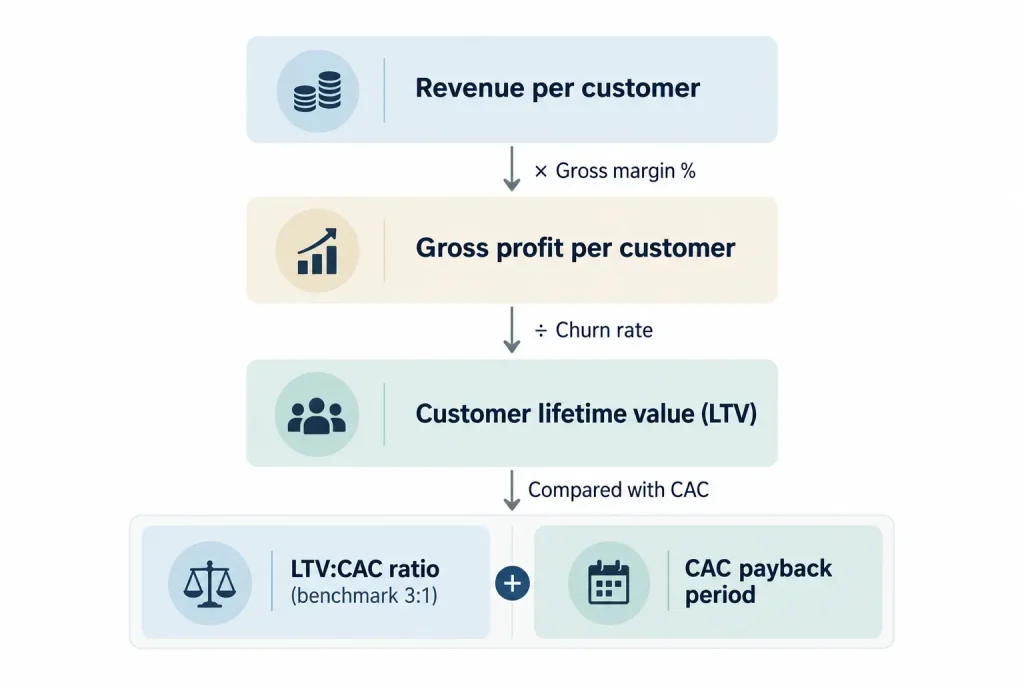
The LTV to CAC ratio, commonly benchmarked at 3:1, offers a first approximation of efficiency, but the structure beneath it matters more. A high CAC can be justified when LTV is robust, while a low CAC paired with shallow LTV signals fragility. Since LTV depends on retention, gross margin, and customer behavior, a longer relationship produces more value, and retention must be earned, not assumed.
How Revenue Models Shape Unit Economics
The shape of the revenue stream changes everything downstream. Recurring, transactional, and seasonal revenue each imply different capital efficiency, forecasting visibility, and margin variability.
| Business Model | Typical Gross Margin | Unit Economics Implication |
| SaaS (recurring) | Often above 80% | Predictable MRR allows tighter LTV forecasts and a longer CAC payback |
| D2C e-commerce (transactional) | Around 40% | High return rates inflate CAC and erode LTV, so payback must be fast |
| Seasonal businesses | Variable | Uneven cash cycles demand conservative LTV assumptions |
A low-margin product must recover CAC quickly or risk a cash flow spiral, whereas a high-margin software company can afford patience. A payback of 6 to 12 months generally signals health, while a 24-month payback in a volatile segment invites danger. Founders need to ask how long the company can fund that gap before capital runs dry, because these mechanics feed directly into runway and cash planning.
Startups that scale on weak unit economics can grow themselves into insolvency. Those with strong economics, by contrast, gain pricing power, investor confidence, and strategic optionality.
Why Unit Economics Change Over Time
Unit economics evolve with customer segment, pricing model, operating scale, and strategic focus. Early CAC may look artificially low because founders are closing deals themselves, and early cohorts may overstate LTV before churn patterns settle. Sound practice applies Bayesian reasoning, updating assumptions as new data arrives.
At a marketplace SaaS company raising a $20M Series B, cohort analysis and unit economics models built from actual customer behavior anchored investor diligence and withstood close scrutiny. That outcome depended on treating the model as a living estimate, not a fixed claim.
Seven Levers That Improve Unit Economics
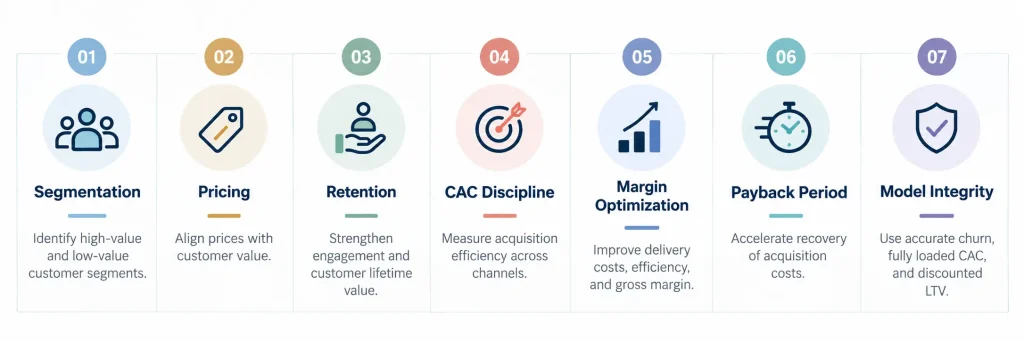
Diagnosis matters only if it leads to prescription. Startups can improve their economic posture through seven levers, each pulled with rigor and integrity.
Segmentation: Averages Lie
A single cohort can hide two different economies: high-value, low-churn customers alongside high-churn, low-spend opportunists. Precision begins with disaggregation by acquisition channel, use case, geography, and persona, which reveals the true LTV to CAC ratio for each segment and guides capital allocation.
| Segment | CAC | LTV | LTV:CAC | Action |
| Blended average | $1.2K | $3.6K | 3:1 | Looks healthy on the surface |
| LinkedIn-sourced leads | Lower | Higher | 5:1 | Scale investment |
| Facebook ads | Higher | Lower | 1.5:1 | Cut or redesign |
Segment-level clarity converts economics from guesswork into governance. At a professional services firm with five business units, engagement-level profitability analytics gave leadership its first view of where margin was being created and where it was quietly leaking.
Pricing and Retention
Most startups underprice out of a fear of rejection, yet pricing is leverage. A 10% price increase on high-retention customers lifts LTV out of proportion to the effort, and tiered pricing, usage-based models, and value-aligned bundling can raise both revenue and retention. Pricing works best as an ongoing experiment instead of a static guess.
Retention compounds in a similar way, since a one-point improvement in monthly retention lifts LTV geometrically. Many startups still favor acquisition over engagement, even though onboarding, product utility, customer success, and relationship management drive retention across the whole company, making retention a direct reflection of the value delivered.
CAC Discipline and Margin Optimization
Acquisition costs need measurement across channels, time periods, and cohorts, with attribution models refined and spend judged by the speed and quality of conversion as well as cost. Sophisticated operators track blended CAC, paid CAC, and organic CAC, since each tells a different story. At a venture-backed performance marketing company that scaled revenue from $9M to $180M in 24 months, CAC, LTV, and contribution margin discipline sustained that growth.
Gross margin is not fixed either, since supplier negotiation, fulfillment efficiencies, automation, and pricing power all improve it, and every point of margin adds flexibility. A cybersecurity SaaS and services company improved gross margin by 12% through pricing discipline, workforce composition, and delivery cost management.
Payback Period and Model Integrity
A startup with a 15-month payback may struggle with cash flow even when its LTV to CAC ratio looks strong. Shorter sales cycles, better conversion rates, earlier monetization, flexible payment terms, and upsell triggers all accelerate recovery.
Model integrity is the final technical lever, since unit economics must reflect real behavior, not ideal behavior, and any inflated metric will betray the business in time. Three rules are non-negotiable:
- Annualize churn accurately.
- Include every variable cost in CAC.
- Discount LTV to present value.
Telling the Unit Economics Story to Boards and Investors
Strong unit economics must be narratable. Founders need to explain why LTV will grow, how CAC will compress, and when margins will expand, connecting each metric to the actions underway, the signals being watched, and the bets being placed. An articulate model with a credible improvement plan persuades far more than inflated metrics paired with vague hopes.
Boards and investors do not expect perfection; they expect progression. A startup that understands its unit economics and improves them methodically signals maturity, while one that obscures or decorates its numbers invites scrutiny. CAC can be gamed, LTV inflated, and payback smoothed, but the market corrects such distortions with force once growth stops masking them.
For founders raising capital, the LTV to CAC ratio is a design constraint, gross margin is the oxygen of the business, and the payback period is the window of solvency. For investors deploying capital, the strongest startups scale wisely, not merely fast, and second-order questions about coherence reveal the difference.
Unit Economics as the Spine of Durable Value
Economic fundamentals do not guarantee success, but they set the boundary within which boldness is rewarded. When unit economics are sound, growth compounds; when they are broken, growth becomes a liability. The conversation is less about cost efficiency than about value creation, asking whether the business makes more than it takes and delivers enduring value at scale.
Those questions act as catalysts that turn ambition into architecture and vision into viability. Unit economics is the spine of the playbook, and the enterprises that pass its test will define the next generation of durable companies.
Three Key Takeaways
- Treat unit economics as a system in which CAC, LTV, gross margin, and payback period interact, and judge the LTV to CAC ratio against the margin structure and revenue model of the business.
- Segment relentlessly, because blended averages hide the channels and customer groups that create value and the ones that destroy it.
- Build models on real behavior, with accurate churn, fully loaded CAC, and discounted LTV, and pair them with a clear narrative of how each metric will improve.
Disclaimer: This article is intended for informational purposes only and does not constitute legal, tax, or accounting advice. You should consult your own tax advisor or counsel for advice tailored to your specific situation.
Hindol Datta is a four-time CFO and senior finance executive with over 25 years of leadership experience across cybersecurity, SaaS, gaming, logistics, digital marketing, medical devices, consumer products, and nonprofit organizations. He has led more than $120M in fundraising and over $150M in M&A transactions while building the financial and operational systems that let complex businesses scale with confidence. He is the author of seven books in the Systems CFO Series and holds active CPA, CMA, and CIA credentials.
AI-assisted insights, supplemented by 25 years of finance leadership experience.