
Executive Summary
Startup traction is the evidence investors trust most before a company has mature revenue or a proven model. It shows whether a product is changing user behavior, and that behavior carries more weight than interest, applause, or a polished slide.
This article explains how to define startup traction, which metrics resonate with early-stage investors, and how to show traction to investors with clarity and honesty. It also covers the ten presentation principles that turn raw data into a credible case for funding.
What Startup Traction Means at the Early Stage
Startup traction is not simply a revenue number, and it is not a vanity metric padded for the pitch deck. It is the empirical footprint of resonance, showing whether a product in any early form has begun to bend behavior. Interest and intention can fade quickly, while repeated behavior offers the only reliable signal of early market fit.
Traction Metrics by Business Model
Each business model speaks its own metric language, so founders need the grammar that fits their category. The table below shows common startup traction signals by model.
| Business Model | Core Traction Metrics | The Question They Answer |
| B2C | Daily active users, retention curves, virality coefficient | Are users staying, not just visiting? |
| B2B | Sales velocity, deal size, expansion revenue | Are customers buying more over time? |
| Marketplace | Liquidity ratio, GMV growth, repeat transaction rate | Are both sides returning and relying on it? |
Behavior over Time Through Cohort Analysis
A burst of usage means little if silence follows it, so good traction metrics measure behavior over time. Cohort analysis tracks how usage, retention, and monetization evolve across user vintages. Patterns across cohorts reveal what is working and, more usefully, what is compounding.
During a $20M Series B raise for a marketplace SaaS platform, cohort and unit economics models anchored investor diligence and held up under scrutiny. The same discipline applies at seed, where a clean cohort view often answers questions before investors ask them.
Leading Indicators, Context, and the Source of Growth
Leading vs Lagging Indicators
Revenue is often a lagging metric that trails product-market fit by months. Leading signals appear earlier and give investors a view of momentum before monetization catches up.
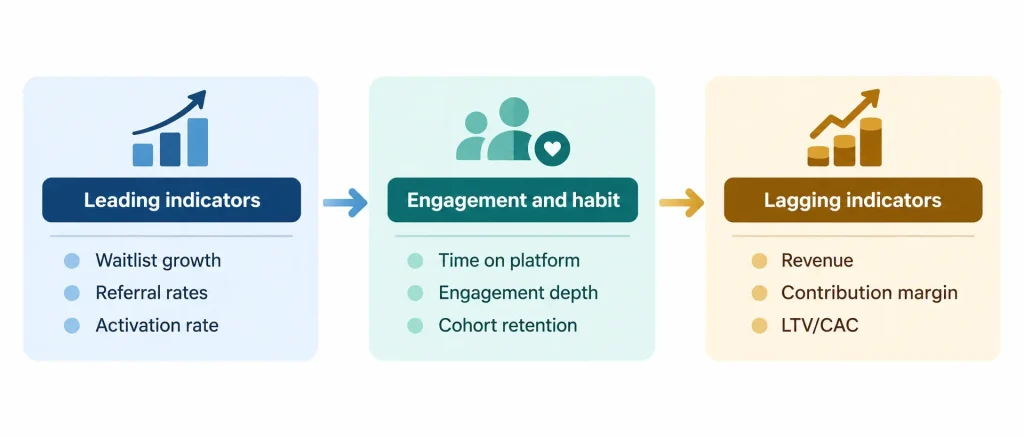
At a professional services firm that scaled from $12M to $63M in eight months, pipeline analytics built from scratch gave leadership early warning on revenue direction. Startups benefit from the same habit, because leading indicators are the early tremors before revenue arrives.
Why Context and Benchmarks Matter
A 20% month-over-month growth rate sounds impressive until investors learn it began from 100 users. Absolute numbers matter, and so do benchmarks for the stage and sector. Traction in a frontier market may look different from traction in a vertical crowded with incumbents. Investors rarely expect scale at seed, but they do expect acceleration.
Organic Growth vs Paid Growth
The source of startup traction tells investors more than its size. Organic usage earned through product quality or community advocacy speaks louder than growth purchased through heavy burn. A high CAC undermines early claims, while users who push through friction to adopt a product signal painkiller-level value.
| Vanity Metric | Meaningful Alternative |
| Gross signups | Activated users who complete a core action |
| Raw installs | Week 4 and week 12 cohort retention |
| One-off usage spikes | Sustained weekly active users |
| Total users acquired | Users acquired at a CAC below LTV |
Consider two startups pitching the same investor in the same week. One reports 10,000 users, yet 9,800 came through paid ads with a CAC that exceeds LTV. The other reports 1,000 organic users with 70% retention across three months, and that second profile earns far more serious interest.
How to Show Traction to Investors: Ten Principles
Strong numbers still need to be legible to outsiders, and investors must believe them as well as see them. The ten principles below cover how to show traction to investors in a way that builds conviction.
- Selection: choose three to five core metrics that reflect stickiness, user delight, and market resonance, and track them consistently.
- Visualization: use growth curves, cohort retention charts, and funnel diagrams that are clean, honest, and labeled with precision.
- Narration: explain what changed in product or GTM strategy, and why a dip happened along with what the team learned.
- Consistency: keep figures aligned across the pitch deck, data room, and every investor conversation.
- Transparency about ceilings: show awareness of saturation points, decay curves, and the levers that can renew momentum.
- Triangulation: pair quantitative data with testimonials, case studies, and NPS.
- Benchmarking: know what strong growth and activation-to-retention ratios look like for the stage and segment.
- Attribution: separate growth from paid, organic, partnership, and viral channels.
- Evolution: show what the last six months taught the team about ICP, pricing, and channel efficiency.
- Forward view: connect current metrics to scalability, LTV/CAC, and margin structure.
Narration and Cause-Effect Thinking
Investors are pattern-recognition machines, and they look for cause and effect. A strong traction narrative connects the dots, such as a statement that activation rose 18% in one cohort after a specific feature launch. That kind of context turns the founder from a data reporter into a market interpreter.
Consistency as a Strategic Asset
Discrepancies between the deck, the data room, and verbal answers trigger doubt quickly. A single source of truth, updated on a regular cadence, prevents that problem and signals operating maturity. At a high-growth cybersecurity SaaS company, a driver-based forecasting engine held actuals within plus or minus five percent of forecast for 8 consecutive quarters. That kind of reliability builds the same trust in a seed-stage data room.
Honesty About Headwinds
Over-polished charts, selective data cuts, and stretched axes signal insecurity to experienced investors. Investors do not expect perfection; they expect clarity. A transparent account of a retention dip, paired with the corrective actions taken, does more for credibility than a slide that pretends it never happened.
Attribution and Repeatability
Knowing what caused growth matters, because attribution determines repeatability. A one-time PR hit differs from a product launch or a new distribution channel. A venture-backed performance marketing company that grew from $9M to $180M in 24 months relied on CAC, LTV, and contribution margin discipline to show which channels could scale. Traction that cannot be replicated cannot be scaled, and investors know it.
Startup Traction as a Capital and Operating System
Startup traction also shapes capital strategy well beyond the pitch itself. A company with clear early traction can raise on better terms, make smarter hires, and negotiate stronger partnerships. Weak or noisy traction, by contrast, forces the founder to rely on narrative alone.
Capital Efficiency as Evidence of Fit
Investors always ask what a team achieved with limited resources. A founder who sustains user growth without heavy burn shows ingenuity and market resonance together. An early-stage email marketing SaaS company that cut monthly burn from $800K to $200K shows how resource discipline sharpens the story investors hear.
Traction as a Feedback Loop
Startup traction works best as a system, not a single outcome. User response shapes the roadmap, positioning, and priorities, and the metrics must mature as the company does.
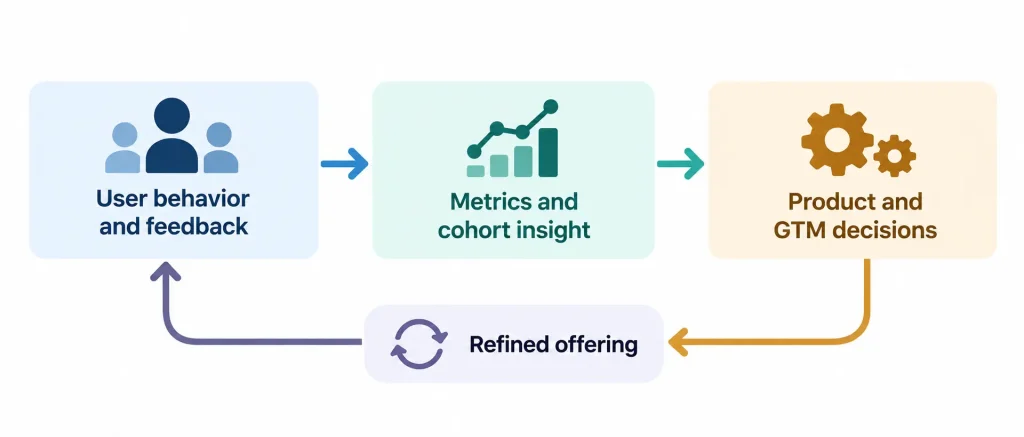
Early on, user count and engagement may be enough. Later, teams need to track monetization, longer retention windows, and contribution margins.
Tailoring Traction for Different Investors
Different investors read startup traction through different lenses. An early-stage investor focuses on product-market fit signals, while a growth investor examines margin scalability. A strategic investor looks for defensibility, so founders should tailor emphasis while keeping a single source of truth.
Aligning the Organization Around Traction
Building traction requires alignment across the company, not just a strong pitch deck. The product team must define engagement, marketing must drive qualified acquisition, and data owners must keep dashboards clean. The CEO then makes that data speak, and strong founders build internal dashboards long before investors request them.
Numbers remain abstractions, so data alone can mislead. Behavioral interviews, customer quotes, and direct observation explain what the metrics only hint at. Traction serves as a mirror and a map, showing where belief is forming and where the venture is moving from theory toward scale.
Three Key Takeaways
- Startup traction is measured by sustained behavior, not signups or one-off spikes. Cohort retention, engagement depth, and organic growth carry far more weight with investors than vanity metrics.
- Learning how to show traction to investors means selecting a few core metrics, explaining cause and effect, and keeping one consistent source of truth. Honest treatment of dips and ceilings builds more credibility than polished charts.
- Traction works as a feedback system that guides product, GTM, and capital strategy. Founders who attribute growth transparently and link it to LTV/CAC and margin structure give investors a trajectory worth underwriting.
Disclaimer: This article is intended for informational purposes only and does not constitute legal, tax, or accounting advice. You should consult your own tax advisor or counsel for advice tailored to your specific situation.
Hindol Datta is a four-time CFO and senior finance executive with over 25 years of leadership experience across cybersecurity, SaaS, gaming, logistics, digital marketing, medical devices, consumer products, and nonprofit organizations. He has led more than $120M in fundraising and over $150M in M&A transactions while building the financial and operational systems that let complex businesses scale with confidence. He is the author of seven books in the Systems CFO Series and holds active CPA, CMA, and CIA credentials.
AI-assisted insights, supplemented by 25 years of finance leadership experience.