
Executive Summary
A startup exit strategy works best as a design principle set at inception, not a plan drafted when a buyer calls. Every dilution decision, investor class, and product choice shapes which exits stay open.
This article shows how finance leaders can build exit optionality into the cap table, the capital stack, and the metric system. It also covers buyer legibility and the ethical weight of exit planning.
Why a Startup Exit Strategy Belongs in the First Term Sheet
The most consequential question in startup finance is the one founders defer the longest: how does this end? Many fear that naming an exit early will cap their ambition. The opposite holds true, because every system, whether biological, mechanical, or corporate, must eventually terminate or transform.
A modern CFO carries the ledger in one hand and an endgame map in the other. That map stays adaptive across several possible paths:
- Strategic acquisition by a larger incumbent
- Private equity buyout or roll-up
- IPO or another public listing route
- Secondary sales to new investors
- Continuation vehicles or perpetual holding structures
Each path implies a different grammar of capital, cadence of growth, and logic of valuation. Mapping an exit strategy does not mean predicting a timeline. It means accepting that optionality decays like an option in a volatile market.
Preserving Optionality Through Exit Planning
A resilient exit strategy requires deliberate design in five areas:
- Capital stack integrity
- Clean IP ownership
- Clear signals in core metrics
- Defensible go-to-market differentiation
- A coherent narrative that a future acquirer can follow
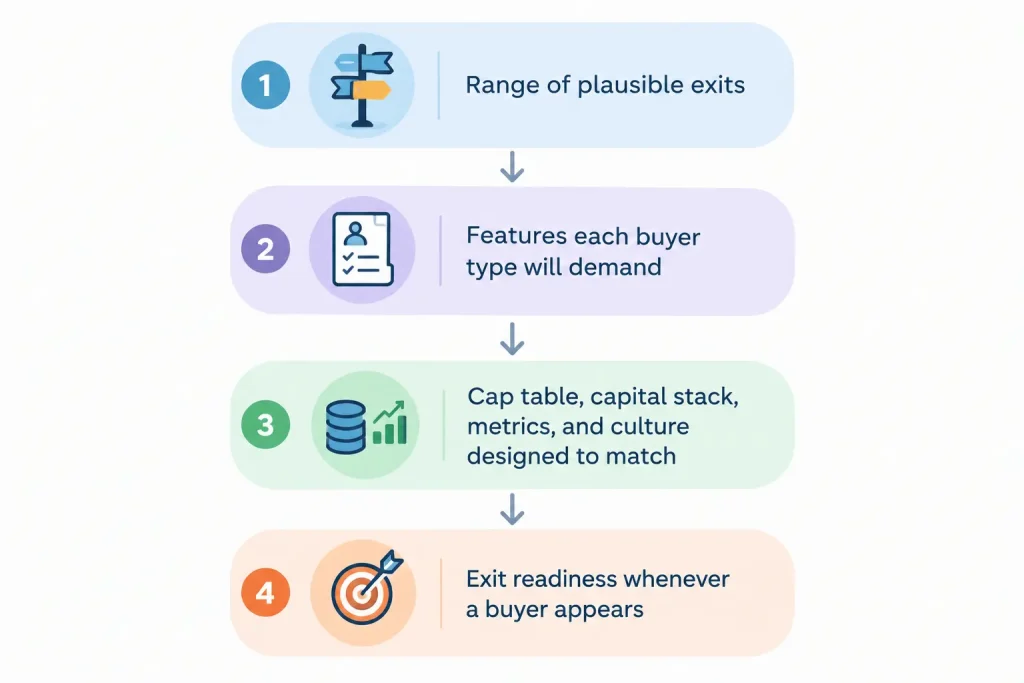
Designing backward from plausible exits lets a company design forward with precision. Teams stop building everything and start building what a buyer, a banker, or a board will value. Exit design also asks who benefits, who drives, and who decides, since waterfall politics can kill a deal that the price alone would support.
Designing Exit Optionality From Inception
Every company will one day exit, whether through a sale, a market failure, a generational transition, or a structural change. Building a venture without an exit architecture is like building a cathedral on sand.
The Early Cap Table as a Strategic Document
Most founders treat the early cap table as paperwork for closing a round. In practice, each name on that register is a latent veto point. Every convertible note, SAFE, and pro rata clause interacts with the timeline, the valuation corridor, and the eventual buyer universe. A seed investor’s liquidation preference can misalign incentives, and a mispriced Series B can force a down round that scares away strategic buyers.
Three Exit Archetypes Worth Modeling From Day One
| Exit Archetype | Typical Route | What It Demands | Design Features |
| Strategic Fit Exit | Acquisition by an incumbent seeking product, talent, or market adjacency | IP clarity, integration readiness, a coherent synergy story | Clean codebase, concentrated talent IP, minimal legal encumbrances |
| Financial Optimization Exit | PE roll-up or secondary sale | Gross margin integrity, cohort stability, repeatable unit economics | Strong revenue operations, CAC discipline, low CAC to LTV variance |
| Public Market Exit | IPO or SPAC | Scale, transparency, credible storytelling | Audit readiness, legible SaaS metrics, defensible growth, institutional governance |
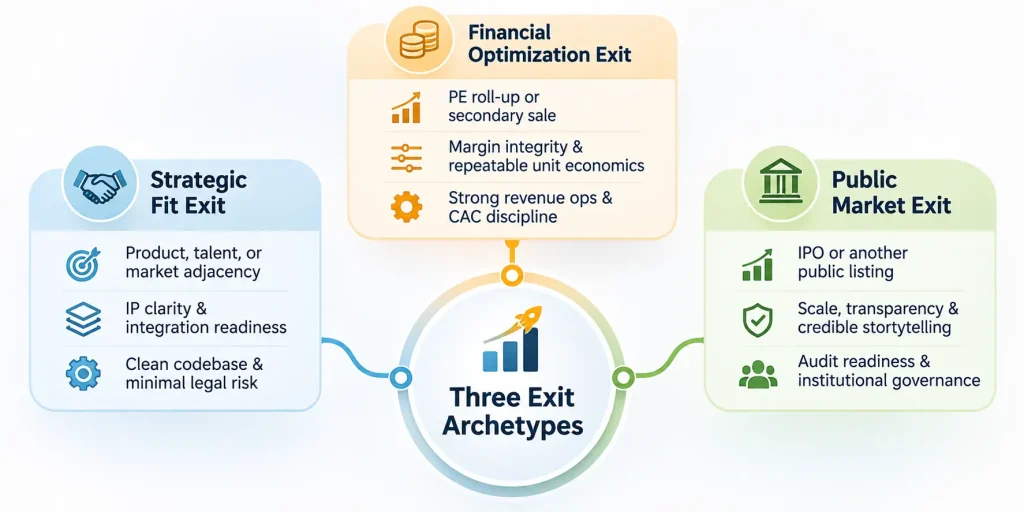
Each archetype rewards a different strategic vector, yet all three punish opacity. If leadership cannot explain in one paragraph how the company exits, the exit strategy needs work.
Metrics, Reversibility, and Culture
Metrics in a startup exit strategy should answer outside questions, such as what a banker needs to underwrite a multiple or what a corporate development team needs to model integration risk.
Operational reversibility matters just as much, because a go-to-market motion that depends on one channel or on founder-led sales leaves blind spots that acquirers will probe.
Culture forms the final layer, since teams that prize independence resist integration, and hypergrowth habits buckle under public market scrutiny. Building a data room before any deal appears forces a coherence that no board deck demands.
Structuring the Capital Stack Around the Exit Strategy
The capital stack encodes power, incentives, control rights, liquidation preferences, and time-sensitive asymmetries. Badly designed, it chokes terminal value, while an elegant stack becomes a bridge to multiple futures.
Why More Capital Is Not Always Better
A high valuation in a euphoric Series B or C can feel like validation. Without matching growth, it acts as a forward-loaded liability that compresses future choices. Warren Buffett’s line about discovering who has been swimming naked when the tide goes out fits here. The liquidity reversals of 2022 and 2023 exposed stacks where investor expectations, founder equity, and buyer reality no longer met.
Four Principles of Exit-Ready Capital Design
- Mirror the exit map: A likely strategic sale calls for simplicity and rapid convertibility, while an IPO path may justify structures that protect growth investors.
- Keep layers clean: Standard 1x non-participating preferred, minimal side letters, and a pre-financing option pool limit leakage of exit value.
- Treat time as a variable: VC funds have lifespans, strategic partners have M&A cycles, and debt covenants trigger at thresholds outside management control.
- Read the cap table as narrative: Reputable investors can unlock strategic exits, while opaque bridge investors can disqualify a company from sponsor-backed deals.
Three questions keep the temporal side of the capital stack visible:
- When does the lead investor need liquidity?
- Which share classes hold blocking rights, and under what conditions?
- Which exits become impossible after one more round?
Finance teams should simulate exit waterfalls at 3 to 5 valuation ranges every quarter. Raising $36.5M across Series A through C at a venture-backed digital marketing company, alongside three acquisitions, shows how fast layers accumulate. Emergency bridge rounds built on uncapped notes add more entropy. A company may spend four years building and only 40 days exiting, so the structure must already support speed.
Exit Readiness: Making the Company Legible to Buyers
Sooner or later, a corporate development lead reaches out or a late-stage investor nudges toward liquidity. The real test at that moment is legibility. Strategic acquirers look for synergy and accretion, private equity looks at EBITDA and debt capacity, and public investors look for a thematic story.
The Three Pillars of Buyer Legibility
| Pillar | What Buyers Test | Habits to Build Early |
| Metric Integrity | Patterns behind CAC, churn, and gross margin | Bottoms-up forecasts, cohort-based retention, granular margin attribution |
| Operational Abstraction | Whether the business can run inside the buyer’s own | Documented processes, distributed decision rights, leading-indicator dashboards |
| Narrative Compression | Whether the story travels without the founder | One-page memos, clear visual frameworks, a data room that earns trust in hours |
Buy-side quality-of-earnings work on an IT services acquisition shows how buyers think. That diligence surfaced material EBITDA adjustments wherever reported earnings diverged from economic reality. Contrast that with a cybersecurity and identity access management company whose forecasts held within five percent of actuals for 8 consecutive quarters. ASC 606 controls and board-grade reporting carried that business through acquisition diligence.
Strategic Signaling and Quiet Readiness
Strategic signaling broadcasts optionality without announcing exit intent. Companies do this by winning the right customer segments, earning coverage in adjacent markets, and hiring talent from likely buyers. Beneath those signals sits a quiet readiness layer:
- GAAP-compliant financials, updated quarterly
- Virtual data room, refreshed annually
- Redlined MSA playbook, vetted by counsel
- Management succession plan, signed and filed
When the buyer taps or the board votes, nobody will have time to build these systems. Leadership will only have time to open the drawer.
Governance, Incentives, and the Ethics of Exit Planning
Exits concentrate power over who decides, who benefits, and who gets left behind. Time, dilution, and accumulated preferences erode incentive alignment. Boards sometimes push for sales that wipe out common shareholders, and unvested employees sometimes leave because nobody explained the mechanics.
The CFO and CEO usually know the offer, the cap table math, and which exits are illusions. Governing that information asymmetry well takes two disciplines:
- No major exit conversation without a full, unredacted waterfall covering every share class
- A plain-language team exit memo explaining cliffs, vesting stages, and tax implications
Consider a founder declining a strategic offer worth $18M personally when holding valuation would require another $60M. Running that math with the board turns an emotional debate into a shared decision. No exit optimizes price, timing, buyer fit, and alignment at once, so the CFO’s job is to harmonize them.
The CFO as Architect of the Endgame
A sound startup exit strategy depends on finance leadership that blends strategist, systems designer, translator, and ethicist. An S-1 and IPO-readiness process at a Euronext Paris-listed gaming company, alongside $100M+ in cross-border M&A, shows how early that work begins. In practice, the role covers five core duties:
- Translate investor capital into narrative signal
- Shape the capital stack into a reversible machine
- Render operations legible to buyers
- Align governance with incentive ethics
- Compress noise into signal, and signal into strategy
No perfect exit exists, only fit exits that reflect coherence between strategy, structure, and time. The best ones feel inevitable because someone designed them from the founding cap table onward.
Three Key Takeaways
- A startup exit strategy starts with the first cap table, so model strategic, financial, and public market archetypes from inception.
- Clean capital layers, standard preferences, and quarterly waterfall simulations protect exit optionality better than the highest available valuation.
- Exit readiness comes from legible metrics, documented operations, and transparent governance built over years, not weeks.
Disclaimer: This article is intended for informational purposes only and does not constitute legal, tax, or accounting advice. You should consult your own tax advisor or counsel for advice tailored to your specific situation.
Hindol Datta is a four-time CFO and senior finance executive with over 25 years of leadership experience across cybersecurity, SaaS, gaming, logistics, digital marketing, medical devices, consumer products, and nonprofit organizations. He has led more than $120M in fundraising and over $150M in M&A transactions while building the financial and operational systems that let complex businesses scale with confidence. He is the author of seven books in the Systems CFO Series and holds active CPA, CMA, and CIA credentials.
AI-assisted insights, supplemented by 25 years of finance leadership experience.