
Executive Summary
A startup business model is more than a plan for monetization; it is the blueprint behind every operational, capital, and strategic decision. In the early stage, sound business model design favors resilience over premature scale. That choice helps the company absorb shocks, adapt under stress, and evolve with feedback.
This article sets out seven design principles for a resilient startup business model and the operating disciplines that keep it intact during growth. It closes with a 14-step framework for building the model from first assumptions to an investor-ready architecture.
Why Business Model Design Should Prioritize Resilience
Resilience does not mean the absence of fragility; it means reducing fragility through deliberate design. A resilient startup business model endures swings in customer demand, capital availability, and strategy. It builds in feedback loops that allow adjustment, redundancy that absorbs shocks, and logic based on real user behavior instead of straight-line projections.
Seven Principles of Resilient Business Model Design
The table below summarizes the core principles of early-stage business model design and what each one protects against.
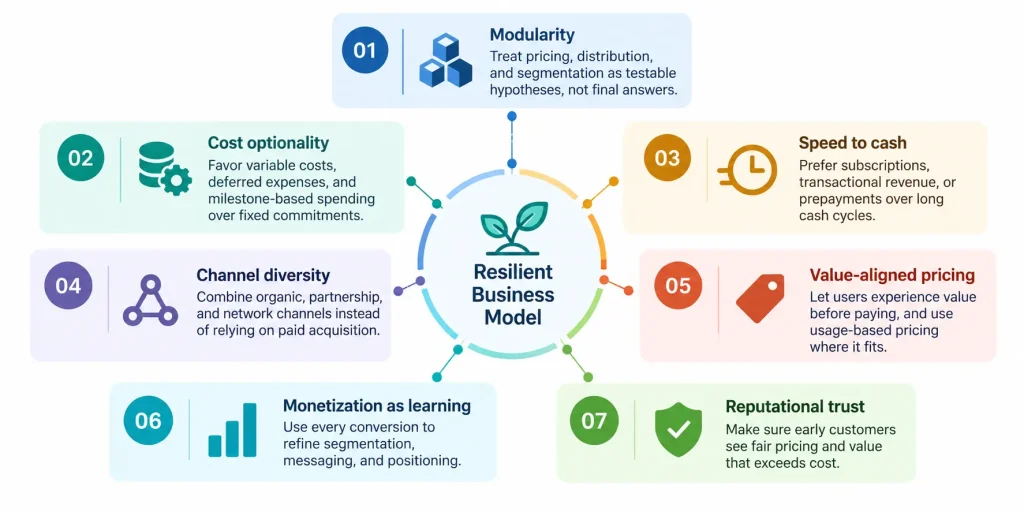
| Principle | What It Means in Practice |
| Modularity | Treat pricing, distribution, and segmentation as testable hypotheses, not final answers |
| Cost optionality | Favor variable costs, deferred expenses, and milestone-based spending over fixed commitments |
| Speed to cash | Prefer subscriptions, transactional revenue, or prepayments over long cash cycles |
| Channel diversity | Combine organic, partnership, and network channels instead of relying on paid acquisition |
| Value-aligned pricing | Let users experience value before paying, and use usage-based pricing where it fits |
| Monetization as learning | Use every conversion to refine segmentation, messaging, and positioning |
| Reputational trust | Make sure early customers see fair pricing and value that exceeds cost |
Cost Optionality and Speed to Cash in Practice
In uncertain periods, fixed costs behave like liabilities, while financial elasticity lets a company modulate burn without stalling momentum. An early-stage email marketing SaaS company cut monthly burn from $800K to $200K through a more flexible cost structure. Freemium and long sales cycles may build long-term value, yet they strain cash in the short term.
Cash at this stage is optionality preserved, not just capital on hand. At a $127M global consumer products company, inventory turns rose from three times to seven times through demand planning and SKU rationalization. That shift released trapped working capital and transformed cash conversion. The lesson applies to any startup business model that carries inventory.
Operationalizing a Startup Business Model Under Growth
The real test of a startup business model is how it performs under growth, feedback, and investor scrutiny. Elegant theory matters far less than execution, and several disciplines keep the model from splintering as the company scales.
Instrumentation and the Cadence of Iteration
Founders should treat the business model as a real-time laboratory. Core metrics include CAC, LTV, payback period, retention cohorts, gross margin trends, and contribution margin. Raw measurement is only the start, because the goal is directional insight into what is improving, what is breaking, and why. Weekly reviews, user feedback loops, and rapid experiments then refine pricing, messaging, and funnel design.
Margins and Channel Efficiency
Investors may tolerate negative unit economics for a short period, but they look for early signs of margin scalability. Gross margin gains from automation, lower churn, or pricing leverage show the business can support future operating costs. At a high-growth cybersecurity SaaS company, pricing discipline, workforce composition, and delivery cost management lifted gross margin by twelve percent. CAC should also stabilize or decline as brand equity, referrals, and content loops mature.
Scaling with Integrity and Simplicity
Many early models fail from fulfillment stress, not weak demand. Operational bottlenecks, customer success load, and fragile infrastructure can erode what looked like strong traction. At a professional services firm with five business units, engagement-level analytics showed where margin was created and where it leaked. Complexity carries a similar risk, since layered pricing and multi-tier funnels confuse users and slow feedback.
Optionality, Capital, and Culture
A resilient model carries the ability to switch tracks when market shocks, regulation, or failed assumptions demand it. New verticals, alternate monetization paths, and product bundles give founders options they can activate quickly. Investors assess downside risk as well as upside. A founder who explains how the model preserves runway improves the odds of better terms. Teams working inside a well-instrumented model also build strategic literacy, and the model becomes shared logic instead of a static plan.
How to Build a Startup Business Model in 14 Steps
Building a startup business model means turning a hypothesis into operational form. The process starts with inquiry, not spreadsheets, by asking what problem the company solves, for whom, and why now. The flow below groups the 14 steps into four phases.
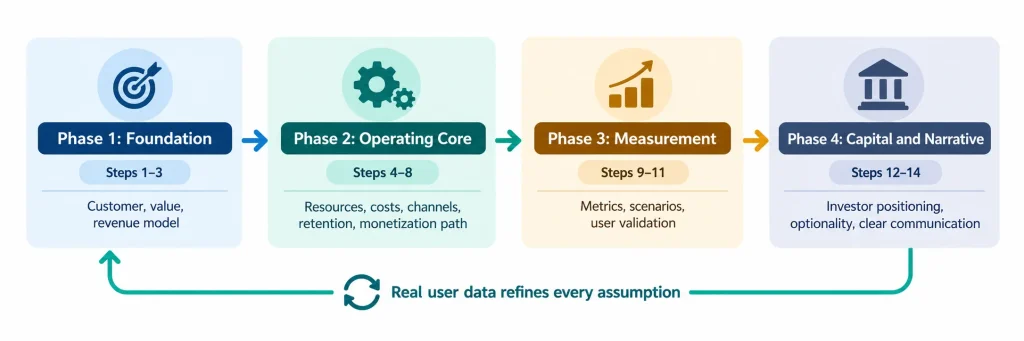
The 14-Step Business Model Design Framework
Each step produces a specific output that feeds the next, as the table below shows.
| Step | Focus | Key Output |
| 1 | Customer segment and pain point | A precise segment with an acute, quantifiable problem |
| 2 | Value proposition mapping | A user-validated reason the solution is better, faster, or cheaper |
| 3 | Revenue model | Pricing that mirrors the rhythm of value creation |
| 4 | Key resources and activities | Critical assets and activities that shape burn and hiring |
| 5 | Cost structure | A clear split of COGS, OPEX, and CAC with built-in flexibility |
| 6 | Distribution channels | Several tested channels with known cost and conversion profiles |
| 7 | Customer relationships | Onboarding, nudges, and account management that drive retention |
| 8 | Monetization path | A clear point at which free or deferred usage converts to revenue |
| 9 | Metrics and instrumentation | A dashboard of MRR or ARR, gross margin, CAC, LTV, churn, and payback |
| 10 | Scenario modeling | Base, upside, and downside cases that calibrate funding and hiring |
| 11 | Validation with real users | Pilots, pricing tests, and behavioral analytics |
| 12 | Capital market positioning | Milestones tied to financial outcomes and margin improvement |
| 13 | Optionality | Escape hatches such as expansion, bundling, licensing, or white-labeling |
| 14 | Clear communication | A model that teams, advisors, and investors can grasp quickly |
Choosing a Revenue Model That Fits Value Delivery
Revenue models must mirror how customers receive value, and they must also suit user psychology. A solution that removes operational friction may fare better on subscription than on per-use pricing, which can add mental load.
- Subscription: suits SaaS and platforms that deliver recurring value.
- Transactional: suits marketplaces and on-demand services.
- Freemium: supports fast user acquisition with a later upsell.
- Licensing or tiered access: suits IP-heavy or regulated offerings.
What Every Founder Should Be Able to Explain
Tools such as the Business Model Canvas or Lean Canvas help organize thinking for teams, advisors, and investors. In any investor conversation, a founder should be able to answer four questions without hesitation.
- Who pays, how much, and how often?
- What does it cost to deliver the value?
- What makes the economics improve over time?
- Which levers can the team pull to improve outcomes?
From Hypothesis to Machine
At the outset, a startup business model runs on qualitative insight, scrappy tools, and conviction. Over time, it becomes data-instrumented, margin-informed, and capital-efficient. At every stage, it remains a living system refined through user response, capital constraints, and operational learning, not inside a spreadsheet alone.
For early-stage founders, the model is both a mirror and a map. It reflects assumptions about how the company creates and captures value, and it guides the path toward resilience, relevance, and repeatability. The real question is not whether the model is right today, but whether it can evolve with the market.
Three Key Takeaways
- Early business model design should favor resilience over premature scale. Modular assumptions, flexible costs, fast cash conversion, and diversified channels give a startup room to absorb shocks and adapt.
- A startup business model proves itself in execution, so founders need tight instrumentation, frequent iteration, and early evidence of margin scalability. Simplicity and operational integrity protect traction as the company grows.
- Building the model in deliberate phases, from customer pain point to investor positioning, turns it into a fundraising asset. Scenario planning and built-in optionality show investors how the model protects runway when markets shift.
Disclaimer: This article is intended for informational purposes only and does not constitute legal, tax, or accounting advice. You should consult your own tax advisor or counsel for advice tailored to your specific situation.
Hindol Datta is a four-time CFO and senior finance executive with over 25 years of leadership experience across cybersecurity, SaaS, gaming, logistics, digital marketing, medical devices, consumer products, and nonprofit organizations. He has led more than $120M in fundraising and over $150M in M&A transactions while building the financial and operational systems that let complex businesses scale with confidence. He is the author of seven books in the Systems CFO Series and holds active CPA, CMA, and CIA credentials.
AI-assisted insights, supplemented by 25 years of finance leadership experience.