
Executive Summary
A product roadmap in a venture-backed startup must serve two audiences at once: the team that builds the product and the investors who fund it. The strongest product roadmap aligns product logic with capital logic, so each build cycle proves something users value and something investors need to see.
This article covers how to anchor a product roadmap to a North Star metric and match it to investor expectations at each funding stage. It also outlines ten principles for presenting the roadmap to investors with honesty, precision, and strategic focus.
Why a Product Roadmap Works as Both Compass and Covenant
In an early-stage company, the product roadmap is more than a sequence of features. It is a wager that the founder sees something others have missed, and that each release will move that vision closer to reality. Because venture capital follows measurable progress, the roadmap must also make sense to investors.
A strong roadmap tells a story about what the team will build and why it matters. It turns the founder’s beliefs about market timing, user psychology, and distribution into a coherent sequence of milestones. In that sense, the roadmap is strategy made legible over time.
Balancing Product Logic and Capital Logic
Every product roadmap carries two kinds of weight. Product logic asks what needs to exist for users to gain outsized value. Capital logic asks what the company must demonstrate to secure its next round of funding. The craft of roadmap planning lies in aligning both without compromising either one.
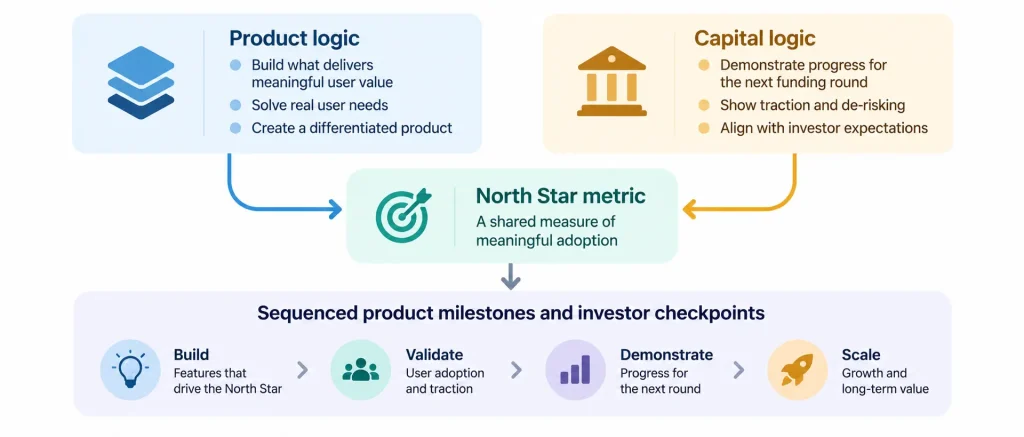
At a pre-Series A AI governance platform, the operating model, resource allocation framework, and investor narrative were built together from a blank page. That approach kept product milestones and the capital strategy speaking the same language during investor conversations.
Anchoring the Roadmap to a North Star Metric
Startups should begin by defining a North Star, a single metric that signals true adoption. Daily usage, expansion revenue, and network density are common examples. This metric shapes what gets built and in what order, and the earliest features should converge on proving that the North Star is reachable. Every quarter, sprint, and engineering decision then becomes a step toward it.
Aligning the Product Roadmap with Investor Expectations by Stage
A North Star alone does not satisfy investors, because each funding round carries an unspoken covenant of progress. A founder who plans without that covenant in mind may build a fine product yet struggle to raise the next round.
| Funding Stage | What Investors Expect | Roadmap Focus |
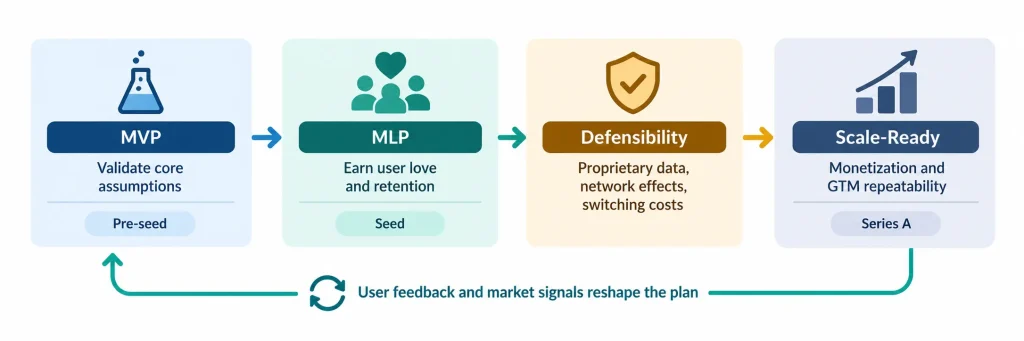
| Pre-seed | Experimentation and a compelling narrative | Test core assumptions quickly and cheaply |
| Seed | Early signal and user insight | Prove the North Star is reachable |
| Series A | Repeatability and early economic efficiency | Build monetization, GTM motion, and scalable infrastructure |
Roadmap Harmonization and Three Core Questions
Roadmap harmonization means aligning product sequencing with the checkpoints investors use to judge progress. A harmonized product roadmap answers three questions at the same time.
- What will prove product-market fit?
- What will unlock monetization or scale?
- What will satisfy the next investor checkpoint?
This approach is choreography, not compromise, and a well-planned roadmap sequences learning, delivery, and demonstration in deliberate layers instead of building everything at once.
Building in Layers from MVP to Moat
The layered approach moves from a minimum viable product to a minimum lovable product, and then toward defensibility. Each layer mirrors both product maturity and capital maturity, and each one hands off to the next funding conversation.
Planning for Flexibility
Every product hypothesis is conditional, so the product roadmap must leave room for change. Founders should budget for what they know they will build and for what user feedback may require later. Investors respect that honesty, provided the logic behind each adjustment is sound.
How to Present a Product Roadmap to Investors
Once the plan is in place, the next task is presenting it with narrative fidelity. The goal is to preserve strategic integrity while meeting the investor’s appetite for progress, momentum, and defensibility. The ten principles below guide a presentation that investors can trust.
- Transparency: acknowledge ambiguity and show the method for managing it.
- Triangulation: tie each feature to a metric and a strategic outcome.
- Timing realism: include buffer time for iteration and failure.
- Capital alignment: flag the milestones that support the next raise.
- Trade-off articulation: explain what the team will not build and why.
- Defensibility sequencing: move from MVP toward a durable moat.
- User empathy: justify releases with behavioral data and customer interviews.
- Internal coherence: align engineering, sales, marketing, and support.
- Feedback orientation: show how user feedback flows into roadmap updates.
- Inspiration: frame the roadmap as a promise to the team, customers, and market.
Transparency and Timing Realism
A product roadmap that hides complexity or overstates certainty erodes investor trust. The best presentations say, in effect, here is what we know, here is what we are testing, and here is how the results will shape direction. A line such as “we are testing two user flows and will select based on retention” builds more trust than a promise of certainty.
Investors can tell the difference between ambition and delusion. Missed milestones are survivable when the underlying learning is strong, but repeated over-promising weakens the whole narrative.
Tying Features to Measurable Outcomes
Dates and feature names alone do not persuade investors. They want the causal logic behind each item, including the problem it solves, the metric it shifts, and the milestone it prepares. A roadmap entry such as “Q2: launch onboarding redesign to lift activation from 22% to 40%” shows a data-literate founder who treats product work as hypothesis-driven learning.
During a $20M Series B for a marketplace SaaS platform, cohort and unit economics models anchored investor diligence. Roadmap items tied to those same metrics carry far more weight than features listed in isolation.
Trade-Offs and Capital Milestones
A product roadmap that includes everything signals a lack of prioritization. Investors prefer a plan that says no as often as yes, and a clear explanation of why one feature was delayed for another shows strategic discipline.
Founders should also highlight which milestones line up with upcoming fundraising. Launching a monetization layer, hitting DAU or MRR targets, or proving infrastructure scalability can all serve as narrative handoffs between rounds. If Series A investors expect revenue activation, the roadmap should include the infrastructure, GTM motion, and feedback loops needed to reach it.
Defensibility, User Empathy, and Cross-Functional Coherence
Early features test usage, while later features must fortify position through proprietary data, network effects, and switching costs. A roadmap grounded in customer interviews, usage telemetry, and pain-point diagnostics gains credibility because behavioral insight supports each decision.
The product roadmap must also hold together across functions. A roadmap that promises product readiness without preparing GTM or customer success is only half a plan. At a high-growth cybersecurity SaaS company, a capacity model built alongside the forecasting engine linked delivery plans to staffing and revenue. That link kept actuals within plus or minus five percent of forecast for 8 consecutive quarters.
The Product Roadmap as Mirror, Magnet, and Map
A product roadmap works in three dimensions that reinforce one another. As a mirror, it reflects what the team has learned. As a magnet, it attracts capital and talent, and as a map, it guides execution across functions. A roadmap is not a Gantt chart; it is a narrative spine around which focus, investor conviction, and sequencing cohere.
An HR technology venture built from conception to launch shows why this matters. Roadmap prioritization, technology selection, and go-to-market planning had to move together, because a gap in any one of them stalled the others.
A Practical Checklist for Roadmap Planning
The checklist below turns these ideas into working habits for founders and finance leaders.
- Start with the North Star metric and sequence features around it.
- Anticipate the validation each funding round requires.
- Build in layers from MVP to MLP to defensibility.
- Attach goals to features and features to investor-relevant outcomes.
- Show what the team is building and what it is not.
- Present the roadmap as a feedback loop that adapts to signals.
- Bridge funding rounds with visible milestones.
- Admit assumptions, articulate risks, and reveal methodology.
Investor attention is fragmented and patience is limited, so the product roadmap should not be a static PDF. It works best as a living document of intent, a strategic ledger between those who build and those who back the build.
Three Key Takeaways
- A strong product roadmap aligns product logic with capital logic, anchored to a single North Star metric. Each build cycle should prove user value and meet the checkpoint the next investor will use.
- Investors respond to roadmaps that tie features to measurable outcomes, show honest trade-offs, and leave room for iteration. Over-promising erodes trust faster than a missed milestone backed by strong learning.
- The roadmap should move in layers from MVP to MLP to defensibility, with milestones that bridge funding rounds. Treated as a living document, it becomes a tool of shared understanding between founders and investors.
Disclaimer: This article is intended for informational purposes only and does not constitute legal, tax, or accounting advice. You should consult your own tax advisor or counsel for advice tailored to your specific situation.
Hindol Datta is a four-time CFO and senior finance executive with over 25 years of leadership experience across cybersecurity, SaaS, gaming, logistics, digital marketing, medical devices, consumer products, and nonprofit organizations. He has led more than $120M in fundraising and over $150M in M&A transactions while building the financial and operational systems that let complex businesses scale with confidence. He is the author of seven books in the Systems CFO Series and holds active CPA, CMA, and CIA credentials.
AI-assisted insights, supplemented by 25 years of finance leadership experience.