
Executive Summary
Product-market fit is spoken of with more reverence, and more ambiguity, than almost any other milestone in a startup’s life. It is often described as the moment a company moves from struggle to scale. Yet for a concept so widely invoked, it remains loosely defined and shaped more by folklore than by precision.
This article treats product-market fit as a gradient, not a binary state. The first half examines how to read its signals and spot its illusions. The second half covers the strategic work of startup validation, from segmentation and pricing to culture, timing and the hard decision to pivot.
What Product-Market Fit Means and Why It Is Not Binary
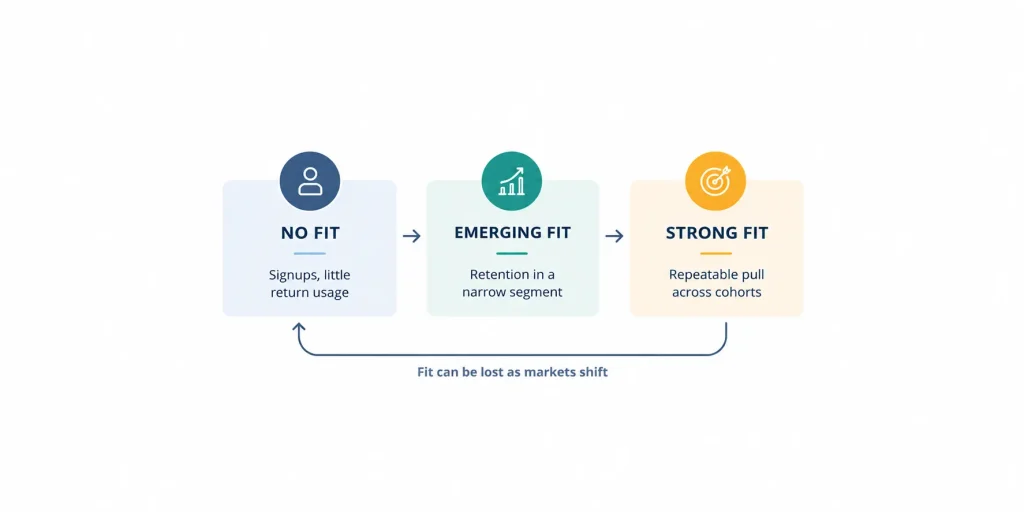
Product-market fit is not a light switch or a single moment of revelation. It is a spectrum of alignment between what a product does and what a market segment demonstrably wants. That alignment must hold at a price and velocity that support sustainable growth.
Marc Andreessen popularized the term as a dynamic equilibrium, not a ceremonial badge. It signals that the core value proposition resonates in the real market, not only in a pitch deck. The real market, however, is noisy and full of competing signals. Early adopter enthusiasm competes with broad indifference, and founder conviction competes with customer churn.
The Product-Market Fit Spectrum
Reading Product-Market Fit Signals Through Retention
A naive founder assumes fit arrives when users sign up, while a seasoned founder waits to see whether they stay. Retention, not registration, is the first real test of startup validation. A few behavioral questions offer more fidelity than any vanity metric:
- Do customers return without being prompted?
- Does their usage grow over time?
- Do they embed the product in core workflows, or only experiment at the edges?
Net Promoter Scores, churn rates, time-to-value and cohort lifetime value all matter. Even so, each can mislead when read out of context. A high NPS in a niche segment may show early traction without proving fit that generalizes. A low churn rate may hide a product kept through inertia, not enthusiasm.
Cohort analysis is where these signals become credible. A marketplace SaaS company raising a $20M Series B found that cohort and unit economics models, not headline growth, anchored investor diligence. Investors trusted the behavior of each cohort more than any single aggregate number.
Product-Market Fit Signal vs Mirage
| Indicator | Real Signal | Possible Mirage |
| Signups | Followed by repeat usage | Spikes after a launch or promotion |
| NPS | High across several segments | High only in a small niche |
| Churn | Low because users get value | Low because switching is hard |
| Revenue | Paid usage that expands | Free adoption with no pricing test |
| Growth | Referrals and organic pull | Paid acquisition or growth hacks |
Product-Market Fit Is Temporal, Not Permanent
Fit can be gained, and it can be lost. Markets evolve, competitors emerge and user expectations shift. A founder who mistakes temporary resonance for permanent alignment risks building around yesterday’s needs. For that reason, product-market fit should be treated as a living hypothesis that requires ongoing validation.
A useful image is a tuning fork striking a note in the market. When the two align, the sound amplifies, and when they do not, only dissonance follows. That resonance often begins faintly and grows louder with each iteration, feedback loop and behavioral confirmation.
Filtering Feedback and Qualitative Indicators
Feedback works as the founder’s stethoscope, but it must be filtered. Enthusiastic early users may be outliers, and negative feedback may stem from poor onboarding, not from a lack of value. The founder’s task is to separate feature-level dissatisfaction from value-level rejection.
Qualitative indicators matter as much as quantitative ones. Strong signs that go beyond the spreadsheet include customers who:
- Describe the value proposition back to the team without prompting
- Recommend the product without any incentive
- Ask about the roadmap, which signals commitment to the product’s future
The Psychology of Declaring Fit Too Early
The greatest obstacle to identifying product-market fit is often psychological. Founders are optimists by necessity, and they see momentum in every signup and every click. The discipline required is epistemic humility, which means updating beliefs when the market speaks. Declaring fit too early hardens assumptions and blinds the organization to necessary change.
When fit is real, organizational behavior shifts in visible ways. Sales cycles shorten, marketing spend becomes more efficient and referrals increase. Internal debates move from what to build toward how to meet demand. Investors, likewise, move from probing questions to capital commitments.
The mirage persists anyway, as some startups raise on the illusion of fit, carried by charismatic storytelling and inflated metrics. Warren Buffett’s line applies here, since only when the tide goes out do you discover who has been swimming naked. Illusory fit shows up not in headlines but in the P&L. An early-stage email marketing technology company that later had to cut monthly burn from $800K to $200K shows the cost of scaling spend ahead of proven demand.
The Strategic Pursuit of Product-Market Fit
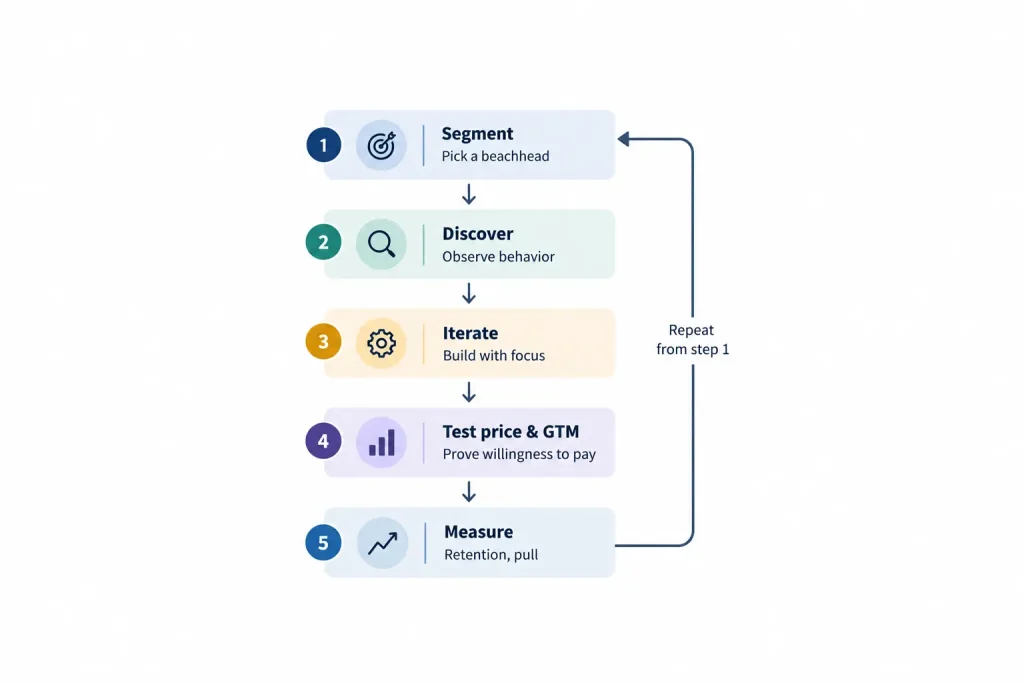
Achieving product-market fit is not a matter of waiting for resonance. It is a deliberate sequence of iteration, customer discovery and organizational alignment.
The Startup Validation Loop
Segmentation and the Beachhead Market
Fit does not occur in aggregate, because it emerges within specific customer cohorts. Founders should resist appealing to everyone and instead find the smallest viable audience that gains transformative value. This beachhead market is a narrow segment with acute problems, frequent usage and enthusiasm that creates narrative gravity.
Segmentation is a sequence, not a static exercise. Early adopters help test hypotheses, refine positioning and prepare for adjacent markets. A common failure is to overgeneralize from early success, assuming that what worked for digitally native startups will translate to legacy enterprises.
Customer Discovery as a Recurring Function
Customer discovery should continue well past launch as a standing discipline. Founders must understand users’ workflows, incentives, constraints and language. The better question is not what users want but what they do, and why. Real insight comes from observing behavior, not collecting opinions.
Product Iteration and Prioritization
Iteration turns discovery into fit, but it must be strategic, not reactive. Feature bloat is not evidence of listening and often reflects indecision. The strongest products tend to be opinionated, solving one problem well before expanding scope.
Frameworks such as RICE scoring, customer impact matrices and behavioral analytics can guide these choices. Frameworks alone will not deliver fit, though, because judgment still decides timing, momentum and when to pivot or persist. Building an HR technology venture from concept through launch shows how many of these calls depend on judgment, from product design to technology selection.
Pricing and Go-to-Market Strategy
Mispriced products distort fit, because a free product may show false adoption while one priced too high may never get tested. Pricing should be treated as a hypothesis, since willingness to pay, not just willingness to use, defines true fit.
Go-to-market strategy is another axis, because channels shape perception. A product that thrives in self-serve may fail in a sales-led motion, and the reverse holds too. A venture-backed digital marketing company that scaled from $9M to $180M in revenue relied on CAC, lifetime value and contribution margin discipline to confirm which channels created durable demand.
Organizational Readiness, Board Dynamics and Culture
Teams chasing fit often swing between chaos and clarity. The founder’s role is to hold the center, absorbing uncertainty while creating urgency. Transparent metrics, fast feedback loops and aligned priorities create the conditions for fit to emerge.
Board dynamics can also shape the path when investors eager for early scale distort focus. Founders must explain that pre-fit is a season for exploration, not exploitation. Culture is the final and often invisible variable. A culture that tolerates failure, values evidence over ego and prioritizes user outcomes is more likely to find fit.
Market Timing and Knowing When to Pivot
The market must be ready, yet many startups build excellent products for markets that do not yet feel the pain. Founders should watch for inflection points such as regulatory shifts, platform transitions and generational change. Timing cannot be controlled, but it can be anticipated.
Some founders never find fit and feel tempted to persist indefinitely. When the market repeatedly rejects a product for lack of need, not lack of effort, radical change deserves consideration. That choice is not surrender but a strategic reallocation of finite time.
Conclusion: Product-Market Fit as Disciplined Exploration
The pursuit of product-market fit is one of the most creative acts in entrepreneurship. It requires listening deeply, adapting quickly, believing fiercely and updating humbly. Investors, teams and early customers all join the climb, offering perspective and momentum. The founder still carries the map and must redraw it as the terrain shifts. Fit is earned through disciplined exploration, strategic patience and empathy, and startups that earn it find not just fit but force.
Three Key Takeaways
- Product-market fit is a repeating pattern of pull, not a one-time milestone, so founders should keep validating it through retention, cohort behavior and willingness to pay.
- Startup validation works best inside a narrow beachhead segment, where focused discovery, opinionated iteration and tested pricing reveal fit before broad expansion.
- Declaring fit too early is a costly mistake, because scaling spend ahead of proven demand shows up quickly in burn, churn and the P&L.
Disclaimer: This article is intended for informational purposes only and does not constitute legal, tax, or accounting advice. You should consult your own tax advisor or counsel for advice tailored to your specific situation.
Hindol Datta is a four-time CFO and senior finance executive with over 25 years of leadership experience across cybersecurity, SaaS, gaming, logistics, digital marketing, medical devices, consumer products, and nonprofit organizations. He has led more than $120M in fundraising and over $150M in M&A transactions while building the financial and operational systems that let complex businesses scale with confidence. He is the author of seven books in the Systems CFO Series and holds active CPA, CMA, and CIA credentials.
AI-assisted insights, supplemented by 25 years of finance leadership experience.