
Executive Summary
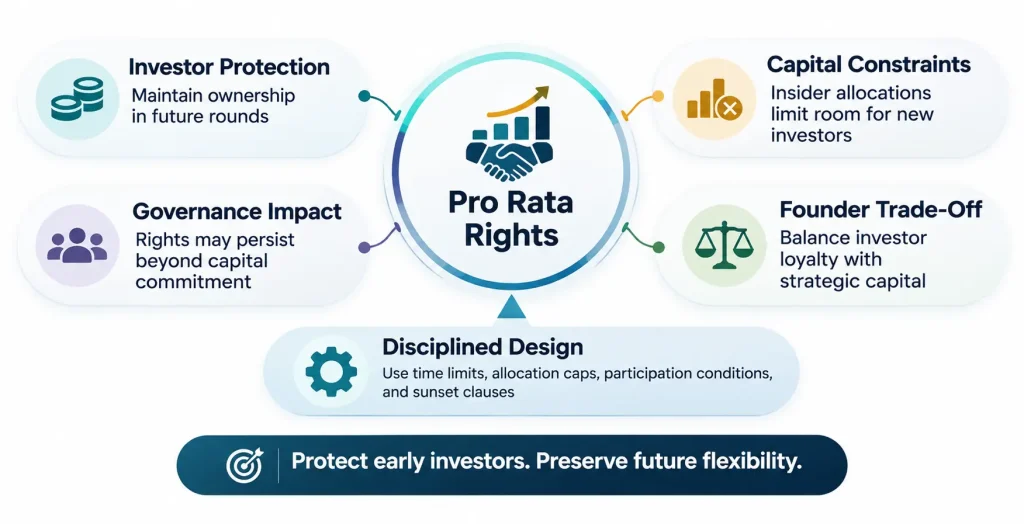
Pro rata rights let existing investors keep their ownership percentage in future rounds, and they tend to pass through term sheet negotiations with almost no debate. Yet these rights shape round composition, governance, and exit waterfalls for years after the original handshake.
This article explains what pro rata rights are, the assumptions they carry, and how they accumulate power across funding cycles. It also sets out the trade-offs founders face and a practical design toolkit for granting these rights with discipline.
What Are Pro Rata Rights?
Pro rata rights give an investor the option, but not the obligation, to maintain their ownership percentage in later equity financings. An investor who owns 10% before a $20M round would invest $2M to hold that 10% afterward. The clause usually sits near the back of the term sheet, typically limited to “major investors” above a set check size.
Supporters make a sound case for these rights, since they reward early risk, signal conviction, simplify syndication, and let a fund protect its best bets. The trouble lies in what the clause quietly pre-empts, since every dollar reserved for pro rata cannot go to a new partner or strategic lead.
The Hidden Costs of Pro Rata Rights
- Round composition tightens, leaving less space for strategic or value-add investors
- New leads hesitate when they fear crowding in their own rounds
- Investors exercise rights by reflex even when fund math no longer supports the check
- Governance asymmetry appears when rights persist after conviction fades
- Founders end up in a three-way negotiation between insider loyalty and future alignment
A $50M Series C with a $10M insider pro rata block shows the stakes. The founder must manage political sequencing as much as capital allocation.
Five Silent Assumptions Behind Pro Rata Rights
Each pro rata clause carries assumptions that few founders examine at signing. The table below sets them out alongside their real-world costs.
Assumptions and Their Hidden Costs
| Assumption | What the Clause Presumes | What Happens in Practice |
| Permanent Relationship | Today’s investor stays engaged in every future round | Partners leave and strategies shift, yet the right survives the change |
| Available Capital | The investor can and will write the check | Finite reserves still block rounds through allocation friction |
| Constant Trajectory | The company keeps moving up and to the right | In a downturn, insiders may sit out and return later with influence intact |
| Equal Participation | Insiders invest on the same footing as the lead | Pro rata works like a zero-premium call option, entered after the lead prices the round |
| Ownership as the Goal | Protecting a stake equals protecting returns | Protection costs rise faster than returns, starving the rest of the portfolio |
Allocation friction shows up fast in practice: if a new lead wants 70% of a round and insiders hold rights to 40%, the math fails and the raise drags. Pro rata without responsibility becomes governance without capital, and that gap erodes trust.
How Pro Rata Rights Reshape Cap Tables Over Time
Power in private markets works through path dependency instead of declaration. These clauses rarely assert themselves at signing, but they build influence across every funding cycle.
The Compounding Effect
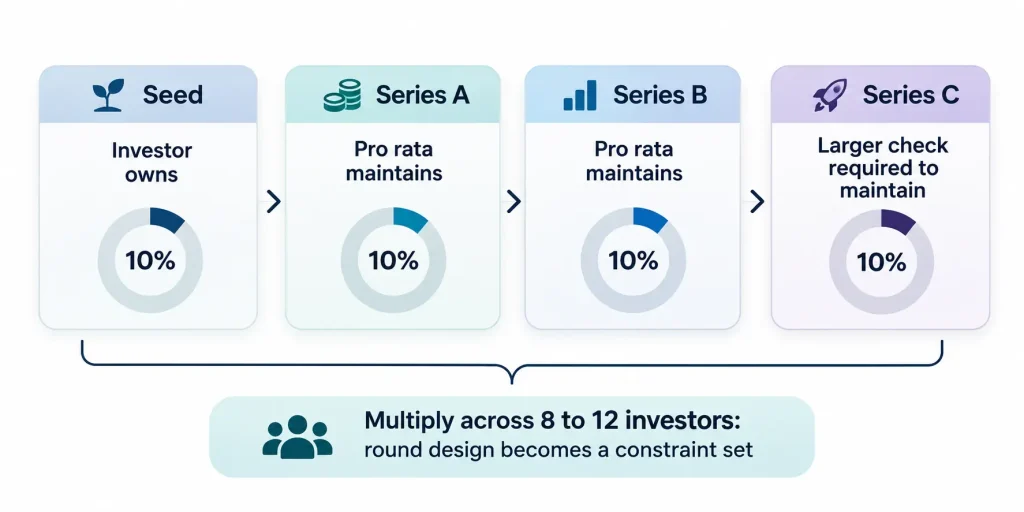
Pro rata rights do not dilute over time but accumulate, so by Series C new investors must negotiate around legacy allocation, and founders have little room left for strategic capital.
Systemic Effects on Syndicates and Governance
- Syndicate inertia: A growth fund may decline to lead when insiders claim 40% to 60% of the round, because it cannot build a position worth the underwriting effort.
- Voice without skin: A seed fund that skips Series B and C may still hold a board seat with only 4% ownership, decoupling influence from risk.
- Narrative noise: A cap table full of small 2% to 4% holders can look fragmented to bankers and buyers.
- Waterfall compression: Repeated preferred layers thicken the stack and squeeze common equity at exit.
Clean ownership matters when outsiders read the company. An S-1 and IPO-readiness process at a Euronext Paris-listed gaming company required consolidated reporting across five countries that underwriters and Big Four auditors could follow. A fragmented, rights-heavy cap table makes that kind of scrutiny harder.
Trade-Offs Founders Face With Pro Rata Rights
At Series B and beyond, founders often treat fundraising as a strategic reset. Prior pro rata rights can consume 20% to 40% of a round before new capital even enters the room.
Flexibility Versus Obligation
Founders who want a growth fund with global reach have three uncomfortable options:
- Refuse the insider and risk fracturing the boardroom
- Accept the insider and dilute the influence of new strategic capital
- Push back and accept delay, conflict, or misalignment
In theory founders control each round, yet rights once granted behave like obligations once exercised.
The Signaling Paradox and Selective Enforcement
Limiting insider participation can send the exact signal founders fear. Even with private agreement from insiders, their absence from an announcement can spark weeks of questions. Founders should pre-wire the board and explain the rationale as strategic context, not apology.
Selective enforcement carries political cost, since honoring some rights and not others breeds resentment. Two practical remedies keep the syndicate coherent and fair:
- All-or-nothing enforcement, where every holder receives the same treatment
- A side pool or secondary carve-out that offers liquidity or future allocation in exchange for a current concession
Fairness Versus Optimization
Founders feel a duty to early believers, and that gratitude is real. Fairness must still compete with the founder’s duty to secure the most catalytic capital for the team, customers, and mission. Turning away capital that would reach $100M ARR faster, simply to honor seed rights, is sentiment, not stewardship.
Raising $36.5M across three rounds at a venture-backed digital marketing company shows how fast these choices pile up. Each round brings a fresh balance between loyalty to existing investors and room for new ones.
Designing Pro Rata Rights With Discipline
Capital, once welcomed, rarely leaves without friction, and a right that outlives its rationale becomes a liability. The remedy lies in design, not ideology. A well-run company makes room for the right investors at the right time, without letting inertia pass for alignment.
A Practical Toolkit for Pro Rata Rights
| Design Lever | How It Works | Why It Helps |
| Time Limits | Rights last for one or two rounds, not in perpetuity | Rewards belief without a legacy of constraint |
| Allocation Caps | Total pro rata capped at 50% of any future round | Leaves real room for a new lead |
| Participation Conditions | Skipping a round, or two, forfeits future rights | Ties rights to engagement instead of history |
| Sunset Clauses | Rights or board seats scale back at dilution or time thresholds | Realigns control with capital at risk |
| Clear Communication | Founders set expectations that participation follows value | Treats the clause as an expectation contract |
Staffing finance and audit committees for a mission-driven education and research institution, while raising $37M in equity and venture debt, reinforced a broader lesson. Boards work best when every stakeholder understands the rules before money moves. A $20M Series B at a marketplace SaaS company drew on the same principle, with cohort and unit economics models giving every investor a shared factual base.
Clarity is the highest form of respect between founders and investors. Investors who pass on a follow-on should not expect their place held in stasis, since capital, like trust, needs renewal, not presumption.
Rights as Instruments of Alignment
Pro rata rights are pre-allocations of future control, not courtesies. The right questions are to whom, for how long, under what conditions, and in service of which future. Treated as a design variable, the clause can harmonize conviction across rounds. Treated as boilerplate, it becomes a quiet saboteur of speed.
The best investors know when to stay and when to yield. They understand that helping the company grow cleanly matters more than defending a slice of it.
Three Key Takeaways
- Pro rata rights let investors maintain ownership in future rounds, yet they also pre-commit round allocation, governance influence, and exit economics.
- Unchecked rights compound across rounds, crowding out new leads, decoupling voice from capital, and compressing common equity at exit.
- Time limits, allocation caps, participation conditions, and sunset clauses let founders honor early believers while keeping room for catalytic capital.
Disclaimer: This article is intended for informational purposes only and does not constitute legal, tax, or accounting advice. You should consult your own tax advisor or counsel for advice tailored to your specific situation.
Hindol Datta is a four-time CFO and senior finance executive with over 25 years of leadership experience across cybersecurity, SaaS, gaming, logistics, digital marketing, medical devices, consumer products, and nonprofit organizations. He has led more than $120M in fundraising and over $150M in M&A transactions while building the financial and operational systems that let complex businesses scale with confidence. He is the author of seven books in the Systems CFO Series and holds active CPA, CMA, and CIA credentials.
AI-assisted insights, supplemented by 25 years of finance leadership experience.