
Executive Summary
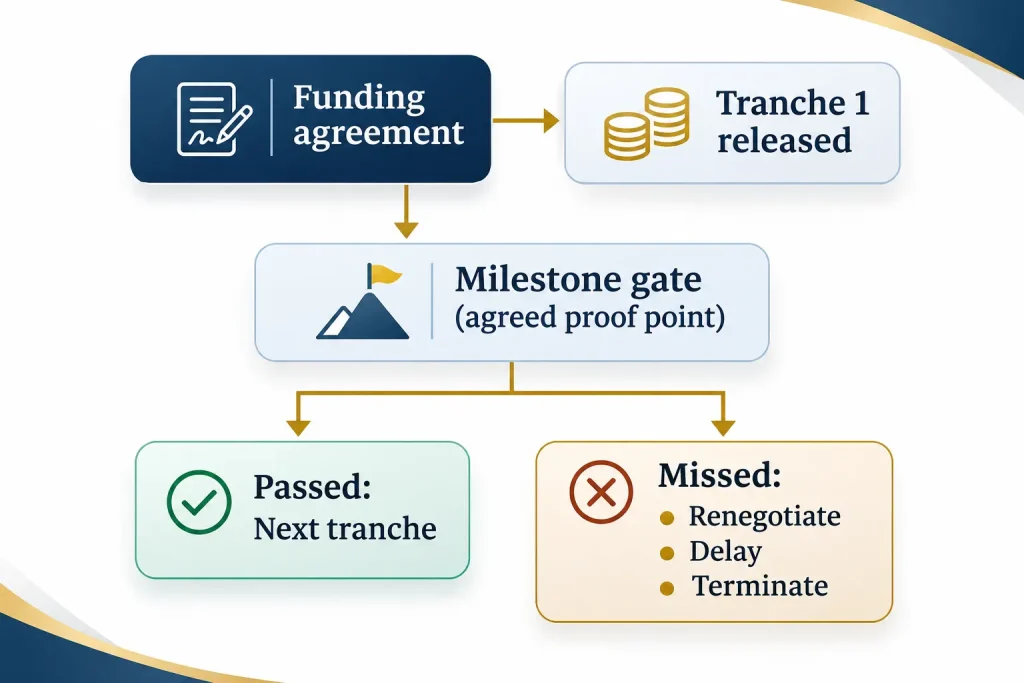
Milestone funding releases capital in stages, with each tranche tied to a proof point such as a prototype, a beta launch, or first revenue. Founders preserve equity and sharpen focus, while investors gain measured exposure and the right to reassess at every gate.
This article explains where the model fits, how to negotiate milestones before signing, and how to manage the conversation when targets slip.
How Milestone Funding Works in Product Development
A lump-sum venture round delivers capital on trust, whereas milestone funding pairs that trust with verification. Capital flows as the company clears pre-agreed technical, commercial, or operational gates. Given the uncertainty in product development, this calibration serves both sides.
Aligning Incentives Through Investment Tranches
A traditional round hands a startup 18 to 24 months of runway regardless of short-term performance. That flexibility can breed complacency, while tranches keep founders executing sharply and let investors reassess commitment as evidence arrives.
Example Tranche Structure for a $2M Seed Round
| Tranche | Amount | Release Trigger |
| 1 | $500K | Signing, for preparation and team buildout |
| 2 | $700K | MVP completion and internal testing |
| 3 | $800K | User beta completed with agreed engagement KPIs |
Under this structure, capital follows traction instead of the calendar, and each release confirms that earlier dollars bought real progress.
De-Risking the Development Arc
Every product journey faces four primary risks, and milestone funding demands evidence on each before more capital moves.
Four Product Development Risks and the Milestones That Test Them
| Risk | Core Question | Milestone That Tests It |
| Technical | Can it be built? | MVP readiness |
| Market | Will users adopt it? | Beta feedback and engagement |
| Execution | Can the team deliver? | On-time progress through each gate |
| Capital | Will funding sustain the pace? | Tranche sizing matched to burn |
Investors avoid front-loading risk, and founders earn leverage by demonstrating competence. The structure also prevents premature scaling, such as building a sales team before product-market fit.
Capital Efficiency, Signaling, and Valuation Layering
Founders must budget for milestone achievement, not cash burn alone, which speeds decisions and cuts waste. An early-stage email marketing technology company that cut monthly burn from $800K to $200K showed how much spending hides in time-based budgets. Future investors read milestone funding discipline as a sign of progress over promise.
Investors gain downside protection and optionality, pausing when early gates slip and doubling down when results exceed plan. Milestone funding also enables valuation layering, where each tranche carries a price set against observed progress. Founders avoid unnecessary dilution, and investors pay for verified potential.
Where Milestone-Based Funding Fits Best
Biotech has used this model for decades, releasing capital at Phase I initiation, FDA clearance, and proven efficacy. Deep tech ventures with long, capital-intensive gestation also benefit from staging. Fintech and healthtech companies gain natural checkpoints from regulatory and compliance work. Accelerators and venture studios now fund team formation first and tie follow-on capital to traction.
Common Pitfalls of Tranche Funding
- Poorly defined milestones create ambiguity about whether a gate was passed.
- Overly aggressive targets set the startup up to fail.
- Different interpretations of success can fracture the founder-investor relationship.
- Rigid gating can discourage a necessary pivot when new insight arrives.
- Funding uncertainty pulls founder time away from building and can drift into micromanagement.
At its core, milestone funding reflects a belief in earned progress, where teams build, test, and validate before more capital arrives. Startups rarely fail from a lack of capital alone; misalignment between product and need, or between pace and burn, does more damage.
Designing Milestones That Hold Up Under Scrutiny
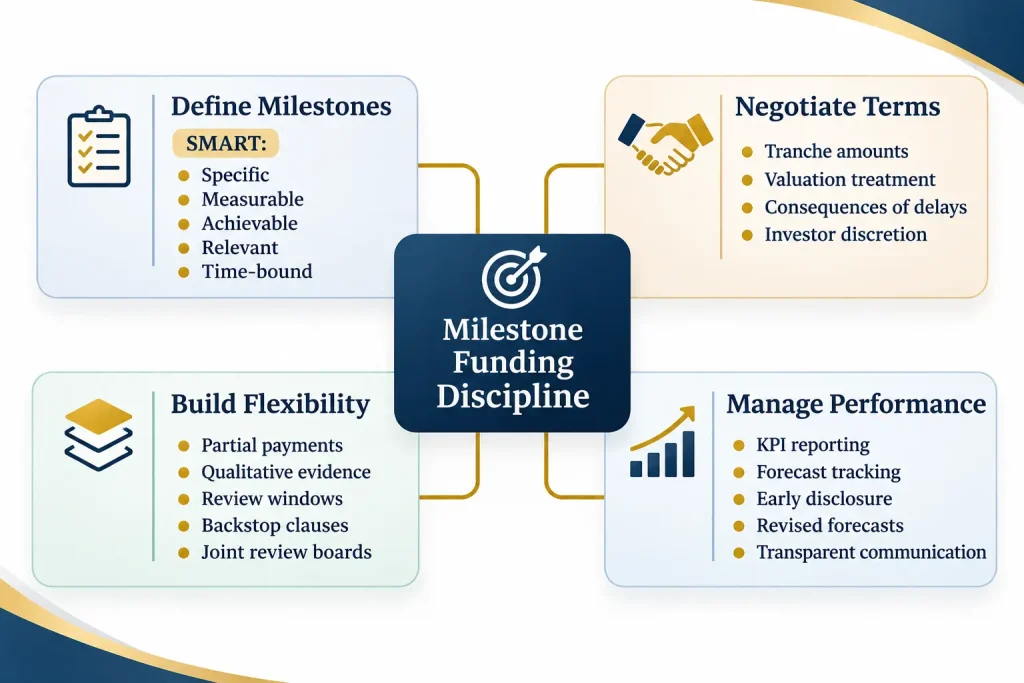
Good milestones follow the SMART standard, which keeps both parties working from one definition of success:
- Specific, with no room for ambiguity
- Measurable, tied to quantifiable outcomes
- Achievable with current resources, yet still demanding
- Relevant to the next inflection point
- Time-bound, with a clear deadline
Milestone Categories and Examples
| Category | Example Milestones |
| Technical | MVP completion, feature release, API stability |
| Market | Active users, beta feedback thresholds, NPS |
| Revenue | First sale, MRR target, renewal rate |
| Regulatory | Compliance completion, third-party audit, legal clearance |
Sequencing matters as much as definition, so a product milestone should precede a user milestone. A sales milestone should follow product-market fit, never lead it.
Negotiating Milestone Funding Terms Before Signing
Investors will test whether each milestone is too conservative or justifies a valuation step-up. Founders should explain why each milestone matters, show how progress will be tracked, and offer fallback plans. The legal documents should then settle four terms in plain language:
- Tranche amounts attached to each milestone
- Valuation treatment, whether pre-agreed or set later
- Consequences when a milestone slips
- Investor discretion over judging milestone success
Raising Concerns Before the Ink Dries
Milestones are economic contracts with embedded assumptions, and accepting them blindly mortgages future leverage. Raising a flag before commitment signals maturity, not weakness. Strong founders present the assumptions, the risks, and comparable outcomes from competitors, then propose a revised target with buffer.
Suppose a term sheet asks for $100K in MRR within 6 months, yet sales-cycle modeling points to $60K. A range-based milestone solves this, with a $60K base and a $100K stretch, each tied to its own tranche.
Building Conditional Leeway and Optionality
Missed milestones work best as diagnostic tools instead of punitive triggers. Founders can negotiate several protective features without diluting accountability:
- Partial payments for directional progress
- Qualitative evidence, such as design partnerships or pipeline growth
- Review windows that adjust milestones for external shocks
- Backstop clauses and time-triggered releases that prevent operational strangulation
- Joint review boards that interpret achievement together
Milestone funding behaves like an options contract, with the first tranche acting as the investor’s premium. Founders can mirror that logic by negotiating early release, penalty-free deferral, and repurchase rights after external shocks. The cost of a miss is asymmetric, since investors hold back capital while founders face unpaid salaries.
An investor who bristles at reasonable pushback during negotiation reveals a great deal. Founders should ask whether this partner handles ambiguity, seeks alignment over control, and adds wisdom beyond oversight.
Managing Progress Toward Each Milestone
Execution under milestone funding depends on visible tracking, monthly KPI reporting, and early disclosure of delays. A cybersecurity SaaS company that held actuals within plus or minus 5% of forecast for 8 quarters shows the payoff. Its driver-based forecasting engine gave every board conversation a reliable baseline.
When markets shift, founders should reassess milestone relevance and bring investors in immediately. A transparent pivot backed by data earns more trust than clinging to outdated targets. Achievements deserve celebration too, because each one lifts morale as well as releasing capital.
Avoiding Operational Pitfalls
- Overloading milestones creates administrative burden and dilutes focus.
- Ignoring soft milestones, such as team achievements, undervalues real progress.
- Investor micromanagement of daily operations breaks the spirit of the model.
- Frequent milestone discussions can exhaust investor goodwill.
Milestones should mature with the company, moving from product goals at Series A to retention and monetization at Series B. Series C often hinges on margin or international expansion. Boards can fold milestones into OKRs so they become part of the operating cadence.
When Milestone Funding Targets Slip
Progress rarely arrives on schedule, and a founder’s true test lies in how the miss is communicated. Spinning the narrative or forcing a reckless sprint compounds the risk. A better response addresses the miss early, gives a revised forecast, explains the causes, and makes a structured ask.
Turning Missed Targets into Strategic Signals
Missed milestones sometimes turn out to be discoveries. A SaaS startup might miss revenue by 25% yet find that customer lifetime value doubled. A healthtech platform might delay its beta by two months while strengthening its compliance architecture.
Milestone Variance Review
| Milestone | Original Target | Current Outcome | Strategic Insight |
| MRR | $50K | $37K | 2x retention rate |
| Launch | Jan 1 | Mar 15 | HIPAA certified |
A side-by-side view like this conveys maturity instead of evasion, and it invites dialogue. Founders should name metrics they can hit within 30 to 60 days and consider directing part of the next tranche toward recovery.
Knowing When to Escalate and When to Absorb
| Escalate When | Absorb When |
| The miss is material, such as a major revenue or regulatory failure | The deviation is under 10% to 15% of target |
| It undermines the next fundraise or a strategic partnership | The cause is transient, such as a vendor delay |
| It reveals a foundational flaw in strategy or execution | The fix is already in motion |
Repeated volatility may call for tiered milestones (base, stretch, breakout) or qualitative milestones alongside quantitative ones. Founders should protect the company story with updated charts, testimonials, and unit economics. Missed milestones rarely kill companies, but eroded trust often does, and that is the real risk in milestone funding.
Three Key Takeaways
- Milestone funding works when each gate maps to a real risk, so every tranche buys verified progress instead of elapsed time.
- The best protection is negotiated before signing, through range-based targets, partial payments, and options-style flexibility that reflects the uneven cost of a miss.
- When targets slip, early disclosure and a clear account of what the miss revealed preserve the trust that keeps future tranches flowing.
Disclaimer: This article is intended for informational purposes only and does not constitute legal, tax, or accounting advice. You should consult your own tax advisor or counsel for advice tailored to your specific situation.
Hindol Datta is a four-time CFO and senior finance executive with over 25 years of leadership experience across cybersecurity, SaaS, gaming, logistics, digital marketing, medical devices, consumer products, and nonprofit organizations. He has led more than $120M in fundraising and over $150M in M&A transactions while building the financial and operational systems that let complex businesses scale with confidence. He is the author of seven books in the Systems CFO Series and holds active CPA, CMA, and CIA credentials.
AI-assisted insights, supplemented by 25 years of finance leadership experience.