Executive Summary
Founders rarely resist stepping down out of ego. They resist because their identity has fused with the enterprise they built, and their instincts, once the company’s greatest asset, begin to strain against the coordination and system thinking that scale requires. This article draws on more than twenty five years of finance leadership across cybersecurity, SaaS, gaming, logistics, digital marketing, medical devices, and nonprofit organizations to examine why founders struggle to hand over the CEO chair and how boards, investors, and finance leaders can design a transition that preserves value rather than eroding it. It explores the early signals that precede a leadership change, the frameworks that build trust between founder and successor, and the practical steps that keep culture intact through the first ninety days. The goal is not to remove the founder from the story. It is to help the founder become its most important narrator.
Why Founders Resist Stepping Aside
Founder succession is one of the most consequential and least discussed challenges in the life of a growth stage company. Having guided finance functions through capital raises, mergers, and leadership transitions across industries ranging from cybersecurity to gaming, I have come to see that the hardest transition a company ever makes is not a product pivot or a market expansion. It is the moment a founder steps back from the CEO chair.
Founders do not hold on to control because they crave power. They hold on because they still see themselves as the architect of the company’s purpose. That bond between identity and enterprise runs deeper than any ownership stake, and it explains why even the most rational, data driven founder can resist a transition that everyone around them agrees is necessary.
The Cognitive Plateau of Founder Led Decision Making
Founders remember how they built the first customer segments, how they pivoted when the market shifted, and how they held culture together during chaotic growth. Those instincts guided the company through ambiguity. Yet the same instincts can become obstacles once the organization requires coordination across departments, formal capital allocation, and structured governance. In one transformation I led, a founder delayed implementing basic cost discipline for months, and the delay cost the company real runway. That experience shaped a belief I carry into every engagement: founder led agility must eventually evolve into institutional control if the business is to navigate real complexity.
Reading the Early Signals
Performance may not falter at first. Ambiguity spreads faster than the metrics that would reveal it. In a founder centric decision model, every debate gravitates toward a single voice, opportunities wait while that voice deliberates, and exit timing quietly shifts as succession is delayed. The board often senses the risk before it can act on it. The earliest warning signs are rarely financial. They show up as lengthening review cycles, stalled hiring, and softening forecast accuracy, all of which precede the lagging indicators that eventually appear in the numbers.
Building a Transition Readiness Index
Across finance transformations, including work that helped raise more than one hundred and twenty million dollars in growth capital and oversee more than one hundred and fifty million dollars in merger and acquisition activity, I have found that founders respond best to structured, data backed frameworks rather than open ended conversations about letting go. I introduced what I call a transition readiness index, a small set of indicators tracked consistently over time.
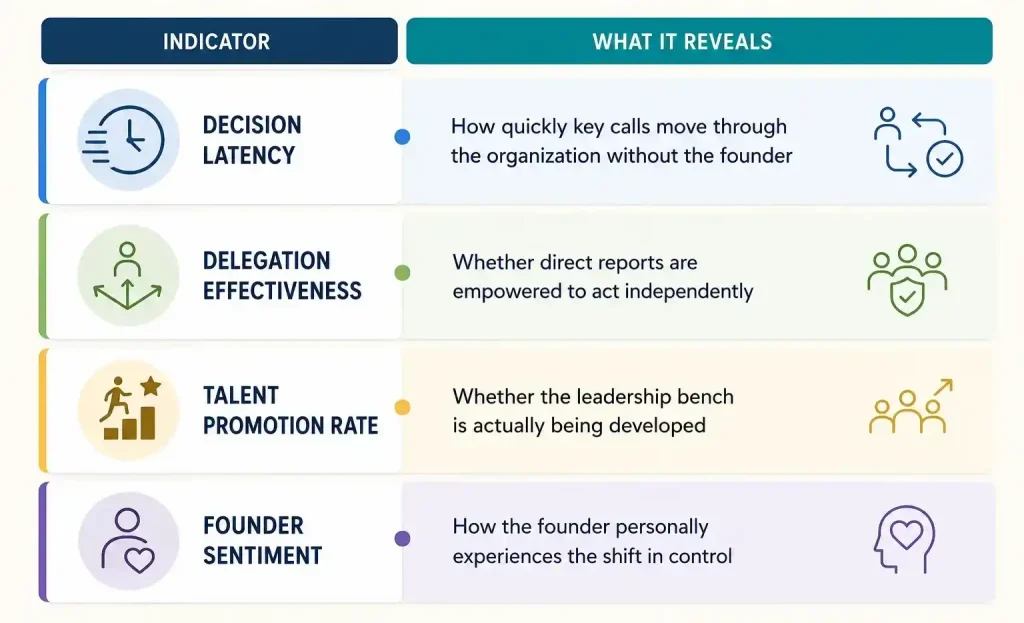
Founders who wanted data felt safe using it. Founders who did not still saw progress reflected in the people stepping up around them. When leadership prepares consciously for this shift, the transition does not fracture enterprise value. It compounds it.
Designing a Transition That Preserves Culture
Once a founder agrees to step back, the harder task begins. The organization must execute the handover without losing its emotional core, because that execution defines not only near term performance but the long term identity of the company. What separates a graceful handover from a clumsy one is rarely capital or credentials. It is narrative integrity. If the organization understands why the change is happening, the how can be taught.
Involving the Founder in Selecting a Successor
Founders often fear that stepping away means a new leader will rewrite the story. In private equity backed transitions, incoming operators frequently emphasize systems, metrics, and disciplined cash management, sometimes at the expense of the intuition that built the company. The best transitions I have seen begin with the founder actively involved in defining the successor’s mandate. In one engagement, a founder wrote a personal memo to the incoming chief executive describing the company’s founding values and unspoken truths. That memo became a guiding compass that the team referenced long after the transition itself was complete.
Selecting a successor is less a talent exercise than a matching problem. The strongest candidates are not always the most decorated. They are the leaders who can extend the current system without erasing its memory, who know when to introduce structure and when to simply listen.
Onboarding Beyond the Balance Sheet
Onboarding a new chief executive requires more than an operational review. In my experience, the most durable onboarding plans include founder narrative walkthroughs, listening tours with key employees, and direct conversations with the board about legacy and intent. These moments turn a calendar milestone into a genuine values handoff, and every new leader who engages sincerely with them gains legitimacy faster than one who relies on the org chart alone.
Some founders take a formal board seat after the transition. Others step back entirely. The strongest outcomes I have observed occur when the founder becomes an ambassador of culture rather than a shadow chief executive, continuing to shape onboarding or mentorship long after the formal handover, which signals continuity rather than displacement.
Sustaining Momentum in the First Ninety Days
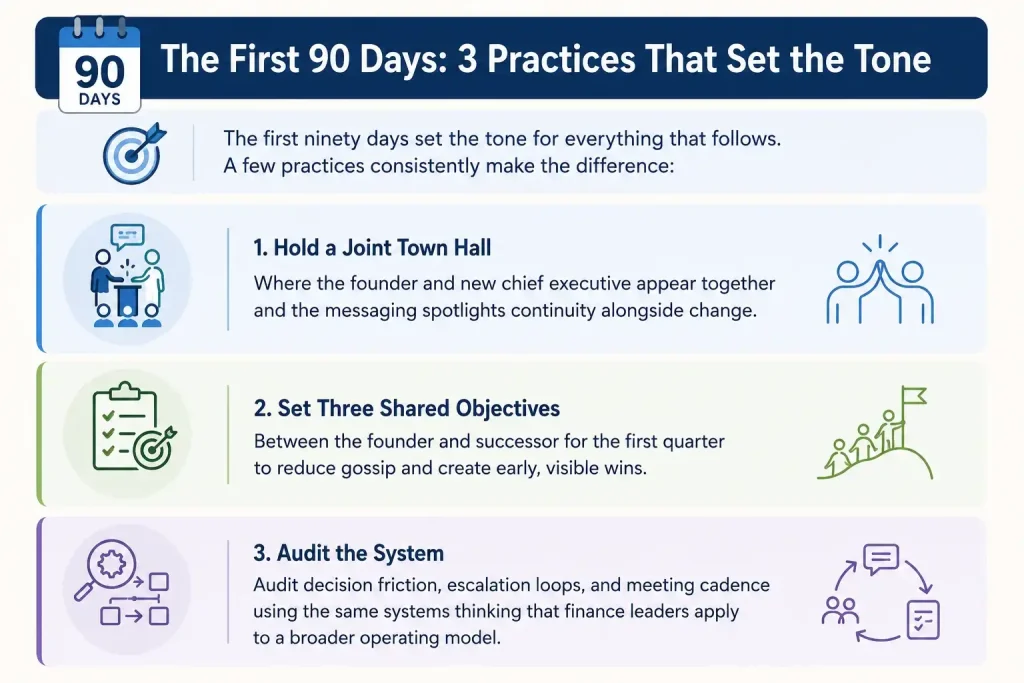
This last point mirrors work I have done reducing month end close cycles and automating reporting inside global finance organizations. The discipline is the same whether the object is a financial close or a leadership handoff. Systems must adapt as the organization scales, but adaptation only works when people believe the underlying intent is aligned. I have seen this principle hold across sectors as different as logistics, where tightening a supply chain process without losing operational trust required the same care as any leadership transition, and mission driven education, where a forty eight million dollar capital raise depended entirely on the board and leadership team trusting the plan behind the numbers.
Conclusion
Founder succession is rarely a single event. It is a sequence of decisions, conversations, and small acts of trust that either compound value or quietly erode it. Founders who navigate it well become legacy bearers, extending a vision they can no longer scale alone. Across finance transformations in cybersecurity, SaaS, gaming, logistics, digital marketing, medical devices, and nonprofits, the same pattern emerges. Companies that treat succession as a strategic capability—with clear metrics, founder involvement, and a deliberate first ninety days—are more likely to protect and grow enterprise value. Those that delay succession or treat it as a quiet crisis often drift. The lesson for boards, investors, and finance leaders is simple: prepare early, measure the right signals, and give founders a meaningful role in shaping what comes next. A founder’s greatest act of leadership is choosing the right moment to let the company grow beyond them.
Disclaimer: This blog is intended for informational purposes only and does not constitute legal, tax, or accounting advice. You should consult your own tax advisor or counsel for advice tailored to your specific situation.
Hindol Datta is a seasoned finance executive with over 25 years of leadership experience across SaaS, cybersecurity, logistics, and digital marketing industries. He has served as CFO and VP of Finance in both public and private companies, leading $120M+ in fundraising and $150M+ in M&A transactions while driving predictive analytics and ERP transformations. Known for blending strategic foresight with operational discipline, he builds high-performing global finance organizations that enable scalable growth and data-driven decision-making.
AI-assisted insights, supplemented by 25 years of finance leadership experience.