
Executive Summary
Strategic plans often promise growth, differentiation, and resilience, yet many collapse the moment they meet real cost behavior. This article examines cost management strategies that keep planning grounded in economic reality rather than aspiration. It traces how fixed, variable, and step-fixed cost behavior shapes pricing latitude. It looks at why decision frameworks from thinkers such as Stigler, Munger, and Bezos help finance judge uncertainty. It also shows how systems thinking reveals feedback loops that static plans miss entirely. Beyond that, it covers long-run marginal cost and cost-to-serve analysis. It treats the deal desk as a live feedback mechanism rather than a bottleneck. A simple diagram maps how cost discipline threads through the full planning cycle. Strategy only holds up once cost structure becomes part of its design. It cannot work as an afterthought applied once numbers disappoint.
Strategy Without Cost Is Just Narrative
A strategic plan can check every box. It may have segment adjacency, product-led growth, and local brand lift. Yet it can still collapse under its own assumptions when it skips real cost management strategies. During a SaaS expansion across new territories, one go-to-market plan looked well designed at first glance. A closer review changed that picture. The same customer acquisition cost recovery timeline had been applied across three very different sales motions. Support costs in one geography were pegged to headquarters assumptions. Churn modeling assumed parity with an entirely different existing customer base. The plan was not strategy. It was spreadsheet optimism dressed as ambition.
This pattern repeats often enough to count as a genuine trend, organizations mistaking aspiration for strategic design. That gap is precisely where finance earns its place, not by vetoing ambition, but by embedding constraints, sequencing, and structure directly into the planning process itself.
Cost Structures Are the Skeleton Beneath Strategy
Cost is not simply an accounting line. It is the architecture of capability, defining what a business can afford to do, how fast it can scale, where it must standardize, and when it can flex. Understanding the behavior of fixed, variable, step-fixed, and discretionary costs is not an academic exercise. It creates structural leverage, particularly in deal desk negotiations. Knowing whether support overhead flexes with usage, or stays fixed regardless of volume, determines pricing thresholds and discount latitude.
The marginal cost of delivering incremental revenue is frequently misunderstood or simply averaged out. This leads to poor deal approvals and quiet revenue leakage. A deal scoring model can change how sales representatives negotiate. It generates an automatic margin forecast based on embedded service costs and pricing complexity. This gives revenue operations a shared language for pushback. It also teaches the field that strategy concerns customer economics as much as customer acquisition.
Deciding Under Uncertainty
Cost gives strategy its foundation, but uncertainty gives it its landscape. Information acquisition carries a cost. It often brings a diminishing return too. Knowing when to stop gathering data and start acting becomes a genuine judgment call. Finance and operations share that call. Forecasting engines built with deep simulation often reveal something useful. One or two input assumptions drive most of the outcome variance. This is a reminder that more analysis does not always mean more insight.
Mental models drawn from multiple disciplines, statistics, psychology, and engineering, help finance see that a revenue operations problem is rarely purely operational. It is often tied to incentive misalignment or channel saturation instead. Reasoning from first principles means stripping away inherited price lists. Price floors get built instead from raw material costs and unit contribution. This can feel unfamiliar to teams used to competitive benchmarking. A clear explanation of pricing thresholds tends to turn skepticism into alignment, though. Distinguishing reversible decisions from irreversible ones also matters. Finance does not need to gate every choice. It must serve as the backstop when reversibility is low and cost impact is high.
Systems Thinking as Finance’s Sensemaking Tool
Static strategy frameworks account poorly for delay, feedback, and interdependence, yet most revenue operations challenges behave exactly like a system rather than a straight pipeline. Tightening deal desk controls to reduce discounting once produced an unexpected churn spike six months later. Deal volume had not dropped, but many closed accounts were barely inside the ideal customer profile, pushed there by reps chasing quota. What looked like a margin victory turned out to be a retention failure.
Quarterly system maps across the go-to-market lifecycle help catch this kind of delayed feedback before it compounds. They capture approval friction, cycle time changes, discount velocity, and support ticket saturation. These maps get embedded directly into the forecast process rather than shared only as static visuals. As a result, finance reports pipeline integrity rather than pipeline volume alone.
The Process of Strategic Cost Management in Practice
When cost structure frames every pricing tier, every quote-to-cash step, and every regional expansion model, finance changes roles. It becomes a co-creator of strategy rather than a passive referee afterward. This requires narrative fluency as much as spreadsheet skill. Finance must explain why fixed costs are not always truly fixed. It must also explain why scale sometimes erodes margin rather than improving it.
Long-Run Marginal Cost and GTM Design
Most go-to-market strategies fail not from a lack of ambition but from unexamined marginal cost behavior. Early deals often look excellent, with strong pricing, responsive accounts, and healthy satisfaction scores. As volume rises, though, capacity saturates and support strains, and a motion that once looked high-margin starts producing results near or below break-even. In one self-service model, support demand spiked exponentially for every additional wave of new users, revealing not a pricing failure but a systems failure, since the business had priced for adoption without investing in enablement. Restructuring tiering, increasing automation, and reallocating budget from brand awareness toward activation infrastructure restored both margin and strategic coherence.
Cost-to-Serve Curves as Strategic Signals
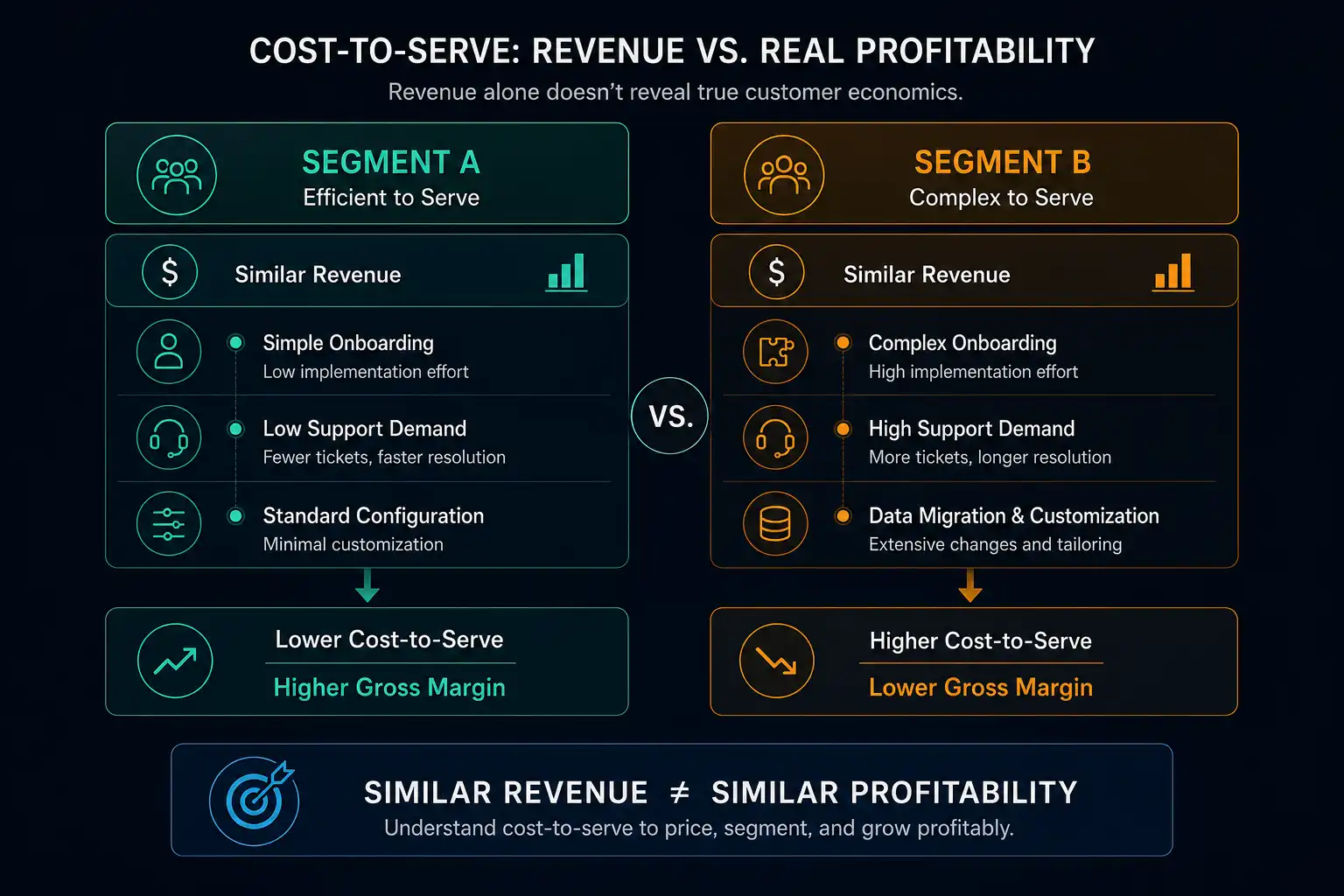
Cost-to-serve, often buried inside service delivery reviews, deserves treatment as a strategic input rather than a purely functional metric. Two customer segments with similar revenue profiles can carry drastically different gross margin contributions once complex onboarding, data migration, and customization costs get properly accounted for. Rather than raising prices immediately, creating a streamlined support tier with self-help content built directly into the product dropped cost-to-serve by forty percent in one such segment within three quarters, proving that fit-for-purpose design can outperform simple cost-cutting.
The Deal Desk as Strategic Sentry
A properly empowered deal desk becomes a sentry post for strategy, the point where product ambition meets revenue pressure and cost structure either holds or buckles. Designing the approval process around decision insight rather than compliance alone means every deal that crosses the desk carries visibility into expected gross margin, variable support costs, regional delivery constraints, and discounting rationale. Feeding that data back into pricing tiers, sales enablement, and product roadmap trade-offs turns the deal desk from a bottleneck into a genuine strategy accelerator. Training finance analysts to spot patterns rather than simply audit forms matters here too, prompting coaching conversations when certain representatives consistently need higher post-deal support and product reviews when customers repeatedly request non-standard deployment terms.
Post-Sale Finance Completes the Loop
The most enduring strategic insight often arrives after the sale, revealing what the original model assumptions got right and what they missed. Churn risk that correlates not with initial discounting but with payment term concessions suggests that longer terms were disguising weak commitment rather than reflecting genuine flexibility. Redesigning approval rules to score term flexibility against activation rates and satisfaction scores, rather than eliminating flexibility altogether, turns finance into the interpreter of strategic signal. Wiring post-sale telemetry, including support ticket volume, license utilization, and late payment patterns, back into the finance system lets recurring revenue models adjust for real-world degradation rather than treating every booking as guaranteed revenue.
Embedding Cost Into the Strategic Planning Cycle
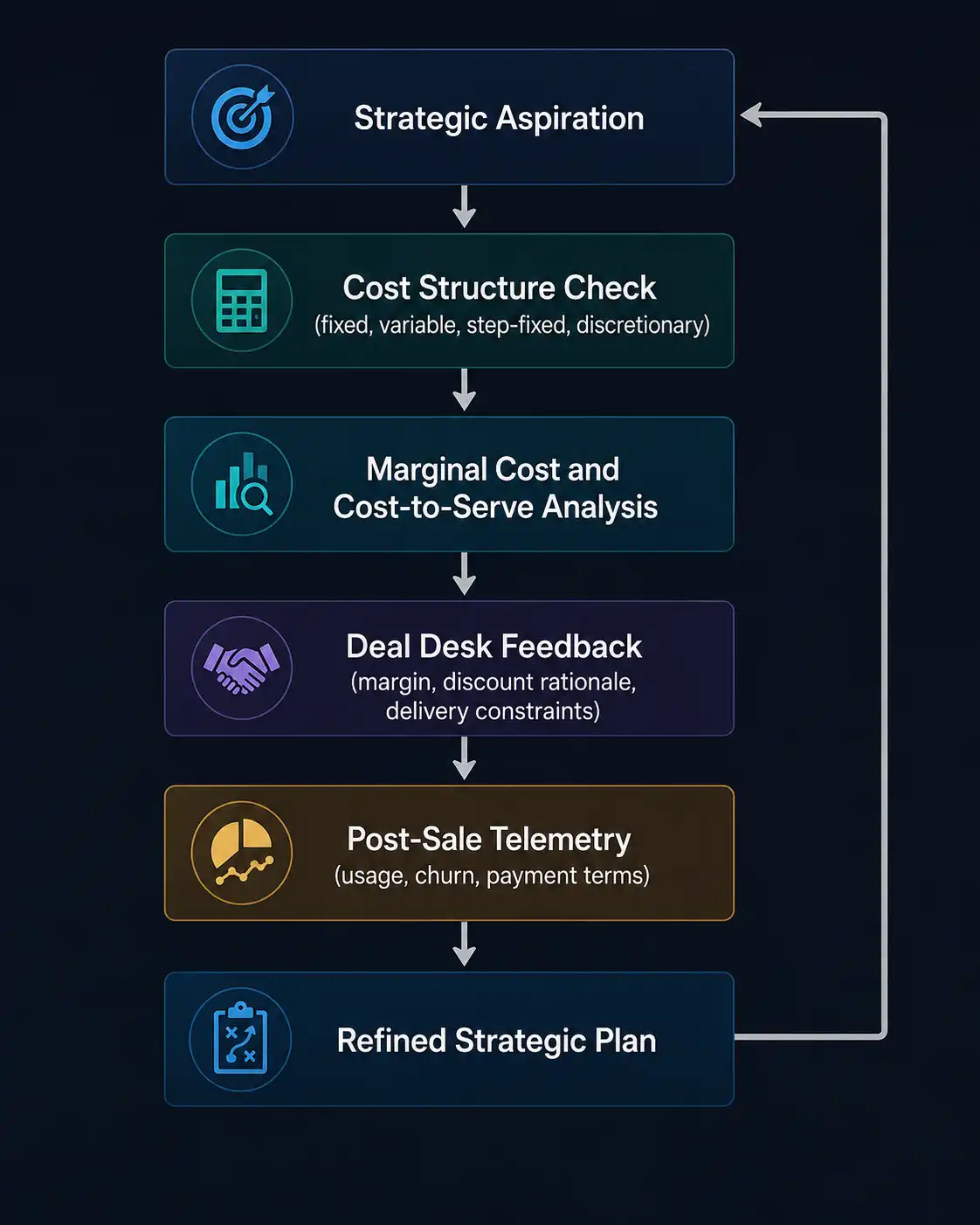
The diagram below summarizes how cost discipline threads through a full planning cycle, from initial strategic aspiration to post-sale learning that feeds the next round of planning.
Conclusion
Strategy is ultimately a commitment to coherence between who a business serves, what it charges, how it delivers, and what it earns. Effective cost management strategies treat that coherence as something to be built rather than assumed, using fixed and variable cost behavior, marginal cost curves, and cost-to-serve analysis as design inputs rather than after-the-fact justifications. A forecast built this way behaves like an engineered path rather than a hope, respecting constraints, absorbing feedback, and adapting as new data arrives. As planning cycles look toward the next few years, treating every strategic plan as a cost-informed hypothesis, and teaching go-to-market leaders to read a cost-to-serve curve, offers a sturdier foundation than chasing scale for its own sake. The strongest strategies are rarely the boldest sounding ones. They are the ones that continue to hold up once the numbers get real.
Disclaimer: This blog is intended for informational purposes only and does not constitute legal, tax, or accounting advice. You should consult your own tax advisor or counsel for advice tailored to your specific situation.
Hindol Datta is a seasoned finance executive with over 25 years of leadership experience across SaaS, cybersecurity, logistics, and digital marketing industries. He has served as CFO and VP of Finance in both public and private companies, leading $120M+ in fundraising and $150M+ in M&A transactions while driving predictive analytics and ERP transformations. Known for blending strategic foresight with operational discipline, he builds high-performing global finance organizations that enable scalable growth and data-driven decision-making.
AI-assisted insights, supplemented by 25 years of finance leadership experience.