
Executive Summary
Distribution partnerships let a company embed its momentum inside another firm’s motion, borrowing reach, credibility, and customer trust. Done well, they lower CAC, shorten sales cycles, and open segments that direct sales would take years to reach.
This article covers the trust logic behind partnerships, the five main partnership types, and the operating systems that make them perform. It closes with the financial models CFOs need to judge whether a partner creates or destroys value.
Why Distribution Partnerships Matter
Markets do not reward the best product; they reward the best path to the customer. Distribution partnerships turn that path into deliberate leverage for growth. Executed with intent, they collapse time, reduce acquisition costs, and extend trust into new segments. Executed poorly, they diffuse ownership and produce more slide decks than results.
Many partnerships launch with press release euphoria and fade into quarterly updates about “evaluating pilot outcomes.” Their failure rarely comes from bad economics. It usually stems from misunderstood asymmetries of urgency, incentives, customer intimacy, and sales cycles. A startup moves in weeks, while a Fortune 1000 partner moves in quarters.
Trust, Leverage, and Directional Alignment
Direct sales, performance marketing, and inbound content work, but they scale with friction and rising cost. A partnership inserts the company into another firm’s existing motion and converts that energy into acceleration. It borrows trust that would otherwise take years to build. It also binds the company to the partner’s rhythms and inertia.
Leverage only helps when it points in the right direction. A $10B partner may produce nothing if its incentives and segments do not match. A $100M partner aligned in segment, motion, and incentive can become a force multiplier. Founders also confuse a partner’s intention with its capability, so every partnership should start with an honest map of constraints:
- What does the partner actually sell?
- Who owns the customer relationship?
- How long is the partner’s sales cycle?
- Do partner reps close quota with this product or without it?
Game theory explains why this map matters, since cooperation stays stable only when payoffs align. A partner who wins more by doing nothing will choose inaction, politely and persistently.
One data infrastructure company won a co-selling agreement with a cloud hyperscaler and chose not to celebrate the logo. Instead, it embedded its product into the hyperscaler’s sales engineer enablement modules and trained the field team. It also aligned success metrics with the partner’s quota structure, and 18 deals closed within six months.
Five Types of Distribution Partnerships
The word “partnership” covers relationships that vary widely in yield, effort, and risk. Matching each type to market structure, product maturity, and buyer behavior is the first act of discipline.
Partnership Typology and Trade-Offs
| Type | How It Works | Strength | Risk |
| Channel (resellers, distributors, managed services) | A third party carries the product to market | Borrowed reach without borrowed payroll | Requires constant enablement and motivation |
| Technology integration | Products connect within customer workflows | Easier adoption, harder abandonment | Integrations with low-usage platforms yield little |
| Co-selling and strategic alliances | Joint sales, narrative, and pre-sales | Faster closes and reassured buyers | Coordination friction when no one owns the outcome |
| Embedded ecosystem (OEM, white-label, API) | The product becomes part of the partner’s product | Growth that rides the partner’s flywheel | Invisibility, weak pricing power, dependency |
| Co-marketing | Webinars, white papers, joint panels | Useful signal for investors and buyers | PR mistaken for distribution |
How to Work with Distributors and Channel Partners
Distributors and resellers sell availability, not devotion, so the company must still supply the training, collateral, and market map. In markets where trust is scarce and differentiation unclear, availability alone rarely wins deals. A $127M global consumer products company selling through DTC, Amazon, and wholesale channels faced this reality. Its demand planning and SKU rationalization lifted inventory turns from 3x to 7x, showing that channel performance depends on disciplined supply behind the partner.
Filtering Partnerships Before Committing
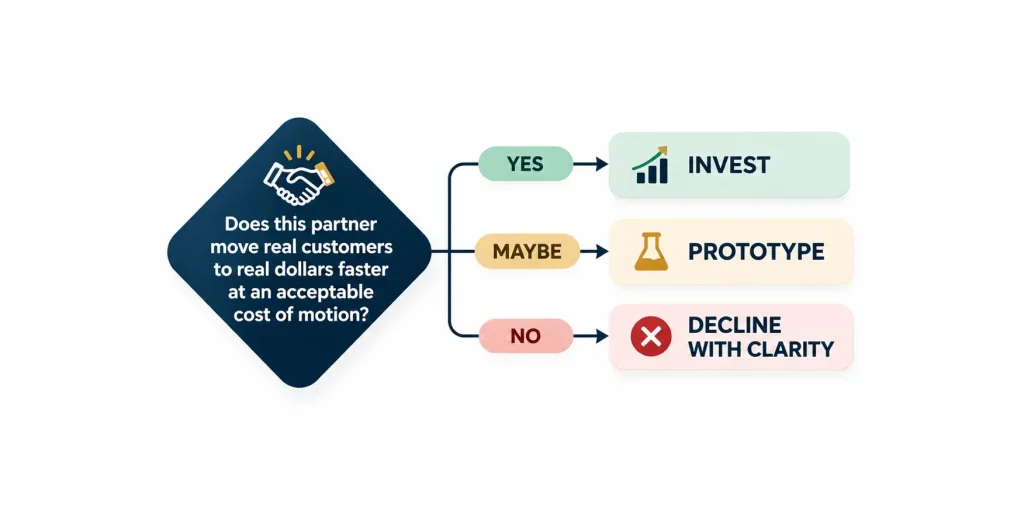
Some distribution partnerships exist to sell, others to signal, and some only to satisfy a board member. Every proposal should pass through one test, shown below.
Turning Distribution Partnerships into Performance
Most distribution partnerships fail in integration, not intent. The CEO strikes the alliance, the board applauds, and then nothing happens in the middle of the organization. Without playbooks or enablement, the partnership lives in board decks but dies in the CRM.
Embedding Partners in the Operating Cadence
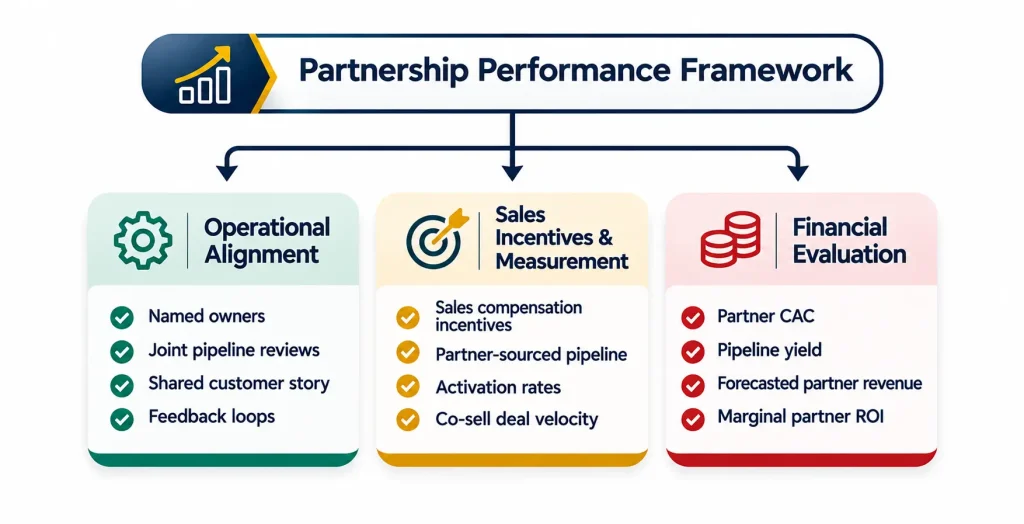
The antidote is to run the partnership with the same discipline as the core business. Four practices make distribution partnerships work in practice:
- Joint pipeline reviews held with the rigor of internal forecast calls
- Named owners on both sides, not departments
- Feedback loops that carry deal learnings into product, messaging, and incentives
- A shared story explaining what problem the combined offering solves
Customers do not buy because two companies collaborated. They buy because the integration reduces implementation risk or shortens time to value. Every rep should be able to explain that story as well as a founder in a keynote.
Incentives, Measurement, and Focus
Salespeople chase what pays, and they quietly route around anything that delays commission. The strongest partnerships hardwire success into comp plans, spiffs, or MBOs for the mid-level operators who execute. Measurement must also track outcomes instead of webinars and meetings. Leading signals include partner-sourced pipeline, activation rates, and co-sell deal velocity, while closed-won revenue confirms results over three quarters or more.
Diffusion is the greatest enemy of distribution partnership success. The strongest companies say yes to fewer partners but commit completely, staffing, tracking, and renewing each one. A partnership should move from bet to proof to flywheel within three quarters; otherwise, leadership should treat it as a relationship, not a channel.
The Financial Case for Distribution Partnerships
Well-built partnerships change the shape of revenue, not just its size. As pipeline shifts from cold outbound to warm introductions, blended CAC flattens and payback compresses. Partner-sourced customers often onboard faster, retain longer, and expand more predictably. Those effects improve cohort quality, net revenue retention, and forecast accuracy.
A venture-backed digital marketing company that scaled from $9M to $180M in 24 months relied on CAC, LTV, and contribution margin discipline, and partner channels deserve that same scrutiny. In one case, a global systems integrator took a solution into five accounts, and investor confidence rose before channel revenue arrived. The market can also tell strategic alignment from opportunistic association, so empty partnerships erode credibility.
Partnership Distribution Metrics Every CFO Should Model
| Metric | Formula | What It Reveals |
| Direct CAC | Total sales and marketing cost ÷ new customers | Baseline acquisition cost |
| Partner CAC | (Enablement costs + revenue share + attribution costs) ÷ partner-sourced conversions | Whether the channel costs less than direct sales |
| Partner pipeline yield | Partner-sourced pipeline × conversion rate × ACV | Whether partner deals convert and monetize |
| Incremental revenue per integration | (Partner-originated revenue − integration cost) ÷ time | How fast embedded investment pays back |
| Forecasted partner revenue | Committed pipeline × historical confidence factor | A probability-weighted view instead of faith |
| Marginal partner ROI | Change in revenue ÷ change in partner investment | Where the next dollar earns most |
| Partnership-driven valuation lift | Change in implied valuation ÷ partnership signal strength index | How partner depth affects valuation |
A few rules sharpen these distribution partnership models. Partner-assisted deals deserve partial attribution, while sourced deals carry full weight. If a tier-one partner brought $1M in pipeline and only 10% closed, future commitments need the same discount. Latency matters too, because a deal closing in 30 days is worth more than one closing in 120. If one more AE yields $800K of ARR and a partner manager yields $500K, the math frames the trade-off.
Partner value also follows the 80/20 rule, with most yield coming from a minority of relationships. Resourcing for distribution partnerships should therefore follow math, not politics. An integration that reaches 10,000 users but activates only 50 is a shelf, not a channel. Pipeline analytics built across five business units at a professional services firm show how attribution reveals where effort pays.
Optionality as the Lasting Return
The most understated gift of distribution partnerships is optionality. It opens categories, segments, and geographies that would otherwise demand years of direct build. In the investor narrative, a strong partner can shift the story from “early traction” to “strategic lock-in.” That shift only holds when the partnership shows up in unit economics, capital efficiency, and measurable pipeline.
Three Key Takeaways
- Distribution partnerships succeed when the partner’s incentives, segments, and sales cycle align with the company’s motion, so modeling the partner’s payoff matters more than the logo.
- Partnerships perform only when embedded in the operating cadence, with named owners, joint pipeline reviews, comp-plan incentives, and a shared customer story.
- CFOs should judge every partner through partner CAC, pipeline yield, probability-weighted forecasts, and marginal ROI, then concentrate resources on the few relationships that compound.
Disclaimer: This article is intended for informational purposes only and does not constitute legal, tax, or accounting advice. You should consult your own tax advisor or counsel for advice tailored to your specific situation.
Hindol Datta is a four-time CFO and senior finance executive with over 25 years of leadership experience across cybersecurity, SaaS, gaming, logistics, digital marketing, medical devices, consumer products, and nonprofit organizations. He has led more than $120M in fundraising and over $150M in M&A transactions while building the financial and operational systems that let complex businesses scale with confidence. He is the author of seven books in the Systems CFO Series and holds active CPA, CMA, and CIA credentials.
AI-assisted insights, supplemented by 25 years of finance leadership experience.