
Executive Summary
Debt vs equity financing is one of the most consequential choices a growing company makes. The capital a company raises shapes its financial statements, but it also shapes its culture, incentives, and trajectory. The decision is strategic as much as numerical, and the wrong instrument can constrain a business for years.
This article first defines both instruments and compares their structural differences, from dilution to tax treatment. It then offers a practical framework for choosing between debt and equity by stage, sector, risk appetite, and market timing, ending with the case for a blended capital stack.
Debt vs Equity: Defining the Two Instruments
Equity financing means the company raises capital by selling ownership shares to investors. Those investors assume high risk in exchange for a share of future upside. The company carries no obligation to repay the money.
Debt financing means the company borrows money and agrees to repay it with interest over time. Lenders accept lower risk, receive fixed returns, and take no ownership stake. The obligation stands whether the business thrives or struggles, and covenants often restrict how the company operates until the loan is repaid.
Structural Differences Between Debt and Equity Financing
The two instruments differ across almost every dimension that matters to a founder or CFO. Cost, control, risk, and tax treatment all move in opposite directions, which is why debt vs equity financing deserves a structured comparison rather than a gut call. The table below sets out the core distinctions.
| Feature | Debt | Equity |
| Ownership dilution | None | Yes |
| Repayment obligation | Yes (principal plus interest) | No |
| Risk for investors | Low to moderate | High |
| Cost of capital | Generally lower for a healthy company | Higher due to risk premium |
| Financial covenants | Common in debt agreements | Rare |
| Tax treatment | Interest is tax-deductible | Dividends are not |
| Voting rights | None | Yes, often with preferred rights |
When Equity Financing Makes Sense
Equity fits companies that cannot yet support fixed repayments, and three situations tend to favor it:
- Pre-revenue or early-stage companies with no cash flow to service debt
- High-risk, high-growth ventures that attract investors who believe in long-term upside
- Strategic partnerships where the investor adds value beyond capital, such as network access or go-to-market support
The main advantages are permanent capital with no immediate repayment and aligned incentives between founders and investors. The costs are dilution of control and future profits, along with more complex governance and reporting. An AI assurance platform in its pre-Series A phase illustrates the logic. With no predictable revenue yet, its capital strategy rested on a multi-year scenario model and an investor narrative built for equity.
When Debt Financing Makes Sense
Debt suits companies with enough predictability to honor a fixed schedule, and three situations tend to favor it:
- Post-revenue companies with predictable cash flow and sound unit economics
- A bridge to a milestone, delaying dilution until a higher-valuation round
- Working capital or asset finance, matching debt to short-term or tangible needs
Debt lets founders retain ownership and upside, and it often closes faster with fewer strings attached. The trade-off is a fixed obligation regardless of performance, which raises the risk of default or insolvency in a downturn. A $127M global consumer products company selling through DTC, Amazon, and wholesale channels secured $12M in growth financing. Strong working capital discipline supported that debt, with inventory turns more than doubling from 3x to 7x.
Venture Debt: A Hybrid Instrument
Venture debt straddles both sides of the debt vs equity divide. It offers cash without heavy dilution, but it carries warrants and repayment schedules. Companies often use it after Series A to extend runway between equity rounds. Lenders typically underwrite it against the strength of the existing investor base rather than current cash flow, so it works best when a company has credible backers and a visible path to its next milestone.
A Framework for Equity vs Debt Financing by Stage
The choice between debt and equity is rarely binary. Strong founders decide based on context, timing, strategic objectives, and capital efficiency. Company stage offers the clearest starting point for that decision.
| Stage | Preferred Capital Type | Rationale |
| Pre-Seed | Equity (friends, angels, pre-seed funds) | High risk, no revenue |
| Seed | Equity | Proving product-market fit |
| Series A | Equity plus venture debt | First go-to-market scale, moderate revenue |
| Series B | Equity plus structured debt | Expanding operations with proven metrics |
| Series C+ | Blend or debt | Revenue traction allows debt layering |
A mission-driven education and research institution shows how the blend works in practice. It raised $37M across equity and venture debt, structuring the capital stack so each layer matched a specific need. Pairing the two instruments gave the organization growth capital without relying on a single source of funding.
A Decision Tree for Debt and Equity Financing
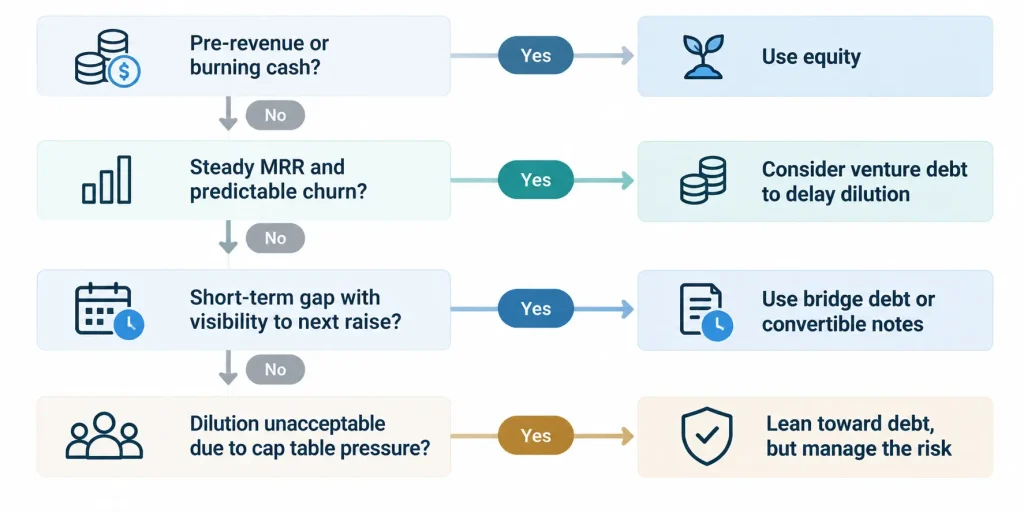
Four questions narrow the choice between debt and equity financing quickly. The flow below shows how each answer points toward a specific instrument.
How Sector and Business Model Shape the Choice
The business model has a strong influence on which capital fits best. Recurring revenue, R&D timelines, and inventory needs all shift the balance in equity vs debt financing decisions:
- SaaS with ARR: debt is more viable because revenue is predictable
- Biotech and deep tech: equity wins out because of long R&D cycles
- DTC and retail: debt may fund inventory, while equity supports brand-building
Risk Appetite, Control, and Founder Preferences
Equity brings partners, oversight, and guidance to the company. Debt brings independence, but it also brings financial stress when cash tightens. Before committing, founders need to weigh three tensions:
- Control versus support
- Short-term dilution versus long-term risk
- Operational stability versus aggressive scaling
An early-stage email marketing SaaS company shows why this matters. Its monthly burn reached $800K before an operational turnaround cut it to $200K. A business burning cash at that rate could not have carried fixed debt service safely.
Market Timing and Valuation Discipline
In high-valuation environments, equity dilution hurts far less than it does in a correction. In downturns, a flat or down round can dilute more than well-structured debt. Two practical rules follow from this for timing a raise:
- Raise equity in bullish markets and lean on debt in bearish ones
- Use debt to stage the next equity round at a higher valuation
A venture-backed digital marketing company raised $36.5M across Series A through C while scaling revenue from $9M to $180M. Spacing three rounds across that growth let each raise point to a larger, more proven business.
Building a Blended Capital Stack
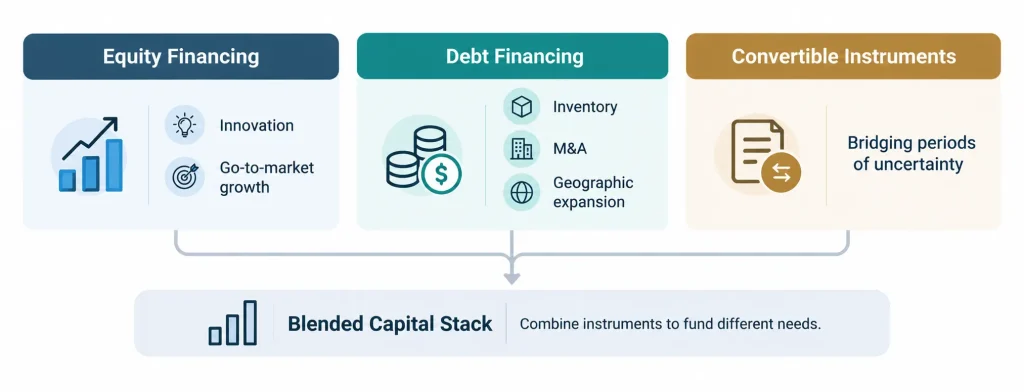
The best path often blends both instruments, with each layer assigned a job:
- Raise equity to fund innovation and go-to-market
- Layer debt to fund inventory, M&A, or geographic expansion
- Use convertible instruments to bridge periods of uncertainty
A blended stack also demands discipline in reporting. Lenders track covenants monthly, and equity investors expect board-grade metrics each quarter. Companies that build forecasting and reporting infrastructure early can manage both relationships without strain.
Conclusion: The Capital You Choose Shapes Your Company
The structure of capital reflects the structure of ambition. Choosing between debt and equity is a question of alignment, not preference. When capital matches stage, need, and trajectory, it accelerates the company. When capital misses that fit, it becomes a shackle. Debt is not cheaper if it costs flexibility, and equity is not better if it dilutes resolve. The art of capital strategy lies in choosing what is appropriate, not merely what is available.
Three Key Takeaways
- Match the instrument to the company’s cash flow reality. Equity fits pre-revenue and high-risk stages, while debt fits businesses with predictable revenue and tangible needs.
- Treat debt vs equity financing as a sequencing decision across stages. Venture debt and bridge notes can delay dilution until the next equity round arrives at a higher valuation.
- Build a blended capital stack where each layer has a clear purpose. Equity should fund innovation and growth, while debt should fund inventory, acquisitions, and expansion.
Disclaimer: This article is intended for informational purposes only and does not constitute legal, tax, or accounting advice. You should consult your own tax advisor or counsel for advice tailored to your specific situation.
Hindol Datta is a four-time CFO and senior finance executive with over 25 years of leadership experience across cybersecurity, SaaS, gaming, logistics, digital marketing, medical devices, consumer products, and nonprofit organizations. He has led more than $120M in fundraising and over $150M in M&A transactions while building the financial and operational systems that let complex businesses scale with confidence. He is the author of seven books in the Systems CFO Series and holds active CPA, CMA, and CIA credentials.
AI-assisted insights, supplemented by 25 years of finance leadership experience.