
Executive Summary
Cross-side network effects explain why some platforms grow harder to dislodge as they expand, while others stall despite rapid user acquisition. When growth on one side of a market raises value for the other side, a business gains a flywheel that compounds over time. That flywheel is engineered, not inherited, and it rarely appears without deliberate product and financial design.
This article examines how network effects form, the architectures behind them, and how founders solve the cold start problem. It then turns to defensibility, monetization, investor diligence, and seven platforms that converted interaction into durable enterprise value.
Understanding Network Effects and Cross-Side Network Effects
A network effect arises when a product becomes more valuable as more people use it. That simple idea underpins many of the most defensible modern business models, from telephone systems to marketplaces.
Same-Side Versus Cross-Side Network Effects
Network effects take two broad forms, and each carries distinct economics. Same-side, or direct, effects occur when each new user adds value for users of the same type, as in a telephone network.
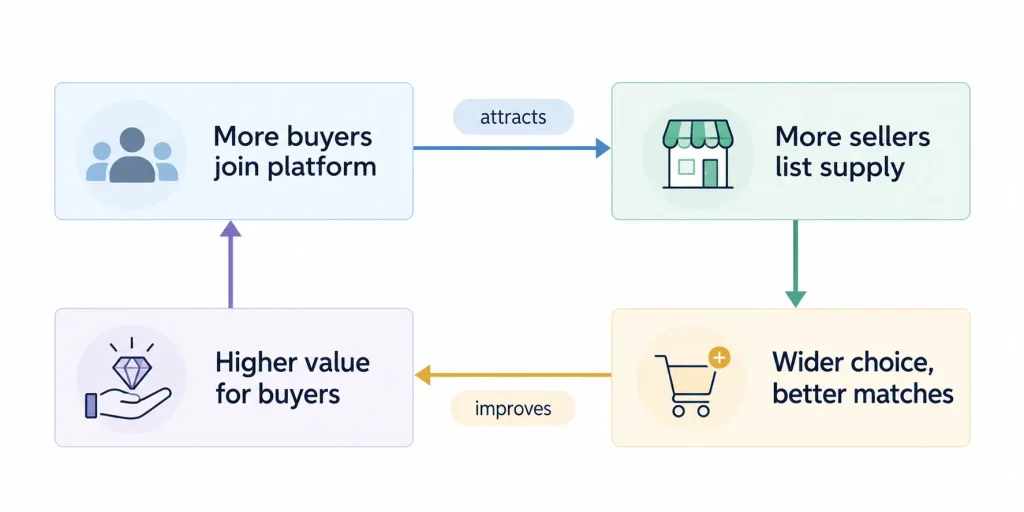
Cross-side network effects, also called indirect network effects, arise when growth in one user group lifts value for a different group. In a two-sided platform, more buyers attract more sellers, and more sellers attract more buyers. The loop below captures this basic mechanism in its simplest form.
Growth Is Not the Same as a Network Effect
Growth measures the number of participants, while network effects describe the quality of interaction among them. A product can add users quickly and still fail to create reinforcing value, because audience aggregation is not interaction multiplication.
What separates a network-effect business from a conventional one is scalability, not scale. Each marginal user makes the ecosystem more valuable and more defensible, so the asset grows harder to disrupt as it expands. Network effects are neither guaranteed nor uniform, however, and misreading their strength is a common strategic error. Founders must design, measure, and nurture the value that flows between users.
Five Architectures Through Which Network Effects Emerge
Network effects rarely appear by accident, since they grow out of intentional product design and strategic patience. Five foundational architectures account for most of them:
- Direct network effects: Messaging and social networks, where each new user benefits existing users through connectivity.
- Two-sided marketplaces: Platforms such as Airbnb or Uber, where cross-side network effects let supply and demand scale together.
- Data network effects: Products that get smarter with use, as Waze does with more drivers.
- Platform network effects: Developer ecosystems such as iOS or Shopify, where third-party products enrich the core experience.
- Protocol or standard effects: Formats such as PDF or SMTP, where adoption locks in a standard and creates stickiness.
Direct networks need high-intensity interactions, marketplaces need balanced density, data products need quality inputs, and platforms need governance.
Solving the Cold Start Problem in Two-Sided Platforms
At inception, network effects are fragile and often invisible to the people building them. A messaging app has no utility with one user, modest utility with two, and substantial utility with dozens, so early detection means studying behavior over headcounts.
The cold start problem is about engineering density before scale. A dating app with five users in a city is dead on arrival, which is why startups must think locally before globally. They manufacture liquidity by subsidizing one side, hosting events, or seeding supply by hand. Invite mechanics, onboarding flows, and default settings act as structural levers of ignition.
Building a Minimum Viable Network
The first ten users matter more than the first thousand, because early participants shape the norms of the network. Facebook started at Harvard and Slack began as an internal tool, which shows that narrow focus is foundational. Once a minimum viable network exists, viral, content, and retention loops convert usage into habit.
Metrics, Monetization, and Early Moats
Leading indicators include activation rates, retention curves, user-to-user invitations, and evidence that communities form on their own. Premature monetization can throttle a young network, yet free usage without a path to defensibility invites fast followers. Founders also choose between openness and exclusivity, since open APIs can amplify a network or let competitors siphon its value.
Scaling Cross-Side Network Effects into Durable Defensibility
Scale is visible, yet interaction loops and defensibility design decide whether cross-side network effects create a flywheel or a fragile shell.
Density, Depth, and Interaction Richness
Enduring networks deepen within a community before they widen across markets. A professional network that spans every country without concentrated industry hubs risks becoming generic. Rich interactions such as messaging, transaction history, and collaboration create embeddedness, so leaving means losing part of a digital identity or workflow.
Five Sources of Platform Defensibility
Content networks often plateau early, while protocol standards show delayed but exponential returns, and defensibility tends to come from five sources:
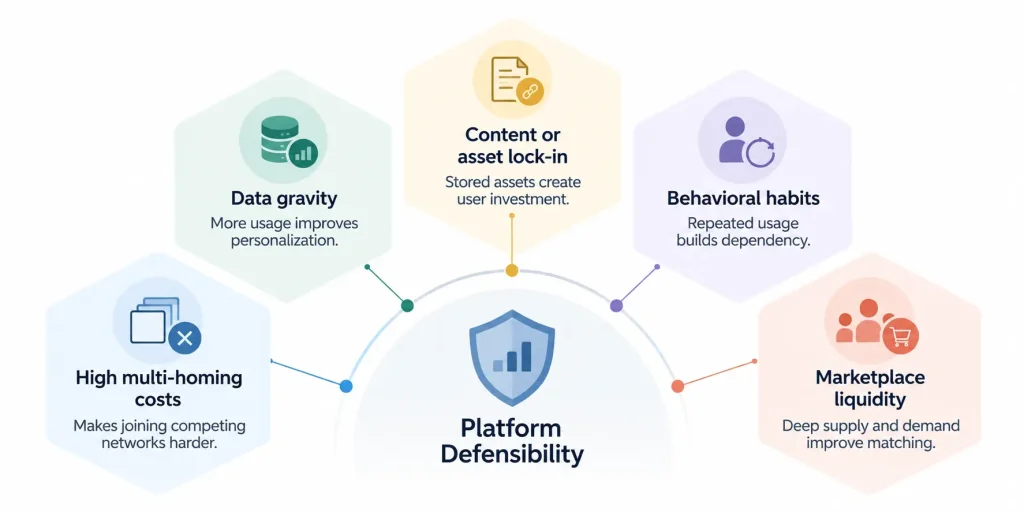
- High multi-homing costs: Time, data, or cost constraints keep users from joining several similar networks.
- Data gravity: More usage yields better personalization, as Spotify’s Discover Weekly demonstrates.
- Content or asset lock-in: Stored files and transaction histories create personal investment.
- Behavioral habits: Daily rituals, such as routine Slack usage, anchor a network in user psychology.
- Marketplace liquidity: Deep liquidity on both sides blocks new rivals as match quality compounds.
Network Fatigue, Abuse, and Governance
Even strong moats erode over time, and network fatigue sets in when interaction quality declines with scale. Algorithms, moderation, and governance therefore become infrastructure for sustained engagement. Exploited developers and creators build alternatives, so platform leaders must manage incentives with care.
At a Euronext Paris-listed gaming company operating across five countries, one firmwide definition of revenue had to replace competing subsidiary versions before the board could trust consolidated reporting. Networks face the same test at larger scale, where clear rules on moderation, rewards, and disputes keep a growing community coherent.
Monetization and Network Adjacency
The passage from free growth to profitable engagement carries real danger. Ads may irritate users and fees may slow growth, so monetization must align with value creation. Airbnb earns on bookings, LinkedIn on job visibility, and GitHub on private repositories.
During the scaling of a venture-backed digital marketing company from $9M to $180M in 24 months, discipline around acquisition cost, lifetime value, and contribution margin kept growth from outrunning its economics. Platform businesses need the same rigor, measured separately for each side of the market.
Once a core network stabilizes, lateral expansion becomes possible. Amazon Web Services grew from internal infrastructure, and Facebook Marketplace grew from peer-to-peer groups.
What Investors Look for in Network-Effect Businesses
Venture investors examine several signals to test the strength of network effects:
- Cohort retention: Later cohorts stick as well as earlier ones.
- Engagement depth: Users do more on the platform over time.
- Referral loops: Users bring in others organically.
- Multi-product usage: Users expand within the ecosystem.
- Churn versus growth: The platform retains users faster than it replaces them.
Investors want these metrics disaggregated, since an average DAU/MAU ratio hides more than it reveals. A marketplace SaaS platform raising a $20M Series B illustrates the point. Its cohort and unit economics models, consolidated across US and Polish operations, withstood diligence because they showed curves by segment. Investors also watch for networks that harden into silos, so wise founders design for modularity and open APIs without losing control.
Case Studies: Platforms That Harnessed Network Effects
The table below summarizes how seven platforms used network effects to build and defend their position.
| Company | Dominant Network Effect | Growth Lever | Source of Defensibility |
| Direct, later platform and marketplace | Campus-by-campus rollout and viral invites | Social, emotional, and data lock-in | |
| Airbnb | Cross-side, between hosts and travelers | Manually seeded listings with professional photography | Reviews, ratings, and Superhost status |
| Direct and data | Colleague invites and skill endorsements | Professional identity and premium recruiter tools | |
| Uber | Cross-side and data | Hyper-local density and driver guarantees | Faster pickups, smarter routing, and Uber Eats |
| Direct | Contact scanning that showed active friends | Simplicity and negligible churn at over 400 million users | |
| GitHub | Developer and platform | Forking, starring, and watching repositories | Canonical home for open source |
| YouTube | Cross-side, between creators and viewers | AdSense income and viewer subscriptions | Recommendation engine trained on watch data |
Airbnb, Uber, and YouTube show cross-side network effects at their purest, with each side giving the other a reason to stay. Facebook, LinkedIn, and WhatsApp leaned on direct effects instead, where value depended on who else in a circle had joined.
Designing for Gravity, Not Just Growth
These companies share structure as well as scale, since each designed for interaction over acquisition. Their trajectories were nonlinear because value per user rose with every new participant. Network effects remain the strongest economic moat of the digital age, yet they never stand still. Leaders must cultivate, measure, and reinterpret them continuously, so that users stay for intrinsic value instead of tactics.
Three Key Takeaways
- Cross-side network effects compound only when interaction between user groups is deliberate, so track the value flowing between sides over headline user totals.
- Founders solve the cold start problem through local density and hands-on seeding of supply or demand, long before broad expansion begins.
- Durable platforms pair defensibility levers such as liquidity, data gravity, and lock-in with governance and monetization that match the value users receive.
Disclaimer: This article is intended for informational purposes only and does not constitute legal, tax, or accounting advice. You should consult your own tax advisor or counsel for advice tailored to your specific situation.
Hindol Datta is a four-time CFO and senior finance executive with over 25 years of leadership experience across cybersecurity, SaaS, gaming, logistics, digital marketing, medical devices, consumer products, and nonprofit organizations. He has led more than $120M in fundraising and over $150M in M&A transactions while building the financial and operational systems that let complex businesses scale with confidence. He is the author of seven books in the Systems CFO Series and holds active CPA, CMA, and CIA credentials.
AI-assisted insights, supplemented by 25 years of finance leadership experience.