
Executive Summary
Consumer products IP law has moved from legal formality to strategic discipline. In crowded markets, copying a product now costs far less than inventing it. Patents, trademarks, copyrights, and trade secrets each guard a different layer of value. The companies that hold their ground treat these rights as a moat built on purpose, not as paperwork filed after the fact.
This article explains how to identify what is worth protecting and how to match each asset to the right legal regime. It then shows how intellectual property becomes leverage through enforcement, licensing, and disciplined portfolio reviews. Founders, CFOs, and boards will find a practical path to stronger pricing power and deeper investor confidence.
Why Consumer Products IP Law Shapes Competitive Position
Every competitive market carries a quiet asymmetry between the inventor and the imitator. A rival can often reverse-engineer a unique formula, a manufacturing technique, or a customer data model faster than the inventor conceived it. The strategic purpose of IP protection is to raise the cost of replication and put toll gates on the road into the market.
That asymmetry is sharpest in physical goods sold through many channels. A $127M global consumer products company selling through DTC, Amazon, and wholesale, with factories in China and Vietnam, shows the pattern. A hero SKU in a business of that shape can attract look-alike listings within months of launch. For such a company, consumer products IP law is less about owning certificates and more about defending margin, shelf position, and brand trust.
The Four Pillars of IP Protection for Consumer Products
Four legal regimes form the core of intellectual property protection, and each offers a different aperture. A sound plan under consumer products IP law usually layers several of them around a single product.
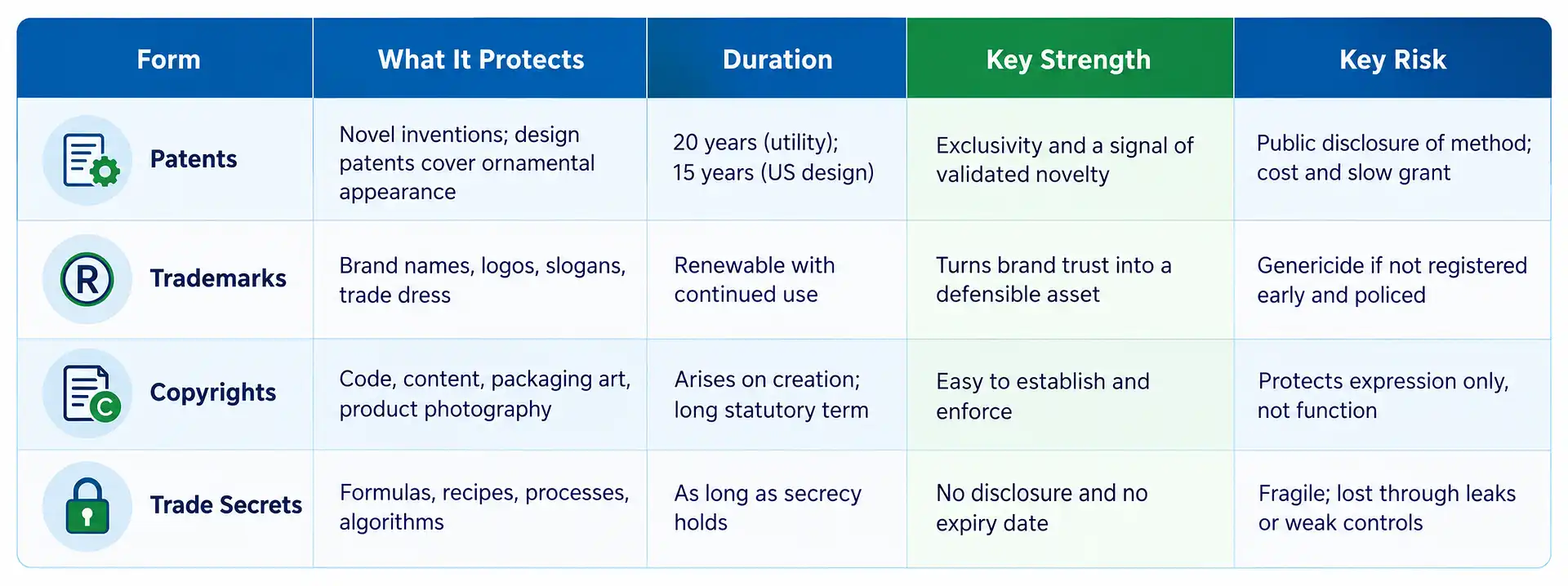
Comparing Patents, Trademarks, Copyrights, and Trade Secrets
Patents and Design Patents
Patents grant exclusive rights to novel inventions, usually for 20 years. For deep tech, materials science, and engineered consumer goods, they protect function and signal validated uniqueness to investors. Design patents add protection for a product’s ornamental look, which matters when the shape itself sells the item. Patents are public documents, though, and they disclose method to every competitor who reads them. In fast-moving categories, the time and cost to secure a patent can exceed its value unless the owner is ready to enforce it.
Trademarks, Trade Dress, and Brand Equity
In consumer businesses, the brand is an asset class of its own. Trademarks protect names, logos, and slogans. Under consumer products IP law, trade dress can also extend protection to packaging and product shape. The goal is not only to defend the mark but to bind it to customer trust. Marks must be distinctive, registered early, and defended actively to avoid genericide.
Copyrights and Trade Secrets
Copyrights guard creative expression such as code, content, design, packaging artwork, and media. They exist upon creation and are easier to enforce than patents. Their reach stops at expression, however, and never extends to function.
Trade secrets are the least visible form of protection and often the most powerful. They cover information that draws its value from secrecy, such as recipes, formulas, and internal processes. Coca-Cola’s formula and Google’s search ranking algorithm show how far that protection can reach. Secrecy stays fragile without NDAs, access protocols, and a culture that respects confidentiality.
Strategic IP That Sits Beyond the Statute
Some of the strongest defenses never appear in a registry. Data moats, user behavior patterns, network effects, and organizational know-how are protected by design rather than by law. The aim here is economic insulation, which complements consumer products IP law instead of replacing it.
Freedom to Operate, Ownership, and Investor Diligence
Under consumer products IP law, the surrounding landscape matters as much as the portfolio itself. Filing without a freedom-to-operate analysis can invite litigation from holders of earlier rights. Missing IP assignments from contractors can leave ownership in doubt at the worst possible moment. Diligence teams tend to ask four plain questions about any IP estate:
- Who owns each asset, and is that ownership documented?
- When was each right filed, and in which jurisdictions?
- Are there liens, licenses, or other encumbrances?
- Is there a coherent strategy that ties the portfolio to the business?
Acquisition diligence turns these questions into hard requirements. A cybersecurity and identity access management company with teams in five countries cannot pass a buyer’s review without clean assignments from staff and subcontractors.
The Founder’s Three Tasks in Building an IP Moat
The founder’s work on intellectual property follows a clear sequence, shown in the flow below.
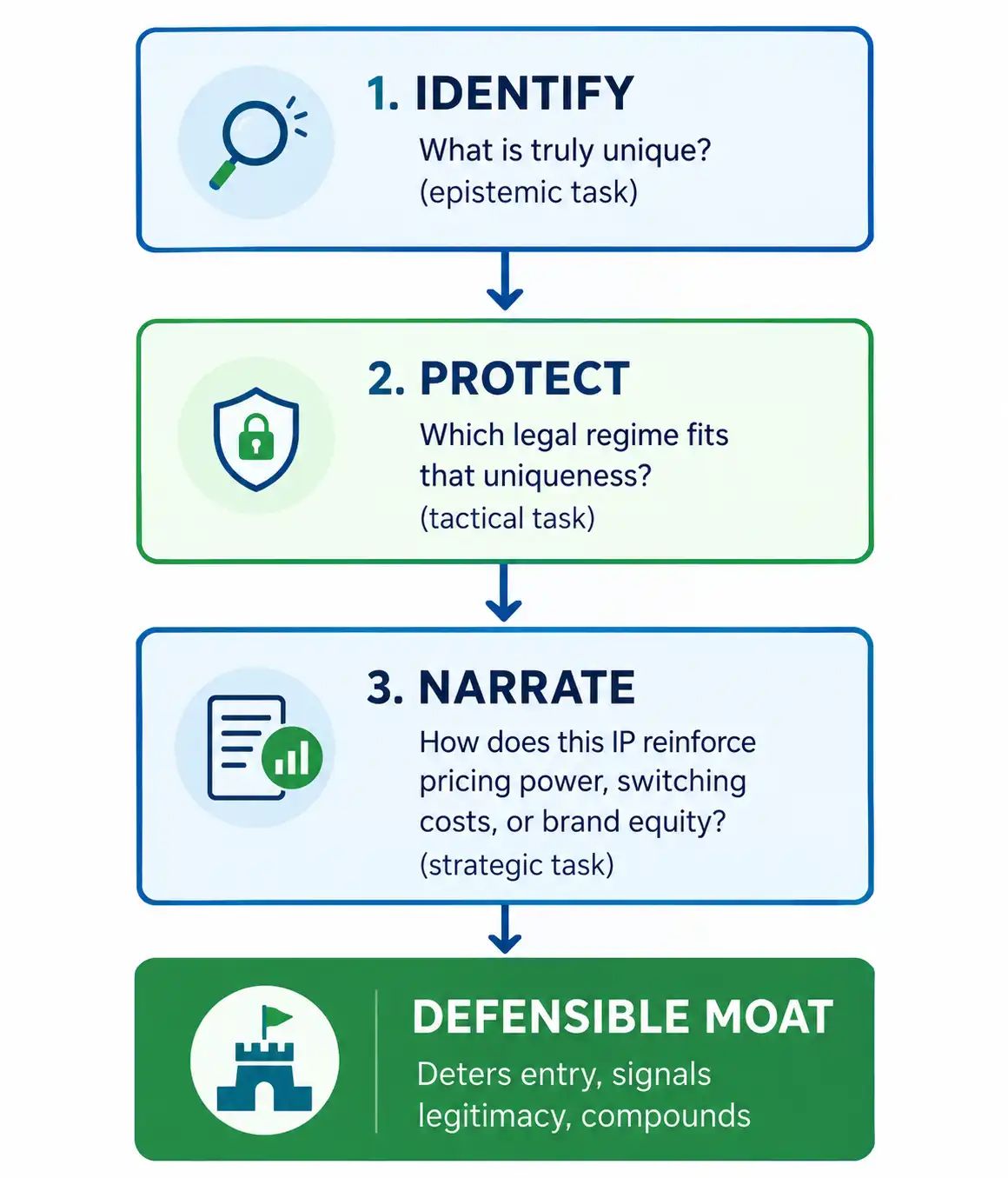
Treated this way, intellectual property works less like a vault and more like a moat around the business. It deters encroachment, signals legitimacy, and compounds over time.
Putting Consumer Products IP Law to Work
Filing a right is only the opening move in any IP strategy. Once established, intellectual property must be enforced, monetized, and embedded in the operating logic of the company. Ten levers turn consumer products IP law from a legal file into daily practice.
Enforcement, Licensing, and Risk Transfer
- Enforcement: An unenforced right is little more than an opinion. Cease-and-desist protocols, outside counsel on retainer, and litigation budget thresholds deter most infringers.
- Licensing: IP can earn revenue directly, as when a biotech firm licenses molecules or a brand licenses its mark into new categories. Each deal needs clear terms on rights, exclusivity, geography, and revocability.
- Defensive licensing: Cross-licensing and patent pools, common in hardware and semiconductors, are sometimes wiser than a courtroom fight.
- IP insurance: Specialized coverage for legal costs and damages is prudence, not paranoia, in patent-heavy sectors.
Openness, Geography, and Employment Hygiene
- Open IP strategy: Open-sourcing part of a stack can speed adoption, while copyright, MIT or GPL licenses, and trademarks preserve control.
- Internationalization: IP is territorial, so a US patent offers no protection in Europe. A brand must file its Chinese trademark in China directly.
- Employment hygiene: Every contractor, employee, and advisor must sign IP assignment and confidentiality agreements, since lapses here have derailed IPOs.
Geography deserves extra weight in consumer products IP law because so many brands manufacture overseas. China follows a first-to-file trademark system, so registering marks there before production scales is basic prudence. A Euronext Paris-listed gaming company with operations across five countries offers a parallel lesson. More than $100M in cross-border M&A depended on confirming that each target held clear title to its code and marks in every relevant jurisdiction.
Narrative, Intelligence, Culture, and Renewal
- Investor communication: IP belongs in the pitch deck, the data room, and the term sheet as evidence of defensibility.
- Competitive monitoring: IP intelligence tools track competitor filings and reveal white spaces, which is strategic awareness, not espionage.
- Internal education: Product managers tag patentable features, designers watermark content, and engineers respect open-source license boundaries.
- Portfolio renewal: An annual review prunes weak claims, sells dormant assets, and extends or bundles the strong ones.
Keeping the Intellectual Property Portfolio Alive
Products change, threats evolve, and competitors adapt, so no portfolio built under consumer products IP law can stay frozen. Every invention, brand asset, and proprietary insight has a half-life that management should track. Portfolio reviews deserve a standing place on the board calendar, much like the annual operating plan.
Narrative is the final layer of a mature IP strategy. In fundraising, partnerships, and hiring, investors look for product-market moat as well as product-market fit. A well-managed portfolio, shaped by a clear grasp of consumer products IP law, makes that moat legible to every outside reader. The greatest vulnerability in a competitive market is not being copied, but failing to know what is worth protecting in the first place.
Three Key Takeaways
- Consumer products IP law works best as a layered system, where patents, trademarks, trade dress, copyrights, and trade secrets each guard a different part of the product. Matching each asset to the right regime matters more than filing everything.
- Ownership hygiene decides whether IP survives diligence, so every employee, contractor, and advisor needs a signed assignment and confidentiality agreement. Freedom-to-operate checks and early filings in manufacturing countries close the most common gaps.
- Intellectual property creates value only when it is enforced, licensed, communicated to investors, and reviewed each year. A portfolio managed this way turns differentiation into lasting pricing power.
Disclaimer: This article is intended for informational purposes only and does not constitute legal, tax, or accounting advice. You should consult your own tax advisor or counsel for advice tailored to your specific situation.
Hindol Datta is a four-time CFO and senior finance executive with over 25 years of leadership experience across cybersecurity, SaaS, gaming, logistics, digital marketing, medical devices, consumer products, and nonprofit organizations. He has led more than $120M in fundraising and over $150M in M&A transactions while building the financial and operational systems that let complex businesses scale with confidence. He is the author of seven books in the Systems CFO Series and holds active CPA, CMA, and CIA credentials.
AI-assisted insights, supplemented by 25 years of finance leadership experience.