
Executive Summary
Every pitch eventually meets one blunt investor question: what stops a rival from doing this tomorrow? A competitive moat is the answer, and it separates a fast-growing startup from a defensible one. This article explains what a moat is, the nine forms it takes, and why venture capital rewards it over momentum.
The second half turns from theory to proof. Founders will find the metrics, cohort signals, governance habits, and narrative discipline that make a startup moat visible to investors. The goal is a defense that strengthens with scale and survives the scrutiny of diligence.
What a Competitive Moat Is and What It Is Not
The word comes from medieval fortresses, where a ring of water kept attackers away from the walls. Venture investors borrowed the image to describe how a company resists competition and protects margins over time. In early-stage investing, few questions carry more weight in the decision to commit capital.
A head start is not a moat, and neither is a clever feature or early traction. These advantages are real, but they erode as soon as competitors catch up. First-mover advantage qualifies only when it compounds, and brand recognition qualifies only when customers form a bond rivals cannot break.
A true competitive moat works as an economic anomaly that tilts competition toward one firm year after year. It bends the rules of the market through a self-reinforcing system of advantage rather than through scale alone.
The Nine Types of Startup Moat
A competitive moat comes in several forms, and the strongest companies often combine two or three of them. The table below summarizes each type alongside the condition that keeps it durable.
Startup Moat Types at a Glance
| Moat Type | How It Works | What Keeps It Durable | Where It Appears |
| Technology | An advanced design or method that is costly to imitate | Barriers to reverse engineering and parallel development | Deep tech, biotech, semiconductors, AI infrastructure |
| Network effects | Value rises as more users join and interact | Interactions between users, not user count alone | Uber, Airbnb, LinkedIn |
| Switching costs | Economic, emotional, or procedural friction to leave | Stickiness earned through value, not coercion | Enterprise SaaS embedded in core workflows |
| Brand affinity | Trust, narrative, and identity beyond recognition | A close pairing with product excellence | Patagonia, Apple |
| Data advantage | The exclusive ability to learn from proprietary data | Continual enrichment of the dataset | Machine learning systems |
| Cost structure | Scale efficiencies that newcomers cannot match | Operational excellence as strategic insulation | Logistics, consumer staples |
| Ecosystem control | Owning the rails that others depend on | Third parties building on the infrastructure | AWS, Stripe, Android |
| Regulatory mastery | Compliance expertise that outpaces rivals | Depth in complex rule sets | Fintech, healthtech, edtech |
| Culture | Cohesion, velocity, and grit that beat better-funded rivals | Compounding excellence over time | Teams at any stage |
Where Each Moat Breaks Down
Technology moats look impressive in a pitch deck, yet they turn brittle without barriers to understanding or copying. Network effects demand more than a large user base, because users who never interact create no compounding value. Switching costs must come from embedded value, since customers who feel trapped leave at the first opportunity.
Data moats fade without fresh inputs, and brand affinity weakens when the product stops living up to the story. Regulatory capture strikes some observers as distasteful, but compliance depth gives fintech and healthtech firms a real edge. Culture is the most overlooked defense, and it counts only when it produces compounding excellence.
Cost structure deserves a practical illustration from the consumer goods world. A consumer products business that doubles inventory turns through demand planning and SKU rationalization releases trapped working capital. That cost position becomes hard for newer entrants to match, even with better funding.
Building a Competitive Moat on Purpose
Moats rarely appear by accident, and many founders mistake speed for insulation. A fast-growing company may sit ahead of the curve today and still get overtaken next year. By contrast, a competitive moat grows stronger as the business scales.
Diagnostic Questions for Founders
Diagnosis requires empirical rigor and a willingness to ask uncomfortable questions such as these:
- What does the company have that competitors cannot copy, buy, or rent?
- What becomes more valuable or harder to attack as the company scales?
- Where do those answers appear in the pitch deck, diligence memos, and investor discussions?
The Competitive Moat Flywheel
A genuine competitive moat compounds instead of accumulating, and each stage of the loop feeds the next one.
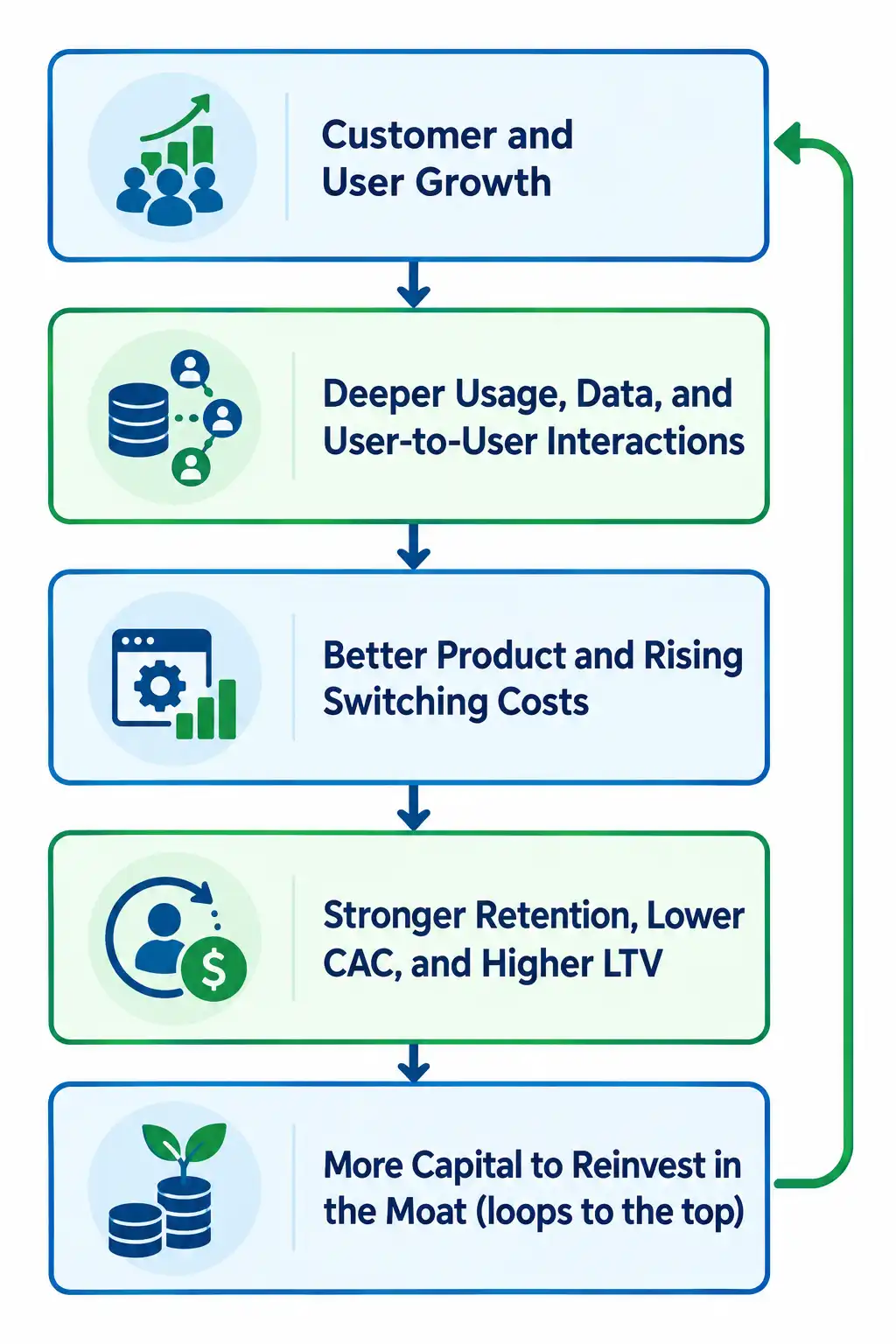
A moat guarantees nothing, but its absence often comes before failure. Venture capital does not back momentum alone; it backs inevitability, and a well-built moat turns the improbable into the inevitable.
Proving a Competitive Moat with Data
Claiming defensibility costs nothing, while demonstrating it with evidence is what earns venture conviction. Investors trained in pattern recognition want to see the competitive moat in numbers, not adjectives.
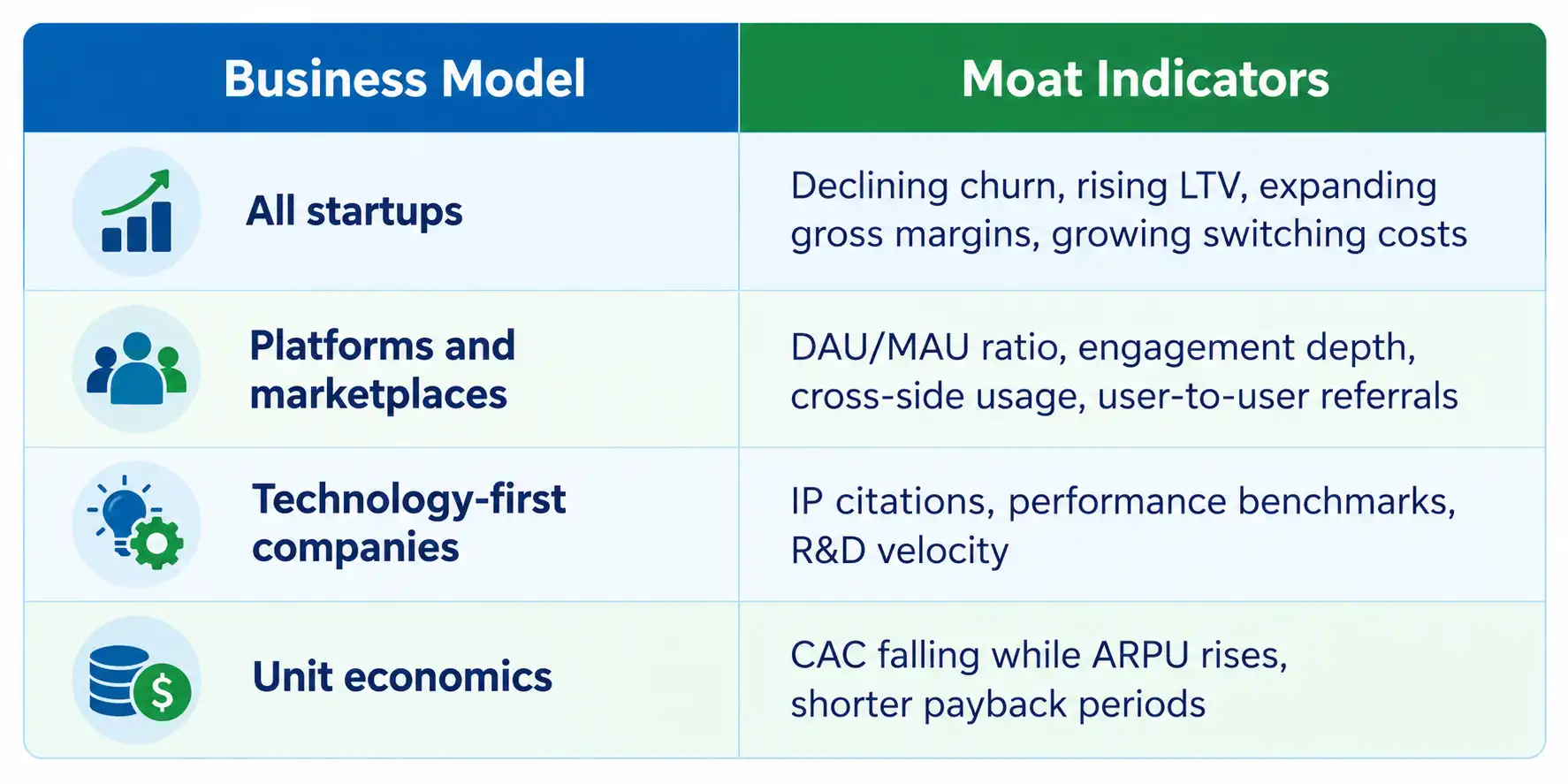
Moat Metrics Investors Track
Each competitive moat leaves a distinct signature in the data that diligence teams look for. The table below maps common moat indicators to the business models where they matter most.
Cohort Analysis and Margin Expansion
A defensible business shows improving metrics across cohorts, with newer users converting faster, spending more, and staying longer. This pattern signals compounding advantage beyond product improvement alone. In a Series B raise, cohort and unit economics models often anchor diligence and decide whether the story survives scrutiny.
Margin expansion tells the same story through economics. When customer acquisition cost falls while average revenue per user rises, founders should surface and explain that inflection point. Rapid growth without this discipline often hides deteriorating unit economics until it is too late. Tight CAC, LTV, and contribution margin tracking keeps fast expansion honest.
Benchmarking Against Competitors
A moat must exceed industry norms, not just exist on paper. Founders should know what rivals spend on CAC, how long their payback periods run, and how fast their customers churn. Without that context, strong numbers carry little meaning for an investor comparing dozens of companies.
Operationalizing the Startup Moat Across the Company
Metrics prove that a competitive moat exists, but operations determine whether it deepens. Investors look for evidence that defensibility shapes how the company plans, hires, and spends.
Roadmap, Customer Testimony, and Culture
The product roadmap should show investments that deepen the competitive moat, such as infrastructure for network effects or data models that sharpen prediction. UX flows that increase stickiness belong on that roadmap as well. VCs gain confidence when future capital targets defensibility, not growth alone.
Retention offers quantitative evidence, while loyalty supplies the qualitative proof investors also want. Case studies, user quotes, and NPS scores put a human face on moat strength. Cultural alignment matters just as much, because every team must understand the moat to defend it. Hiring, OKRs, and incentives should all reinforce that shared understanding.
Governance and Capital Allocation
Board materials, KPI dashboards, and OKR frameworks should track moat health on a regular cadence. Directors want to know whether LTV/CAC is improving, whether switching costs are rising, and whether competitors are copying the model. Holding actuals within five percent of forecast for 8 straight quarters gives a board that kind of confidence.
Companies that invest in their competitive moat at the expense of short-term metrics earn long-term trust. Those investments include brand, platform reliability, customer success, and compliance.
Narrating the Competitive Moat for Investors
Investors are not archaeologists, and they will not dig through cap tables and call logs to find the advantage. Founders must articulate how the company built the moat, why it resists replication, and how it will grow. The strongest narratives weave numbers, customer stories, and vision into one coherent argument.
A competitive moat behaves as a dynamic system that combines economic, psychological, technical, and cultural forces against entropy. A startup with a moat compounds instead of merely growing, retains instead of merely selling, and defends as it scales. Anyone can start a company, but few build the permanence that commands venture conviction.
Three Key Takeaways
- A competitive moat is a self-reinforcing advantage that strengthens with scale, so speed, features, and early traction do not qualify on their own.
- Investors trust a startup moat only when it shows up in data, including cohort improvement, margin expansion, falling CAC, and benchmarks that beat industry norms.
- Defensibility must run through the roadmap, culture, board reporting, and capital allocation, then reach investors as a clear narrative backed by evidence.
Disclaimer: This article is intended for informational purposes only and does not constitute legal, tax, or accounting advice. You should consult your own tax advisor or counsel for advice tailored to your specific situation.
Hindol Datta is a four-time CFO and senior finance executive with over 25 years of leadership experience across cybersecurity, SaaS, gaming, logistics, digital marketing, medical devices, consumer products, and nonprofit organizations. He has led more than $120M in fundraising and over $150M in M&A transactions while building the financial and operational systems that let complex businesses scale with confidence. He is the author of seven books in the Systems CFO Series and holds active CPA, CMA, and CIA credentials.
AI-assisted insights, supplemented by 25 years of finance leadership experience.