
Executive Summary
Choosing a tech stack is among the earliest decisions a startup makes, and it is among the longest lasting. What begins as an engineering preference soon hardens into an architectural commitment. That commitment governs how fast a team ships, how safely the product scales, and what each new feature will cost.
This article sets out ten criteria for selecting a startup technology platform, then follows that platform through its later life of migration, modularization, and technical debt. Founders, CFOs, and investors will find a practical lens for treating technology as a business decision instead of a matter of developer taste.
Why Choosing a Tech Stack Is a Strategic Decision
Early-stage companies live with a permanent asymmetry between ambition and resources. They hold more ambition than capital, more ideas than time, and more vision than infrastructure. Under those conditions, a platform has to do more than function; it has to compound. A good choice lets the team ship quickly, iterate with confidence, and pivot without starting over.
A poor choice imposes drag that grows each quarter. Engineering debt piles up, integrations stall, and performance turns fragile under load. Founder-led product ventures show this pattern again and again. Technology selection made in the first few months tends to shape every later conversation about roadmap priorities, vendor spend, and the financial architecture behind the business.
How a Platform Decision Travels Through a Company
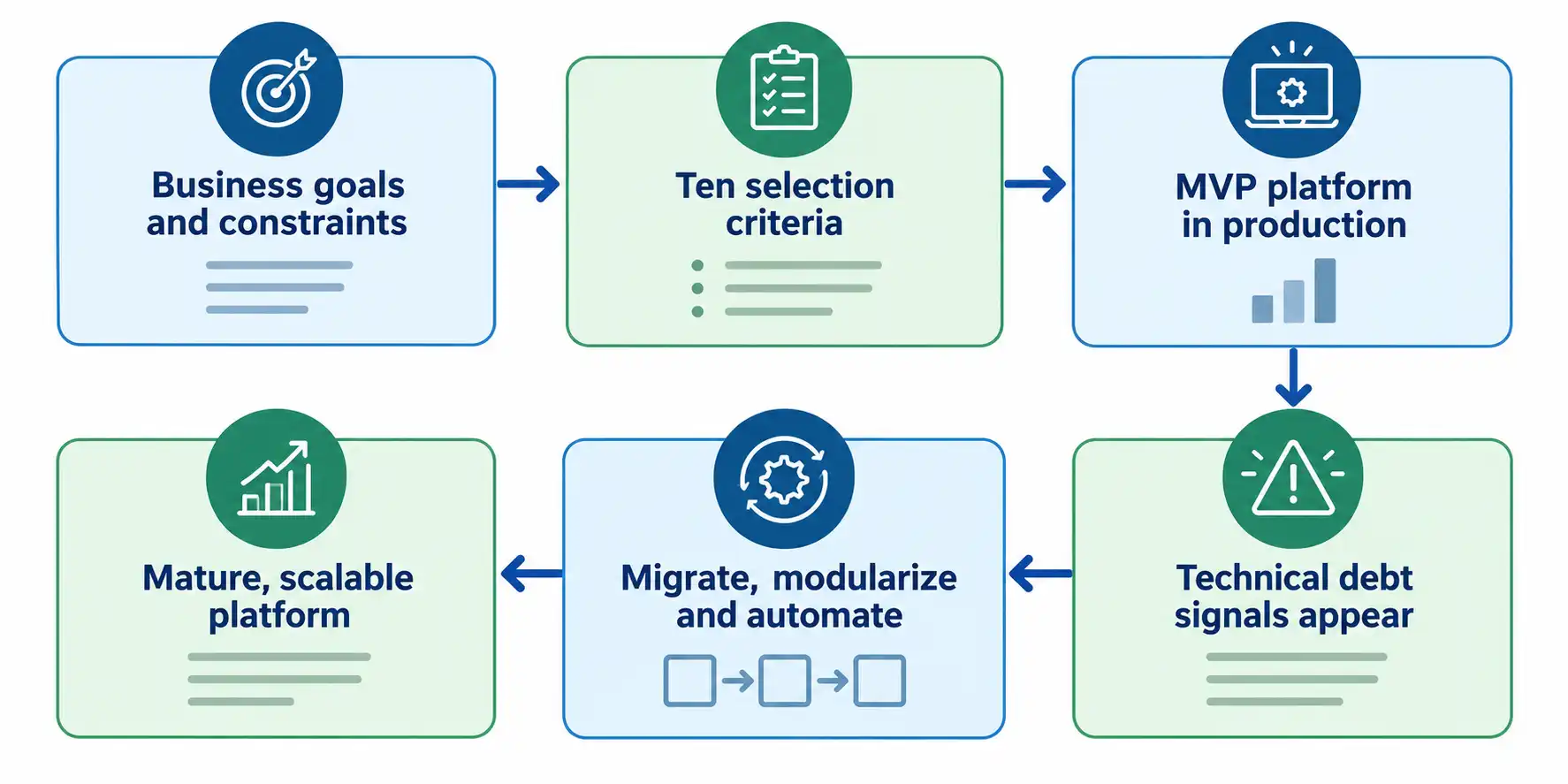
Ten Criteria for Choosing a Tech Stack at the Early Stage
Velocity, Reliability, and Scalability
When choosing a tech stack, velocity comes first, because startups must optimize for time-to-product and not only time-to-market. The right platform reduces boilerplate and removes deployment friction. Consumer apps may favor mobile-first frameworks or no-code tools. SaaS products often benefit from opinionated full-stack environments that limit decision fatigue. The goal is the fastest credible prototype, not a perfect system.
Speed without stability, however, invites failure once real customers arrive. Reliability asks how the stack handles concurrency, outages, and version control. Documentation quality, community support, open-source maturity, and cloud service SLAs all deserve a hard look here.
Scalability asks whether the system can absorb a 10x surge in users without an architectural rewrite. Kubernetes, microservices, and serverless compute offer elasticity, yet each one adds complexity. The skill lies in choosing what scales just enough for now. A venture-backed digital marketing company that grew revenue from $9M to $180M in 24 months shows why this matters. Systems sized for the first stage would have broken long before the second.
Security, Hiring, and Cost
No team can bolt security on later without paying heavily for it. Data privacy, authorization logic, and audit trails belong in the foundation. For fintech and healthcare startups, compliance requirements turn secure defaults into a non-negotiable condition.
Hiring matters because every platform is also a talent ecosystem. An esoteric stack may flatter an architect, yet it narrows the pool of engineers a startup can recruit and retain. Technologies with active communities and strong documentation give a small team leverage.
The cost of choosing a tech stack reaches well beyond the cloud invoice. Developer productivity, third-party integrations, and technical debt all belong in the total cost of ownership. The cheapest platform can become the most expensive one if it demands constant patching. Any turnaround, such as an early-stage email marketing company cutting monthly burn from $800K to $200K, puts every recurring technology cost under review.
Extensibility, Vendor Risk, Observability, and Alignment
Extensibility recognizes that the first use case will not be the last. New APIs, admin layers, and analytics dashboards will follow, and the platform has to welcome them. Vendor risk asks what happens if a single cloud provider, closed-source tool, or proprietary database becomes a dependency. Founders choosing a tech stack should weigh lock-in and plan an exit path early.
Testing and observability form the ninth criterion, and neither is optional. CI/CD pipelines, log aggregators, and performance monitoring are table stakes from day one. Strategic alignment completes the list of ten criteria. A startup that promises speed must build quickly, and one that sells security cannot afford a breach.
Summary of Criteria for Choosing a Tech Stack
| Criterion | Key Question | Early-Stage Guidance |
| Velocity | How fast can the team ship? | Minimize setup and maximize developer throughput |
| Reliability | Will it hold under real load? | Check documentation, uptime, and community maturity |
| Scalability | Can it handle 10x growth? | Build elastic, but avoid premature microservices |
| Security | Is secure design the default? | Favor identity integration and audit tools |
| Hiring | Can the team find talent? | Match the stack to the available talent pool |
| Cost | What is the full cost? | Evaluate total cost of ownership, not cloud fees |
| Extensibility | Can it grow with the product? | Confirm APIs and third-party integrations |
| Vendor Risk | What if a vendor fails? | Diversify core infrastructure dependencies |
| Observability | Can bugs surface quickly? | Add logging, tracing, and monitoring early |
| Strategic Alignment | Does it express the mission? | Let platform choices reinforce market positioning |
From MVP to Maturity: Evolving the Chosen Tech Stack
Every platform, like every strategy, must evolve as the company grows. Choosing a tech stack wisely at formation does not exempt a company from the friction of scale and the inertia of legacy code. The question becomes how to move from minimum viable infrastructure to a robust platform without paralysis.
Managing Technical Debt Before It Compounds
Early platforms accumulate technical debt, and that debt is the price of speed, not a sign of failure. The real issue is whether teams acknowledge, measure, and manage it. Strong teams catalog trade-offs, set service-level objectives (SLOs), and schedule refactoring sprints inside the product roadmap.
Technical debt also accrues interest in velocity, morale, and user experience. Premature optimization carries its own danger, draining time from customers. The best startups build scrappy but never sloppy, and they treat debt repayment as a core discipline.
Timing a Platform Migration
Migration often sits at the center of this evolution. Common examples include moving from a monolith to microservices, from SQL to NoSQL, from Heroku to AWS, or from in-house authentication to Auth0. Migrate too soon and the team wastes cycles; migrate too late and outages follow.
One cybersecurity and identity access management company offers a useful case. A NetSuite implementation across 5 country entities compressed the monthly close from 18 days to 10. The project worked because the pain signals were already loud and the business case was clear.
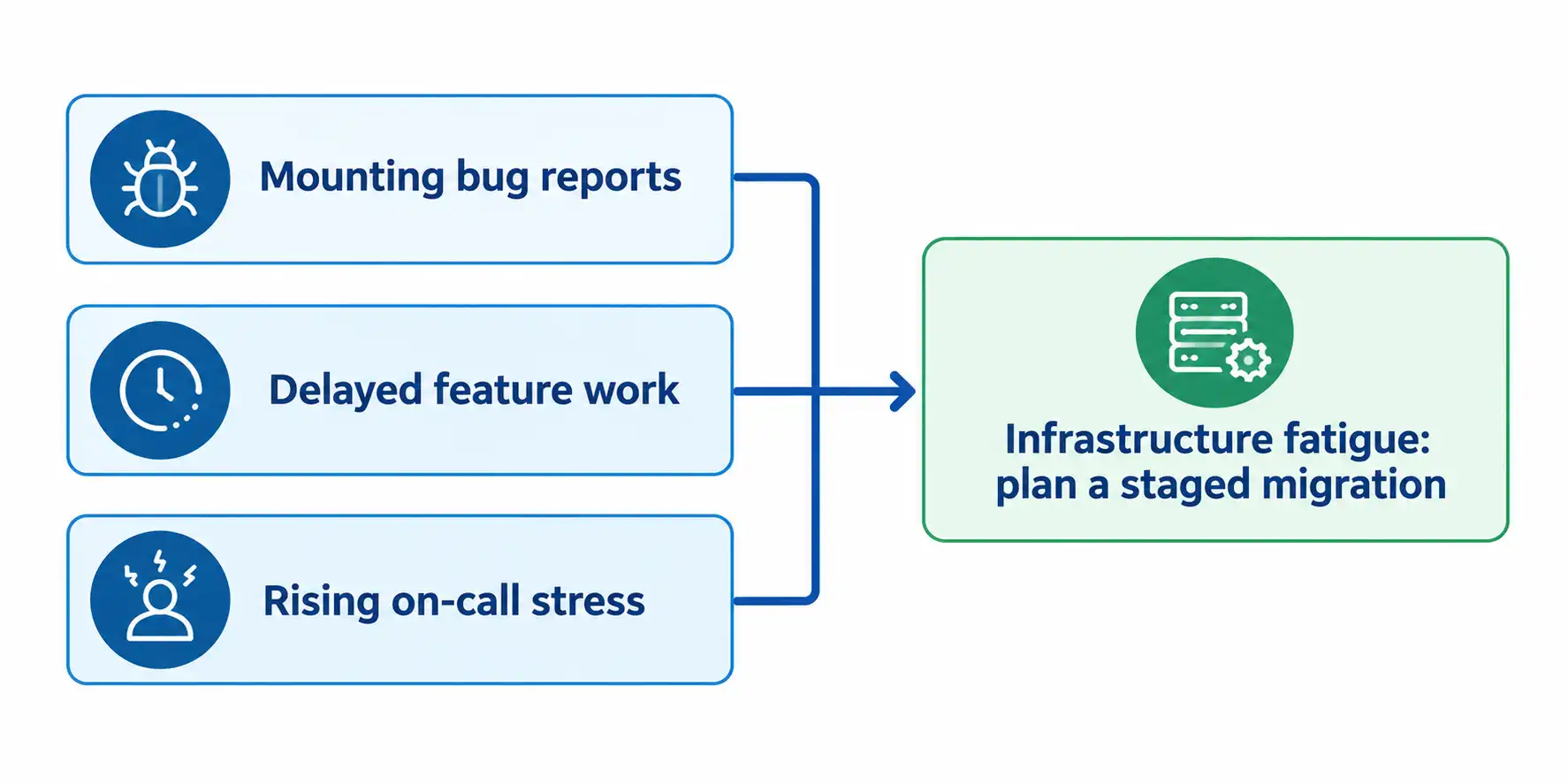
Warning Signals That Call for a Migration
Disciplines That Carry a Platform to Maturity
Beyond debt and migration, eight disciplines decide whether a platform matures gracefully. A public gaming company with operations in five countries illustrates the value of shared platforms. Rolling out Oracle Financials and MicroStrategy firmwide created a single definition of revenue across every subsidiary. Consistency of that kind is the payoff of deliberate platform abstraction, and the disciplines below complete the maturity agenda.
- Modularization: Break billing, user authentication, and analytics into services that evolve at their own pace.
- Observability: Build dashboards, alerting, and root-cause tools so that growing complexity stays visible.
- Automation: Use CI/CD, infrastructure-as-code, and automated testing to cut toil and prevent regressions.
- Resilience engineering: Run chaos tests, fault injection, and load tests so systems degrade gracefully.
- Platform abstraction: Offer internal “paved roads” with opinionated tooling that enforce best practices.
- Developer experience: Make onboarding, coding, and deployment intuitive to lower ramp-up time.
- Product-technical alignment: Tie every platform investment to user impact, such as faster loads or fewer bugs.
- Cost-to-serve and mentorship: Audit spend as unit economics shift, and let senior engineers document decisions and guide juniors.
A platform that grows faster than the product adds bloat. One that lags behind the product adds friction. The right platform evolves just ahead of need.
Treating Technology as a Leadership Responsibility
Technology platforms are not an engineer’s prerogative alone. They reflect how a company thinks, learns, and builds, and they deserve attention from the entire leadership team. CFOs have a direct stake in choosing a tech stack, because platform choices drive cost-to-serve, hiring plans, audit readiness, and the credibility of future fundraising.
Strong founders look past what is trending and ask what future a given platform makes possible. Every platform decision deserves the weight of the next 10,000 users, because those users will depend on it.
Three Key Takeaways
- Choosing a tech stack is a business decision that should weigh velocity, reliability, scalability, security, hiring, cost, extensibility, vendor risk, observability, and strategic alignment together.
- Technical debt is the price of early speed, so teams should measure it openly and repay it on a schedule instead of letting it compound.
- Migration should follow clear signals such as rising bugs, delayed features, and on-call strain, and it should proceed in stages that protect momentum.
Disclaimer: This article is intended for informational purposes only and does not constitute legal, tax, or accounting advice. You should consult your own tax advisor or counsel for advice tailored to your specific situation.
Hindol Datta is a four-time CFO and senior finance executive with over 25 years of leadership experience across cybersecurity, SaaS, gaming, logistics, digital marketing, medical devices, consumer products, and nonprofit organizations. He has led more than $120M in fundraising and over $150M in M&A transactions while building the financial and operational systems that let complex businesses scale with confidence. He is the author of seven books in the Systems CFO Series and holds active CPA, CMA, and CIA credentials.
AI-assisted insights, supplemented by 25 years of finance leadership experience.