


Executive Summary
The model of strategy most organizations still rely on was built for a world that no longer exists. Annual planning cycles, top-down vision documents, and lagging indicators made sense when markets moved slowly and competitive advantages held for years. Today, business level strategy must function as a continuous capability, not a calendar event. This guide synthesizes a four-part framework for making that transition: diagnosing why static planning fails, reorienting measurement around real-time signals, designing a live planning architecture, and building the cultural conditions that allow adaptive strategy to take hold. For senior leaders navigating dynamic markets, the shift is not about discarding discipline. It is about embedding discipline into the rhythm of the business itself.
Why Static Planning No Longer Holds
There was a time when a leadership team could convene, set a three-year course, and trust that the environment would hold still long enough for execution to catch up with intent. That time is gone. Markets shift in weeks, not quarters. Customer behavior changes faster than planning cycles can accommodate. And geopolitical, technological, and economic volatility has become the operating norm rather than the exception.
The failure of traditional business level strategy is not one of ambition. It is one of tempo. Static plans rest on assumptions frozen at a point in time, validated through consensus, and supported by data that often ages by weeks or months before it reaches a decision-maker. Execution teams, meanwhile, operate in real time. The gap between what the plan says and what the market is actually doing widens silently until it becomes a crisis.
That gap has a recognizable set of consequences. Capital continues flowing into priorities that have lost their relevance. Teams lose confidence in leadership when the strategy on paper no longer reflects the reality on the ground. And in fast-moving markets, timing is itself a competitive asset. Rigidity destroys it.
The problem is structural, not cosmetic. Traditional planning treats strategy as an episodic event rather than a responsive function. Fixing it requires more than compressing the planning calendar or adding a rolling forecast. It requires rethinking what strategy is, what it measures, and how the organization acts on what it learns.
The Four-Part Framework for Adaptive Strategy
The transition from static to adaptive planning unfolds across four connected dimensions. Each builds on the one before it.
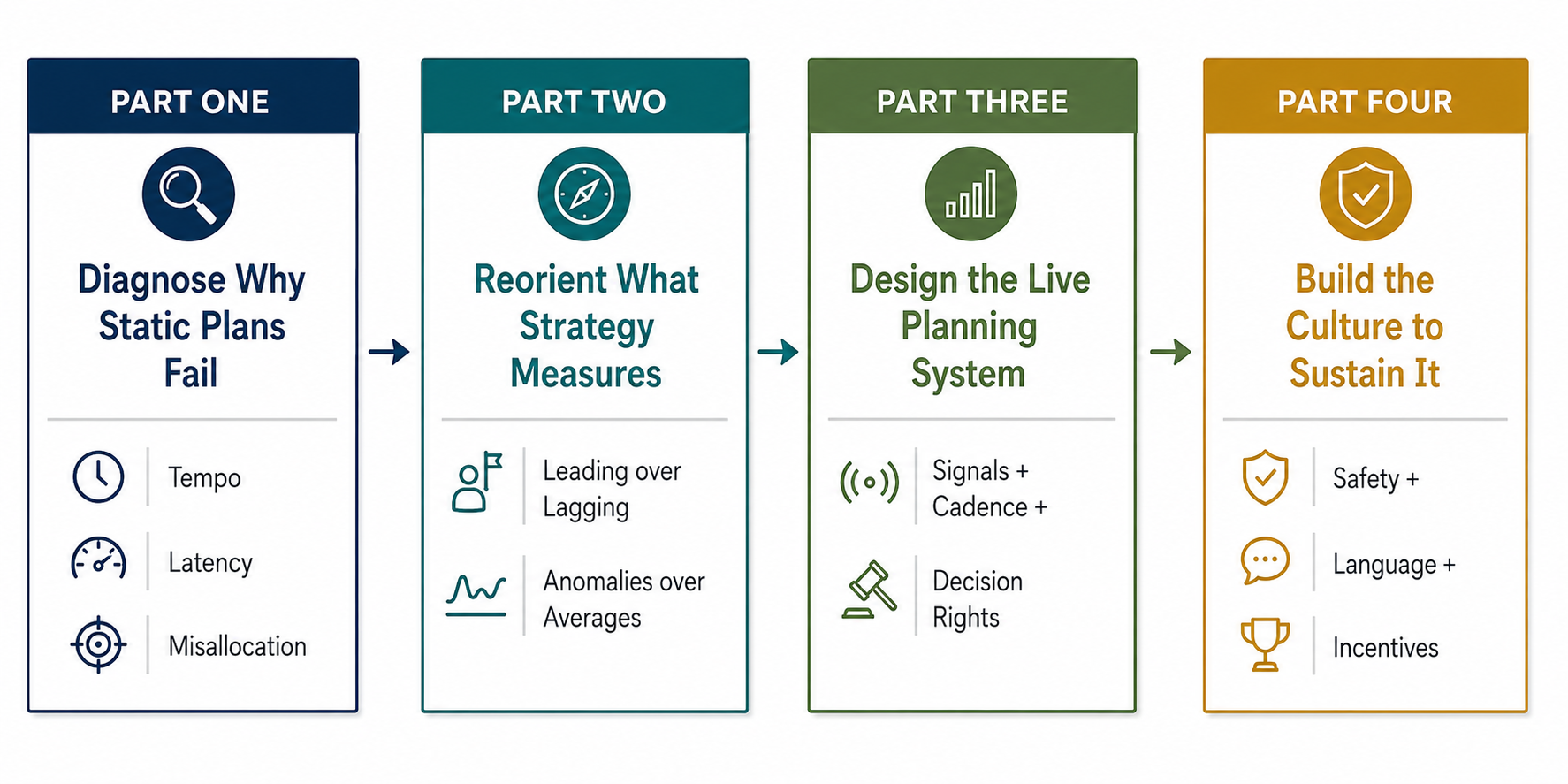
Part One: The Diagnosis — What Static Strategy Gets Wrong
The Structural Root of the Problem
Strategic drift rarely announces itself. It appears in small signals: a missed shift in customer preference, a competitor’s unexpected pricing move, a supply chain disruption that the plan did not account for. These are not black swan events. They are predictable consequences of a planning model that values consensus over inquiry and historical data over present signals.
The deeper issue is that traditional planning served a world where competitive advantages lasted years and market structures changed slowly. In that world, it made sense to invest heavily in a single annual planning cycle, align the organization around a fixed set of priorities, and execute against them with discipline. But in an environment where the half-life of a strategic assumption has shortened dramatically, that model introduces latency at precisely the moment agility is most valuable.
As someone who has operated across SaaS platforms, cybersecurity organizations, logistics networks, and digital marketing environments, I have watched this dynamic play out repeatedly. A company that builds its growth thesis around a stable interest rate environment, only to see rates move sharply within six months, does not fail because it lacked insight. It fails because its planning architecture was too slow to incorporate what became obvious too late.
The Three Costs of Latency
Static planning imposes costs that compound over time:
- Misallocation of resources: capital flows into priorities that have lost relevance while emerging opportunities remain underfunded
- Erosion of credibility: when operating teams see the gap between strategy and reality, trust in leadership degrades
- Missed timing: in dynamic markets, the ability to act early is a form of competitive advantage that rigidity forfeits
Part Two: The Measurement Shift: What Real-Time Strategy Must Track
From Lagging to Leading Indicators
The measurement philosophy of most organizations is built around outcomes: revenue, margin, market share, return on investment. These are important truths, but they are backward-facing ones. They tell leaders how the business performed, not how it is performing or where it is heading.
Real-time business level strategy requires metrics that signal change before it becomes visible on the financial statements. In SaaS environments, that might mean product usage trends or pipeline velocity. In consumer businesses, it might mean net promoter score volatility or digital channel sentiment. The goal is to surface intelligence early enough to act on it, not to explain a result after the fact.
This is a shift I have seen pay dividends across organizations: when a digital marketing platform I worked with embedded pipeline velocity as a core strategic signal, revenue predictability improved in a way that lagging revenue metrics alone could never have enabled.
From Averages to Anomalies
Traditional strategic data relied on consolidation. Performance was smoothed across business units, time periods, and customer cohorts to identify trends. But meaningful change rarely begins in the mean. It begins at the margin.
A three percent decline in overall customer satisfaction may appear manageable in aggregate, but a thirty percent decline driving it in one high-value geography tells a different story entirely. Real-time strategy pays attention to outliers, not as statistical noise, but as early signals of shifts that will eventually show up in the consolidated numbers.
From Fixed Targets to Dynamic Thresholds
A company that set a fifteen percent growth target in a market growing at twenty-five percent may report goal achievement while losing competitive ground. Static KPIs measure performance against a promise made in the past. Dynamic thresholds measure performance against what the present moment makes possible.
This reorientation demands that leaders recalibrate targets not just annually but in rhythm with external context. It is a form of intellectual discipline that separates companies with genuine strategic awareness from those executing against a plan that has already been overtaken by events.
Part Three: The Architecture — Designing a Live Planning System
The Five Principles of Live Planning
A live planning system does not replace discipline. It embeds discipline into the continuous flow of information and decision-making. It is built on five connected principles.
The first is integration. Data must flow horizontally across the enterprise, not just vertically through reporting lines. Sales forecasts must inform supply decisions. Product usage must inform pricing strategy. Market sentiment must inform hiring plans. Breaking the traditional silos between functions is not a technology problem alone. It is a design problem that requires deliberate architectural choices about where data lives, who can see it, and how it connects.
The second is visualization. A well-constructed dashboard is a decision support system, not a reporting tool. It must present the right signals, at the right altitude, with enough context for leaders to answer three questions at a glance: what is moving, why is it moving, and what does it mean for priorities. Clutter is the enemy of clarity, and clarity is the precondition for speed.
The third is cadence. Live planning operates in cycles rather than annual events. Monthly and biweekly planning sprints allow teams to review key signals, stress-test assumptions, and adjust operating plans within a governed framework. This creates directional fidelity with tactical flexibility, not chaos.
The fourth is decentralized decision rights. In a live planning model, not every adjustment should require executive approval. Teams closer to the data must act within defined guardrails without waiting for executive approval on every adjustment. A business strategy consultant advising on this design would begin by mapping which decisions belong at which levels, under what thresholds, and with what feedback loops in place.
The fifth is narrative. In a world of real-time signals, people still need meaning. Leaders must translate data into story: what the organization believes is happening, what it is testing, and what it is adjusting. Without that narrative layer, teams lose alignment and begin optimizing for their own interpretation of the truth.
Identifying the Right Signals
Not every available metric belongs in the live planning system. The most effective approach is to identify the dozen or so signals that, if they moved significantly, would require a strategic response. These become the heartbeat of the planning rhythm. Everything else is context, reviewed less frequently and with less urgency.
In building finance organizations across multiple sectors, from a cybersecurity company with multi-entity global architecture to a logistics operation managing over one hundred and twenty million dollars in revenue, the consistent finding is that signal overload is as dangerous as signal absence. The discipline is in selection, not accumulation.
Part Four: The Culture — What Systems Alone Cannot Fix
Why Technology Is Not the Answer
The most elegantly engineered live planning system will fail at the first point of cultural resistance. Dashboards can deliver data with precision. Planning cadences can be retooled for agility. But if the people inside the system do not trust the signals, fear accountability for course correction, or default to the comfort of fixed plans, the system collapses into compliance theater.
Moving to real-time strategy is not a digital challenge. It is a cultural one. And for most organizations, that is the harder transformation.
The Five Cultural Levers
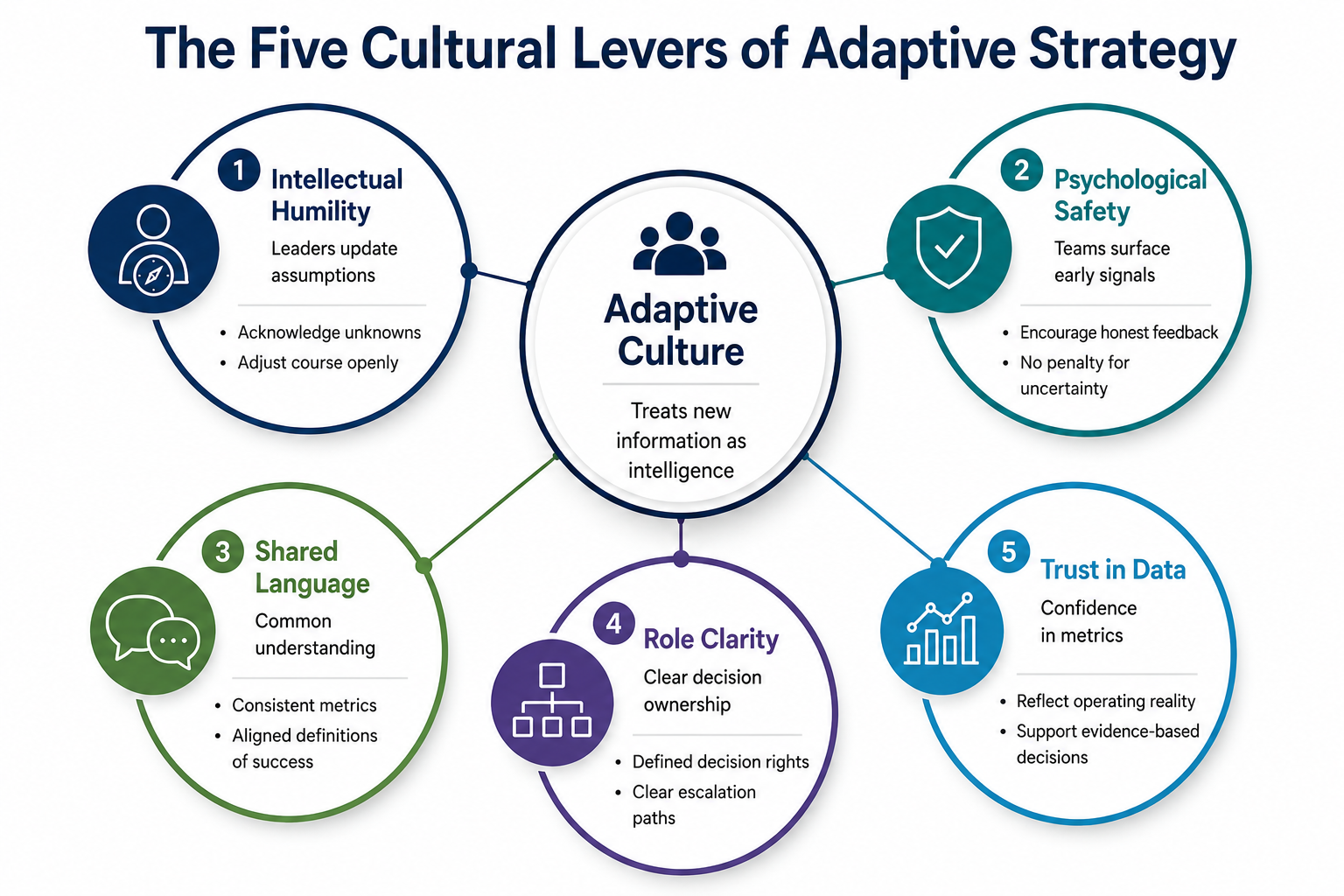
Culture reveals itself most clearly in how an organization reacts to new information. In a static planning environment, teams often suppress or explain away data that contradicts the plan. In an adaptive culture, leaders treat it as intelligence.
Building that kind of culture requires attention to five levers:
Incentives Must Follow the Culture
The deepest lever is also the most often overlooked. Too many organizations still reward adherence to the plan over responsiveness to reality. Performance evaluations celebrate stability even when it masks stagnation. For adaptive strategy to take hold, organizations must reinforce the behaviors it requires in how they measure success. Leaders should recognize teams not just for results, but for the speed and intelligence of their adjustment.
I once worked with an organization that implemented a technically sound rolling forecast model, only to watch it become ceremonial within six months. Every downward revision was met with scrutiny rather than engagement. The message was clear: forecast only when it flatters. The system was ahead of the culture. The turning point came when the chief executive stood before the leadership team and said that adjusting the plan was not a sign of weakness but a sign of leadership. That statement changed the dynamic entirely.
Conclusion
The organizations that will outperform in the years ahead are not those with the most sophisticated planning tools or the longest strategic horizons. They are the ones that have learned to sense sooner, adjust faster, and align more continuously than their competitors. Business level strategy, in this environment, is not a document. It is a discipline: one that connects real-time data to real-time decisions through systems, culture, and leadership that treat change not as a threat to the plan but as the raw material of it. Building that capability takes time, and it takes deliberate design at every layer of the organization. But it is the only form of planning that is honest about the world we are actually operating in.
Disclaimer: This blog is intended for informational purposes only and does not constitute legal, tax, or accounting advice. You should consult your own tax advisor or counsel for advice tailored to your specific situation.
Hindol Datta is a seasoned finance executive with over 25 years of leadership experience across SaaS, cybersecurity, logistics, and digital marketing industries. He has served as CFO and VP of Finance in both public and private companies, leading $120M+ in fundraising and $150M+ in M&A transactions while driving predictive analytics and ERP transformations. Known for blending strategic foresight with operational discipline, he builds high-performing global finance organizations that enable scalable growth and data-driven decision-making.
AI-assisted insights, supplemented by 25 years of finance leadership experience.