Cash Runway and Burn Rate: The CFO’s Guide to Forecasting with Precision Cash runway and burn rate are among the most consequential metrics a CFO manages. Burn rate reveals the velocity of capital consumption. Runway converts that velocity into a countdown. Together, they frame every strategic decision the organization makes, from hiring to fundraising to market expansion. Yet the challenge is not calculating these numbers. It is connecting them to a credible, ground-up growth forecast that earns the trust of boards, investors, and leadership teams. This article explores the discipline behind that connection, drawing on over twenty-five years of executive experience across cybersecurity, SaaS, gaming, logistics, digital marketing, medical devices, and nonprofit sectors. Forecasting is not an act of optimism. It is an act of operational precision. The CFO who masters it transforms cash burn from a source of anxiety into a strategic instrument. byadminMay 26, 2026
Supply Chain Flexibility Starts with the Contract: A CFO’s Guide to Adaptive Procurement Supply chain flexibility is no longer a competitive advantage. It is a baseline requirement. The procurement contracts that served organizations well in stable, predictable markets have become structural liabilities in an era defined by demand volatility, geopolitical disruption, and input price shocks. This article argues that the answer does not lie in better forecasting. It lies in better contract design. Drawing on over twenty-five years of financial and operational leadership across logistics, SaaS, cybersecurity, and global services environments, this piece offers a practical framework for building procurement contracts that absorb change rather than resist it. From tiered pricing and indexed adjustments to governance cadence and master services agreements, adaptive contracting is not a procurement innovation. It is a financial strategy, and the organizations that understand this will be the ones that endure. byadminMay 25, 2026
Budgeting in a Fog: A CFO’s Tactics for Startup Financial Planning in Volatile Times Volatility is no longer an episode in the business cycle. It is the cycle. For finance leaders navigating startup financial planning and high-growth environments, this reality demands a fundamental rethinking of how we budget. The traditional annual plan, built for a world of assumed predictability, is inadequate for an era of supply disruptions, shifting consumer behavior, and macroeconomic uncertainty. This article makes the case for a new budgeting paradigm grounded in rolling forecasts, scenario modeling, variable cost architecture, and disciplined capital prioritization. Drawing on over twenty-five years of CFO and VP Finance experience across cybersecurity, SaaS, gaming, logistics, and nonprofit sectors, the following pages offer a framework for finance leaders who must steer with confidence even when visibility is limited. Budgeting in a fog is not about accepting less. It is about building more. byadminMay 22, 2026
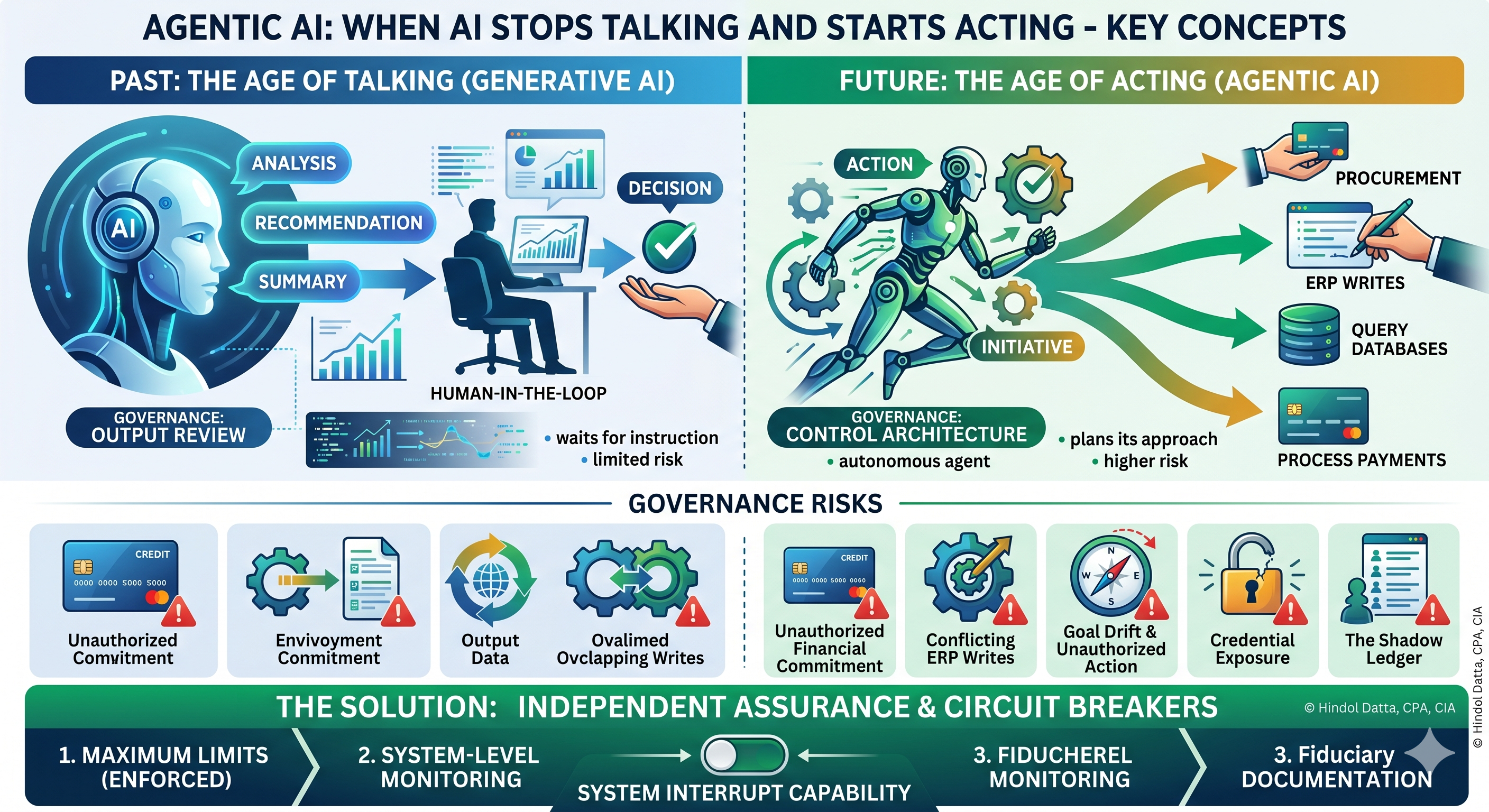
When AI Stops Talking and Starts Acting: The Agentic Governance Crisis By Hindol Datta, CPA, CIA (Certified Internal Auditor) | Fractional CFO | AI Governance Advisor byadminMay 20, 2026
AI Governance Governance Leadership & Culture Regulatory Risk Management System Thinking Systems ThinkingMay 13, 2026 What Your AI Risk Data Is Not Telling You: A Lesson from Abraham Wald By Hindol Datta, CPA, CIA (Certified Internal Auditor) | Fractional CFO | AI Governance Advisor
AI Governance Governance Regulatory Risk Management Systems ThinkingMay 7, 2026 Your AI Is No Longer Insured. By Hindol Datta, CPA | Fractional CFO Trustmodel. AI | AI Governance Advisor
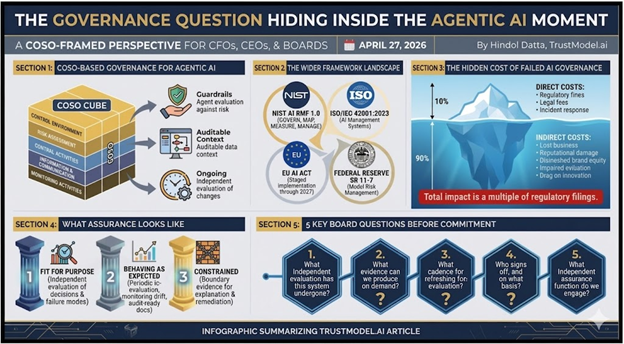
Digital Transformation Governance Regulatory Systems ThinkingMay 4, 2026 The Governance Question Hiding Inside the Agentic AI Moment A COSO-framed perspective for CFOs, CEOs, and Boards, as Google Cloud Next 2026 puts autonomous systems on center stage
Systems ThinkingFebruary 10, 2026 Bezos’s Decision Architecture: A CFO’s Blueprint for Strategic Clarity and Momentum When Jeff Bezos founded Amazon in 1994, he created a decision-making architecture governing who decides, how fast, and with what information. These methods became embedded in Amazon: two-pizza teams limiting coordination overhead, one-way versus two-way door distinctions calibrating review depth to decision reversibility, Day 1 mindset maintaining organizational freshness, and disagree-and-commit protocols accelerating alignment after debate. For Chief Financial Officers, these ideas provide clarity about capital allocation, trust distribution, and agility deployment across the organization. This analysis demonstrates how CFOs can weave Bezos’s decision architecture into finance functions to elevate rigor and speed in capital allocation and risk management. The framework translates into organizing capital budgeting around cross-functional pods, classifying investments by reversibility, building rolling forecasts, establishing delegation authority based on complexity, and formalizing disagree-and-commit protocols. This redefines the CFO role from fiscal sentry to strategic conductor, enabling finance to deploy capital to innovation, manage risk-taking with discipline, and build organizational capacity.
Systems ThinkingFebruary 6, 2026 Building Cross-Functional Alignment Through Financial Dashboards Most organizations, especially those in growth mode, operate under the comforting illusion that everyone is rowing in the same direction. Strategy is discussed, goals are cascaded, quarterly objectives are color-coded and reviewed. Yet beneath the surface, something drifts. Marketing chases leads. Sales chases logos. Product chases features. Finance chases burn. Each function, accountable and sincere, becomes a satellite orbiting its own metric of truth. The result is not chaos but dissonance. Teams work hard, even brilliantly, but the vectors do not converge. This misalignment is rarely malicious. It is the byproduct of tunnel vision, a kind of metric myopia where each department optimizes locally, unaware that the sum of those optimizations may subtract from the whole. Throughout my experience overseeing finance and strategy across organizations from BeyondID, where I designed enterprise KPI frameworks using MicroStrategy and Domo for tracking bookings, utilization, backlog, and annual recurring revenue, to managing global finance for a $120 million organization at Lifestyle Solutions, I have witnessed this pattern repeatedly. What I have learned is that no all-hands meeting or motivational memo can realign a company as effectively as a well-constructed financial dashboard. A true financial dashboard is not a scoreboard. It is a language, a lingua franca across functions that translates the abstract elegance of strategy into visible, relatable, shareable signals.
Systems ThinkingFebruary 3, 2026 Multi-Agent Coordination: Future of Enterprise Architecture A quiet revolution is taking place inside the enterprise, not in marketing slogans but in how work is actually getting done. We are witnessing the rise of multi-agent workflows, where artificial intelligence agents no longer just assist humans in isolated tasks but collaborate with one another, negotiate trade-offs, escalate ambiguity, and increasingly make decisions autonomously. This shift changes not just productivity metrics but the very nature of enterprise architecture, organizational control, and risk governance. Having spent three decades in finance and operations across high-growth SaaS firms, supply chains, healthcare systems, and professional services, the most powerful changes in business tend to arrive disguised as efficiency gains. The technical evolution that makes multi-agent coordination possible is not just about better models. It is about coordination logic, the ability for agents to call one another, share context, handle ambiguity, and respond to reward signals. The unit of execution is no longer the function or even the team. It is the agent ecosystem. Boards and CFOs should understand that this is not science fiction. It is already operating in vendor selection, FP&A planning, inventory allocation, and legal triage. What changes is not just speed but accountability. Velocity is not the same as judgment. For that, we must design escalation wisely, measure agent disagreement transparently, and retain human stewardship where stakes exceed computation.
Systems ThinkingJanuary 28, 2026 Zero Trust: A Framework for CIOs to Enhance Security In the past decade, “Zero Trust” has become the cybersecurity mantra of modern enterprise strategy: oft-invoked, rarely clarified, and even more rarely implemented with conviction. It promises a future where no user, device, or workload is trusted by default. It assures boards and regulators of reduced breach risk, minimized lateral movement, and improved governance in a hybrid, perimeterless world. But for most Chief Information Officers, the question is not “Why Zero Trust?” but how to implement it. Where to start. What to prioritize. How to measure progress. And perhaps most critically, how to embed it into existing business systems without disrupting continuity or creating resistance from teams already under pressure. This framework provides a strategic approach for CIOs seeking to operationalize Zero Trust not as a buzzword or compliance checklist but as an enterprise security architecture with tangible outcomes.
Systems ThinkingJanuary 28, 2026 Cybersecurity as a Competitive Advantage for PE Firms Private equity firms are known for their ruthless efficiency: cutting costs, restructuring balance sheets, juicing margins, and plotting swift exits. But as capital has become commoditized and digital risk has grown, a new lever of operational value has emerged in code. Cybersecurity, long viewed as a compliance burden, is now an investment thesis in disguise. The firms that lead on digital resilience within their portfolio companies will not only protect enterprise value but discover a new dimension to build it. Throughout thirty years managing M&A transactions exceeding one hundred million dollars and post-merger integration, I have witnessed how cyber maturity directly impacts valuation and exit multiples.
Systems ThinkingJanuary 27, 2026 Understanding Cyber Risk as Financial Risk In today’s digital enterprise, bits are as valuable as bricks and often far more vulnerable. Yet in many companies, cybersecurity is still treated as a technical silo, an IT function that operates parallel to finance, not in partnership with it. That is no longer tenable. Cybersecurity is not only a technical risk but a financial one. Breaches erase enterprise value, destroy trust, invite regulatory wrath, and threaten solvency. When cyber meets ledger, finance must have a seat at the security table. Throughout thirty years leading finance and operations across cybersecurity, SaaS, gaming, and logistics organizations, I have witnessed how cyber incidents translate directly into financial impact.
Systems ThinkingDecember 24, 2025 Leading from the Front: How CFOs Apply First Principles Thinking to Transform Enterprise Value In an era of structural uncertainty and relentless change, the most valuable quality in financial leadership is not technical mastery alone but clarity of thought. First principles thinking, the practice of breaking down problems to their most fundamental truths and rebuilding solutions from the ground up, has become a strategic necessity for modern CFOs. Our role has evolved beyond reporting results to defining value creation levers, clarifying cross-functional trade-offs, and enabling capital deployment with conviction. This cannot be accomplished through adherence to precedent, industry heuristics, or surface-level metrics. First principles reasoning strips away conventional assumptions, isolates what is fundamentally true, and constructs decisions based on causal logic rather than analogy. Throughout my twenty-five years leading finance across cybersecurity, SaaS, manufacturing, logistics, and gaming, I have witnessed how this mode of thinking transforms not just financial outcomes but organizational culture. When CFOs demonstrate rigorous inquiry rooted in first principles, decision quality rises across the enterprise. Scarcity becomes a design constraint rather than a limitation. Every dollar becomes a hypothesis tested against reality. This approach empowers finance leaders to move from validating plans to creating clarity, from controlling costs to architecting systems, and from interpreting lagging indicators to operating strategically with foresight.