What Your AI Risk Data Is Not Telling You: A Lesson from Abraham Wald By Hindol Datta, CPA, CIA (Certified Internal Auditor) | Fractional CFO | AI Governance Advisor byadminMay 13, 2026
Your AI Is No Longer Insured. By Hindol Datta, CPA | Fractional CFO Trustmodel. AI | AI Governance Advisor byadminMay 7, 2026
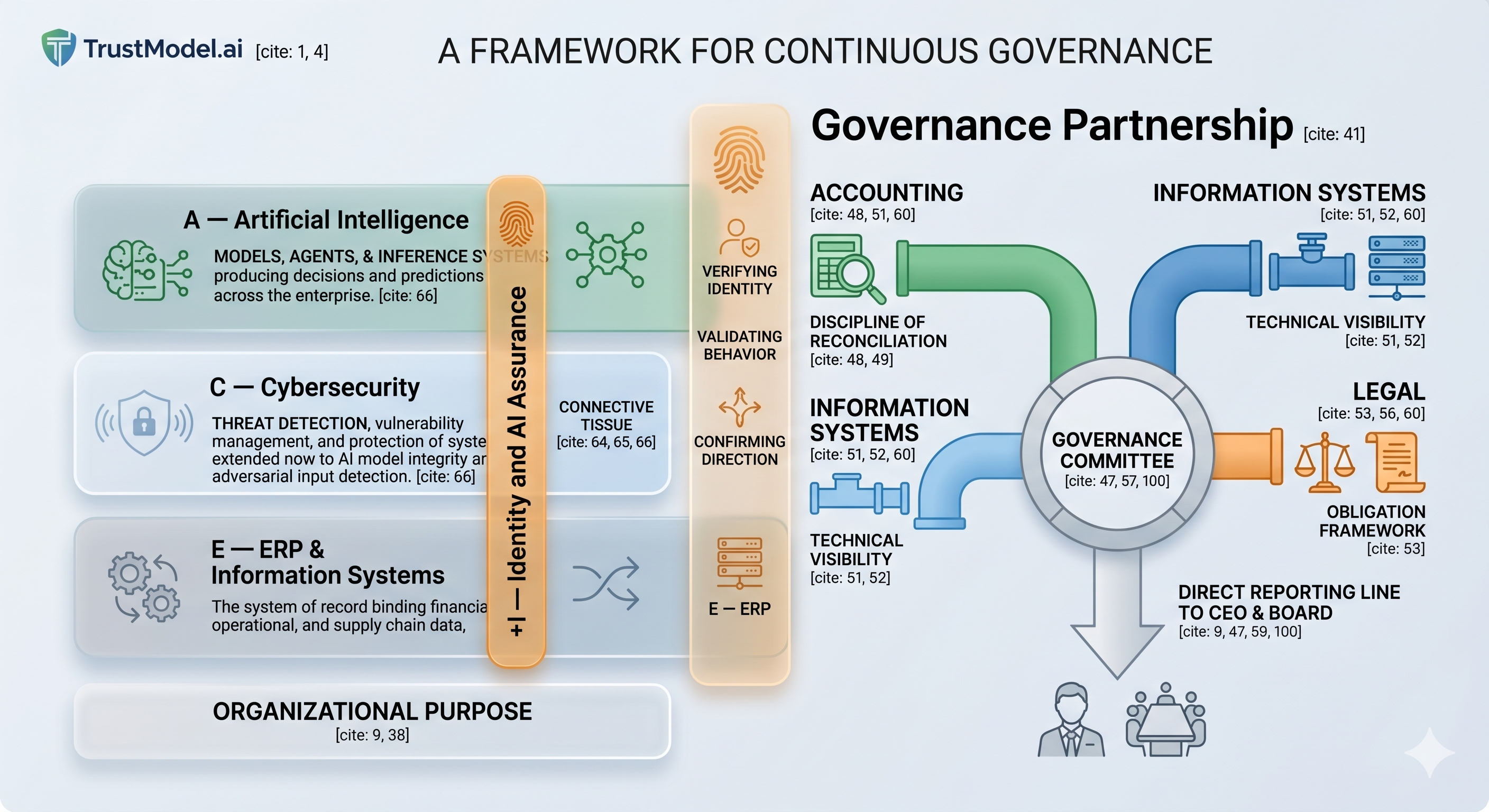
Against Drift: The Case for IAM and AI Assurance as Organizational Imperatives A Framework for Continuous Governance Across AI, Cybersecurity, and ERP byadminMay 7, 2026
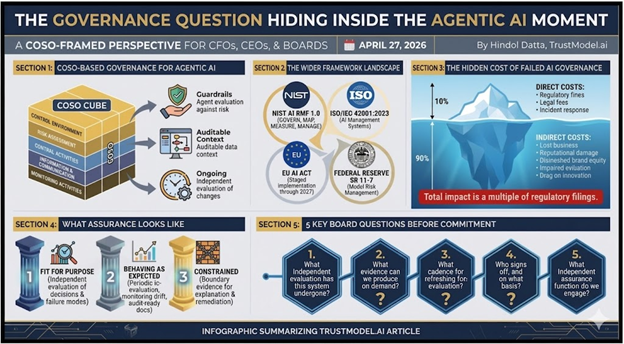
The Governance Question Hiding Inside the Agentic AI Moment A COSO-framed perspective for CFOs, CEOs, and Boards, as Google Cloud Next 2026 puts autonomous systems on center stage byadminMay 4, 2026
AI Governance Governance Leadership & Culture Regulatory Risk Management System Thinking Systems ThinkingMay 13, 2026 What Your AI Risk Data Is Not Telling You: A Lesson from Abraham Wald By Hindol Datta, CPA, CIA (Certified Internal Auditor) | Fractional CFO | AI Governance Advisor
AI Governance Governance Regulatory Risk Management Systems ThinkingMay 7, 2026 Your AI Is No Longer Insured. By Hindol Datta, CPA | Fractional CFO Trustmodel. AI | AI Governance Advisor
Digital Transformation Governance Regulatory Systems ThinkingMay 4, 2026 The Governance Question Hiding Inside the Agentic AI Moment A COSO-framed perspective for CFOs, CEOs, and Boards, as Google Cloud Next 2026 puts autonomous systems on center stage
GovernanceFebruary 9, 2026 Aligning Founder Incentives for Post-Deal Success Every founder knows the thrill of bootstrapping, the terror of missed payrolls, and the quiet pride of customer validation. What is less commonly addressed is the strange, disorienting moment when a liquidity event reshapes all of it. For founders who sell a stake to private equity, the deal is never the end. It is the beginning of a complex new chapter that blends performance, psychology, and contract mechanics. Having worked across transformations and buyouts, I have seen how well-designed post-deal incentives not only retain founder engagement but deepen strategic alignment. When incentives align with purpose, founders do not just stay. They lead again. The structure of post-deal compensation has evolved to reflect the maturing relationship between capital and capability. No longer can sponsors assume that a simple cash-out followed by a management reshuffle delivers alpha. Most private equity firms today recognize that founder DNA remains critical long after Day Zero. The question becomes how to retain that DNA without letting legacy distort the path to scale. This is where mechanisms like equity rollover, earnouts, and vesting cliffs become not just terms but tools. Used well, they act as bridges between belief and performance. Used poorly, they erode trust and dilute intent.
GovernanceFebruary 5, 2026 How Series A Affects Founder Control and Equity The excitement of closing a Series A round is palpable. But amid the celebration, something quieter happens. A fog settles over the cap table. Before Series A, the cap table is simple. Founders own nearly all the shares, and everyone is aligned. After Series A, investors want growth but also downside protection through rights, preferences, and board control. Liquidation preferences give investors their money back before anyone else gets paid. If the exit is below the Series A valuation, investors may come out whole while common shareholders take the loss. Then there is dilution, anti-dilution protection, participating preferred shares, board seats, protective provisions, and drag-along rights. Each layer changes how power is shared and where value flows. The fog becomes thickest when multiple rounds have occurred. Cap table literacy should be a core skill for any founder. Founders need to understand the mechanics themselves, how to read a term sheet, and how to model a liquidation waterfall. This is not finance for its own sake. It is strategy.
GovernanceFebruary 2, 2026 Building a Culture of Exit Readiness in Your Company A well-managed company operates with an eye toward its eventual exit. Whether through acquisition, IPO, or merger, the CFO holds responsibility for ensuring the organization is always ready to transact. Transactions often come when least expected, so the time to prepare is long before. Exit readiness is a forward-looking framework. Exit-ready companies operate with rigor, with reliable numbers, scalable systems, and complete documentation. These qualities make companies more resilient and better governed. Exit readiness includes accurate financial statements, reliable forecasts, clear capital structure, identified tax exposures, accessible legal documents, and coherent strategic plans. The best-run companies treat exit readiness as normal operating discipline. In transactions ranging from thirty-five million to three hundred fifty million dollars, preparedness level makes visible difference. Buyers respond to clarity. Valuations hold when diligence confirms what was promised. Exit readiness is not about preparing for an ending but operating at a higher standard.
GovernanceJanuary 23, 2026 Surviving the Down Round with Reputation, Culture, and Optionality Intact The down round often begins not with an announcement but with a quiet reckoning. For the CFO, this moment is as strategic as it is financial. The most damaging part is not the repricing but the narrative collapse that follows. Perception drives value, and a company seen to be weakening can find its brand, culture, and future capital access compromised. Yet if a CFO frames the down round with clarity and strategic positioning, they can re-establish control of the narrative. This begins by naming reality: soft-pedaling valuation resets only deepens mistrust. The survival strategy requires managing internal culture through radical transparency and celebrating operational wins. Terms matter more than headline valuation; poorly negotiated terms can install ratchets that cripple future rounds. The CFO must preserve optionality by mapping the recovery arc with clear operational metrics and future-proofing governance. Board dynamics shift dramatically, requiring proactive briefings and scenario modeling. External reputation rebuilding demands message discipline and intensified investor relations. The operating model must be reengineered for capital efficiency through unit economics scrutiny and zero-based budgeting. Tax implications and equity restructuring carry lasting consequences requiring thoughtful planning to preserve value while managing employee psychology around underwater options.
GovernanceJanuary 23, 2026 Board, CEO and CFO Liability: Triggers and Risk Management The authority of a board, CEO, or CFO is matched only by its vulnerability. Legal liability spanning civil, regulatory, and criminal domains casts a shadow across every strategic decision, public statement, and control failure. In an environment of heightened regulatory scrutiny, activist enforcement, and stakeholder expectation, understanding the liability landscape is no longer a legal function but a strategic imperative. At the core lies fiduciary duty: directors owe care and loyalty to the corporation and shareholders, while CEOs and CFOs, as operational fiduciaries, bear personal consequences for breaches through negligence, recklessness, or concealment. The liability structure is layered, from federal securities law under Section 10(b) of the Securities Exchange Act to Sarbanes-Oxley certification requirements that trigger strict liability regardless of intent. Eight primary triggers elevate routine governance into personal risk: financial misstatement, inadequate disclosure, failure of internal controls, red-flag neglect, enforcement escalation, event-driven litigation, ESG-related exposure, and personal conduct violations. The defense against liability is not reaction but structure, built through compliance architecture that maps every intersection of law and behavior, disclosure rigor that ensures coherence between statements and reality, control integrity that defines ownership at every point, and cultural vigilance that models truth-telling without fear. When liability crises occur, disciplined response requires clear roles, immediate framework activation, and measured communication that balances accountability with restraint. Real governance begins not with prevention or response but with what happens after the reckoning, turning failure into foresight and vulnerability into credibility through institutional learning and systematic reform.
GovernanceJanuary 22, 2026 No More Learning on the Job: Designing Onboarding for High-Impact Board Members Boards rely on their members to bring insight, challenge, and foresight, yet too often new directors are expected to contribute meaningfully before they truly understand the business, culture, or context. This default to learning on the job carries steep costs: missed signals, misaligned priorities, and underutilized potential. High-impact boards reject this approach, designing onboarding not as orientation but as activation, embedding directors quickly into both content and culture, perspective and performance. Effective onboarding must be structured around four core dimensions: enterprise fluency through operational deep dives that instill the ability to ask nuanced questions, stakeholder mapping that builds trust and surfaces alignment between internal and external expectations, judgment calibration through structured mentorship and scenario rehearsal, and network integration that transforms solo initiation into shared acculturation. The most common failure is timing: too much too fast overwhelms, too little too late creates drift. Best-in-class boards anchor onboarding around a 90-day cadence structured into pre-meeting immersion, first-meeting engagement, and post-meeting integration. When onboarding is designed as governance capital, its return on investment compounds: the board gets smarter faster, strategy gets sharper, management gets better guidance, and the enterprise earns deeper trust from investors, regulators, employees, and communities.
GovernanceJanuary 22, 2026 The Audit Committee is Not the Enemy: Leveraging it for Strategic Credibility The audit committee sits at a unique intersection of financial integrity, regulatory expectation, and strategic exposure. It is often cast as the disciplinarian including keeper of checklists, gatekeeper of disclosures, and custodian of financial controls. But this perception, while historically grounded, is increasingly limiting. Throughout my twenty-five years leading finance across cybersecurity, SaaS, manufacturing, logistics, and gaming, I have learned that in high-performing organizations, the audit committee has transcended its stereotype. It no longer merely ensures compliance. It becomes a credibility platform. It signals rigor to investors, consistency to regulators, and truth to executives. In moments of crisis, transformation, or growth, this credibility becomes the strategic ballast boards depend on. Yet many boards underutilize the audit committee’s potential. They tolerate narrow scopes. They frame the committee’s mission around accounting integrity alone. They relegate it to retrospective reviews of controls without leveraging it for proactive risk assessment or forward-looking financial scrutiny. This is a missed opportunity that organizations can no longer afford.