What Your AI Risk Data Is Not Telling You: A Lesson from Abraham Wald By Hindol Datta, CPA, CIA (Certified Internal Auditor) | Fractional CFO | AI Governance Advisor byadminMay 13, 2026
Your AI Is No Longer Insured. By Hindol Datta, CPA | Fractional CFO Trustmodel. AI | AI Governance Advisor byadminMay 7, 2026
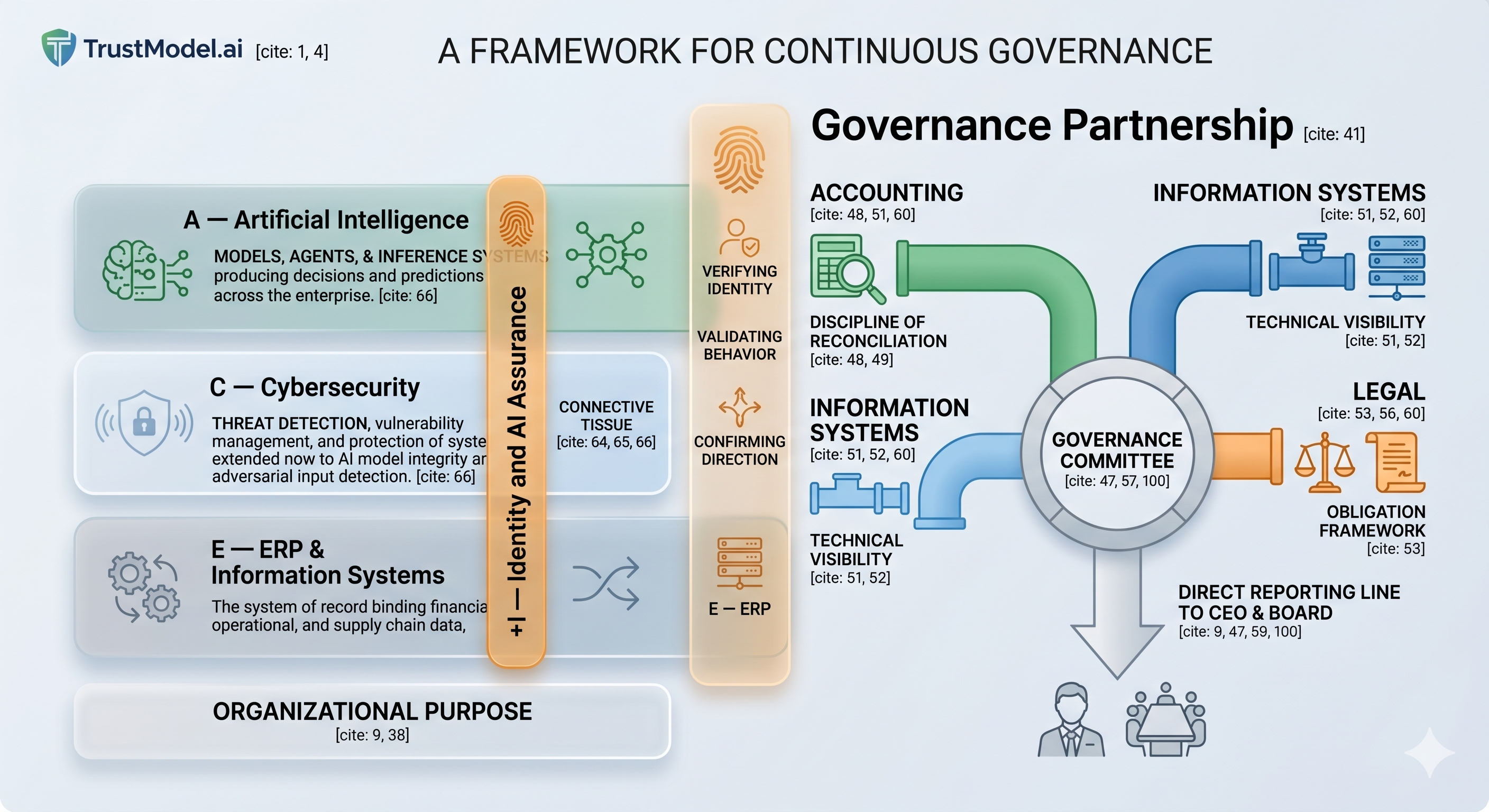
Against Drift: The Case for IAM and AI Assurance as Organizational Imperatives A Framework for Continuous Governance Across AI, Cybersecurity, and ERP byadminMay 7, 2026
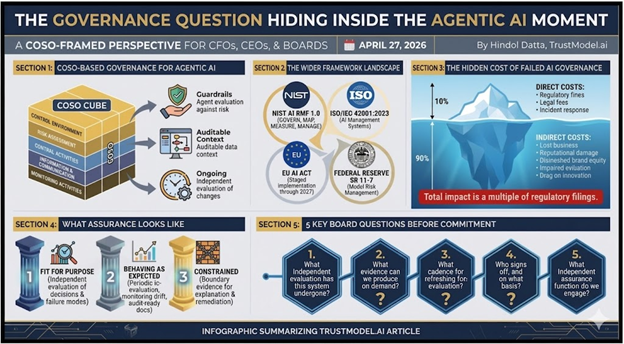
The Governance Question Hiding Inside the Agentic AI Moment A COSO-framed perspective for CFOs, CEOs, and Boards, as Google Cloud Next 2026 puts autonomous systems on center stage byadminMay 4, 2026
Digital Transformation Governance Regulatory Systems ThinkingMay 4, 2026 The Governance Question Hiding Inside the Agentic AI Moment A COSO-framed perspective for CFOs, CEOs, and Boards, as Google Cloud Next 2026 puts autonomous systems on center stage
Digital TransformationFebruary 10, 2026 Building Digital Maturity Through Strategic Partnerships Digital partnerships represent far more than tactical solutions to immediate technical challenges. They function as strategic instruments that shape organizational identity, operational coherence, and long-term competitive positioning. Drawing from three decades of financial leadership across global enterprises, this analysis demonstrates how Chief Financial Officers must evolve from technology approvers to custodians of strategic coherence. The fundamental challenge lies in distinguishing between partnerships that merely solve today’s problems versus those that architect tomorrow’s capabilities. When enterprise tempo accelerates and quarterly pressures intensify, the temptation to select digital partners based on immediate needs becomes overwhelming. Yet such decisions, made without anchoring in strategic identity, mortgage organizational elegance for operational relief. True digital maturity emerges not from accumulating technologies but from choreographing them in service of purpose. Success requires establishing narrative clarity around strategic horizons, implementing governance frameworks that protect intellectual property and cultural alignment, developing multidimensional evaluation methodologies that measure impact across functional domains, and institutionalizing review rhythms that determine when partnerships should scale, restructure, or sunset. The CFO’s role transcends financial oversight to become curatorial stewardship, ensuring companies grow not merely in capability but in character, building systems that reveal corporate values while enabling sustainable transformation.
Digital TransformationFebruary 6, 2026 Transforming Leadership Development with Data Science For generations, leadership was treated as elusive, something that resists quantification. We said it cannot be measured, only felt. Yet we now stand in an age where the invisible has become legible. Data science extends its reach into leadership. With each interaction recorded, each decision logged, each outcome analyzed, we ask: can leadership be measured, or is it only mirrored? The evidence suggests that behavior leaves a signature, something patternable and traceable in its impact. The leadership we once identified by gut now leaves behind data in calendar density, email latency, Slack threads, performance reviews, and team churn rates. Data becomes a mirror that allows leaders to see whether their direct reports actually speak more over time or whether alignment scores reflect their clarity. The true power is not to score or rank but to awaken self-awareness, illuminating the space between how we see ourselves and how our presence is experienced. Data science enables observation of micro-behaviors for elevation, not surveillance. Communication frequency, network centrality, and sentiment shifts become proxies that form a developmental map. Leadership pipelines often fray because they are reactive. A system that tracks potential early allows for intentional development. Data becomes a companion to mentorship, surfacing the overlooked. The mentor who uses data to understand will expand.
Digital TransformationFebruary 3, 2026 Reimagining Corporate Vision with Financial Automation A quiet revolution is taking place inside the enterprise, not in marketing slogans but in how companies think about value, time, and vision itself. Financial automation, once dismissed as a mechanical efficiency play, has become the crucible for innovation in corporate strategy. For most of corporate history, finance has been the keeper of the past. It reconciled what had already occurred and measured the known. Yet with automation, the balance of attention is shifting. Freed from the labor of tallying and tracking, finance is beginning to look forward with new eyes. When real-time data flows through intelligent systems, when anomalies surface autonomously, and when forecasts adjust themselves on fresh inputs, the role of finance morphs from archivist to architect. But vision is not shaped by automation alone. It is shaped by the clarity with which leadership reads the signals that automation surfaces. Corporate vision blurs not through dramatic failure but through quieter forces: data noise, short-termism, internal misalignment, the seduction of consensus, and the hesitation that fear breeds. To restore vision is to remember what mattered before the noise set in. Finance, often the most underestimated function in the vision conversation, becomes vital in this restoration. Budgets, forecasts, and KPIs are not just control mechanisms. They are expressions of what a company values. When automation liberates thought and strategy is recalibrated with humility, the distance between idea and execution narrows. The most inspiring companies are not those that see farther. They are those that see more honestly.
Digital TransformationJanuary 29, 2026 Transforming Financial Controls Through AI Artificial intelligence is fundamentally transforming financial controls from static compliance frameworks into dynamic, learning systems that anticipate rather than merely detect risk. Drawing from three decades of operational CFO experience across industries, this article examines how AI introduces a third dimension to traditional controls: anticipation that warns organizations before systems veer off track rather than catching mistakes after occurrence. The shift from rule-based to probabilistic controls requires new governance frameworks addressing opacity, accountability, and bias while maintaining the trustworthiness that defines effective control systems. Success demands treating AI as tiered partner rather than autonomous decision-maker, establishing model explainability protocols, and training teams to interpret machine-generated signals alongside traditional metrics. CFOs must evolve from designing static rules to curating dynamic signals, from approving thresholds to setting guardrails, and from asking what went wrong to understanding what the agent learned. The greatest opportunity lies not in automation alone but in building controls that surface inefficiencies, suggest better workflows, and distribute trust from individuals to architectures while retaining human judgment for context-laden decisions that define real-world finance.
Digital TransformationJanuary 29, 2026 Understanding Cybersecurity Risks of GenAI Agents Generative AI agents represent a fundamental shift in enterprise risk management. Unlike traditional software systems that require technical exploitation, GenAI agents can be compromised through carefully crafted language alone. These agents, increasingly embedded in financial systems, legal workflows, and customer operations, possess unprecedented access to organizational knowledge while operating with probabilistic logic that lacks inherent awareness of malicious intent. The cybersecurity challenge has evolved from controlling who accesses systems to managing what agents can be influenced to reveal or execute. For CFOs and boards, this represents not merely a technical concern but a financial and compliance imperative, as exposure through agent manipulation translates directly to brand damage, legal liability, and audit risk. Effective risk mitigation requires three foundational controls: prompt firewalling to validate inputs, role-aware memory boundaries to limit context retention, and escalation logic that recognizes when human judgment becomes necessary. Organizations must treat GenAI security as core risk oversight, establishing clear governance around agent deployment, interaction logging, and behavioral auditing.
Digital TransformationDecember 23, 2025 Reimagining the Digital Evolution of Treasury Management For decades, treasury has quietly served as the operational circulatory system of finance. It has managed cash, ensured liquidity, and optimized capital deployment within defined parameters. But as the velocity of business increases and digital infrastructure rewires how firms operate, the role of treasury is undergoing a profound transformation. Having served as operational CFO with over three decades of experience managing treasury operations, securing credit facilities including an eight million dollar credit line, managing working capital for a one hundred twenty million dollar logistics enterprise, and leading capital allocation across organizations that scaled from nine million to one hundred eighty million dollars in revenue, I have witnessed the shift from spreadsheet-based forecasting to artificial intelligence-powered scenario planning, from manual bank interfaces to application programming interface-driven treasury networks, and from siloed decisions to integrated treasury intelligence. The modern treasury is evolving from a back-office custodian into a digital command center, one that spans liquidity, currency exposure, financial risk, and strategic capital optimization. This comprehensive article explores how digital evolution is reimagining treasury across four dimensions: strategic reframing, operational architecture, capital agility, and enterprise integration. The outcome is not just better cash flow. It is better optionality at lower cost and with higher confidence.
Digital TransformationDecember 19, 2025 Why Digital Investments Are Key to Competitive Advantage Executive Summary
Digital TransformationOctober 14, 2025 GenAI in Finance: Redefining the CFO’s Role Finance has always been known for precision, structure, and control. Numbers were sacred, spreadsheets carried the weight of strategy, and decisions followed strict reporting cycles. For decades, finance acted as the anchor of stability, measured, methodical, and operational. But that model is showing its age.
Digital TransformationOctober 14, 2025 AI Co-Pilot: Transforming the Modern CFO’s Decisions If the twentieth-century CFO was the steward of capital and the early twenty-first-century CFO became the strategic partner to the CEO, today’s AI CFO is undergoing yet another transformation. The shift is being powered by a new kind of teammate: the AI co-pilot. This evolution reflects the rise of modern finance, where digital assistants are not confined to spreadsheets or dashboards. Instead, they bring contextual understanding, pattern recognition, and real-time recommendations into the finance office.