
Executive Summary
Business escape velocity is the point where a company grows on its own, without repeated fundraising, heavy subsidies, or costly marketing. It arrives when the forces propelling a business consistently outweigh the drag of acquisition cost, churn, burn, and competition. Few companies notice the moment itself, yet most feel its effects in their unit economics and their culture.
This article defines business escape velocity, offers a simple model of propulsion and drag, and sets out a five-step path to reach it. It also covers the metrics that confirm breakaway, the warning signs of falling short, and how leaders should respond when drag wins.
What Business Escape Velocity Means
In physics, escape velocity is the minimum speed an object needs to break free of a larger body’s gravity without further propulsion. In business, it describes the point where growth sustains itself through favorable unit economics, loyal customers, and network effects. Both the rocket and the startup must overcome heavy friction before acceleration becomes self-sustaining.
The Gravitational Pull on a Growing Company
Several forces hold a young company in an orbit of dependency, including:
- High customer acquisition cost (CAC)
- Weak retention rates
- Low brand awareness
- Competitive pressure
- Operational inefficiencies
- Unclear market positioning
A Simple Model of Propulsion and Drag
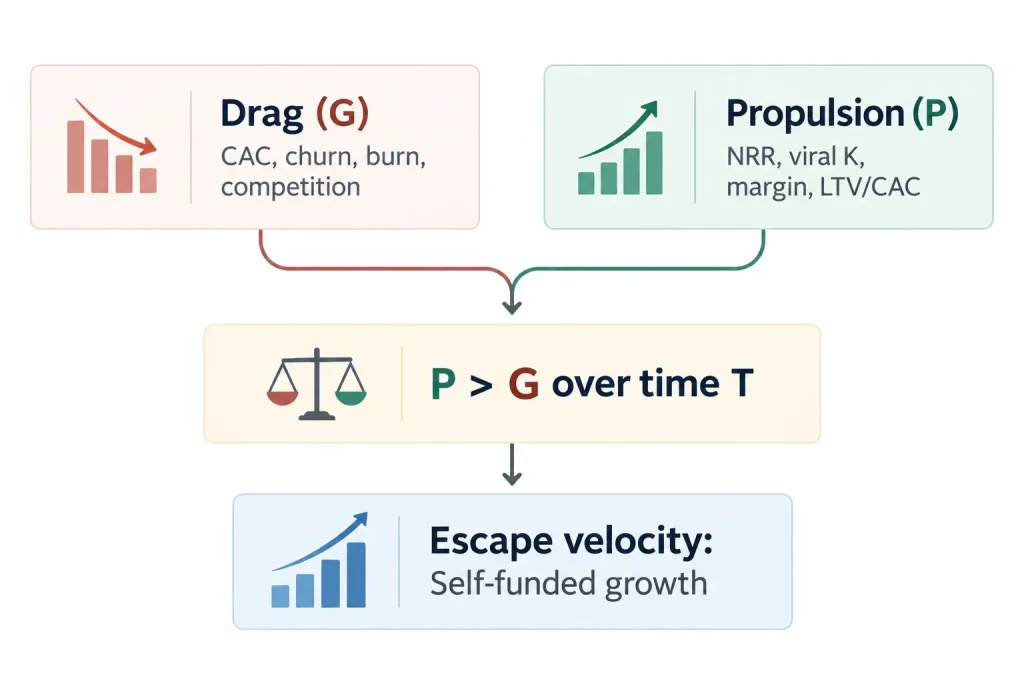
A simplified model makes the idea measurable, letting G represent gravitational drag and P represent propulsion, each built from a handful of operating variables:
- G = f(CAC, churn, burn rate, competition index, market awareness deficit)
- P = f(net revenue retention, viral coefficient, operating margin, LTV/CAC, brand affinity)
- Business escape velocity occurs when P exceeds G over a sustained period T, measured in operating quarters.
Recognizing the Moment of Breakaway
Businesses rarely spot the exact moment they break free, and most recognize it only in hindsight. Like astronauts noticing the silence of space, leaders sense the absence of friction first, and the typical signs include:
- New customers arrive faster than marketing dollars are spent.
- Word of mouth replaces advertising as the dominant acquisition channel.
- Retention holds steady without intensive lifecycle management.
- Gross margins expand while revenue accelerates.
- Competitors imitate instead of innovating.
Airbnb crossed the line when bookings outpaced its marketing and hosts arrived through referrals instead of paid acquisition. WhatsApp crossed it when telecom carriers watched message volume shift away despite no comparable promotion. In both cases, network effects supplied the thrust while operational discipline reduced the drag.
Timelines, Cash Flow, and Cultural Signals
The timeline to business escape velocity varies by sector. Consumer apps may reach it in 12 to 24 months, while enterprise SaaS often needs four to six years. What unites them is an inflection point where output decouples from input.
Cash flow independence offers another lens, because once a company can reinvest profits to fund growth, outside capital becomes optional and strategic instead of existential.
Culture shifts as well, as teams move from firefighting to proactive scaling, roadmaps stretch from quarters to years, and board meetings turn toward the future. At a high-growth cybersecurity company with $30M in recurring revenue, actuals landed within five percent of forecast for 8 consecutive quarters. That kind of predictability marks a business whose metrics now forecast the future instead of explaining the past.
Engineering Business Escape Velocity in Five Steps
Business escape velocity is not achieved through a single explosive force. It comes from a series of calibrated thrusts, built deliberately and in sequence, as the flow below shows.
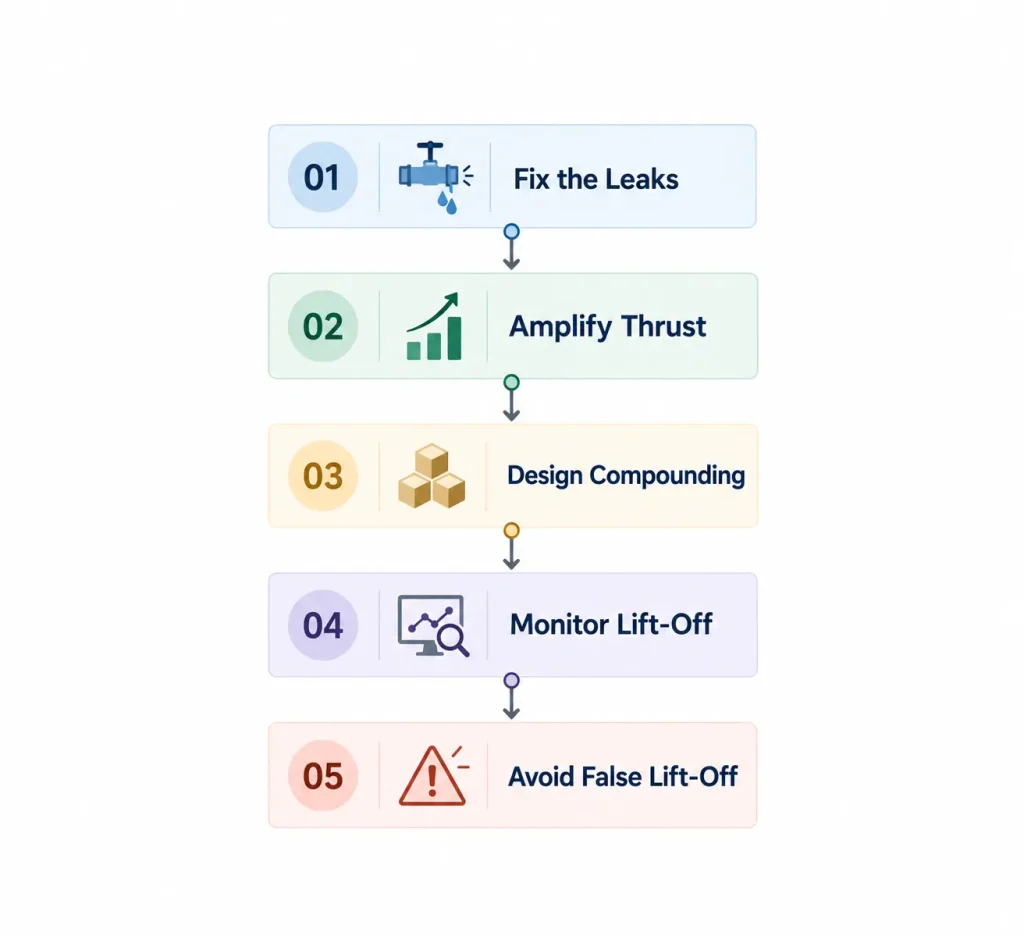
Step 1: Fix the Leaks to Reduce Drag
A company cannot escape gravity in a leaky vessel, so founders must first tighten the core:
- Reduce CAC: Lean on inbound channels, partnerships, and content, with paid payback ideally under 12 months.
- Improve retention: Reach product-market fit through feedback loops, targeting a DAU/MAU ratio above 25%.
- Lower burn: Align headcount and spend with revenue reality, favoring scalable systems over manual effort.
- Neutralize competition: Find wedges such as niche markets, superior UX, or proprietary data.
- Raise awareness efficiently: Use virality, influencers, and PR with discipline.
An early-stage email marketing company shows how much this step matters. Cutting monthly burn from $800K to $200K gave the business room to stabilize and operate within its means.
Step 2: Amplify Thrust to Increase Propulsion
Once the vessel is sealed, propulsion systems can go in:
- Maximize net revenue retention: Build upsell paths, usage-based pricing, and land-and-expand motions.
- Engineer virality: Use product loops to push the viral coefficient above 1.0.
- Improve operating margin: Automate, outsource non-core work, and delay expensive hires.
- Optimize LTV/CAC: Target at least 3x by raising ARPU or extending customer lifespan.
- Build brand affinity: Keep narrative, mission, and UX consistent to create defensibility.
A venture-backed digital marketing company that grew from $9M to $180M in 24 months relied on this discipline. Tracking CAC, lifetime value, and contribution margin kept rapid growth tied to sound economics.
Step 3: Design for Compounding
Velocity requires acceleration, not just motion, so the business must layer feedback loops. Network effects, as at Figma and Slack, create user-to-user value. Data flywheels, such as YouTube recommendations, use activity to improve algorithms. Content loops, as on Reddit and Quora, let user content attract new users. Each loop lowers CAC and raises value at the same time.
Steps 4 and 5: Monitor Lift-Off and Avoid False Signals
Leaders should watch for a viral coefficient above 1.0 for more than two cycles, NRR above 120%, and LTV/CAC above 3x. Referrals outpacing paid acquisition and unsolicited advocacy add qualitative proof. Internally, the shift shows up as reduced fundraising dependency, confident roadmaps, and organizational calm.
Vanity metrics can fake a lift-off, since high installs with low engagement, press buzz without usage, and promotional spikes all mislead. Sustainable escape velocity is quiet, marked by predictable cohort behavior and deep user value.
Diagnosing Escape Readiness
No single metric confirms breakaway, so leaders should read the indicators together. A high K-factor without retention is noise, and strong LTV/CAC with high churn is short-term optimization.
| Indicator | Signal of Escape Velocity | Signal of Falling Short |
| Acquisition | Referrals and organic channels drive growth | Paid channels saturate with diminishing returns |
| Unit economics | LTV/CAC above 3x and payback under 12 months | High CAC plateau with weak payback |
| Retention | Stable MAU and DAU/MAU above 25% | High churn negates acquisition gains |
| Revenue base | NRR above 120% from expansion revenue | Flat NRR as customers stop expanding |
| Cash | Operating cash flow funds growth | Runway needs constant replenishment |
| Momentum | Unsolicited advocacy and community amplification | Early virality decays without recovery |
| Team | Strategic execution and forward-looking boards | Fatigue from maintaining instead of building |
When red flags persist, they point to structural misalignment, where revenue arrives through force and not through flywheel. Operating leverage, with revenue growth outpacing cost growth, is often the clearest sign that the engine has turned.
Adapting When Drag Outpaces Thrust
When drag exceeds thrust, leaders should recalibrate early through these responses:
- Re-segment the market: Find niches with lower CAC or faster cycles.
- Revamp the product: Test activation, reduce friction, and improve stickiness.
- Pivot the model: Introduce freemium, usage-based pricing, or new revenue streams.
- Right-size spend: Focus resources on proven acquisition or retention levers.
- Shift leadership focus: Move from growth at all costs to quality-of-growth metrics.
Leadership must also cultivate intellectual honesty, so the narrative matches the numbers. Founders should resist scaling or raising large rounds before the core engine is tuned, because escape velocity punishes haste and rewards resilience.
Case Example: How Notion Reached Escape Velocity
Notion built product traction methodically before scaling, starting with design-savvy teams as early adopters. Shared templates, clean UX, and embedded workflows created organic spread while the company raised modest sums. As templates and integrations multiplied, user adoption rose with them. Its breakaway showed three marks: lower CAC from virality, high retention from utility, and an ecosystem built on shared templates.
Escape Is a Beginning, Not an Exit
Business escape velocity is a condition, not an event, where thrust reliably outpaces drag. It cannot be guaranteed, yet design, iteration, and focus can engineer it. Founders must balance patience with urgency, and investors must back long-term compounding over short sprints.
Escape also marks a beginning, since a company free of gravity must still choose its trajectory. It can scale with integrity or spin into reckless acceleration, and those choices echo louder after lift-off. A company that reaches this state has earned the freedom to define its direction and build a category of its own.
Three Key Takeaways
- Business escape velocity arrives when propulsion from retention, expansion, and virality consistently exceeds the drag of CAC, churn, and burn over several quarters.
- Founders should fix leaks before amplifying thrust, since scaling acquisition without retention and efficient CAC produces false lift-off.
- Read escape metrics together, including LTV/CAC above 3x, NRR above 120%, and payback under 12 months, and recalibrate early when drag wins.
Disclaimer: This article is intended for informational purposes only and does not constitute legal, tax, or accounting advice. You should consult your own tax advisor or counsel for advice tailored to your specific situation.
Hindol Datta is a four-time CFO and senior finance executive with over 25 years of leadership experience across cybersecurity, SaaS, gaming, logistics, digital marketing, medical devices, consumer products, and nonprofit organizations. He has led more than $120M in fundraising and over $150M in M&A transactions while building the financial and operational systems that let complex businesses scale with confidence. He is the author of seven books in the Systems CFO Series and holds active CPA, CMA, and CIA credentials.
AI-assisted insights, supplemented by 25 years of finance leadership experience.