
Executive Summary
Board reporting is among the most misunderstood disciplines in corporate governance. Most board reports recite operating facts, reassure directors, and quietly bury the signals that matter. Applied with rigor, board reporting best practices turn the report into a strategic instrument that shows how a company sees itself.
This article examines four disciplines behind that shift. The first treats the board report as signal compression, and the second casts the CFO as a curator of truth. The third designs board reporting as an engine of organizational learning, while the fourth addresses the ethics of disclosure. Together, they help finance leaders turn a quarterly obligation into a source of strategic leverage.
Why Board Reporting Is So Often Reduced to Recitation
On the surface, a board report summarizes financial performance, key metrics, and strategic updates. Management calibrates each element to reassure, to inform, and occasionally to obscure. Beneath that surface, the report can act as a precise signal of where the institution believes it must go next.
The board exists to interpret the business, not to manage it. Directors sit at the highest altitude of the enterprise, watching for gaps between what is said and what is done.
Yet the report often shrinks into charts without story and forecasts without caveat. Wins earn the headline while losses drift into the footnotes. None of this is deception; it is a form of entropy driven by the performance of assurance. Over time, directors sense they are receiving partial signal, and the relationship turns performative.
Strong board reporting rejects the false choice between transparency and control. It treats the board as a thinking partner instead of an adversary that management must handle. The most useful reports are not longer than the rest, but deeper. They frame ambiguity, surface second-order risk, and offer hypotheses that remain open to refinement.
Board Reporting as Signal Compression
Every board report is an act of compression performed under tight limits of time and attention. The CFO must distill an entire enterprise into signals that a small group of directors can decode. Choices about what to keep, amplify, or drop determine how well the board can govern.
Raw data such as cost lines, headcount, and burn rate is only the substrate. What the board seeks is meaning, with every number tied to a belief that outcomes can test. As a Bayesian artifact, the report shows what management expected, what occurred, and what it now believes.
Three Traits of Effective Board Decks
The most strategically effective board decks share three traits, each born of deliberate compression:
- Structural signal over transient noise: a degraded trend matters more than one missed number.
- Explainability over aesthetics: a well-framed contradiction beats a polished but opaque summary.
- Uncertainty as territory for engagement: a caveated forecast beats a projection posing as fact.
Consider a high-growth SaaS business that builds a driver-based forecasting engine and keeps actuals within a narrow band of forecast. Over several quarters, that consistency gives its board reporting the credibility to withstand acquisition diligence.
What Happens When Compression Fails
When signals become diluted or saturated, the board cannot sense drift or interrogate emerging risk early. Directors begin to lose trust in the very reports they receive. Presenting the report as theater may feel safe, but markets remain indifferent to narrative. They punish misalignment between expectation and reality, and an uninformed board cannot act when it matters.
The CFO as Curator of Board Reporting Truth
Among the CFO’s duties, few carry more quiet weight than deciding what to highlight, omit, or qualify. In board reporting, the CFO shapes what directors believe about the company and what the company believes about itself. Curation here calls for interpretive restraint, not embellishment, bringing forward only what matters most at this moment.
The board is not just reviewing performance; it is updating its internal model of the business. The real question is not whether the company hit plan, but whether its underlying mechanism still behaves as expected.
Seeing Systems Instead of Silos
Other executives speak from within functions, while the CFO sees across them. That vantage point lets the finance leader show how a change in churn echoes through CAC efficiency. It also reveals how a product delay cascades into deferred bookings, or how a hiring freeze reshapes velocity.
Curating with integrity requires fluency in the ethics of implication. Reports built to protect morale or defer contradiction may feel palatable, yet they slowly degrade the signal. Over time, such reports teach the board to accept polish in place of substance.
Multi-entity public companies offer a sharp illustration. When subsidiaries describe revenue in different ways, the board receives several versions of the truth at once. A single, unified revenue definition gives directors one consistent language for performance under IFRS and US GAAP.
When directors sense that management trusts them with real signal, they respond with sharper questions and better guidance. Honesty can feel abrasive in the moment, yet it builds a governance relationship that is generative instead of adversarial.
Designing Board Reporting as an Engine of Organizational Learning
Quarters come and go, teams explain variances, and the report enters the archive, rarely revisited. This ritual hides a subtle loss, because the report becomes a ledger instead of a rehearsal.
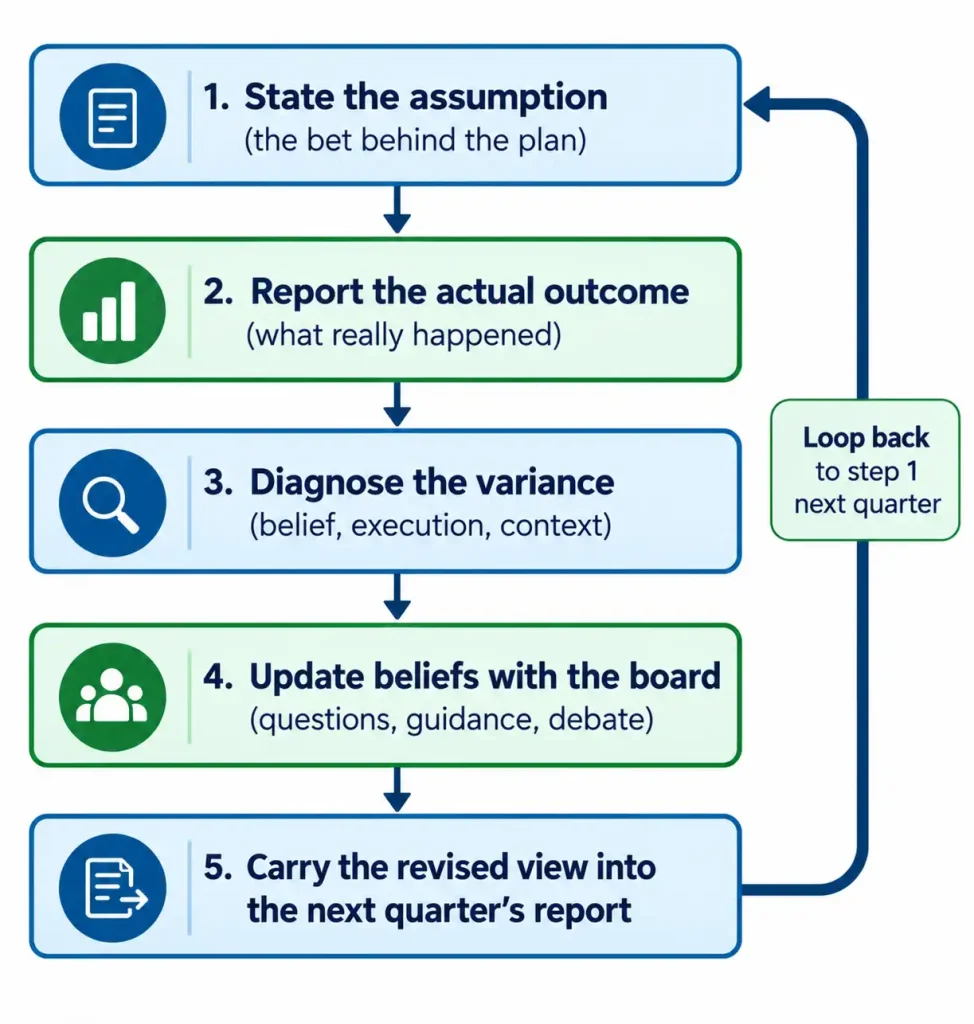
Properly designed, the board report is a structured hypothesis about how the business should behave under specific constraints. Each quarter then becomes an experiment, and each board meeting becomes a checkpoint in an ongoing system of sense-making.
Four Board Reporting Best Practices for Continuous Learning
- Make assumptions legible: a plan assuming 10% uplift from a launch is a bet, and a miss is signal.
- Preserve temporal continuity: consistent structure, metrics, and logic let each report build on the last.
- Practice humility: admit when a model failed to predict, and update the view openly.
- Favor truth over optics: treat the report as a diagnostic, not a defense.
Across quarters, the CFO becomes a librarian of hypotheses, tracking which beliefs held up, which remain open, and which now look false. Mission-driven institutions that report monthly to a Finance and Audit Committee show how this compounding works. Each report builds on prior predictions, flagged risks, and funding scenarios. By the time a major capital raise reaches the board, directors are judging with cumulative context.
The Board Reporting Learning Loop
The Ethics of Financial Disclosure in Board Reporting
During transformation or duress, the accuracy of the numbers stops being the hardest question. The harder question is whether management has told the truth, not only in fact but in frame. No board report is neutral, because every choice about emphasis alters what directors believe they know. Softening forecast risk breeds optimism without basis, and excluding an early fragility withholds signal when it matters most.
The CFO stands at a moral fulcrum in this process. While the CEO dreams forward, a careless CFO may end up managing backward, rationalizing underperformance and quietly shifting baselines.
Resisting Semantic Drift in the Board Deck
Pressure to defer a difficult disclosure for one more quarter never fully disappears. It is tempting to recast an execution failure as a strategic recalibration. Such choices are not technically false, yet they corrode trust through the slow erosion of candor.
Candid board reporting follows a simple sequence that mirrors institutional learning itself. Management states what it thought, what it observed, where it erred, and what it now believes. Naming an unmeasured risk or a weak segment early is better than letting ignorance pass for safety.
In a global consumer products business, directors need to see trapped working capital stated plainly, without softening. That clarity frames the work required to raise inventory turns and release cash. A board kept too comfortable cannot govern, and a board kept in the dark cannot adapt.
The Board Report as Mirror and Strategic Leverage
Four Disciplines of Strategic Board Reporting
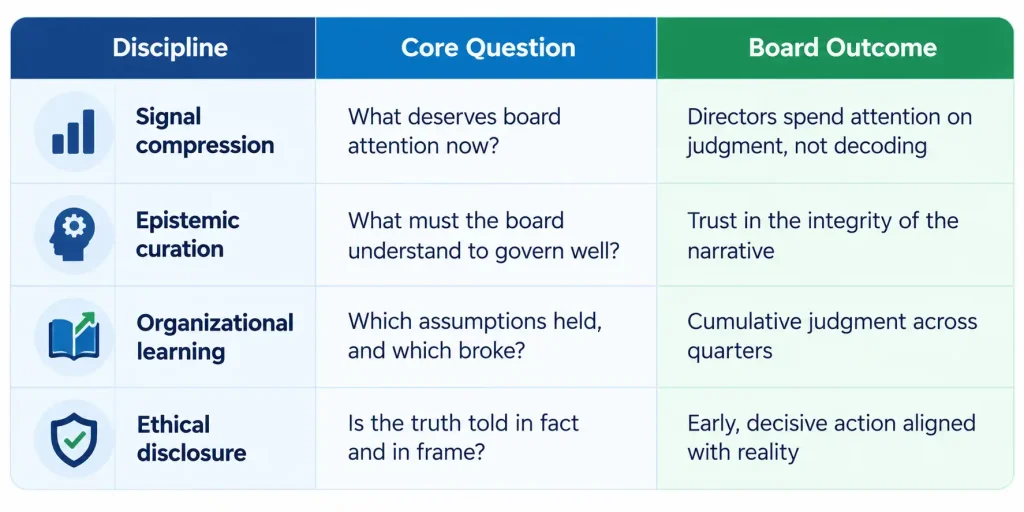
Wielding board reporting as a strategic weapon has nothing to do with adversarial tactics. It means authoring a recurring space where the company tells itself the truth, quietly and persistently. Written well, the board report becomes a mirror of institutional coherence and, at its best, a proof of character.
Three Key Takeaways
- Treat the board report as signal compression, not recitation. Elevate structural trends and named uncertainty above polished summaries of transient noise.
- Build board reporting as a learning system with legible assumptions and consistent structure across quarters. Each variance then becomes a diagnostic signal instead of a distraction.
- Hold the ethical line on disclosure and name fragility early. A board shielded from bad news cannot govern when the company needs its judgment most.
Disclaimer: This article is intended for informational purposes only and does not constitute legal, tax, or accounting advice. You should consult your own tax advisor or counsel for advice tailored to your specific situation.
Hindol Datta is a four-time CFO and senior finance executive with over 25 years of leadership experience across cybersecurity, SaaS, gaming, logistics, digital marketing, medical devices, consumer products, and nonprofit organizations. He has led more than $120M in fundraising and over $150M in M&A transactions while building the financial and operational systems that let complex businesses scale with confidence. He is the author of seven books in the Systems CFO Series and holds active CPA, CMA, and CIA credentials.
AI-assisted insights, supplemented by 25 years of finance leadership experience.