



Executive Summary
Most revenue conversations center on pipeline size. The more consequential conversation is about pipeline quality. For finance leaders, the distinction is not semantic. It is the difference between a forecast that holds and one that falls apart at close. Sales pipeline quality determines not only whether deals convert but whether they renew, expand, and contribute to durable margin. When pipeline is polluted with low-fit opportunities, the consequences extend far beyond missed quota. Forecasts become unreliable, hiring plans misalign, and capital flows toward the wrong segments. This article examines how a rigorous approach to customer fit, early disqualification, and pipeline quality metrics can transform the revenue system from a volume engine into a precision instrument. It draws on over twenty-five years of finance leadership across cybersecurity, SaaS, logistics, digital marketing, and nonprofit sectors, and on the hard-won insight that fit is not a feature of the product. It is a feature of the system.
The Moment Pipeline Size Stops Mattering
Nearly two decades ago, while reviewing a quarterly sales report in Singapore, I encountered a pipeline that looked healthy on paper. Coverage exceeded three and a half times the target. Yet close rates were troubling, forecast confidence hovered just above fifty percent, and sales cycles had expanded in markets we had previously considered predictable. The problem was not inefficiency. It was noise. The team was pursuing leads that simply did not fit.
That pattern repeated across subsidiaries in Europe, North America, and Latin America. The team pushed more volume into the funnel, pursued larger logos, and opened new verticals. Yet the ratios kept deteriorating. What that experience made clear, and what has shaped every revenue system I have built since, is that the single greatest determinant of revenue quality is customer fit. Not deal size, not industry, not product maturity. Fit.
When a company sells to the wrong customer, it does not just risk a bad deal. It distorts the entire system. Forecasts lose accuracy. Expansion slows. Pricing becomes defensive. And morale across sales, customer success, and finance quietly erodes.
Building a Dynamic Ideal Customer Profile
Most organizations define their Ideal Customer Profile as a marketing exercise. Verticals, revenue bands, and buyer personas are assembled into a slide deck and assumed to govern GTM behavior. In practice, they rarely do.
What a mature revenue system requires instead is dynamic ICP modeling, where fit is assigned probabilistically based on empirical post-sale data rather than pre-sale assumptions. The pipeline quality metrics that matter most in this exercise include:
- Lifetime value to customer acquisition cost ratio
- Net revenue retention by cohort
- Sales cycle length by segment
- Support burden and cost-to-serve
- Days sales outstanding
- Reference probability post-close
Having built this framework across global RevOps functions, I have seen consistent results. High-fit deals close faster, renew at higher rates, cost less to support, and deliver stronger gross margin even when headline discounts are comparable. Fit, in this context, is not a qualitative judgment. It is a calculable variable.
The practical step is to tag every closed-won deal with a retroactive fit rating, scored not by marketing but by RevOps and Finance using downstream performance data. When those ratings are mapped against LTV-to-CAC ratios, the economics of fit become impossible to ignore.
The Revenue Integrity Index
One of the most effective pipeline quality tools I have introduced is the Revenue Integrity Index, a composite score that combines four dimensions of deal health:
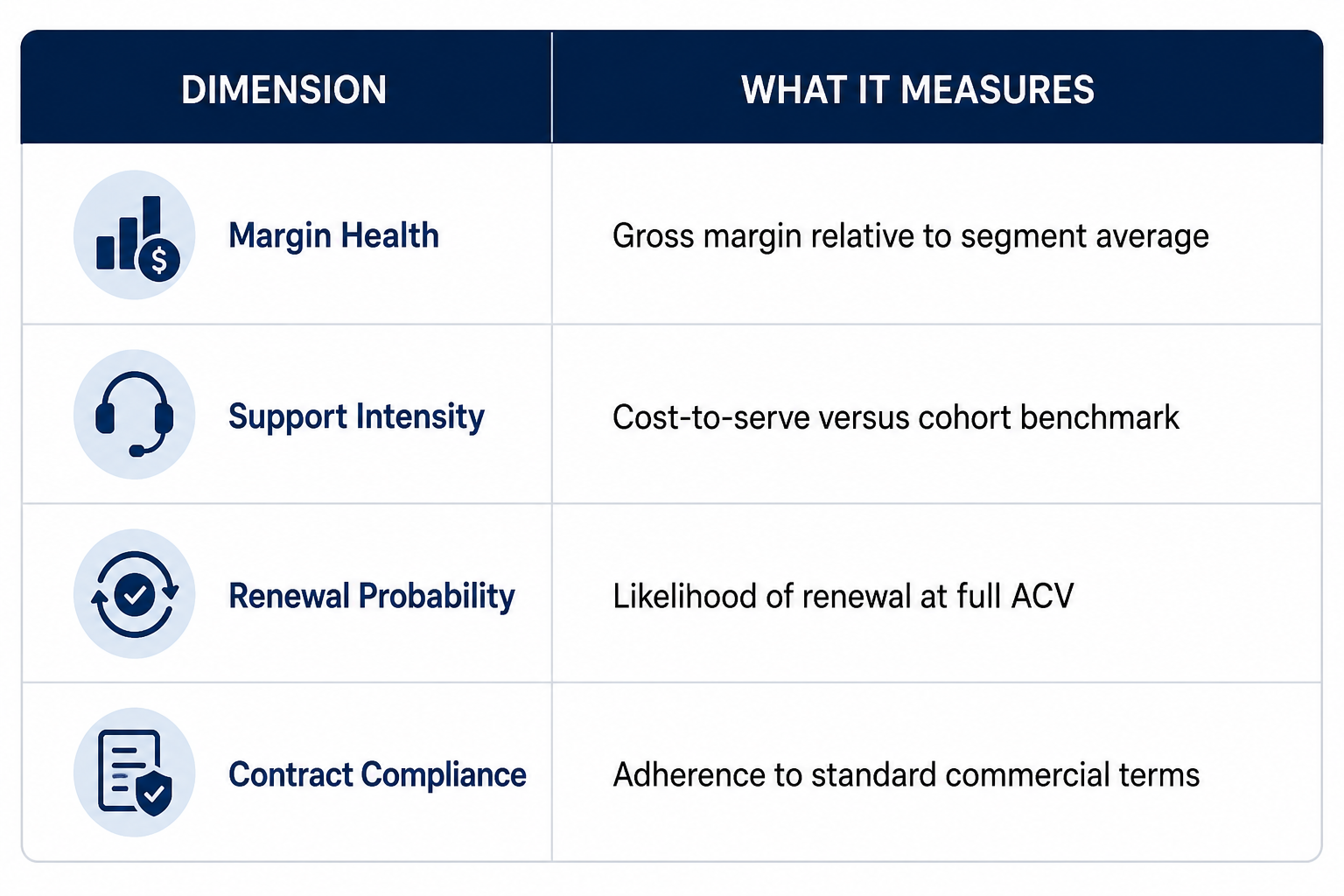
Deals with high fit consistently score well across all four dimensions. Deals with low fit, regardless of their nominal size, tend to score poorly. When this index is embedded into pipeline reviews, it reframes the conversation. A one million dollar opportunity with low integrity carries more scrutiny than a six hundred thousand dollar opportunity with high integrity. That shift in perspective alone reduces forecast variance and improves capital allocation.
The index also surfaces patterns over time. Certain segments routinely demand concessions that compress margin. Some buyer personas stall consistently post-proposal. Others require contract structures that create downstream billing friction. These patterns, once visible, feed directly into ICP refinement and sales enablement design.
Disqualification as a Strategic Act
Disqualification is widely misread as a conservative instinct. In practice, it is one of the most strategic decisions a revenue organization can make. When sales teams lack the discipline to walk away early, the entire organization absorbs the cost later in the form of margin leakage, implementation overruns, support overload, and unexpected churn.
Early in one finance leadership role, I conducted a diagnostic on every deal that had downgraded or churned within the first twelve months. The finding was consistent and sobering. More than sixty percent of those deals had raised internal red flags during the qualification stage. None had been formally disqualified. Instead, they had been managed through. Reps discounted more aggressively. Implementation teams promised greater flexibility. Legal softened contract terms. The system conspired to push weak deals forward out of hope rather than confidence.
That analysis led directly to the creation of a Disqualification Index, a structured log that recorded the rationale behind every disqualification decision:
- Insufficient urgency from the buying team
- Absence of an executive sponsor with authority
- Unrealistic implementation timeline
- Procurement rigidity incompatible with standard terms
- Budget misalignment relative to deal structure
These logs became an institutional learning database. Within three quarters, patterns emerged that reshaped lead scoring, sales enablement, and campaign targeting. Disqualification, once made visible and systematic, increased rather than diminished rep confidence. It signaled that the organization valued productive time as much as bookings. When sales began to protect time, pipeline began to self-select toward fit.
Pipeline Integrity as a Finance Function
Pipeline integrity is rarely the subject of board-level discussion. Executives ask about growth, conversion rates, and quota attainment. But underlying all of those outcomes is the quality of inputs. A pipeline inflated by stage manipulation, unqualified volume, and duplicate accounts does not just produce inaccurate forecasts. It produces inaccurate hiring plans, misallocated enablement budgets, and underestimated churn exposure.
To address this, I introduced a parallel Pipeline Quality Report that ran alongside standard pipeline dashboards. Every open opportunity was subjected to three tests before being included in the financial forecast baseline:
- Behavioral engagement: documented recent activity from the buyer
- Persona validity: confirmation that a decision-maker with authority was actively involved
- Fit score: a rating above the established threshold based on ICP criteria
The filtered pipeline that resulted was smaller than the headline number. It was also far more accurate. Forecast variance dropped by over thirty-five percent. Sales leadership redirected coaching time toward fit adherence rather than deal volume. Capital planning became more precise because the inputs it rested on were more honest.
Equally important, this process created a shared language across functions. Marketing focused on leads that converted rather than leads that clicked. Sales focused on progression quality rather than stage count. Finance focused on unit economics by cohort rather than aggregate revenue totals.
Conclusion
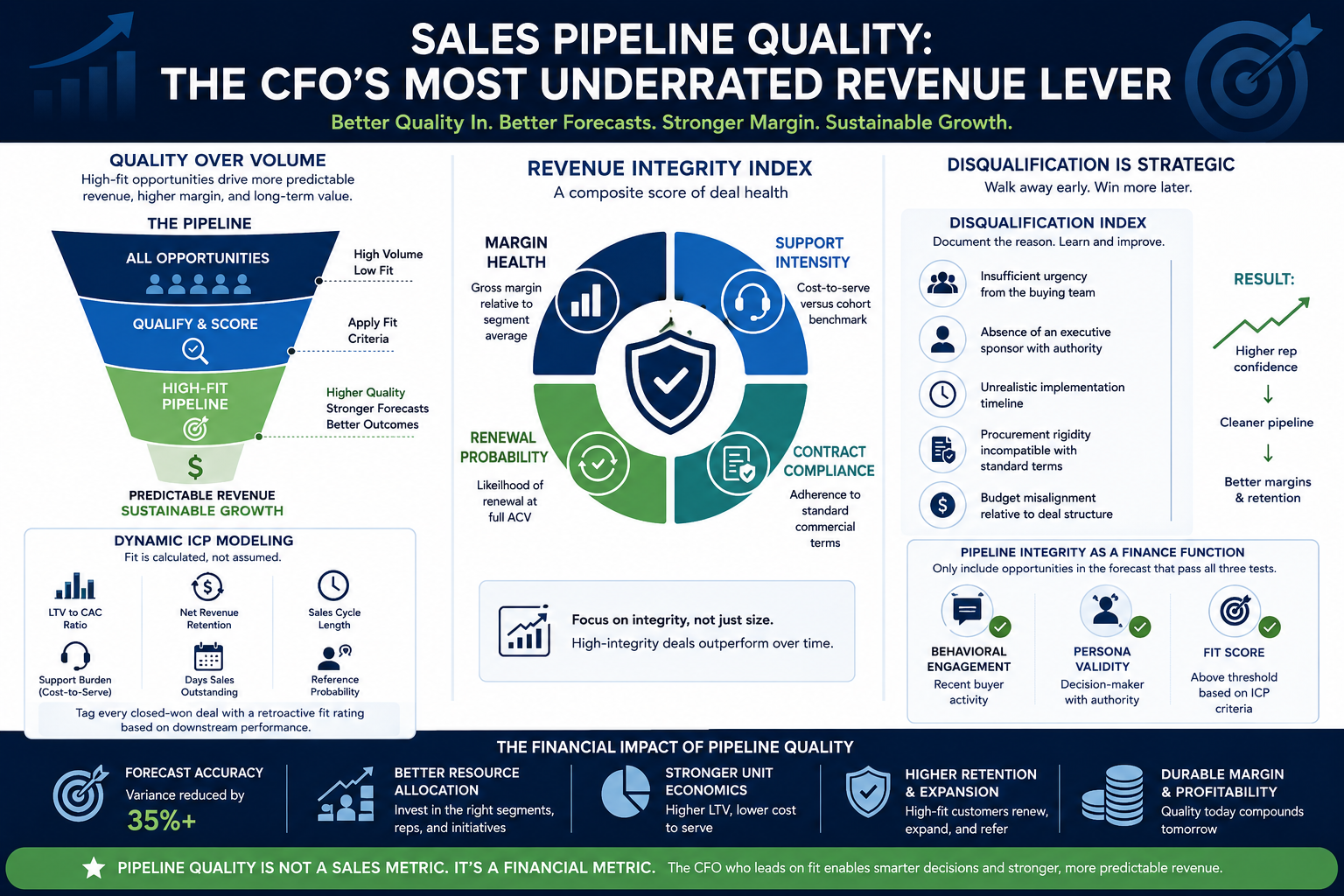
Sales pipeline quality is not a sales metric. It is a financial metric, and every CFO should treat it as one. The discipline of customer fit, the rigor of early disqualification, and the precision of pipeline quality metrics collectively determine whether a company’s revenue system generates durable margin or merely the appearance of growth. Over the course of building revenue operations across multiple sectors and geographies, the evidence has been consistent: high-fit pipeline compounds, and low-fit pipeline corrodes. The CFO who embeds fit logic into forecasting, incentive design, and capital allocation does not just improve the accuracy of financial planning. That CFO fundamentally changes the quality of decisions the entire organization makes.
Disclaimer: This blog is intended for informational purposes only and does not constitute legal, tax, or accounting advice. You should consult your own tax advisor or counsel for advice tailored to your specific situation.
Hindol Datta is a seasoned finance executive with over 25 years of leadership experience across SaaS, cybersecurity, logistics, and digital marketing industries. He has served as CFO and VP of Finance in both public and private companies, leading $120M+ in fundraising and $150M+ in M&A transactions while driving predictive analytics and ERP transformations. Known for blending strategic foresight with operational discipline, he builds high-performing global finance organizations that enable scalable growth and data-driven decision-making.
AI-assisted insights, supplemented by 25 years of finance leadership experience.