
Executive Summary
Credit officer best practices extend far beyond ratios and leverage covenants. Across more than two decades of finance leadership spanning cybersecurity, SaaS, gaming, logistics, digital marketing, medical devices, and nonprofit organizations, I have learned that lenders remember behavior more than they remember a single quarter’s results. Banks think in arcs, not snapshots. They recall whether a borrower called before or after a slip, whether a leader owned a number or argued its nuance, and whether communication arrived early or only when forced. This article distills the soft factors that consistently shape banking outcomes: consistency, humility, follow-through, and disciplined communication cadence. For CFOs and finance leaders, embedding these behaviors into organizational culture is not a courtesy to lenders. It is a strategic asset that lowers risk premiums, preserves flexibility during downturns, and compounds into what I call soft capital, a form of credibility that performs like real capital when conditions tighten.
Culture as the Bedrock of Credit Relationships

Every senior banker I have worked with across cybersecurity, gaming, logistics, and SaaS environments has confirmed the same pattern. They remember how a borrower treated them years ago more clearly than they remember a single quarterly result. Lending decisions rarely pivot solely on financial ratios. They hinge on how a borrower responds when circumstances depart from plan.
Early in my career, while overseeing finance for organizations ranging from a multi-studio gaming enterprise to a logistics and wholesale company generating roughly one hundred twenty million dollars in revenue, I observed that credit officers place enormous weight on conduct during stress. A leadership team that engages transparently during a difficult covenant discussion builds goodwill that outlasts the cycle that created it. A team that obscures or delays communication erodes trust that took years to establish.
This understanding shaped my approach to every fundraising and refinancing conversation I led, including efforts that secured more than one hundred twenty million dollars in capital across multiple organizations. Transparency over optics, and meeting deadlines even when results fell short of projection, created what I think of as credit equity. That equity compounds over time, while even the most polished forecast can evaporate in the absence of trust.
Banks Remember in Arcs, Not Snapshots
One of the clearest lessons from the 2008 downturn was that banks evaluate behavior across cycles rather than isolated quarters. During that period, I helped arrange a covenant waiver for a distressed borrower in a regulated industry. We explained the temporary nature of the pressure, proposed clear recalibrations, and followed through precisely on every commitment made. Two years later, when leverage tightened again, the lending relationship looked past elevated ratios because the bank referenced our prior conduct.
This is among the most important credit officer best practices for any finance leader to internalize. Cultivating long memory with lenders requires humility when results are strong and accountability when they are not. It requires documenting conversations, following through on stated commitments, and demonstrating ethical intent consistently rather than selectively.
Consistency, Humility, and Follow-Through in Practice
A refinancing negotiation I led during a period of elevated leverage illustrates this principle directly. Lenders expected difficult terms given the financial position at the time. Rather than presenting a polished narrative, I walked into the discussion acknowledging weaker performance, explaining the corrective plan in measured terms, and expressing genuine appreciation for the lender’s prior flexibility. The facility was reinstated at reasonable pricing, not because the numbers had changed, but because the posture had.
Credit officers respond more deeply to consistent humility and reliable delivery than to optimistic projections alone. A finance leader who brings realism and ownership into a covenant call signals partnership rather than passivity. This single shift in posture has, in my experience across nonprofit, SaaS, and manufacturing environments alike, changed the tenor of entire lending relationships.
Personal Credibility as Corporate Currency
Personal credibility functions as an intangible form of corporate currency that directors, investors, and banks all trade upon. When I stepped into a turnaround mandate, I brought both data and demeanor. Rather than emphasizing tenure or credentials, I emphasized accountability: an acknowledgment that performance was behind plan, paired with a specific plan and a commitment to report progress weekly. Lenders extended working capital support based on confidence in leadership, not balance sheet strength alone.
I now carry this lesson into the mentoring of newer CFOs. Many rely heavily on spreadsheet fluency while underinvesting in the communication of integrity. Encouraging a posture of ownership, paired with proactive disclosure, consistently improves how lenders receive financial data, because the numbers arrive with a visible personal commitment behind them.
Operationalizing Trust Across the Organization
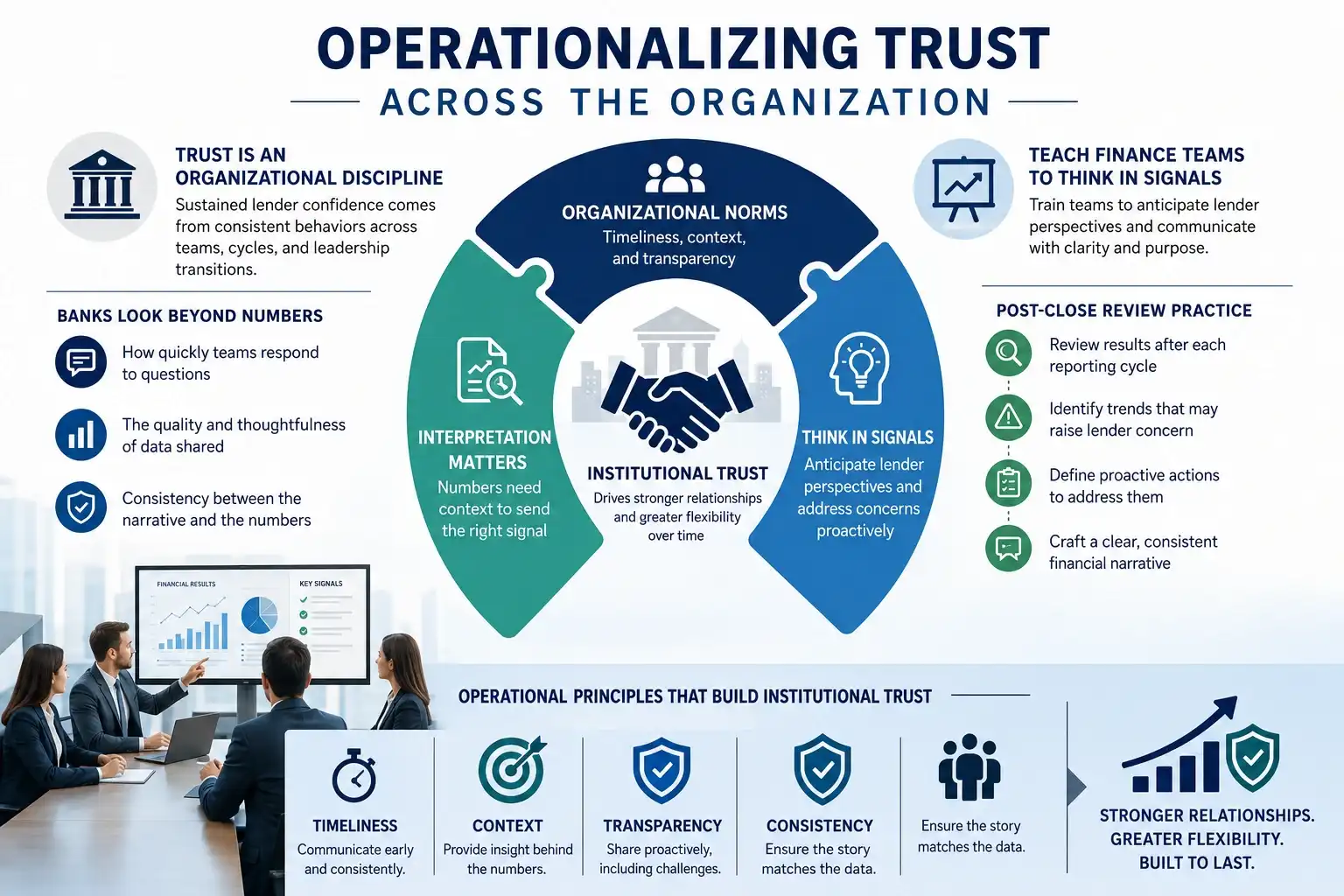
Building a single strong relationship with a lender is one achievement. Sustaining that trust across multiple business cycles, leadership transitions, and market conditions is a different discipline entirely. The most durable credit officer best practices are not personal habits alone. They are organizational norms that cascade from finance leadership into reporting teams, analysts, and treasury functions.
Across the organizations I have led, I have formalized communication principles that emphasize timeliness, context, and transparency. These norms have outlived individual budget cycles and leadership changes, in part because banks assess institutional behavior as closely as they assess financial results. A relationship bank notices how quickly a reporting team responds to questions, how thoughtfully data is packaged, and whether the narrative consistently matches the numbers over time.
Teaching Finance Teams to Think in Signals
Strong numbers do not always speak for themselves. A favorable signal can be lost without context, and a weak one can be misunderstood without explanation. Early in my leadership career, I assumed accurate financial reporting was sufficient. Over time, I learned that interpretation matters as much as accuracy.
I began institutionalizing structured post-close reviews across finance teams in cybersecurity and digital marketing organizations alike. After each reporting cycle, teams would map results to a credit officer’s likely perspective: what trends might raise concern, and what actions could be addressed proactively. This practice trained analysts to anticipate lender thinking rather than simply explain variance after the fact, and it consistently produced more disciplined, signal-aware financial narratives.
Communication Cadence as a Strategic Lever
If ethical posture forms the foundation of a lending relationship, communication cadence is the structure built upon it. Companies with strong controls can still falter in banking relationships if they communicate only reactively, while companies with average performance can navigate tight liquidity successfully simply by speaking early, frequently, and coherently.
Scheduling regular updates, even when performance is tracking to plan, creates two distinct benefits. It builds psychological safety for the lender, and it surfaces potential concerns before they calcify into misinterpretation. During a period of industry volatility, standing weekly check-ins with a relationship bank became an anchor of trust well before any difficulty appeared. When a revenue dip eventually occurred, the lender’s response was calm and constructive, because a year of consistent communication had already demonstrated how the team would behave under pressure.
The table below summarizes the core practices that consistently produce stronger lending outcomes across the sectors I have worked in, from medical devices to SaaS to logistics.
| Practice | Behavior in Action | Outcome with Lenders |
| Proactive disclosure | Share concerns before being asked | Builds psychological safety and trust |
| Consistent cadence | Schedule updates even when results are on plan | Prevents surprise-driven scrutiny |
| Ownership over optics | Acknowledge shortfalls directly with a clear plan | Strengthens personal and institutional credibility |
| Documented follow-through | Record commitments and close the loop on each one | Creates a verifiable track record over cycles |
| Signal-aware reporting | Frame data the way a credit officer would interpret it | Reduces follow-up requests and clarifying questions |
Aligning Organizational Culture with Credit Discipline
The most effective time to define financial culture is not when risk appears, but when conditions are stable. Across two organizations, I introduced a short internal document outlining behavioral principles for finance teams: always close the loop, never obscure a signal, assume external scrutiny, avoid surprises, and document intent. This was never treated as a compliance checklist. It functioned as a compass for judgment.
Teams adopted these principles quickly because they addressed the most human dimension of finance, which is judgment under ambiguity. Over time, the result was fewer last-minute requests from banks, fewer follow-up clarifications, and stronger terms during renegotiation. One credit officer remarked that the finance team behaved like an extension of the bank’s own internal credit group, a comment that reflected years of consistent, principled engagement rather than any single strong quarter.
The Strategic Payoff of Soft Capital
Lenders carry institutional memory that extends well beyond any single transaction. They remember grace under pressure, whether a leader called before or after a slip, and whether a number was owned or argued. Over time, this blend of consistency, ethics, and humility begins to function like actual capital. It buys time during stress, cushions errors, lowers risk premiums, and opens doors that remain closed to more aggressive peers with stronger reported metrics but weaker behavioral track records.
This dynamic is not theoretical. Organizations with comparable or even better financial multiples have been denied flexibility that other borrowers secured with more modest metrics, simply because the latter had built years of transparent, principled engagement. The difference was posture, not performance, and it is one of the clearest demonstrations of why credit officer best practices belong in the same strategic category as financial planning itself.
Conclusion
Credit officer best practices ultimately rest on behavior rather than metrics alone. Across decades of finance leadership in cybersecurity, SaaS, gaming, logistics, medical devices, and nonprofit organizations, the clearest pattern has been that lenders respond to posture as much as performance. They watch for consistency across cycles, humility during setbacks, and proactive communication rather than reactive disclosure. These behaviors are not soft in the dismissive sense. They are strategic, and they compound into a form of credibility that protects an organization when conditions tighten. For CFOs and finance leaders, the lesson is straightforward: ethics, culture, and communication discipline belong inside the capital structure conversation, not outside it. They may not appear on a balance sheet, but they shape the decisions of those who extend the trust that allows an organization to grow. Building this soft capital deliberately, rather than incidentally, is one of the most durable advantages a finance leader can offer their organization.
Disclaimer: This blog is intended for informational purposes only and does not constitute legal, tax, or accounting advice. You should consult your own tax advisor or counsel for advice tailored to your specific situation.
Hindol Datta is a seasoned finance executive with over 25 years of leadership experience across SaaS, cybersecurity, logistics, and digital marketing industries. He has served as CFO and VP of Finance in both public and private companies, leading $120M+ in fundraising and $150M+ in M&A transactions while driving predictive analytics and ERP transformations. Known for blending strategic foresight with operational discipline, he builds high-performing global finance organizations that enable scalable growth and data-driven decision-making.
AI-assisted insights, supplemented by 25 years of finance leadership experience.