
Executive Summary
SOX compliance automation has moved from the margins of finance transformation to its center. For the modern CFO, the question is no longer whether to automate, but how to do so with enough discipline that control integrity deepens rather than erodes. Automation replaces the manual choreography of binders, spreadsheets, and reconciliation cycles with rules-driven systems that are traceable, consistent, and auditable in real time. When implemented thoughtfully, it reduces audit costs, scales without proportional headcount growth, and embeds governance into daily operations. Yet automation is not absolution. It reframes compliance as a living architecture that demands active stewardship. This article examines the operational, financial, and strategic dimensions of SOX compliance automation, drawing on lessons from high-growth environments where the pressure to scale governance alongside the business is not optional. It is existential.
The Manual Compliance Era and Why It No Longer Holds
For most of its history, SOX compliance was a discipline of endurance. Quarterly closes brought with them armies of analysts reconciling ledgers, assembling evidence binders, and constructing audit trails that accumulated under their own weight. The process offered hard-won assurance, but it arrived late and at considerable cost. What passed for control was often, in practice, fatigue dressed in documentation.
This is not a critique of the people who sustained those systems. It is a recognition that the architecture was ill-suited to the pace of modern enterprise. As companies grow more complex, spanning multiple entities, geographies, and regulatory environments, the manual model does not scale. It fractures.
Having led finance functions across cybersecurity, SaaS, gaming, logistics, and digital marketing, I have seen this fracture firsthand. At a gaming enterprise managing over one hundred million dollars in acquisitions, the compliance burden of post-merger integration exposed every weakness of manual control testing. The controls existed. But their traceability under audit pressure was another matter entirely.
The shift to automation does not simply reduce labor. It changes the fundamental nature of what compliance means.
What SOX Compliance Automation Actually Does
Embedding Controls in Workflow
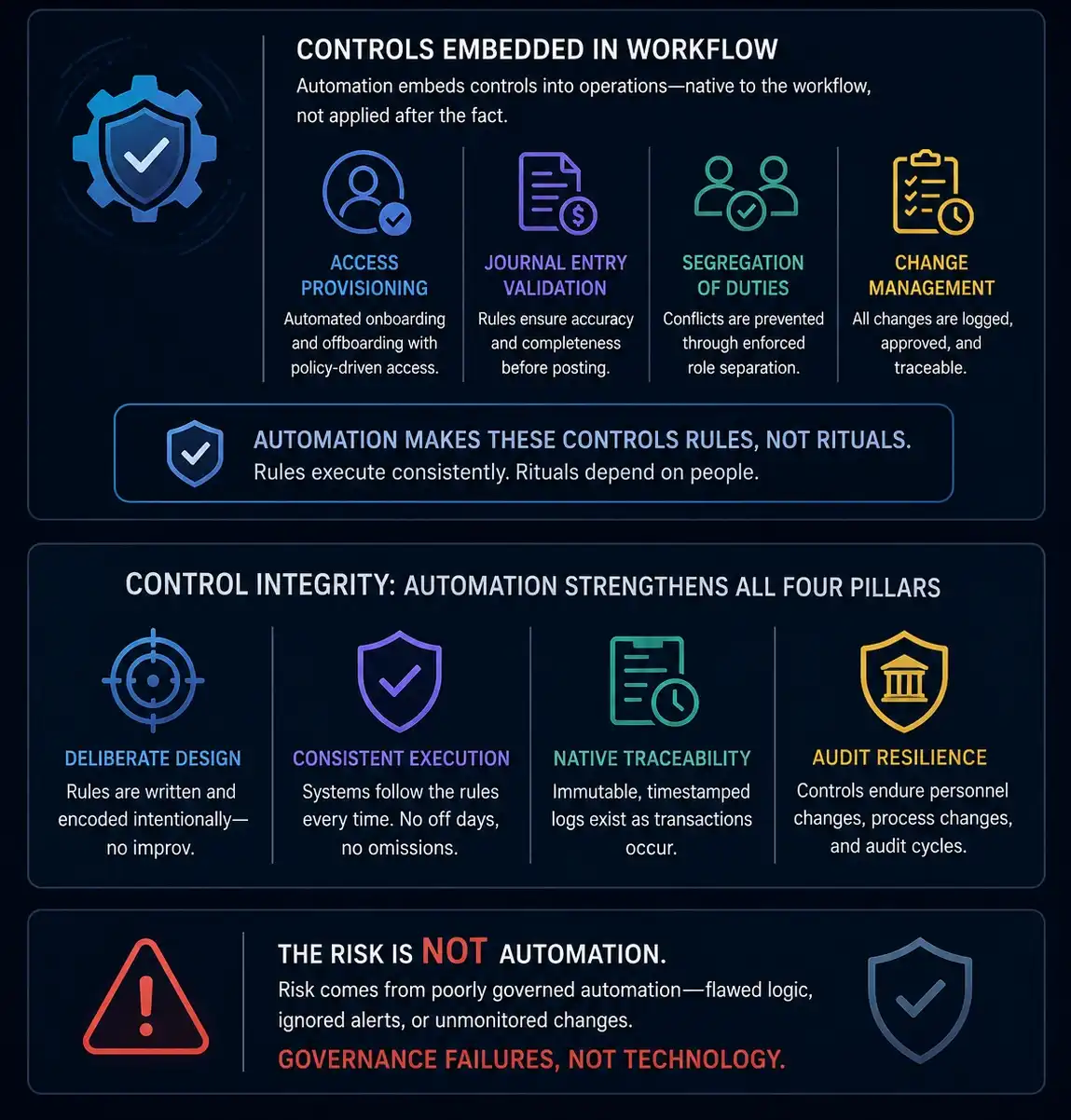
In a non-automated environment, compliance is something applied after the fact. It is a layer placed over operations. In an automated environment, controls are embedded in the operations themselves. They are native to the workflow rather than adjacent to it.
Consider access provisioning. In a manual setting, employee offboarding involves checklists, email reminders, and post-departure audits to confirm access removal. A step is missed. A reminder goes unanswered. An access review occurs weeks after it should have. In an automated system, provisioning and deprovisioning are governed by role hierarchies and policy logic. There is no room for oversight to quietly become risk.
The same principle applies to journal entry validation, segregation of duties enforcement, and change management logging. Automation makes these controls rules, not rituals. And rules, unlike rituals, do not depend on memory or energy to execute.
The Control Integrity Question
A legitimate concern follows every automation conversation: does replacing human judgment with system logic weaken control integrity?
The answer, when implementation is disciplined, is no. Control integrity rests on four pillars: design, execution, traceability, and resilience under audit. Automation strengthens all four simultaneously.
- Design becomes deliberate and explicit rather than improvised. Rules must be written down before they can be encoded.
- Execution becomes consistent. A system does not have an off day.
- Traceability becomes native. Immutable, timestamped logs are not reconstructed after the fact. They exist as the transaction occurs.
- Resilience is enhanced because controls survive personnel changes, process changes, and audit cycles without degrading.
The risk to integrity does not come from automation itself. It comes from poorly governed automation, where logic is flawed, alerts are ignored, or system configurations are changed without audit oversight. These are governance failures, not technological ones.
The Financial Case: Cost Implications and Return on Investment
The Upfront Investment
The costs of SOX compliance automation are real and front-loaded. Software licensing, systems integration, professional services, and internal bandwidth all arrive before the returns do. For mid-sized organizations straddling private and public market realities, the instinct to delay and solve compliance with headcount first is understandable. It is also increasingly expensive.
The full cost picture looks different when modeled over a three-to-five year horizon.
| Cost Category | Manual Compliance Model | Automated Compliance Model |
| Control testing labor | High, scales with entity count | Low, asymmetrically scalable |
| External audit fees | High, driven by control failures | Reduced by up to 20-30% post-automation |
| Remediation costs | Recurring and unpredictable | Significantly reduced |
| Headcount to sustain | Linear with complexity | Sub-linear with complexity |
| Scalability under growth | Degrades | Maintains or improves |
Where the Return Accumulates
The return on SOX compliance automation is not a single line item. It accumulates across several dimensions.
External audit firms price their work based on complexity, control failures, and the effort required for remediation. When automated systems produce reliable evidence trails, reduce deficiencies, and allow system-verifiable reporting to replace time-consuming walkthroughs, audit fees follow. Organizations that have made this transition have documented reductions of twenty to thirty percent in external audit costs within two fiscal years.
Beyond direct cost containment, the return on investment materializes in risk reduction. Manual processes carry statistically predictable error rates. A missed access control review or an overlooked segregation conflict can produce a material weakness that reverberates through investor calls. Automation mitigates these through design rather than detection.
The most strategically significant return, however, is the ROI of scale. When I helped scale a digital marketing firm from nine million to one hundred and eighty million dollars in revenue, the compliance infrastructure could not afford to scale linearly with the business. Automated controls do not scale linearly. The same platform architecture that governs three entities can, with modest configuration, govern thirty. In hypergrowth environments, that asymmetry is not a convenience. It is what makes expansion sustainable.
SOX Automation Within the Digital Transformation Agenda
Compliance as Architecture, Not Overhead
Digital transformation is too often framed as a technology project. At its core, it is a redesign of how an organization operates, and compliance is not exempt from that redesign. A company cannot be forward-looking in its product strategy and backward-looking in its control environment. The dissonance is visible to investors, felt by finance teams, and ultimately costly.
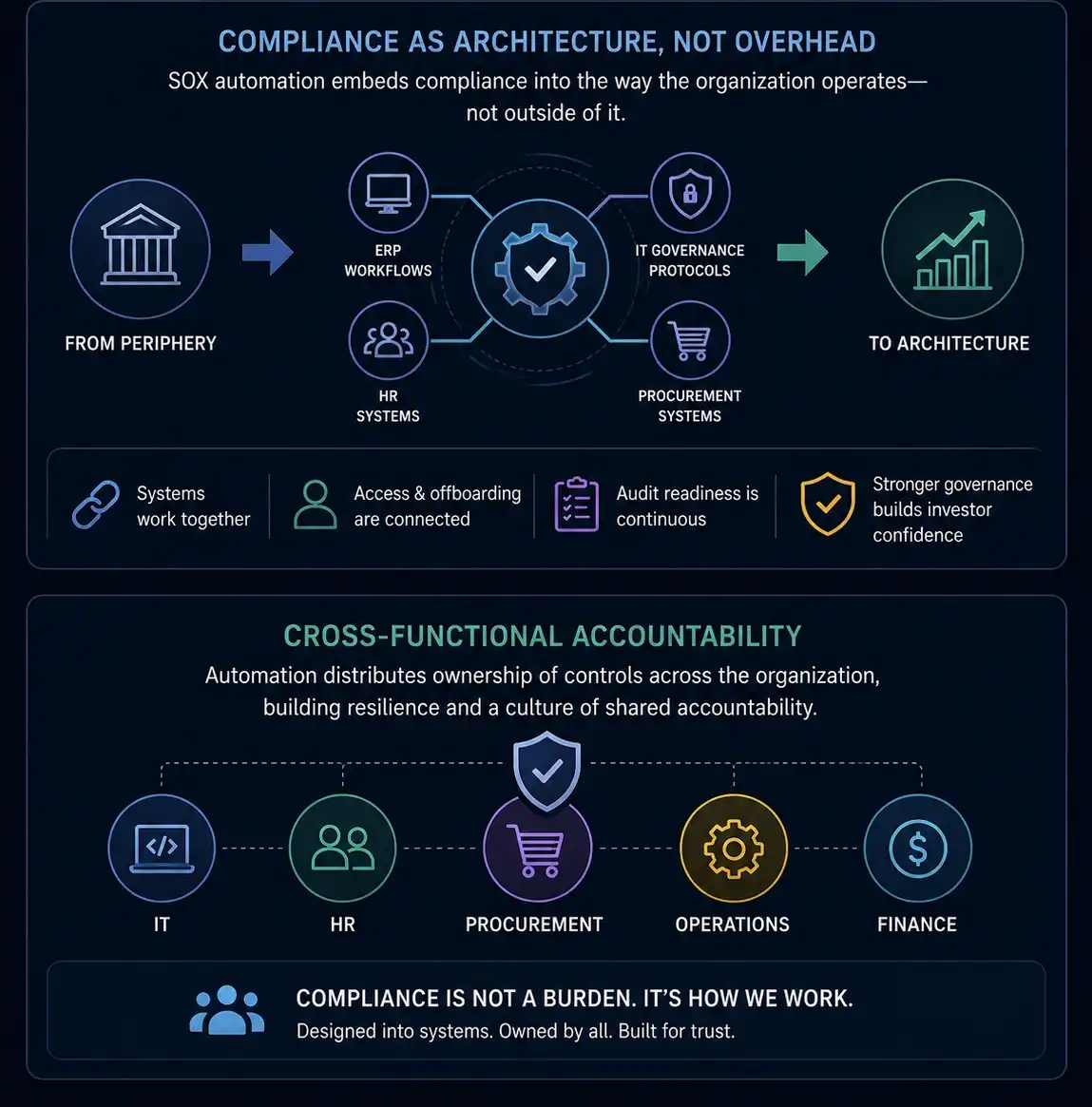
SOX compliance automation resolves that dissonance. It brings compliance from the periphery of the digital agenda into its architecture. Controls become embedded in ERP workflows, integrated with HR systems, and aligned with IT governance protocols. Finance speaks to procurement. Offboarding logic connects to access governance. Audit readiness becomes a continuous state rather than a seasonal sprint.
At a mission-driven education institution where I led the CFO function and secured a forty-eight million dollar capital raise, the board’s confidence in governance was not separate from the investment decision. It was central to it. Automated controls, clearly documented and defensibly designed, communicate a message that no investor deck fully captures: this organization takes stewardship seriously.
Cross-Functional Accountability
One of the structural contributions of SOX compliance automation is that it widens the ownership of control. In a manual environment, compliance tends to concentrate in the finance function. The binders live in finance. The evidence lives in finance. The fatigue lives in finance.
In an automated environment, controls are embedded in systems that span IT, HR, procurement, and operations. Each function becomes a stakeholder in the shared risk ecosystem. This distribution of ownership creates organizational resilience. It also creates a culture in which compliance is not experienced as an imposition from above, but as a design feature of how work gets done.
Risks That Remain After Implementation
The Complacency Trap
There is a quiet danger that arrives with a well-functioning compliance system: the belief that it requires no further attention. Dashboards glow green. Alerts fire on schedule. The audit trail is clean. And in that rhythm of reassurance, vigilance begins to relax.
This is the most consequential post-automation risk. Not system failure, but the gradual erosion of the curiosity required to steward the system well.
Automation works exactly as designed. That is precisely the risk when context shifts around it. A restructuring introduces new cost centers. A system change alters role hierarchies. A regulatory update requires control redesign. When these changes occur without corresponding updates to the automation logic, the controls continue operating, producing outputs that appear accurate but no longer are.
What the CFO Must Monitor
Post-automation governance requires a different kind of vigilance. The CFO is no longer monitoring the task. The CFO is monitoring the system.
This means:
- Validating that automation logic remains aligned with current operational structures and regulatory requirements
- Establishing change control protocols that include risk impact assessments before process or system changes go live
- Conducting periodic independent validations of control effectiveness, not merely confirming that the system is running
- Partnering with internal audit not as a compliance enforcer, but as a co-steward of the integrity layer
Early in my career as an audit associate at a major professional services firm, the discipline of control design was taught as a function of context. A well-designed control must reflect not only accounting accuracy, but the operating reality in which it lives. That principle does not change when the control is automated. It becomes more important.
Frequently Asked Questions
Does SOX compliance automation eliminate the need for internal audit?
No. Automation changes the nature of internal audit work, but it does not eliminate its necessity. In an automated environment, internal audit shifts from performing manual control tests to validating the integrity of automation logic, testing the accuracy of system inputs, reviewing configuration changes, and assessing whether the controls in place continue to reflect current operating realities. The function matures from reactive remediation to proactive risk stewardship. The need for skilled, independent oversight becomes greater as systems grow more complex, not lesser.
Conclusion
SOX compliance automation is not a technology initiative dressed in finance language. It is a governance philosophy made operational. It asks whether a company takes control seriously enough to build it into the architecture of daily work rather than appending it as a periodic obligation. For CFOs who have navigated the full arc from early-stage growth through public market scrutiny, the answer is rarely in doubt. What is in question is the discipline of implementation, the culture of stewardship that surrounds it, and the intellectual honesty to keep questioning systems that appear to be working. The organizations that get this right do not merely reduce audit costs or control failures. They build something more durable: an institutional credibility that compounds over time, attracts better capital, and sustains faster growth. In a world where complexity accelerates and investors scrutinize governance with increasing rigor, that credibility is not a byproduct of compliance. It is one of its highest purposes.
Disclaimer: This blog is intended for informational purposes only and does not constitute legal, tax, or accounting advice. You should consult your own tax advisor or counsel for advice tailored to your specific situation.
Hindol Datta is a seasoned finance executive with over 25 years of leadership experience across SaaS, cybersecurity, logistics, and digital marketing industries. He has served as CFO and VP of Finance in both public and private companies, leading $120M+ in fundraising and $150M+ in M&A transactions while driving predictive analytics and ERP transformations. Known for blending strategic foresight with operational discipline, he builds high-performing global finance organizations that enable scalable growth and data-driven decision-making.
AI-assisted insights, supplemented by 25 years of finance leadership experience.