
Executive Summary
Boardroom decision making is rarely determined by the one who controls the capital. Over three decades of finance leadership across cybersecurity, SaaS, gaming, logistics, digital marketing, medical devices, and nonprofit organizations, I have learned that influence in sponsor-led boardrooms is earned through clarity, credibility, and disciplined preparation rather than authority. Financial sponsors operate through a specific lens: return velocity, exit optionality, and valuation inflection. Finance leaders who learn to translate operational decisions into that language gain access to strategic conversations that titles alone cannot unlock. This article examines how to build, sustain, and compound influence inside rooms where capital controls the floor. It covers the communication frameworks, preparation disciplines, coalition-building tactics, and execution behaviors that convert a finance leader from a reporting function into a genuine boardroom strategist. The boardroom belongs to those who prepare for it, speak to it precisely, and deliver against what they promise.
Building Influence in Sponsor-Led Boardrooms
In every boardroom I have occupied across three decades of finance leadership, one lesson has held without exception. Influence is earned, not granted. It does not rest with titles, and it does not always follow capital. In rooms dominated by financial sponsors, private equity partners, venture capitalists, and institutional investors, the one holding the checkbook often commands the floor. Yet commanding the floor and shaping the strategy are not the same thing. The former is visible. The latter is deliberate.
When a company transitions from founder-led governance to investor-led oversight, the center of power shifts. Capital efficiency, return on invested capital, IRR, and exit timing begin to overshadow familiar operational metrics. I have experienced this shift multiple times, including during my tenure overseeing global finance for a multi-studio gaming enterprise managing more than one hundred million dollars in acquisitions and at a mission-driven education institution where I secured a forty-eight million dollar capital raise. In each context, the path to strategic relevance ran through the same discipline: understanding what the sponsor values and translating every proposal into that framework.
The sponsor mindset is shaped by time and return. Their investment horizon is finite. Their accountability is to limited partners, not employees. They evaluate everything through the lens of financial velocity, assessing whether an initiative accelerates valuation, preserves optionality, or creates unnecessary friction on the path to exit. Once I internalized this lens, I stopped presenting in the language of operations and began translating impact into enterprise value. That single shift changed how I was heard, how I was consulted, and how much latitude I was given to shape direction.
Translating Operations into Valuation
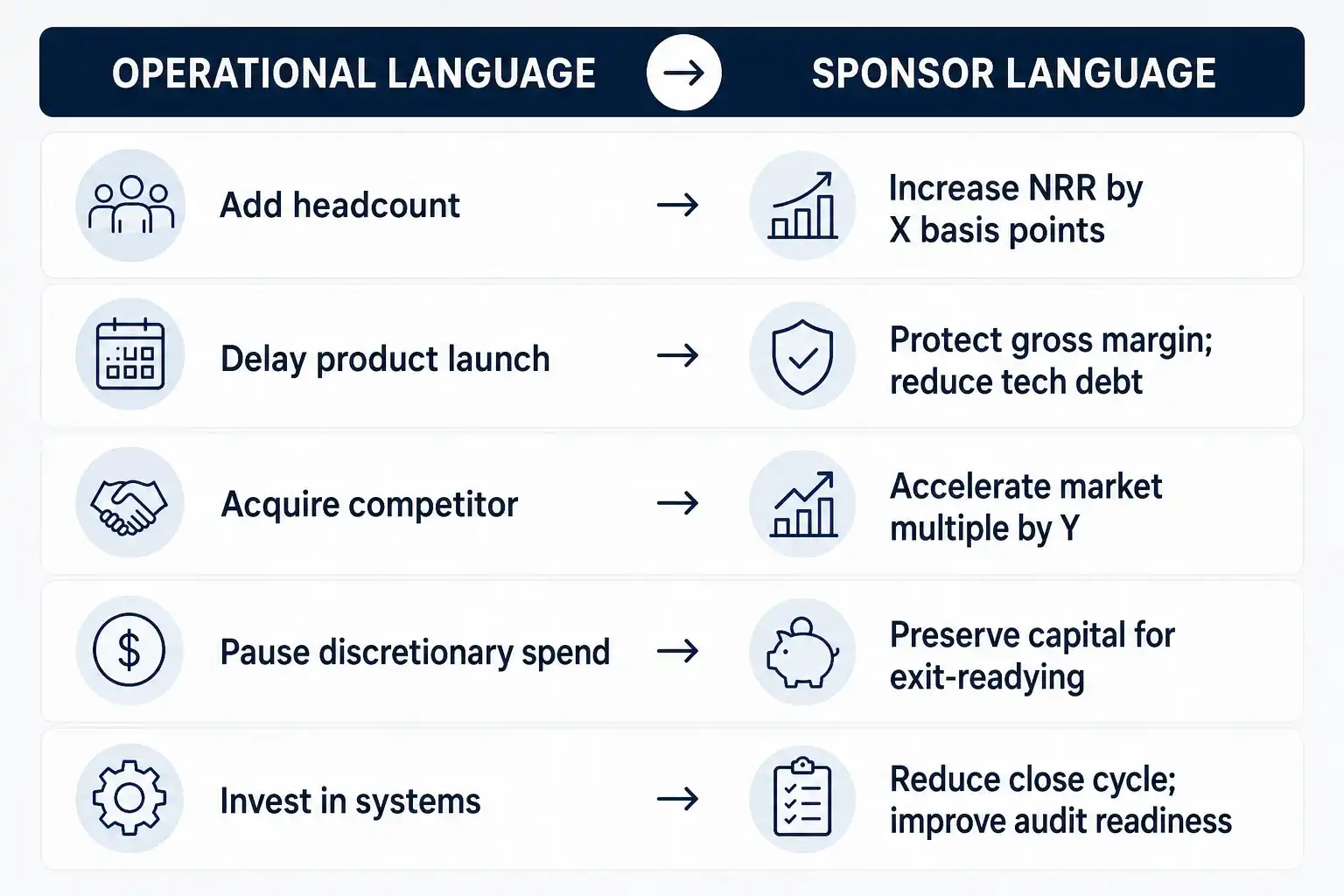
The shift from operator to strategic partner begins with language. In one boardroom discussion, a debate arose over adding headcount in customer success. The sponsor interpreted it as cost. The real argument was retention. Rather than presenting the case through anecdote, I quantified how improved engagement would lift net dollar retention by three hundred basis points, justifying a higher revenue multiple at exit. The room shifted not because of conviction but because of precision. The ask was aligned to the sponsor’s goal. You do not need to hold the checkbook to change the strategy if you can demonstrate how your proposals move enterprise value.
The framework below captures the core translation a finance leader must perform in every sponsor-facing conversation:
Preparation as the Real Strategic Advantage
Boardrooms are rarely won in the room. The real moves are made in the weeks leading up to the meeting, through the quality of the board deck, the sharpness of the pre-reads, and the deliberate construction of the narrative arc. I treat every board meeting as a strategic case study, not a reporting exercise. The framing of each session follows a consistent logic: what did we believe last quarter, what did we learn, what changed in the market, and what trade-offs are now in front of us. This structure builds trust over time because it demonstrates that leadership is learning rather than simply executing. And trust, in rooms where capital holds authority, is the most valuable currency available to an operator.
Communication style carries equal weight. Financial sponsors do not want completeness. They want clarity. Early in my career, I provided too much context, assuming it signaled thoroughness. Over time I learned to distill data into insight, convert insight into scenarios, and present decisions as genuine options rather than veiled approvals. This approach respects the board’s mandate while creating space for the operator’s strategic voice.
There is also an underappreciated advantage in understanding the sponsor’s rhythm. Private equity firms think in quarters, fund cycles, and exit timelines. Venture firms think in milestones, funding stages, and market windows. Knowing this, I adjust the tempo of my proposals accordingly. Capital requests are timed to liquidity events. Non-critical asks are deferred when bandwidth is visibly constrained. This is not deference. It is the alignment of influence with receptivity, and it makes a measurable difference in how proposals land.
Navigating Disagreement Without Escalation
Boardroom disagreements, handled well, become design sessions. Handled poorly, they become credibility risks. In a pivotal exchange during one portfolio company engagement, a sponsor favored an immediate product launch to bolster near-term revenue. I advocated for a phased rollout to protect gross margin and avoid accumulating technical debt. Rather than framing the disagreement as opposition, I constructed a forward-looking profit and loss analysis that made the hidden cost of acceleration visible. We reached a compromise: a sequenced rollout that served both objectives. The lesson was not about winning the argument. It was about making the best outcome easier for the board to reach.
Framing matters enormously in sponsor-led environments. A proposal to slow hiring sounds defensive. A plan to preserve capital for a timely acquisition sounds strategic. The underlying facts are identical. But the story around them determines how they are received. This is not manipulation. It is contextualization, and it is the difference between reacting and orchestrating.
Sustaining Influence Through Execution Consistency
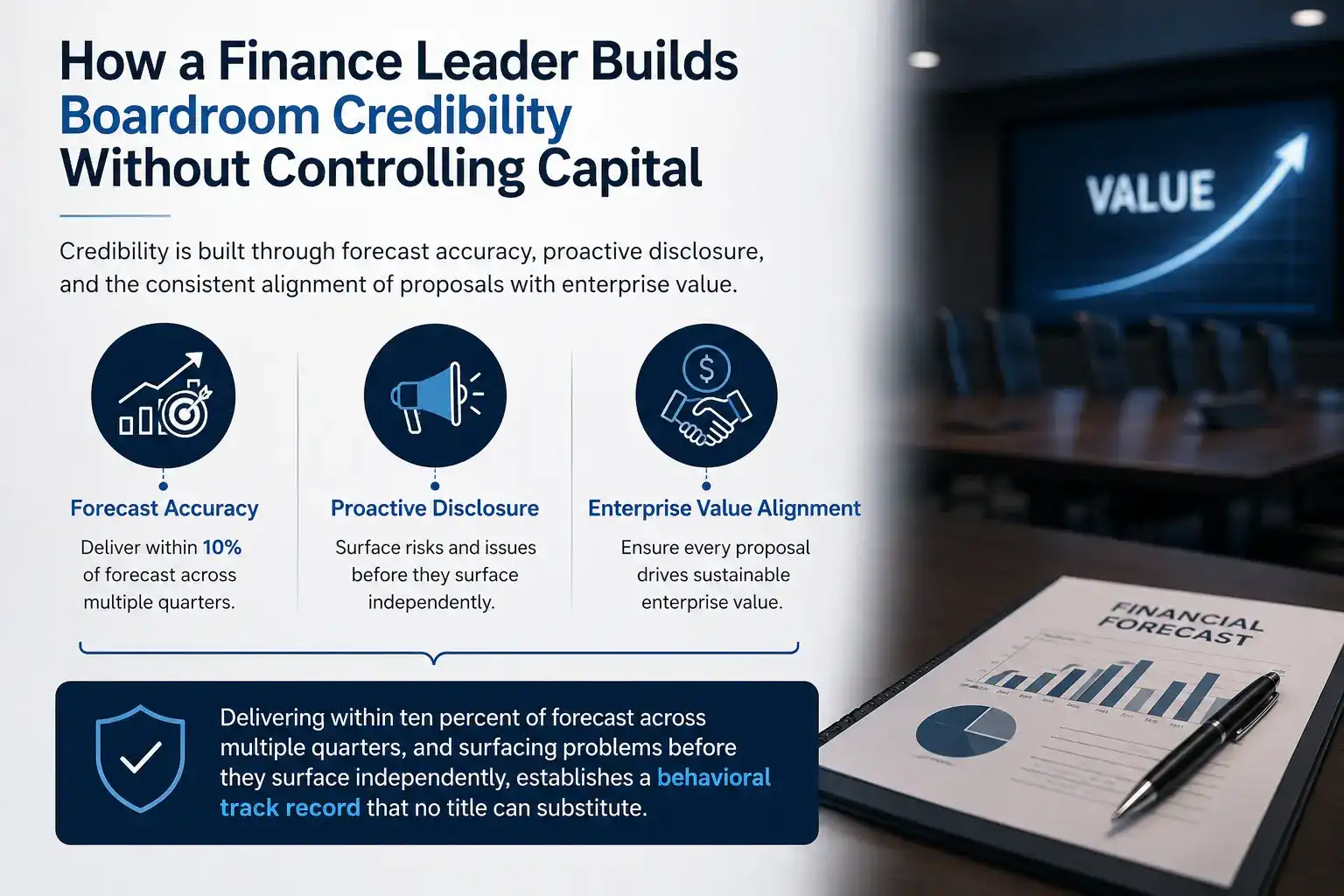
Influence gained early will erode without consistent delivery. In sponsor-led environments, what investors fear most is not underperformance. It is surprise. During one engagement where customer acquisition fell fifteen percent below target, the board’s response was measured rather than reactive because we had modeled downside scenarios in advance and presented the gap alongside a clear recovery initiative. Forecasts were revised, momentum was maintained, and trust remained intact.
This pattern of overcommunicating when performance deviates has remained one of the most consistent practices across my career. Whether leading finance for a cybersecurity company scaling rapidly or managing working capital for a logistics organization generating over one hundred twenty million dollars in revenue, the behavior of the leadership team under pressure always shaped how the board interpreted the numbers that followed.
There is also a longer arc to consider. As companies mature under sponsor guidance, the narrative eventually shifts toward exit readiness. This is where sustained influence truly compounds. The operator who has shaped the business across multiple quarters earns the right to shape the exit story alongside the sponsors. I have led these narratives from inside boardrooms, helping define not just the timing of a transition but the terms of the next phase. This includes co-authoring investor presentations, preparing leadership teams for diligence scrutiny, and positioning the organizational story for the broadest possible audience. Sponsors lead the monetization. But they remember, and reward, the operators who helped build the equity that made monetization possible.
Scenario Planning as a Boardroom Language
Rather than presenting a single recommended strategy, I consistently frame three paths in board-facing materials: a conservative scenario, an aggressive one, and a balanced path, each with explicit trade-offs clearly stated. This transforms board discussions from approval conversations into optimization conversations. Sponsors think in trade-offs every day. When an operator brings the same logic to operating decisions, the dynamic shifts from oversight to collaboration, and from deference to partnership.
Building Coalitions That Carry the Room
Influence is easier to project when it reflects internal alignment. Before every significant board meeting, I align with the heads of sales, product, and operations. Not to rehearse responses, but to converge on priorities and identify where genuine divergence exists and why. Sponsors interpret internal friction as execution risk. When a leadership team demonstrates cohesion without appearing scripted, sponsors extend greater latitude.
I also cultivate relationships with independent directors and non-capital board members. These voices carry disproportionate weight during contested decisions. Sharing pre-read drafts, testing assumptions informally, and inviting critique before the formal session ensures that by the time the board convenes, a proposal has already been stress-tested by allies. The boardroom strategy that succeeds is rarely a solo performance.
One equally important dimension is the visibility of the team itself. Sponsors care not only about the executive presenting but about the depth of leadership below them. I make it a deliberate practice to bring finance managers, product leads, and operations heads into board-facing conversations where appropriate. When a Head of Operations walks through a process improvement with data, or a treasury manager articulates a risk with the composure of a credit analyst, the board’s confidence in the institution widens. That widening is what creates true operational autonomy. It shifts trust from a single leader to a system, and systems are what sponsors ultimately want to back.
Conclusion
Boardroom decision making is not reserved for those who write the checks. It belongs to those who show up prepared, translate operational realities into the language of value creation, and deliver consistently against what they commit to. Across three decades of finance leadership, from overseeing more than one hundred million dollars in gaming sector acquisitions to reducing monthly burn from eight hundred thousand to two hundred thousand dollars at a digital marketing platform, the pattern has been consistent: influence follows credibility, and credibility follows behavior. The finance leader who prepares rigorously, communicates with precision, disagrees through data rather than posture, and builds coalitions before the meeting begins will shape boardroom strategy regardless of who controls the capital. The checkbook determines who funds the decisions. Clarity, consistency, and principled execution determine who designs them.
Disclaimer: This blog is intended for informational purposes only and does not constitute legal, tax, or accounting advice. You should consult your own tax advisor or counsel for advice tailored to your specific situation.
Hindol Datta is a seasoned finance executive with over 25 years of leadership experience across SaaS, cybersecurity, logistics, and digital marketing industries. He has served as CFO and VP of Finance in both public and private companies, leading $120M+ in fundraising and $150M+ in M&A transactions while driving predictive analytics and ERP transformations. Known for blending strategic foresight with operational discipline, he builds high-performing global finance organizations that enable scalable growth and data-driven decision-making.
AI-assisted insights, supplemented by 25 years of finance leadership experience.