
Executive Summary
CFO decision making has always rested on more than financial fluency. Over three decades of finance leadership across cybersecurity, SaaS, gaming, logistics, digital marketing, medical devices, and nonprofit organizations, I have learned that the executives who lead with the greatest clarity do so because they possess a structured way of thinking, not merely a command of the numbers. Three cognitive models define how the most effective finance leaders approach complexity: pattern thinking, which draws insight from historical rhythm; lateral thinking, which challenges assumptions and reframes problems; and model thinking, which simulates futures under uncertainty. Used in isolation, each has limits. Used together, they form a cognitive toolkit that elevates the finance function from a reporting mechanism into a genuine engine of strategic intelligence. This article examines each model in depth, demonstrates how they intersect in real decisions, and outlines how to institutionalize them across the office of the CFO.
The Three Minds of the CFO
The difference between good and great financial leadership lies not in data access but in cognitive architecture. CFO decision making at the highest level depends less on the sophistication of a spreadsheet model and more on the quality of the reasoning behind it. Early in my career, I relied almost entirely on pattern thinking, drawing forecasts from historical cycles and refining them iteratively. As I stepped into global roles spanning multiple industries, including overseeing more than one hundred million dollars in gaming sector acquisitions and later scaling a digital marketing firm from nine million to one hundred and eighty million dollars in revenue, I encountered decisions that historical patterns simply could not resolve. I needed tools that could challenge what I already believed and stress-test what I planned to do. That need brought lateral thinking and model thinking into my daily practice, and together with pattern analysis, these three models have defined how I approach every complex decision since.
These three modes of reasoning are not mutually exclusive. They thrive in combination. The table below summarizes their defining characteristics and the contexts in which each performs best.
| Thinking Model | Core Mechanism | Best Applied To | Key Risk Without It |
| Pattern Thinking | Historical observation and cycle analysis | Forecasting, budget planning, trend detection | Overreliance on past; blind to structural change |
| Lateral Thinking | Assumption challenge and creative reframing | GTM design, process redesign, organizational pivots | Incremental improvements only; missed innovation |
| Model Thinking | Scenario simulation and probability weighting | Capital allocation, expansion decisions, risk planning | False precision; decisions made without uncertainty range |
Pattern Thinking: Reading the Rhythm of the Business
Pattern thinking is the natural starting point for any finance leader. It involves sustained observation of historical data, the identification of cycles, and the iterative refinement of forecasts based on what has reliably recurred. Applied well, it generates genuine competitive advantage.
During one regional finance review, I identified a persistent revenue dip in Q4 across an Asia-Pacific portfolio that defied the obvious explanations. By tracking regional purchasing cadences, regulatory cycles, and local holiday patterns, I was able to decouple product seasonality from buying behavior. Applying those seasonal factors to the global forecast model improved accuracy by more than twenty-five percent. That improvement was not academic. It produced fewer budget surprises, more timely capital allocation, and stronger investor confidence in the planning process.
The limitation of pattern thinking, however, becomes visible precisely when businesses evolve. When an acquisition strategy carries a company into new geographies, when a new product disrupts established buying rhythms, or when macroeconomic conditions break historical correlations, past cycles lose their predictive power. I have seen finance teams continue to apply historical assumptions to structurally different businesses and generate forecasts that were internally coherent but strategically misleading. Pattern thinking must always be paired with a mechanism for questioning whether the pattern itself still holds.
Lateral Thinking: Challenging the Obvious
Lateral thinking offers that mechanism. Where pattern thinking extrapolates, lateral thinking interrogates. It approaches problems from unexpected angles, through analogy, contrarian insight, or deliberate reframing of the question being asked.
I applied lateral thinking directly during a period of pipeline compression in a European sales cluster. The standard response would have been to increase activity metrics: more calls, more outreach, more coverage. Instead, I stepped back and asked whether the process itself was misaligned with the market. The insight was not financial. It was behavioral. Standard contract templates had been designed for large enterprise buyers and were creating friction at the mid-market level, where the cluster operated. Rather than accelerating a broken process, we repurposed the deal desk to include local compliance pre-screens and introduced a lighter contractual framework for smaller transactions. Conversion from lead to opportunity improved by eighteen percent within six months. That result did not emerge from rerunning the model. It came from challenging the assumption that the existing model was right.
In GTM design more broadly, lateral thinking is what surfaces the questions that data alone cannot generate.
- What if field coverage roles in mature markets were replaced by regional strategic partnerships?
- What if our discount approval workflow is producing the very behavior it was designed to prevent?
- What if churn in a specific cohort reflects a product communication failure rather than a product quality failure?
These questions do not arrive through pattern analysis. They arrive through deliberate, structured intellectual challenge.
Model Thinking: Simulating What Could Be
Model thinking brings structure to uncertainty. It draws from decision theory and systems thinking to simulate outcomes across a range of scenarios, replacing false precision with a calibrated range of likely futures.
When I led an expansion evaluation into a new international market, I resisted the temptation to project ARR growth from existing curves. Instead, I constructed a simulation that incorporated exchange rate volatility, local tax regimes, partner hiring timelines, and operational cost buffers. Running Monte Carlo simulations across ten thousand scenarios produced not a single growth prediction but a risk range, with explicit decision triggers for each outcome band. That approach reframed the expansion from a growth bet into a managed portfolio decision, one where every scenario had a pre-assigned response rather than a post-hoc rationalization.
The same discipline applies to forecasting. Many finance organizations confuse precision with accuracy. They refine variables to hit expected outputs while ignoring uncertainty bands or compounding variability across assumptions. Strategic finance requires something different: stochastic models that help leadership allocate resources by likelihood rather than aspiration, and that make the cost of being wrong visible before a commitment is made.
The CFO as Signal Architect
Underlying all three models is a deepened respect for information. A finance leader operating at the strategic level cannot rely solely on headline KPIs. Those are summaries. Insight lives in variance.
I use signal-level analysis to identify where systems degrade: where opportunity stage duration expands unexpectedly, where customer satisfaction feedback diverges by cohort, where churn follows a non-linear trajectory that standard retention metrics obscure. These are not purely financial problems. They are signal detection problems. And the CFO, more than any other executive, sits at the intersection of cross-functional data flows where those signals converge.
Model thinking formalizes that role. It enables Bayesian churn prediction, NPS drift analysis as a lead indicator of customer value erosion, and systematic identification of data gaps that inhibit strategic foresight. The office of the CFO must become a signal laboratory, cleaning, translating, and communicating the stories embedded in data with both narrative precision and mathematical confidence.
Applying All Three Models in Practice
The real test of any cognitive framework is whether it holds up in live decisions. The three models I have described are not reserved for annual planning or capital committee reviews. They are daily operating tools that apply across the most common decisions a finance leader faces.
In pipeline reviews, for instance, I bring all three lenses simultaneously:
- Pattern thinking surfaces historical close rates by stage, territory, and rep tenure to establish a baseline expectation.
- Lateral thinking flags category errors, such as opportunities tagged as enterprise based on logo size rather than actual buying behavior, that would distort the forecast if left unchallenged.
- Model thinking pressure-tests the aggregate through win-propensity models and deal-stage probability weighting, generating a confidence range rather than a single coverage number.
The same applies to RevOps architecture. Too many organizations build technology stacks for function rather than flow, automating inefficiencies rather than eliminating them. I approach RevOps design by first mapping where friction predictably emerges (pattern), then asking whether the incentive structure is generating the behavior the system was designed to prevent (lateral), and finally simulating the impact of structural changes before implementation (model). When I led a quote-to-cash stack audit and found that fewer than forty percent of quotes were passing through legal review without revision, it was this three-lens approach that identified the root cause and produced a solution: a tiered contract framework that matched document complexity to deal size.
Building a Thinking Culture in the Finance Function
Institutionalizing these models requires more than personal practice. It requires that the finance function itself becomes a thinking organization rather than a reporting one.
I structure my team’s work around three operating principles:
- Always identify which thinking model is driving a given analysis. Is this a pattern observation, a lateral hypothesis, or a modeled scenario? Naming the mode keeps reasoning explicit and debatable.
- Quantify uncertainty. No forecast is presented without a confidence range. Certainty is never claimed where the underlying data does not support it.
- Make trade-offs visible. Every model conceals assumptions. The discipline of surfacing and debating those assumptions is what separates strategic finance from sophisticated accounting.
At the start of every planning cycle, I run a systems review that evaluates not just financial performance but the quality of prior reasoning. Did the patterns we relied on hold? Did the lateral bets we made pay off? Which modeled risks actually materialized, and did our confidence ranges reflect real outcomes accurately, or did we systematically overestimate our certainty in a particular direction? This transforms annual planning from a budgeting ritual into a genuine learning process, and it creates the kind of institutional memory that makes each subsequent planning cycle more accurate and more strategically grounded than the last.
The cultural payoff extends beyond Finance. When the finance function models intellectual humility, when it normalizes uncertainty and rewards the quality of thinking rather than the precision of a number, it gives the broader organization permission to engage with complexity rather than retreat from it.
Conclusion
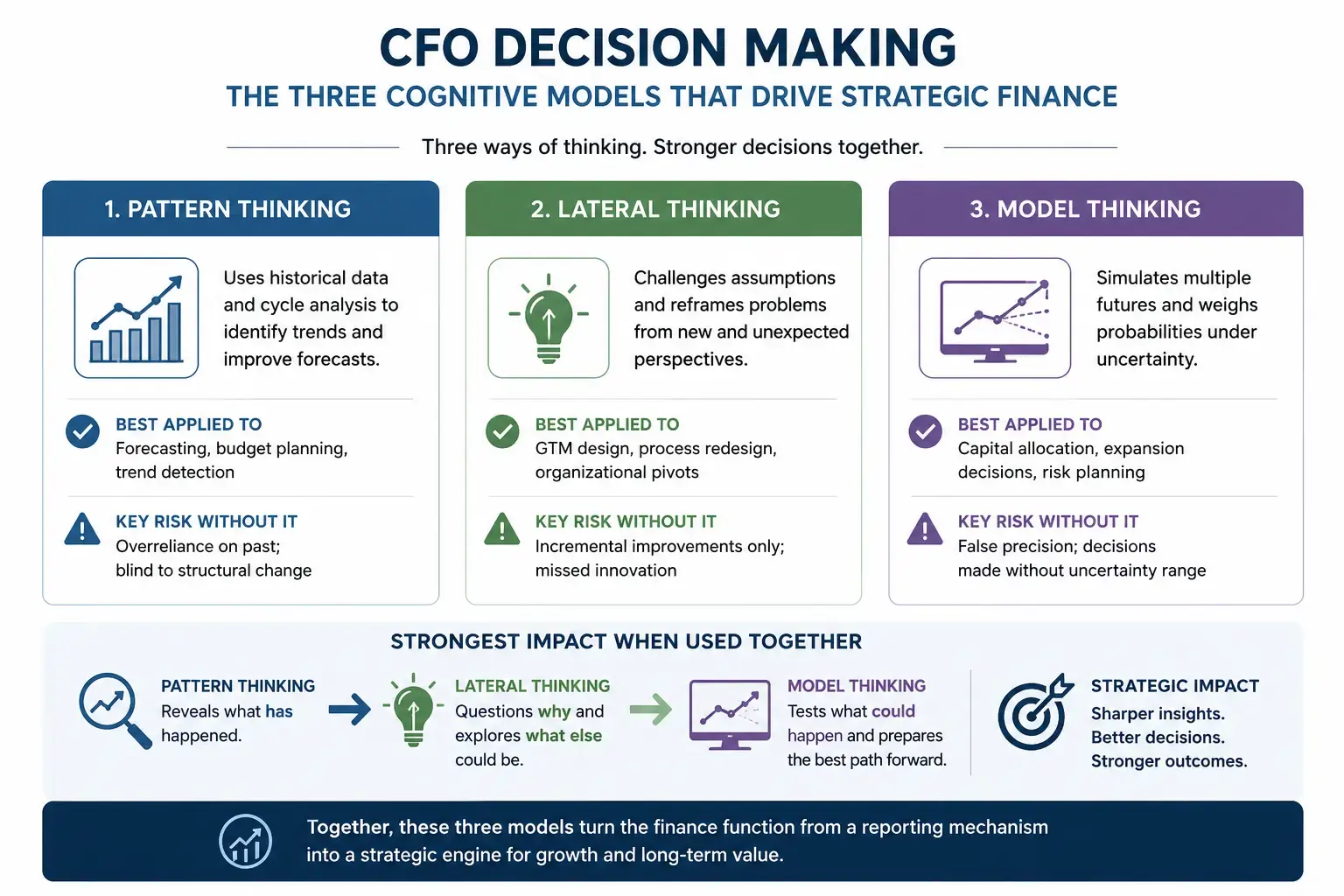
CFO decision making at the highest level is a cognitive discipline before it is a financial one. Pattern thinking, lateral thinking, and model thinking are not exotic frameworks. They are the daily instruments through which a finance leader converts complexity into clarity, uncertainty into calibrated risk, and data into decisions that endure across market cycles. Over three decades of finance leadership spanning sectors as varied as cybersecurity, nonprofit education, gaming, and logistics, I have returned to these three models in every significant decision I have navigated. They are not a replacement for financial expertise. They are the architecture that makes expertise strategic. The CFO who masters them does not simply report on what happened or project what is likely. That leader designs the system through which insight becomes action, and through which the finance function earns its place not at the edge of strategy, but at its center.
Disclaimer: This blog is intended for informational purposes only and does not constitute legal, tax, or accounting advice. You should consult your own tax advisor or counsel for advice tailored to your specific situation.
Hindol Datta is a seasoned finance executive with over 25 years of leadership experience across SaaS, cybersecurity, logistics, and digital marketing industries. He has served as CFO and VP of Finance in both public and private companies, leading $120M+ in fundraising and $150M+ in M&A transactions while driving predictive analytics and ERP transformations. Known for blending strategic foresight with operational discipline, he builds high-performing global finance organizations that enable scalable growth and data-driven decision-making.
AI-assisted insights, supplemented by 25 years of finance leadership experience.