
Executive Summary
Data hygiene best practices form the quiet infrastructure behind every successful capital raise, acquisition, or audit. Long before a term sheet is signed, investors and acquirers are already reading signals. Those signals come from how an organization organizes, secures, and presents its information. A finance leader who treats this discipline as ongoing rather than reactive builds credibility before the first diligence call begins. This article draws on more than two decades of experience. That experience spans capital raises, M&A transactions, and finance transformations. The sectors include cybersecurity, SaaS, gaming, logistics, digital marketing, medical devices, and nonprofit organizations. It covers version control and access governance. It also covers cross-functional ownership and the systems that keep an organization ready for scrutiny at any time. The goal is not perfection for its own sake. It is building a finance function that is always prepared and always credible. That function is never caught off guard when the next opportunity or audit arrives.
Why Disciplined Information Management Signals Institutional Maturity
Throughout my career, from early stage capital raises to nine figure exits, one pattern has held true. This pattern holds across every sector I have worked in. The organizations that move fastest through diligence, audits, and board scrutiny share one trait. They have already done the work of getting their information in order. Data hygiene best practices are not a finance department chore. They are a leadership discipline that touches legal, human resources, product, and operations alike. They also determine how quickly an organization can respond when opportunity or scrutiny arrives without warning.
Inconsistent file versions, missing approvals, or unclear ownership of records suggest weaker internal controls. This holds true even when the underlying business is sound. Investors, auditors, and acquiring teams form impressions quickly. I have sat on both sides of this equation. During a fundraising process for a fast growing cybersecurity and identity access management company, the speed and clarity of our financial reporting structure became part of the narrative investors told themselves about our operational maturity. The reverse is also true. I have walked into diligence rooms for prospective acquisitions in the medical device and digital entertainment sectors where outdated records and unclear file ownership created doubt before a single financial question was asked. Clean information does not just support a transaction. It becomes part of the story.
Core Components of a Well Managed Information Environment
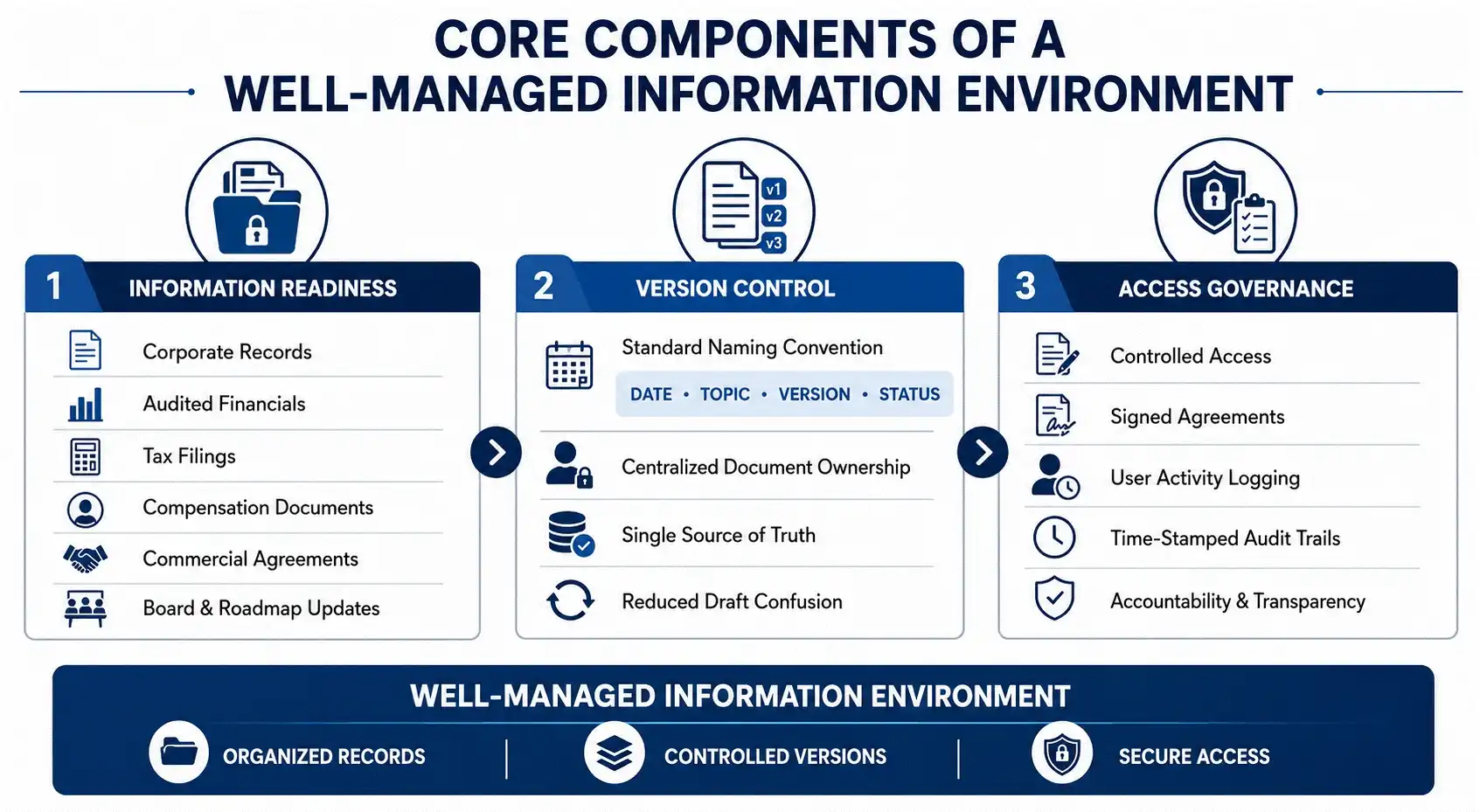
A finance organization with strong data hygiene typically maintains current versions of corporate records, audited financials, tax filings, compensation documentation, and commercial agreements, alongside contextual materials such as roadmaps and board updates that help outside parties understand intent and trajectory.
Version Control as a Daily Habit
During a logistics and wholesale finance transformation I led, we adopted a simple naming convention built around date, topic, version, and status, paired with centralized upload permissions held by a single gatekeeper. This single change eliminated the confusion that arises when multiple drafts of the same agreement circulate through different inboxes. The same logic scales down to small teams and up to multi entity global organizations, including a recent engagement where we redesigned finance architecture across operations in the United States, India, and Nepal and cut month end close time by more than half.
Access Governance and Audit Trails
Every participant in a sensitive review should operate under a signed agreement, with access logged by user, time, and document. This protects an organization from disputes over who knew what and when, and it builds a culture where access is intentional rather than incidental.
Engaging Data Hygiene Services for Year Round Readiness
Many organizations now turn to dedicated data hygiene services to maintain this discipline between major events rather than scrambling before one. These services typically combine document management platforms, periodic audits of file structures and permissions, and quarterly reviews that keep records current. In a nonprofit and education sector engagement where I led a forty eight million dollar capital raise, the groundwork of maintaining current board minutes, financial statements, and operational documents on a rolling basis meant the organization was deal ready well before the raise began. Whether handled internally or through outside data hygiene services, the principle is the same. Readiness should be a continuous posture, not a project.
Sustaining Hygiene Beyond the Transaction
The work does not end at close. Buyers and partners often need continued access for integration, audits, or compliance reviews. Maintaining a properly archived and appropriately permissioned copy of key records ensures that post transaction requests do not trigger another scramble. Cross functional ownership matters here as much as it does during the initial buildout. Legal verifies validity, finance confirms accuracy, human resources protects sensitive personal information, and product or technical teams review forward looking materials. A short standing review cadence, even monthly, keeps this distributed across the organization rather than resting entirely on finance.
Conclusion
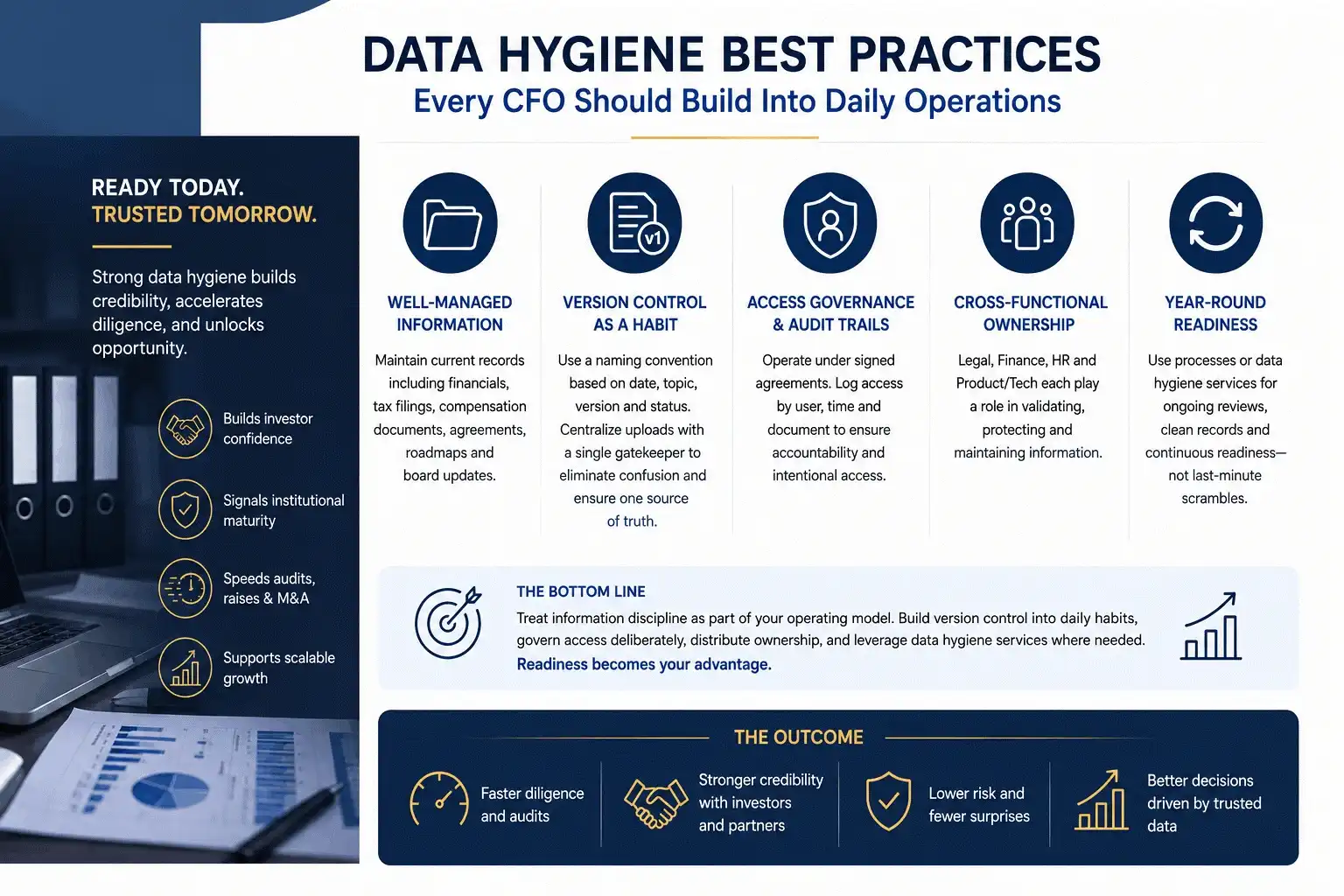
Data hygiene is ultimately a leadership signal. It tells investors, acquirers, auditors, and partners how an organization thinks about itself when no one is watching. Across cybersecurity, SaaS, gaming, logistics, digital marketing, medical devices, and nonprofit work, I have seen the same truth repeat itself. Organizations that treat their records as living infrastructure, reviewed and refreshed continuously, move through diligence and audits with confidence and speed. Those that treat it as a last minute task often find that the scramble itself becomes the story, regardless of how strong the underlying business is. For CFOs and finance leaders, the path forward is straightforward. Build version control into daily habits, govern access deliberately, distribute ownership across departments, and consider data hygiene services where they extend internal capacity. The investment is modest compared to the cost of a stalled transaction or a diligence process that loses momentum over avoidable confusion. Treat information discipline as part of the operating model, not an exception to it, and readiness becomes the default state of the organization rather than a goal to chase.
Disclaimer: This blog is intended for informational purposes only and does not constitute legal, tax, or accounting advice. You should consult your own tax advisor or counsel for advice tailored to your specific situation.
Hindol Datta is a seasoned finance executive with over 25 years of leadership experience across SaaS, cybersecurity, logistics, and digital marketing industries. He has served as CFO and VP of Finance in both public and private companies, leading $120M+ in fundraising and $150M+ in M&A transactions while driving predictive analytics and ERP transformations. Known for blending strategic foresight with operational discipline, he builds high-performing global finance organizations that enable scalable growth and data-driven decision-making.
AI-assisted insights, supplemented by 25 years of finance leadership experience.