
Executive Summary
Inventory often sits quietly on the balance sheet. It’s treated as a technical line item — until an auditor or a board member asks why margin moved without explanation. I’ve run finance functions across manufacturing, consumer products, and technology companies. In that time, I’ve learned the choice between FIFO, LIFO, or average cost inventory valuation is rarely just an accounting footnote. It shapes gross margin, taxable income, and the story a company tells its investors about the health of its operations.
This article works through the mechanics and consequences of cost flow assumptions, standard costing, and inventory obsolescence reserving. I draw on two decades of building these systems from the ground up. Readers will leave with a practical framework. It helps evaluate whether their current inventory accounting reflects economic reality or just the path of least resistance.
The Invisible Levers Behind Cost of Goods Sold and Cash Flow
Inventory rarely gets the strategic attention it deserves. Finance teams tend to relegate it to the back office. It becomes a compliance obligation, handled once a quarter and forgotten the rest of the time. That treatment misses the point. Inventory is a capital allocation decision as much as an accounting entry. This matters for any company navigating volatile input pricing, offshore suppliers, or long freight timelines. How that inventory gets measured becomes one of the more consequential judgments calls a finance leader makes each year.
At a venture-backed manufacturing company, I was the first finance hire. I built the chart of accounts before any of these questions could even be asked. At a $127M global consumer products company, I managed a supply chain spanning China and Vietnam. In both settings, inventory valuation and reserving decisions determined one thing. Did the board see the truth about the business, or a flattering version of it?
Cost Flow Assumptions Are More Than Mechanics
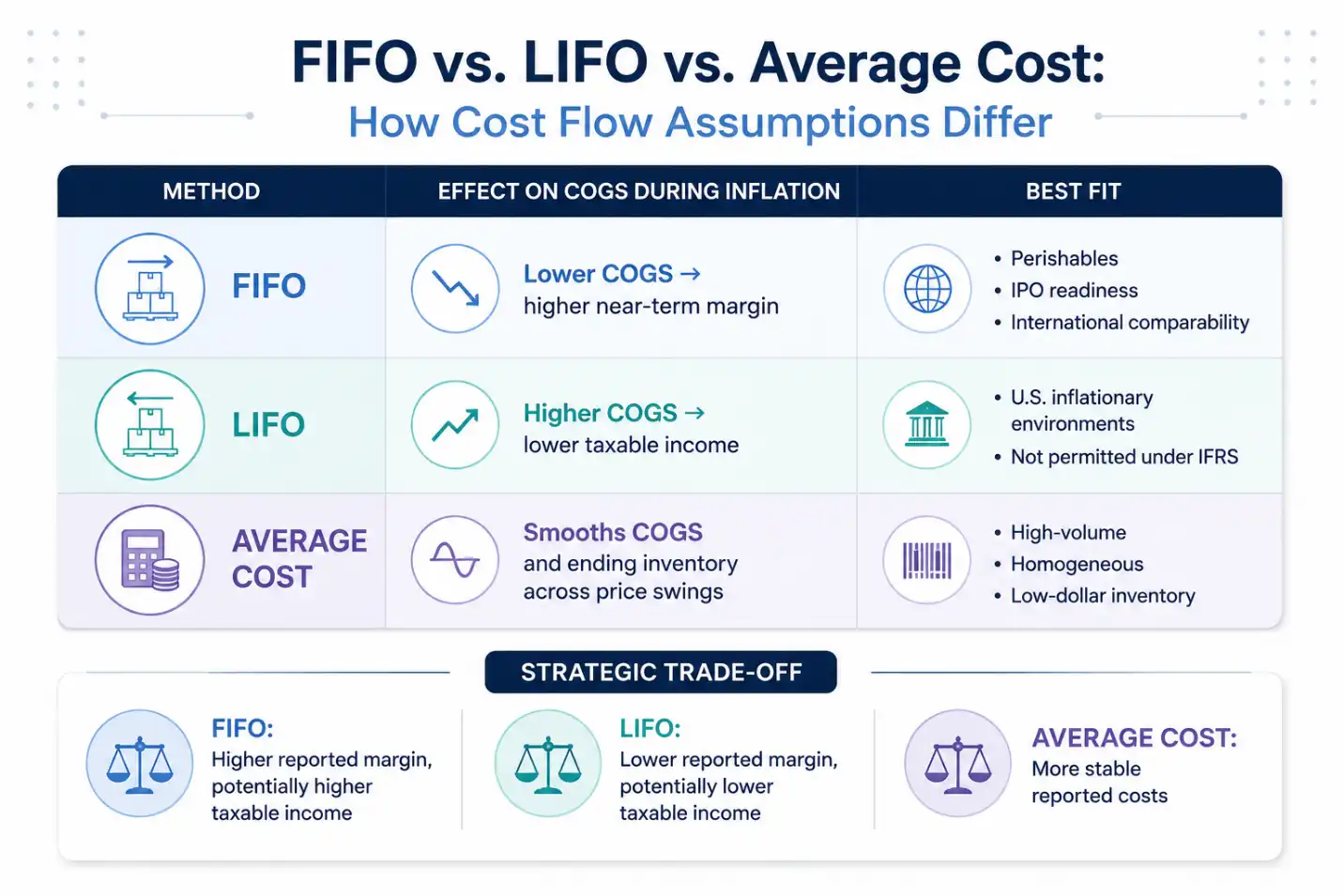
Start with the most elemental decision every inventory-holding company faces. Under US GAAP, that’s the choice among FIFO, LIFO, and the average cost method. These are often described as technical elections buried in a footnote, but the financial and operational implications run deep.
Consider a hardware company sourcing microchips in an inflationary environment. Under FIFO, cost of goods sold reflects older, cheaper inventory, inflating gross margin near term but also taxable income. LIFO reverses this. It runs newer, costlier inventory through cost of goods sold first, depressing margin while minimizing the tax bill. That’s why LIFO tends to be favored during rising input costs though it is not permitted under IFRS.
Where the Average Cost Method Inventory Approach Fits
The average cost method inventory calculation sits between these two extremes. It smooths cost of goods sold and ending inventory values. It does this by applying a single weighted average cost across all units available for sale during the period. This approach earns its place in businesses carrying large volumes of low dollar, largely homogenous SKUs. There, tracking specific lots would cost more in system overhead than the precision would return. The average cost method inventory valuation dampens the swings that FIFO and LIFO introduce during volatile pricing cycles. That makes it the more defensible choice when a company cannot cleanly attribute cost variance to a specific batch.
For startups and mid-market companies contemplating an IPO or an acquisition, FIFO is typically the preferred election. It aligns with replacement cost logic and travels well across international comparability standards. That preference carries risk, though. In volatile cost environments, FIFO can mask real margin compression until the erosion becomes too large to ignore.
The Role of Standard Costing in Operational Stability
Standard costing serves a different purpose from FIFO, LIFO, or the average cost method inventory election. It is not a valuation method so much as a control mechanism, comparing what a unit of production actually costs against what it was expected to cost. Standard costs get set using engineering estimates, supplier contracts, and labor models, and when variances show up in material pricing, labor efficiency, or overhead absorption, those variances signal that something in the operation needs attention.
I managed operations controllership at a $170M global medical device manufacturer with plants across Copenhagen, Cork, and Taiwan, and standard costing there was not optional. Bill of materials management and cost accounting had to withstand line by line audit scrutiny in a heavily regulated industry, with standard cost updates tied directly to supplier contracts and labor agreements across three countries. That experience taught a lesson that has held true since, standard costing becomes indispensable once monthly production volumes start to fluctuate. It lets finance catch process inefficiencies early, forecast margin erosion before it hits the quarterly numbers, and build the kind of KPI a board actually finds useful. The system does demand constant calibration though, and using stale standards is a bit like driving with a map from a year ago, directionally useful, but capable of leading a company somewhere it does not want to go.
Inventory Obsolescence and the Slow Leak in the Balance Sheet
Perhaps the most overlooked piece of inventory accounting is obsolescence reserving. As product life cycles shorten and customization increases, unsellable inventory stops being a possibility and becomes something closer to a certainty. ASC 330 requires that inventory be carried at the lower of cost or net realizable value, forcing a reserve against slow moving, excess, or obsolete stock.
Defining Slow-Moving Inventory in Practice
The challenge rarely lives in the rule itself, it lives in the judgment the rule demands. Is inventory slow moving after 180 days without a sale, or is it better defined by a turns ratio or a forecasted drop in demand? Finance has to partner with operations, sales, and supply chain leadership to build reserve policies that reflect both historical clearance behavior and where the product roadmap is heading. A flat 10 percent write down policy might satisfy an auditor on paper, but it rarely reflects the underlying business reality, and the real test is whether the methodology would survive an investor diligence process or an acquirer purchase accounting review.
At the $127M global consumer products company where I served as CFO, more than doubling inventory turns from 3x to 7x required this kind of partnership, tying demand planning, SKU rationalization, and logistics optimization into a single reserve discipline rather than a quarterly afterthought. That work released trapped working capital and changed how the company converted revenue into cash.
Inventory Write-Downs and the P&L Shock
The consequences of a weak reserve policy are stark, and this plays out on both sides of the ledger. A Series D company in precision hardware failed to update its reserve methodology as its SKU count expanded, and when demand for its first-generation product dropped faster than modeled, the CFO wrote off $3M in obsolete inventory. Gross margin fell 900 basis points that quarter, triggering board level concern and pushing the fundraising timeline back by months.
An e-commerce company that maintained rolling SKU level aging analytics and updated reserves quarterly had a different experience. When a supplier introduced a return to vendor clause, the company reversed $800K in reserves, lifting EBITDA and giving the CEO leverage heading into Series B negotiations.
The Capital Efficiency Angle
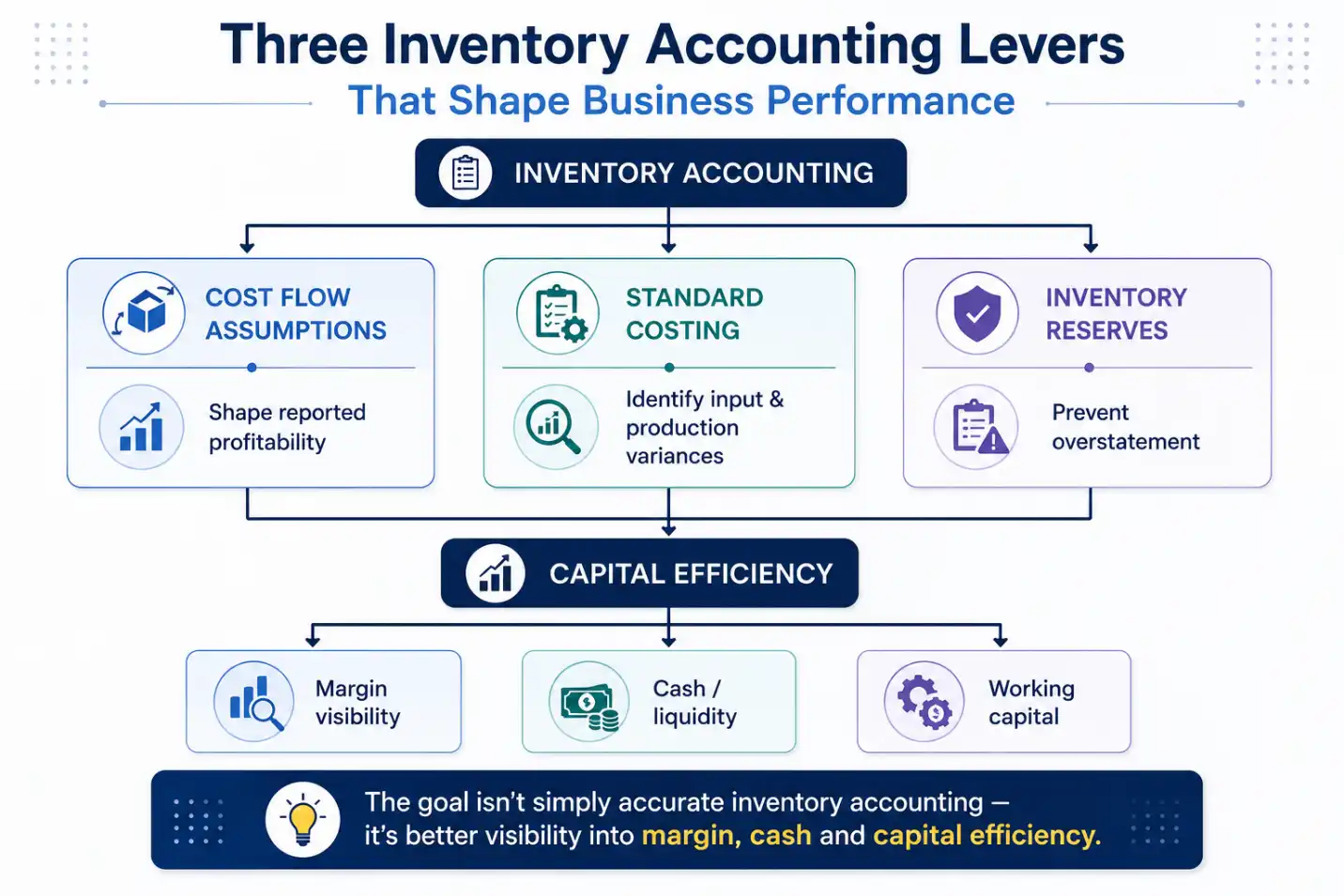
Inventory accounting is not only about compliance; it is about capital efficiency. Holding excess inventory ties up cash, drives up carrying costs, and distorts working capital metrics that lenders and investors watch closely. Under-investing to protect the optics of a lean balance sheet carries its own cost, showing up later as stockouts, lost revenue, and customers who do not return.
Standard costing manages input variance. FIFO, LIFO, and the average cost method inventory election shape the optics of reported profitability. Reserves protect against overstating what the business actually owns. None of these mechanisms should sit on default settings inherited from a prior finance leader, they need intentional orchestration.
Practical Actions for Finance Leaders
- Review cost flow assumptions annually. In a rising cost environment, assess whether FIFO, LIFO, or the average cost method still reflects economic substance rather than legacy habit, and if a switch is warranted, model both IRS and GAAP treatment before committing.
- Tie standard cost updates to sourcing events rather than to the audit calendar. A new supplier, a tariff change, or a wage renegotiation should trigger a cost revision on its own timeline.
- Build an aging and movement matrix. Set dynamic reserve thresholds by SKU category, geography, or life cycle stage, and include liquidation probabilities or backhaul costs where they apply.
- Model the impact of reserves on borrowing base calculations. Banks frequently discount or exclude reserved inventory from asset backed lending covenants, tightening liquidity faster than a P&L review would suggest.
Elevating Inventory from Technical to Tactical
Inventory accounting, done with rigor, elevates finance from a reporting function into a strategic enabler. It gives product leaders a feedback loop, strengthens vendor negotiating positions, and sharpens capital planning. More than that, it lets boards and investors see the true margin story rather than one distorted by cost flow assumptions or reserves that no longer reflect reality.
A Call to Action for Finance Leaders
Finance leaders who are scaling should treat this quarter as the moment to revisit the inventory accounting framework end to end. Evaluate whether the cost flow assumptions, the standard costing discipline, and the reserve methodology still reflect the realities of the supply chain and product roadmap. Bring the conversation to the COO rather than leaving it inside finance alone, since inventory accounting belongs in strategic planning, not just audit prep.
Three Key Takeaways
- The choice among FIFO, LIFO, and the average cost method inventory valuation is a strategic decision with tax, margin, and comparability consequences, not a mechanical bookkeeping election, and it deserves an annual review tied to the company cost environment.
- Standard costing and inventory reserving function as early warning systems, and finance leaders who calibrate them against real sourcing events and aging data catch margin erosion months before a quarterly close reveals it.
- Inventory decisions are capital efficiency decisions, and finance teams that build SKU level aging analytics and dynamic reserve thresholds protect working capital, borrowing base calculations, and the credibility of the numbers a board sees.
Disclaimer This article is intended for informational purposes only and does not constitute legal, tax, or accounting advice. You should consult your own tax advisor or counsel for advice tailored to your specific situation.
Hindol Datta is a four-time CFO and senior finance executive with over 25 years of leadership experience across cybersecurity, SaaS, gaming, logistics, digital marketing, medical devices, consumer products, and nonprofit organizations. He has led more than $120M in fundraising and over $150M in M&A transactions while building the financial and operational systems that let complex businesses scale with confidence. He is the author of seven books in the Systems CFO Series and holds active CPA, CMA, and CIA credentials.
AI-assisted insights, supplemented by 25 years of finance leadership experience.