
Executive Summary
Zero-based budgeting asks every dollar to earn its place again instead of inheriting last year’s allocation. Most budgets grow from historical momentum, and that habit quietly locks capital inside low-return activities. Applied well, a zero-based budget becomes a strategic lever that aligns spending with current priorities and frees capital for growth.
The sections ahead explain what zero-based budgeting is and why incremental planning falls short. They also cover how to design the framework, roll it out without fatigue, and build a culture where teams budget with purpose.
What Is Zero-Based Budgeting and Why Does It Matter?
Every budget tells a story about what an organization values, assumes, and fears. In most companies, that story starts from the prior year, with each function defending its share and adding a modest increase. The outcome resembles planning, yet in practice it is inertia with arithmetic attached.
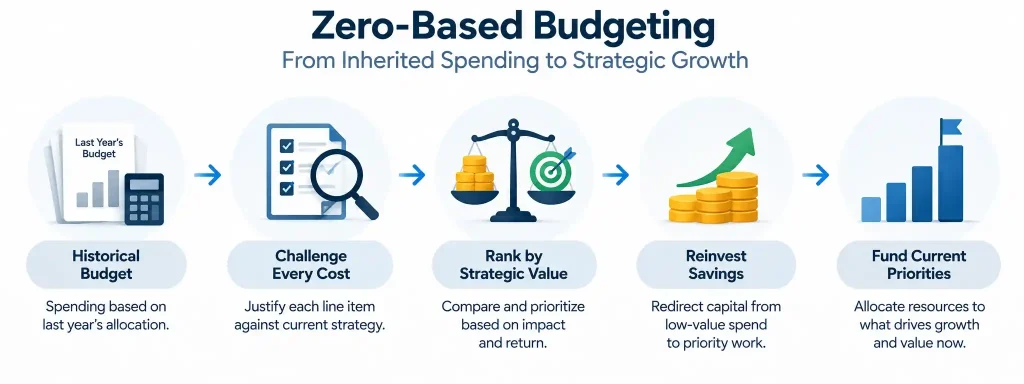
Zero-based budgeting starts from what the business needs today, not from what it spent before. Each line item, initiative, and cost structure must justify itself against current strategy. The method is not a blank slate that ignores history; it is a disciplined reconstruction that evaluates history before funding it again.
Incremental Budgeting Versus Zero-Based Budgeting
| Dimension | Incremental Budgeting | Zero-Based Budgeting |
| Starting point | Last year’s actuals plus an adjustment | Current strategy and required outcomes |
| Burden of proof | Finance must justify any reduction | Budget owners must justify every cost |
| Focus | Changes at the margin | The full cost base |
| Typical result | Legacy spend persists unchallenged | Capital shifts toward priority work |
The Hidden Cost of Incremental Budgeting
Incremental budgeting assumes the existing cost structure is sound. Legacy programs survive because they existed yesterday, and weak initiatives keep funding because cutting them would trigger internal politics. Over time, the budget mirrors institutional memory instead of institutional value.
How Status Quo Bias Shapes Behavior
The cultural cost runs just as deep as the financial one. Teams start to treat the budget as a game of defense, where the goal is to retain funding instead of refining it. Creativity fades, and financial stewardship shrinks into tactical negotiation over percentages.
Markets also move faster than incremental plans allow. Consumer behavior shifts, technology disrupts, and competitors leapfrog, while the internal budget marches on from an outdated baseline. Strategy races ahead, but funding lags behind like a train pulling cars built for an earlier destination.
This inertia rarely comes from bad intent, since most of it stems from a wish for continuity and fairness. Still, what looks like prudence may be complacency, and what looks like consensus may be drift in disguise.
Designing a Zero-Based Budget Framework
A sound framework begins with a shift in accountability. In a traditional process, finance leads and the business responds. In a zero-based model, each function becomes the author of its own financial case. Operating teams must defend continuing spend instead of finance defending every reduction.
Building and Ranking Decision Packages
Budget owners describe their work in discrete, costed units known as decision packages. Each package should include the following elements, written in plain language:
- The function, service, or initiative being funded
- Its full cost and the drivers behind that cost
- The strategic purpose it serves
- A measurable outcome that shows whether it worked
Leadership then ranks each package by strategic contribution, operational necessity, and return on capital. Ranking forces real trade-offs, since it exposes duplication, challenges pet projects, and shows where value has moved while cost has not. The CFO does not judge every request but builds the decision architecture that makes cross-functional comparison possible.
Challenging Fixed Costs and Reinvesting Savings
Fixed costs deserve scrutiny too, because many costs labeled immovable rest on expired logic. Leases, licenses, and recurring campaigns should all face the same question of value. An early-stage email marketing SaaS company offers a useful example. A disciplined operational turnaround reduced monthly burn from $800K to $200K, a result that depended on examining costs from the ground up.
Savings should not simply disappear into a general pool. Capital released from low-priority spend can fund innovation, talent, or market expansion. When teams see savings reinvested, the zero-based budget turns from a ceiling into a mechanism for progress.
Implementing Zero-Based Budgeting Across the Enterprise
The first challenge is psychological, since most teams equate reductions with threat. Finance leaders must open with a message of trust, framing zero-based budgeting as a path to focus instead of a penalty for waste. That tone matters because the mechanics are demanding, and each function must learn to express its work in packages.
Sequencing the Rollout
A full deployment in one cycle often produces fatigue and backlash. Phasing the work in stages works better, starting where spending is least transparent and discretion is highest.
Phased Rollout of Zero-Based Budgeting
| Phase | Focus Area | Key Activity |
| Pilot | G&A and overhead-heavy functions | Test templates, rubrics, and ranking |
| Refine | Lessons from the first cycle | Adjust cost categories and train budget owners |
| Expand | Operating units and shared services | Extend coverage function by function |
| Sustain | Whole enterprise | Review high-variability areas more often |
A central team of finance leads and analysts should build the cost taxonomy, standard templates, and evaluation rubrics. Digital tools help teams submit and compare packages, though no platform replaces judgment. Implementation also exposes silos, such as marketing that overlaps with communications or analytics run separately by product and finance.
A professional services firm with five business units shows how this visibility pays off. Engagement-level profitability and utilization analytics, built from scratch, revealed where margin was leaking across service lines. That kind of granular view is the foundation any zero-based budget needs.
Feedback Loops and Governance
Zero-based budgeting must learn from its own results, or it risks cutting without context. Finance teams should track whether removed programs caused performance erosion and whether consolidations delivered real synergies. Executive reviews should measure alignment with goals instead of the size of the cuts. Board conversations shift in the same direction, moving from variance explanations toward forward-looking allocation logic.
Building a Culture of Financial Intention
Zero-based thinking rests on one deceptively simple question: if the company were built again today, would it spend the same way? Asked repeatedly, that question turns cost tracking into cost understanding. This is a culture of intention, not austerity, because austerity breeds fear while intention breeds clarity.
How the Conversation Changes
Language is often the first visible marker that the shift has taken hold. Budget conversations begin to sound noticeably different across the organization.
From Incremental Language to Zero-Based Language
| Incremental Question | Zero-Based Question |
| What was the budget last year? | What is this team trying to achieve? |
| How much funding did the team receive? | What will this spending deliver? |
| How can the team protect its share? | What should stop so something better can start? |
| Did the business hit the numbers? | Is the business funding its future? |
Comfort with trade-offs follows, and shared ownership replaces silent competition between functions. Measured risk-taking also matters, since not every experiment will have historical justification. The goal is to separate speculation from conviction and to fund new work that grows from strategy.
A cybersecurity SaaS company with more than 230 employees across five countries illustrates this balance. Optimizing the mix of employees and subcontractors kept bench utilization under five to seven percent during rapid growth. That discipline allowed investment to follow demand instead of habit.
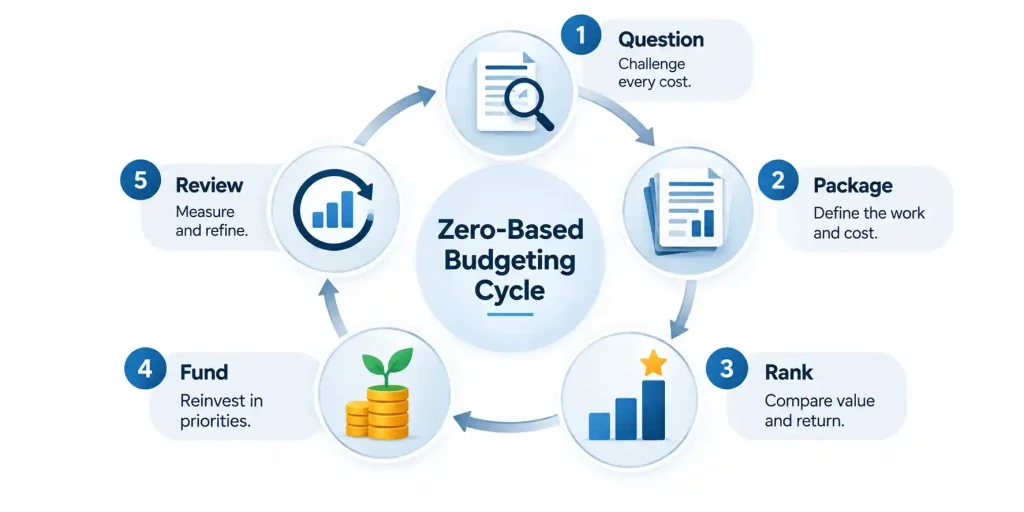
The Zero-Based Budgeting Cycle
| Question | Package | Rank | Fund | Review |
| Challenge every cost | Describe work in costed units | Compare by value and return | Reinvest savings in priorities | Measure outcomes and refine |
The Budget as an Expression of Strategy
Over time, zero-based budgeting stops being a project and becomes a norm. Planning grows more anticipatory, and leaders become fluent in the economics of their own decisions. The budget turns into a map of conviction that shows what the company believes and what it is willing to bet on. The strongest budgets come from authorship instead of inheritance, and zero-based budgeting reveals value far more than it reduces cost.
Three Key Takeaways
- Incremental budgeting preserves legacy spend by default and rarely questions it. Zero-based budgeting reverses the burden of proof so every cost must earn its place against current strategy.
- Decision packages, clear ranking criteria, and a phased rollout turn the method into a practical system. Visible reinvestment of savings keeps teams engaged instead of defensive.
- The lasting value of a zero-based budget is cultural, since it replaces entitlement with intention and moves budget conversations toward outcomes.
Disclaimer: This article is intended for informational purposes only and does not constitute legal, tax, or accounting advice. You should consult your own tax advisor or counsel for advice tailored to your specific situation.
Hindol Datta is a four-time CFO and senior finance executive with over 25 years of leadership experience across cybersecurity, SaaS, gaming, logistics, digital marketing, medical devices, consumer products, and nonprofit organizations. He has led more than $120M in fundraising and over $150M in M&A transactions while building the financial and operational systems that let complex businesses scale with confidence. He is the author of seven books in the Systems CFO Series and holds active CPA, CMA, and CIA credentials.
AI-assisted insights, supplemented by 25 years of finance leadership experience.