
Executive Summary
Working capital management is often treated as a technical exercise buried inside the balance sheet, yet it functions as the circulatory system of the enterprise, determining how quickly cash moves through inventory, receivables, and payables. Companies that master working capital management convert operating activity into cash faster than competitors, and that speed becomes a source of strategic optionality rather than a routine accounting metric.
This article examines how working capital management drives enterprise value, sustains resilience through market disruption, benefits from data analytics and forecasting, and requires deliberate communication to align boards and functional leaders around a shared liquidity strategy.
Why Working Capital Management Shapes Enterprise Value
Working capital management is the discipline of converting revenue into usable cash without relying on external financing, and that internal efficiency signals something investors value: operational control. A tightly managed cash conversion cycle demonstrates that forecasting is grounded in reality rather than optimism, and that the business is not dependent on bridge financing or speculative capital raises to meet its obligations.
Every dollar trapped in excess inventory or slow-paying receivables is a dollar unavailable for debt reduction, market expansion, or research investment. This is why sophisticated finance organizations treat working capital management as capital strategy without dilution rather than a seasonal cost-cutting exercise.
A $127M global consumer products company operating direct-to-consumer, Amazon, and wholesale channels across a supply chain spanning China and Vietnam offers a concrete illustration. Through demand planning, SKU rationalization, and logistics optimization, the finance function more than doubled inventory turns from three times to seven times annually, releasing meaningful trapped capital and transforming the cash conversion cycle while the company also delivered four consecutive clean external audits. That kind of transformation does not happen through a single initiative. It requires sustained working capital optimization embedded into daily operating rhythm rather than activated only during a downturn.
The Cash Conversion Cycle at a Glance
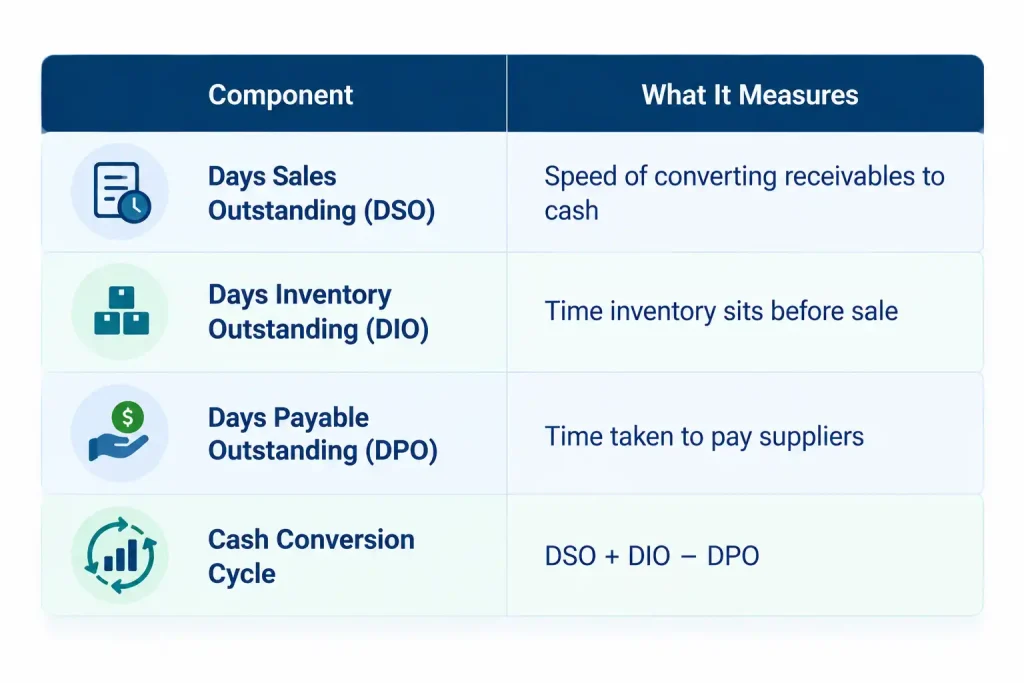
A shorter cycle means cash returns to the business faster, funding growth without new capital.
Building Resilience: Working Capital Management Through Market Disruption
When volatility enters through supply chain shocks, geopolitical tremors, or shifting trade policy, it is the velocity of cash rather than the size of revenue that determines whether a company endures or expands. Working capital management stops being a passive metric during these periods and becomes a form of organizational readiness.
Inventory as Buffer, Not Fortress
Excess inventory can feel protective, yet it consumes cash, requires storage, and depreciates while sitting on the shelf. Too little inventory, by contrast, risks missed sales and frustrated customers. The balance depends on predictive analytics and real-time vendor collaboration rather than instinct.
Receivables and Payables as Levers
In downturns, customers stretch payment timelines, and days sales outstanding can elongate quickly in emerging markets. Effective working capital management distinguishes leniency from leverage through:
- Early payment discounts tied to customer segmentation
- Automated invoicing paired with credit analysis
- Vendor segmentation by criticality rather than blanket payment delays
- Transparent liquidity communication with suppliers to preserve the supply chain
An early-career engagement in rail and transportation FP&A illustrates why this discipline travels across industries. Analyzing freight economics, route profitability, and capacity utilization builds a foundational understanding of how physical supply chains generate and consume capital, a grounding that carries directly into working capital optimization and operations-level cost analysis in asset-heavy businesses of any kind.
Similarly, a high-growth cybersecurity and identity access management company with approximately $30M in annual recurring revenue held forecast actuals within plus or minus 5% for 8 consecutive quarters by building a driver-based forecasting engine from scratch, a level of predictability that gave leadership the confidence to manage working capital proactively rather than react to surprises.
From Static Metrics to Strategic Insight: Data-Driven Working Capital Management
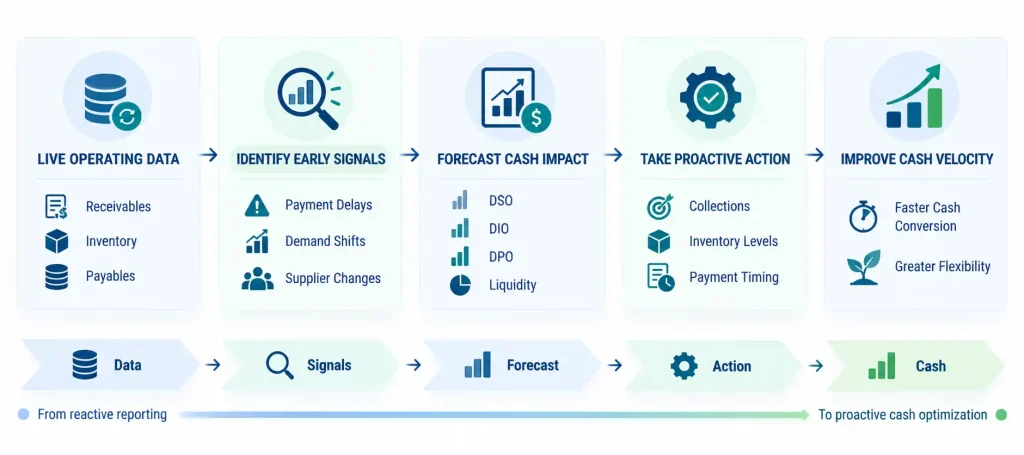
Working capital management has shifted from a backward-looking exercise, tabulated at month end, into a forward-looking discipline powered by analytics and forecasting. Predictive models now allow finance teams to anticipate customer payment delays before they occur, based on seasonality and buyer behavior, which means collections teams can engage proactively rather than reactively.
Inventory optimization has followed a similar path. Stocking decisions once driven by tribal knowledge can now be modeled through algorithms weighing demand volatility, supplier performance, and cost of capital. Even accounts payable decisions benefit from vendor segmentation and cash-on-hand modeling that treats payment timing as a strategic choice rather than a delay tactic.
A venture-backed performance marketing company scaled revenue from $9M to $180M in 24 months while building the customer acquisition cost, lifetime value, and contribution margin discipline that sustained that growth, alongside a finance team that grew from a single person to twelve. The infrastructure built to support that scale-up, including a first external audit and a $36.5M capital raise across three funding rounds, demonstrates how analytics-driven working capital management scales alongside the business rather than trailing behind it.
More recently, rebuilding finance workflows around AI-first tooling for an early-stage AI governance platform compressed the time between question and decision across modeling, reporting, and diligence, a pattern increasingly common as finance teams adopt automation for working capital forecasting rather than relying on static, month-end reporting.
Communicating Working Capital Strategy to the Board
Working capital management rarely sits at the top of mind for functional leaders. Sales focuses on pipeline and bookings, operations focuses on throughput, and procurement focuses on supplier terms. Each function sees a corner of the picture, and the finance leader’s task is to make the connective tissue visible.
A useful approach treats working capital as a current flowing through the organization, with inventory acting as a dam, receivables as tributaries, and payables as gates. Once that framing lands, executives begin to see days sales outstanding not as an abstract finance metric but as a reflection of customer onboarding delays or disputed invoices trapping capital.
At the board level, the conversation shifts toward optionality:
- Can the company self-fund expansion without new equity?
- How does the liquidity position compare with industry peers?
- What is the resilience posture heading into a downturn?
A mission-driven education and research institution offers a relevant parallel. Structuring a $37M capital raise across equity and venture debt required owning the investor narrative, board relationships, and audit committee engagement simultaneously, reinforcing that working capital strategy communication is inseparable from broader capital strategy communication at the governance level.
Three Key Takeaways
- Working capital management functions as capital strategy without dilution, and companies that treat the cash conversion cycle as a design question rather than a budget line unlock options to reinvest, acquire, and weather downturns without external financing.
- Resilience during market disruption depends on treating inventory, receivables, and payables as dynamic levers rather than static balance sheet line items, with predictive analytics replacing gut instinct in decisions about stocking, collections, and vendor terms.
- Working capital strategy only becomes organizational practice when it is communicated as a shared narrative rather than a finance-only dashboard, connecting functional decisions across sales, procurement, and operations to a single measure of enterprise liquidity.
Disclaimer: This article is intended for informational purposes only and does not constitute legal, tax, or accounting advice. You should consult your own tax advisor or counsel for advice tailored to your specific situation.
Hindol Datta is a four-time CFO and senior finance executive with over 25 years of leadership experience across cybersecurity, SaaS, gaming, logistics, digital marketing, medical devices, consumer products, and nonprofit organizations. He has led more than $120M in fundraising and over $150M in M&A transactions while building the financial and operational systems that let complex businesses scale with confidence. He is the author of seven books in the Systems CFO Series and holds active CPA, CMA, and CIA credentials.
AI-assisted insights, supplemented by 25 years of finance leadership experience.