
Executive Summary
For decades, variance analysis has lived in the background of the finance function. It has been a monthly ritual: compare budget to actual, then file the result. Understanding why variance analysis is important starts with recognizing that the exercise never functions as a rearview mirror. It functions as a radar. The diagnostic runs constantly. It tests whether the assumptions behind a plan still hold true in a market that rarely stays still.
This article reframes variance analysis as an operating discipline rather than an accounting chore. Drawing on finance leadership across cybersecurity, education, consumer products, and gaming, it walks through what variance analysis actually measures. It explains why the traditional monthly cadence has become too slow for growth-stage companies. Forward-looking finance teams, it shows, have rebuilt the process around real-time signals and root-cause thinking. The result is board communication that earns trust rather than manufactures comfort.
What Is Variance Analysis, and Why Has Its Role Changed
At its simplest, variance analysis compares planned financial results against actual outcomes. It breaks the gap into underlying drivers, price, volume, cost, and productivity chief among them. The practice has existed in one form or another since budgeting itself became a formal discipline. For much of that history it served one narrow purpose. Confirm that spending tracked the plan, and flag anything that did not.
That narrow purpose no longer matches the pace at which growth-stage companies operate. A monthly or quarterly variance report is prepared with care and defended in a board meeting. It often arrives after the moment it should have informed has already passed. The organization documents what happened rather than shapes what happens next. The report becomes an artifact of record instead of a tool of navigation.
The Cost of Treating Variance as an Audit
In one cybersecurity and identity access management company, generating approximately $30M in annual recurring revenue, variance reporting had settled into exactly this pattern. Then the forecasting engine and capacity model were rebuilt from the ground up. Sales viewed the report as a scoreboard kept by finance. Delivery teams treated it as retrospective commentary with no bearing on the current sprint. The reporting cadence shifted from monthly to weekly. It stayed tied to the same operational data delivery teams already tracked. Once that happened, actuals held within plus or minus five percent of forecast for eight consecutive quarters. That level of predictability changed how the leadership team planned hiring and pricing.
Why Variance Analysis Is Important Beyond the Monthly Report
The deeper argument for why variance analysis is important has less to do with accuracy for its own sake and more to do with what a persistent variance reveals about the assumptions underneath a plan. A revenue miss is rarely just a revenue miss; it is often evidence that a pricing assumption, a sales cycle length, or a channel mix has shifted in ways the original budget did not anticipate. Treated this way, variance stops being a scorecard and becomes a form of organizational feedback.
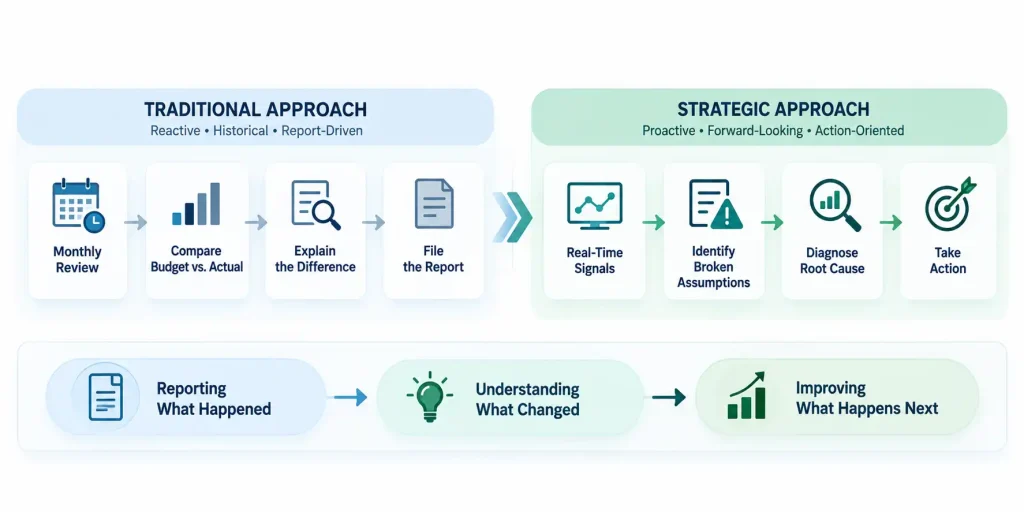
This is where finance leadership earns its seat at the strategy table rather than the compliance table. The following shifts distinguish variance analysis used as a signal from variance analysis used as a filing exercise:
- Weekly or real-time review of key drivers, rather than a monthly close-out
- Root-cause discussion embedded in the operating rhythm of go-to-market and product teams, not isolated to finance
- Explicit tracking of which assumptions broke, not just which line items moved
- Dashboards that connect variance to hypotheses tested, not only to tasks completed
From Scorecard to Signal
The language teams use around variance tends to reveal which mode they are in. Explanations built around timing differences, seasonality, or execution delay are often an act of narrative preservation rather than analysis, a way of accounting for the gap without examining what it teaches. A more useful question replaces “why did this happen” with “what does this tell the organization about how it is thinking.” That question is harder to answer honestly, and it is precisely the discomfort that makes the answer valuable.
Building a Variance Analysis Process Finance Teams Will Actually Use
A well-designed variance analysis process earns adoption because it produces something people act on, not because it is procedurally correct. Several practices consistently separate processes that get used from processes that get filed:
- Embed variance review inside the cadence teams already run, rather than creating a separate finance-only meeting
- Tie variance discussion to the specific assumption behind each driver, so the conversation stays diagnostic rather than defensive
- Distinguish controllable variances, such as hiring pace or discounting behavior, from uncontrollable ones, such as macro demand shifts
- Close the loop by updating the forecast, not only the commentary, once a root cause is confirmed
A $127M global consumer products company with distribution across direct-to-commerce, marketplace, and wholesale channels illustrated the value of this discipline during a period when inventory turns needed to move from three times to seven times. Variance in carrying cost and fill rate, tracked weekly against demand planning assumptions rather than monthly against a static budget, surfaced the SKU-level patterns that made that improvement achievable and released working capital that had been trapped for years.
Root-Cause Thinking Over Narrative Control
Variance conversations that stay defensive tend to produce padded forecasts and masked risk over time, because managers learn that a clean variance report is rewarded more than an honest one. Variance conversations that stay diagnostic produce the opposite effect: forecasts sharpen, assumptions get debated openly, and teams gain confidence not from being right on the first try but from being ready to adjust quickly when they are not.
The Architecture Behind Modern Variance Analysis
Real-time data infrastructure has changed what is operationally possible, and it has changed the honest answer to why variance analysis is important for finance teams competing on speed rather than size. Predictive analytics now allows teams to model drift before it fully materializes in the numbers, shifting finance from a function that reports the past to one that anticipates what is likely to move next.
A simple way to visualize the shift is as a closed loop rather than a linear report:
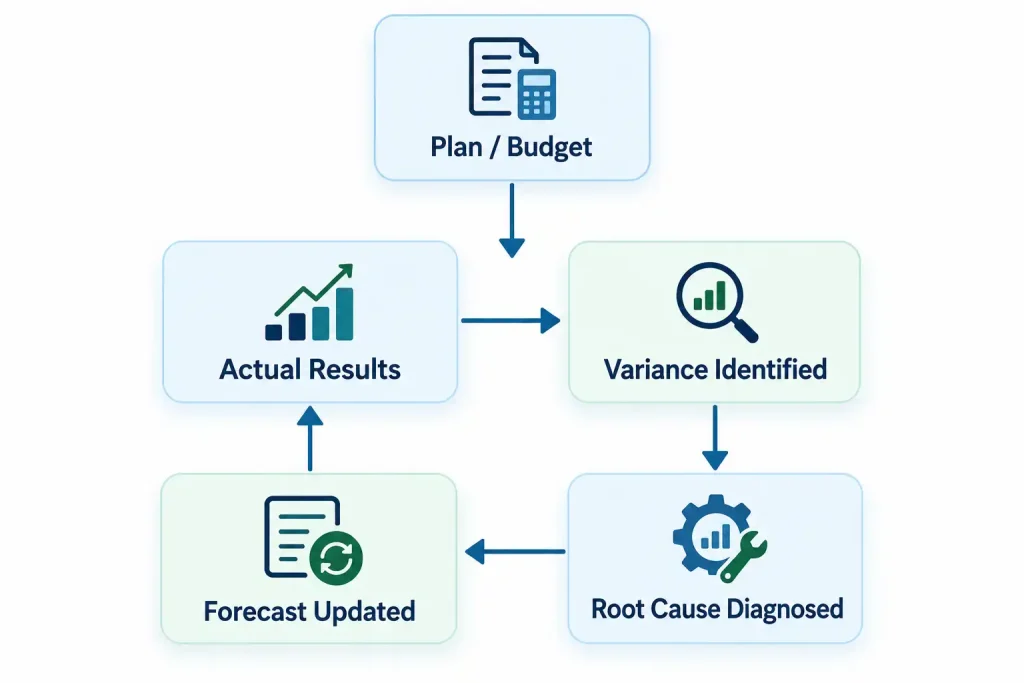
Where traditional variance analysis stopped at “Variance Identified” and filed the result, the loop above only creates value when root cause diagnosis feeds directly back into an updated forecast, closing the circle rather than leaving it open for the next quarter to rediscover.
In a mission-driven Silicon Valley education and research institution operating under variable philanthropic and earned-revenue conditions, this loop mattered as much for funding scenarios as it does for a commercial P&L. Multi-year modeling under uncertain revenue conditions, reviewed against actuals on a rolling basis rather than an annual one, gave the board and audit committee a defensible narrative for financial sustainability even when individual funding sources proved unpredictable.
Communicating Variance to Boards and Investors
Boards and investors ultimately care less about whether a number matched a plan and more about whether the organization understands why it did or did not, and what it intends to do about it. A public gaming and digital entertainment company listed on Euronext Paris, operating across five countries under both IFRS and US GAAP, depended on a single, consolidated definition of revenue precisely so that variance discussions with the board and with underwriters during IPO-readiness could focus on operational cause rather than reconciliation confusion between subsidiaries.
Framing variance in terms of risk-adjusted confidence, rather than false certainty, tends to build more durable trust than a report that never shows a miss. Investors grow wary of organizations that appear surprised by their own numbers, not of organizations that show variance and demonstrate fluency in responding to it.
Three Key Takeaways
- Variance analysis earns its strategic value only when it moves from a monthly filing exercise to a weekly or real-time discipline embedded in the same operating cadence that go-to-market and product teams already use, so that a broken assumption gets caught while there is still time to act on it.
- The most durable variance analysis processes distinguish controllable drivers from uncontrollable ones and tie every explanation to a specific assumption rather than a narrative of timing or seasonality, because that discipline is what separates genuine root-cause thinking from narrative preservation.
- Boards and investors respond less to the absence of variance than to the organization’s fluency in explaining it and closing the loop with an updated forecast, which is why the architecture connecting variance identification to forecast revision matters as much as the analysis itself.
Disclaimer: This article is intended for informational purposes only and does not constitute legal, tax, or accounting advice. You should consult your own tax advisor or counsel for advice tailored to your specific situation.
Hindol Datta is a four-time CFO and senior finance executive with over 25 years of leadership experience across cybersecurity, SaaS, gaming, logistics, digital marketing, medical devices, consumer products, and nonprofit organizations. He has led more than $120M in fundraising and over $150M in M&A transactions while building the financial and operational systems that let complex businesses scale with confidence. He is the author of seven books in the Systems CFO Series and holds active CPA, CMA, and CIA credentials.
AI-assisted insights, supplemented by 25 years of finance leadership experience.