
Executive Summary
Return on investment is the most familiar metric in business, and also one of the most misunderstood. Ask ten finance leaders what ROI is, and most will recite the formula. Few pause on the harder question buried inside it: a return on what, exactly? This article breaks down what ROI actually measures. It explains why a purely financial definition of return leaves value on the table. It also shows how disciplined finance teams build ROI models that survive contact with reality rather than collapsing under it.
The goal here is not to replace the ROI formula. It is to widen it. Understanding the full architecture behind ROI makes for sharper capital allocation decisions. That architecture runs from cost visibility to assumption testing to post-implementation measurement. A CFO who treats ROI as a single number on a slide does not.
What Is Return on Investment, and Why Does the Definition Matter?
Return on investment, or ROI, is a ratio that compares the gain from an investment against its cost. Finance teams usually express it as a percentage of the original cost. The formula is simple: subtract the cost of the investment from the gain, then divide by the cost. A project that costs $500K and returns $650K in benefit produces a 30% ROI. That much is arithmetic, and arithmetic rarely lies. What is far less settled, and far more consequential, is what counts as the “return” in the first place.
Most ROI conversations default to cash. Revenue generated, cost saved, margin expanded. These are legitimate and necessary inputs. Defining return only in dollar terms narrows ambition to what a spreadsheet can currently count. Not every investment that shapes a company’s future fits cleanly into a cell. A platform investment might deliver a modest ROI this year and unlock disproportionate leverage three years out. A retention program might never generate a measurable revenue line yet materially change hiring costs and institutional trust. Treating ROI as a single financial ratio, without asking what kind of return the organization actually needs, is the most common failure point in capital allocation.
Beyond the Ratio: Financial Return vs. Strategic Return
Financial return should function as the floor for any investment decision, not the ceiling. Strategic return, the harder category to defend in a quarterly review, is what separates companies that compound advantage from companies that only optimize what is already visible.
A mission-driven education and research institution raised $37M in capital across equity and venture debt. That raise did not rest on projected earned revenue alone. The investor narrative had to account for philanthropic funding cycles, enrollment sustainability, and institutional mission, none of which reduce neatly to an IRR calculation. The financial model still mattered, but it sat inside a larger argument about what kind of institution the organization was trying to become. That is the essential discipline behind strategic return: naming the outcome explicitly, rather than hoping the board infers it from a spreadsheet.
Three questions tend to separate a financially literate ROI conversation from a strategically literate one:
- What is the direct economic return of this investment?
- What is the strategic unlock if the investment succeeds?
- What is the cost of doing nothing at all?
An organization can claim to understand the return it is actually pursuing only after it answers all three questions honestly.
Seeing the Full Cost Behind Every ROI Calculation
An ROI model is only as trustworthy as the cost side of the equation, and cost is where most models quietly understate reality. A vendor invoice rarely captures the full cost of an investment. The real cost lives in implementation drag, coordination overhead, and the opportunities deliberately or accidentally set aside to pursue this one.
The Cost Beneath the Cost
Implementation overhead often forms the largest unmodeled line item in any ROI case. It shows up as competing priorities across teams, delayed onboarding, and the slow accumulation of change resistance that never appears in a capital expenditure line but draws directly from organizational energy. Common sources of unmodeled cost include:
- Coordination time across departments that never appears as a line item
- Training, change management, and behavioral adjustment during rollout
- Temporary productivity loss while teams transition to a new system or process
- Political capital spent aligning stakeholders around the decision
At a high-growth cybersecurity and identity access management company generating approximately $30M in annual recurring revenue, a driver-based forecasting engine and capacity model were built from the ground up specifically to surface these hidden costs before they became surprises. The result held actuals within plus or minus 5% of forecast for eight consecutive quarters, a level of predictability that came directly from modeling the full cost picture rather than the sticker price alone.
Opportunity Cost and the Price of What Gets Deferred
Every investment decision is also a decision not to fund something else. At a $127M global consumer products company operating across DTC, Amazon, and wholesale channels, a decision to prioritize demand planning and SKU rationalization more than doubled inventory turns, from three times to seven times, releasing working capital that had been trapped in the supply chain. That gain looked excellent on paper, but it was only defensible because the tradeoff, slower expansion into a secondary channel during the same period, was named explicitly rather than discovered after the fact.
Opportunity cost is rarely visible inside the ROI cell itself. It becomes visible only when someone asks, directly, what the organization is choosing not to do in order to fund this decision.
Why Assumptions Determine Whether an ROI Forecast Holds
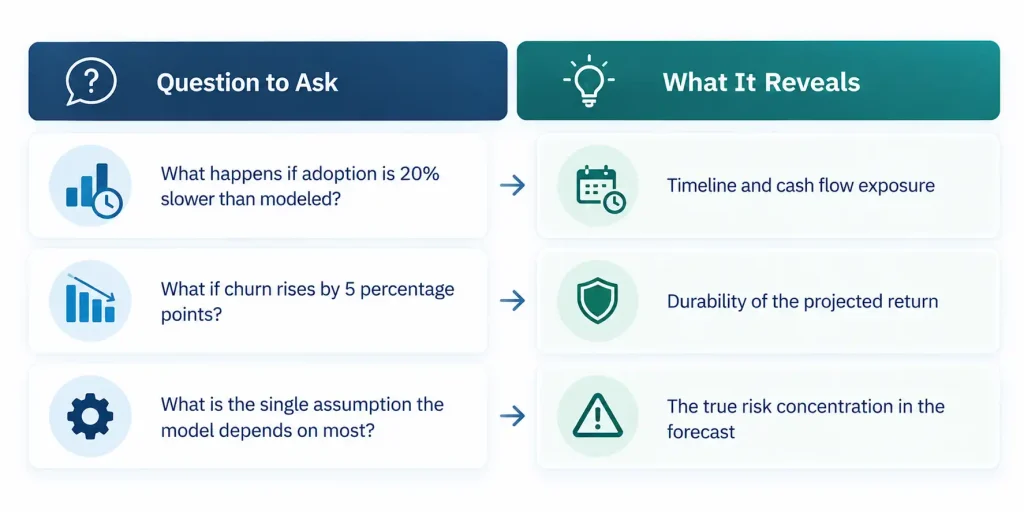
Every ROI model rests on assumptions: conversion rates, adoption speed, churn, ramp time, market stability. These assumptions are not a flaw in the model. They are the model. The danger is not that assumptions exist, but that they go unexamined and get treated as certainties rather than as bets.
A useful discipline is sensitivity testing: varying the key assumptions systematically to see where the projected return breaks down. A marketing campaign projected to generate 1,000 new leads per month, for example, may fall beneath breakeven if lead volume slips by only 15%. Naming that sensitivity aloud, before the investment is approved, does more for organizational trust than any polished forecast slide.
Measuring Actual ROI After the Decision Is Made
The discipline around ROI tends to peak at approval and quietly disappear afterward. Budgets get allocated, the initiative launches, and twelve months later almost no one compares the original forecast to what actually happened. This is not a minor oversight. If ROI is only used to justify a decision and never to validate one, the organization is not investing with discipline. It is guessing with paperwork attached.
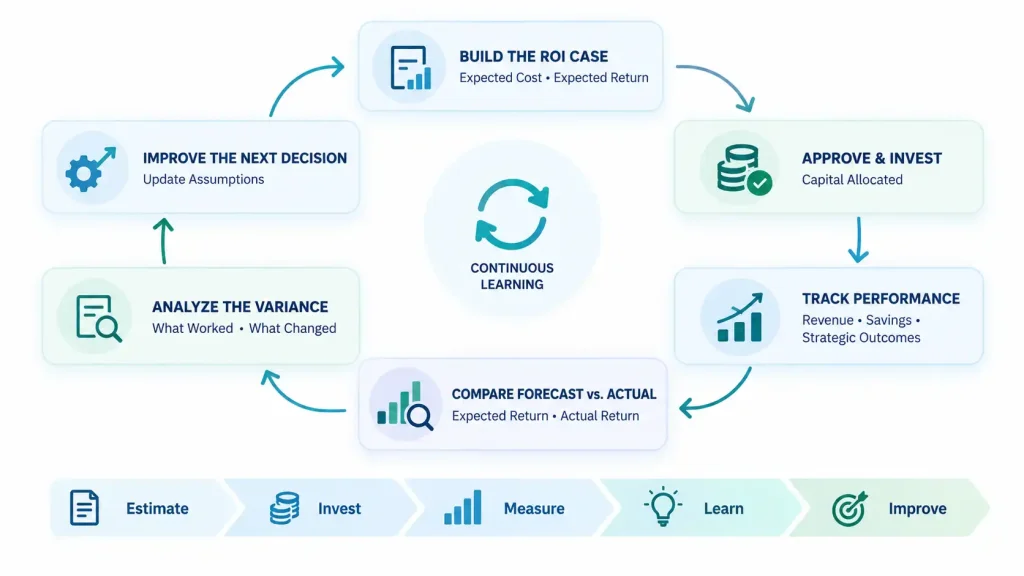
Effective measurement assigns clear ownership before the project begins: who owns the result, what metric proves it, and when it will be reviewed. At the Euronext Paris-listed gaming and digital entertainment company operating across five countries, more than $100M in cross-border M&A was executed with post-merger integration responsibility built into the deal structure from the outset, not bolted on afterward. That is the difference between ROI as a one-time estimate and ROI as an ongoing contract between forecast and fact.
Ranking Investments: The Fifth Question Most ROI Models Skip
A strong ROI on a single initiative means little in isolation. The real constraint most organizations face is not capital. It is capacity, the finite attention and execution bandwidth of the teams doing the work. An investment with excellent projected ROI can still fail if it lands on an organization already stretched across three other priorities.
The strongest finance teams treat capital allocation as portfolio construction rather than a sequence of independent approvals, building a comparative view, sometimes called a decision stack, of every current and proposed initiative ranked by return, risk, and strategic fit. That comparative discipline is what prevents drift, the slow accumulation of well-intentioned initiatives that collectively exceed what the organization can actually execute well.
Three Key Takeaways
- Return on investment should never be treated as a single financial ratio in isolation. The most consequential capital decisions require naming both the financial return and the strategic return before the model is built, not after.
- The true cost of an investment extends well beyond the price tag, and models that ignore implementation overhead and opportunity cost will consistently overstate the case for approval.
- ROI is not complete at the moment of approval. It becomes trustworthy only when the organization returns to measure the actual result against the original forecast and uses that variance to sharpen the next decision.
Disclaimer: This article is intended for informational purposes only and does not constitute legal, tax, or accounting advice. You should consult your own tax advisor or counsel for advice tailored to your specific situation.
Hindol Datta is a four-time CFO and senior finance executive with over 25 years of leadership experience across cybersecurity, SaaS, gaming, logistics, digital marketing, medical devices, consumer products, and nonprofit organizations. He has led more than $120M in fundraising and over $150M in M&A transactions while building the financial and operational systems that let complex businesses scale with confidence. He is the author of seven books in the Systems CFO Series and holds active CPA, CMA, and CIA credentials.
AI-assisted insights, supplemented by 25 years of finance leadership experience.