
Executive Summary
What is a controlled foreign corporation? And why does the question often arrive on a CFO’s desk months after the entity that triggers it already exists. The answer is rarely a tidy legal definition. It arrives as a note from a tax advisor during a quarter close. An overseas subsidiary, built to support engineering or customer operations, has quietly crossed the ownership threshold. That threshold defines a controlled foreign corporation under U.S. tax law. A Form 5471 filing obligation follows. So does a Subpart F income analysis. Constructive ownership questions follow too, ones most operating teams never anticipated when they opened the entity.
This article walks through CFC classification and the constructive ownership rules that catch companies by surprise. It covers Subpart F income and the Form 5471 filing categories too. It closes with a governance framework for tracking CFC exposure before it becomes a compliance emergency.
What Is a Controlled Foreign Corporation, and Why It Reaches Beyond the Tax Department
A controlled foreign corporation, by statutory definition, is a foreign corporation. U.S. shareholders must own more than 50 percent of its total combined voting power or value. That ownership can be direct, indirect, or constructive. The definition sounds contained until a finance team applies it to a real capitalization table. At that point, CFC status reveals itself as a description of relationships more than ownership. Some of those relationships never appear on any single document.
The framework is not new. Subpart F entered the tax code in 1962. The Treasury grew concerned. U.S. shareholders were using offshore entities to defer taxation on income with little connection to genuine foreign business activity. The 2017 Tax Cuts and Jobs Act converted a worldwide tax system into something closer to a quasi-territorial one. But GILTI, Subpart F, and the CFC rules that anchor both now function as the enforcement mechanism for that system. It no longer assumes offshore income escapes U.S. taxation by default.
A high-growth cybersecurity and identity access management company operated across five countries. That footprint included delivery centers in India and Nepal. Multi-entity structures of that kind are where CFC exposure tends to surface first. Operating needs, not tax planning, drove the entities, and nobody mapped the ownership implications until growth made the mapping unavoidable.
What Is a CFC for Tax Purposes: Ownership, Attribution, and the Fifty Percent Threshold
A high-growth cybersecurity and identity access management company operated across five countries. That footprint included delivery centers in India and Nepal. Multi-entity structures of that kind are where CFC exposure tends to surface first. Operating needs, not tax planning, drove the entities, and nobody mapped the ownership implications until growth made the mapping unavoidable.
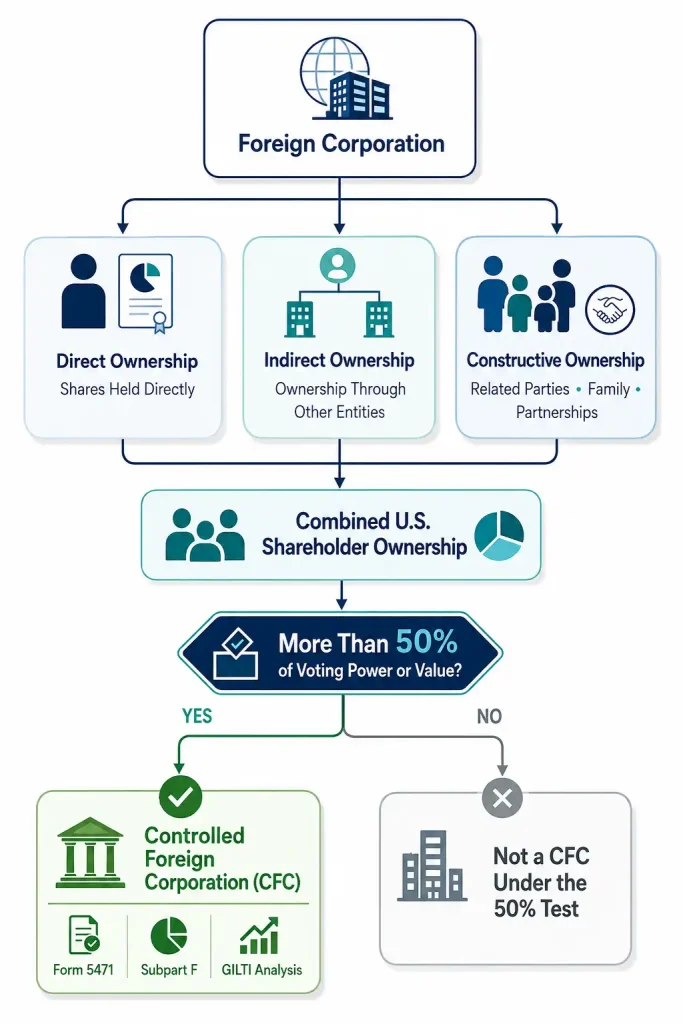
Constructive Ownership in Practice
Finance teams often build attribution diagrams in this kind of engagement. The charts look closer to genealogy charts than organizational structures, and they become the work product that determines whether a company owes a Form 5471 filing. In one Series B company, CFC status emerged because a founder’s wholly owned U.S. entity held 40 percent of a foreign joint venture, which another U.S. shareholder’s spouse also co-owned in part. No individual holding crossed 50 percent. But §958(b) attribution rules combined the two holdings and pushed the foreign entity past the threshold. The company found itself preparing back-year filings and protective disclosures rather than a routine annual return.
Intent rarely triggers CFC status. Proximity does, along with an accumulation of ownership interests that no single stakeholder was tracking. During a public-company mandate at a Euronext Paris-listed gaming and digital entertainment business spanning the United States, France, the United Kingdom, Singapore, and South Korea, constructive ownership analysis was a standing item in evaluating cross-border transactions, because one overlooked attribution chain could unwind consolidated reporting built under both IFRS and US GAAP.
Subpart F Income and the End of Indefinite Deferral
Subpart F income is the mechanism that pulls certain foreign earnings into U.S. taxable income immediately, rather than allowing deferral until repatriation. It targets foreign base company income: dividends, interest, rents, royalties, and other passive categories suggesting the entity functions as a holding structure rather than a business conducting substantial activity in its own right. If an entity is not doing much beyond collecting income that originated elsewhere, the tax code declines to reward it with deferral.
The friction shows up when an efficient corporate structure and a Subpart F exposure turn out to be the same structure. Companies that have routed intellectual property licensing through a foreign subsidiary for legitimate operational reasons have discovered during CFC analysis that the royalty stream met the definition of foreign base company income. Rebuilding the structure to reflect substantial business activity in the jurisdiction became necessary, and cheaper done proactively than unwound under audit pressure.
The decisions that create this exposure rarely originate in the tax function. A chief technology officer signs an IP assignment agreement with an overseas team. A chief operating officer opens a subsidiary for a European customer success hub. General counsel executes an intercompany services agreement formalizing work already underway. Each decision is defensible in isolation, but together, across a company with more than one foreign entity, they build a pattern CFC and Subpart F rules were written to catch, and the chief financial officer is usually the only one positioned to see it.
Form 5471: Filer Categories and the Cost of Missing One
Form 5471 is a twenty-page information return, and its obligations depend on which of five filer categories apply:
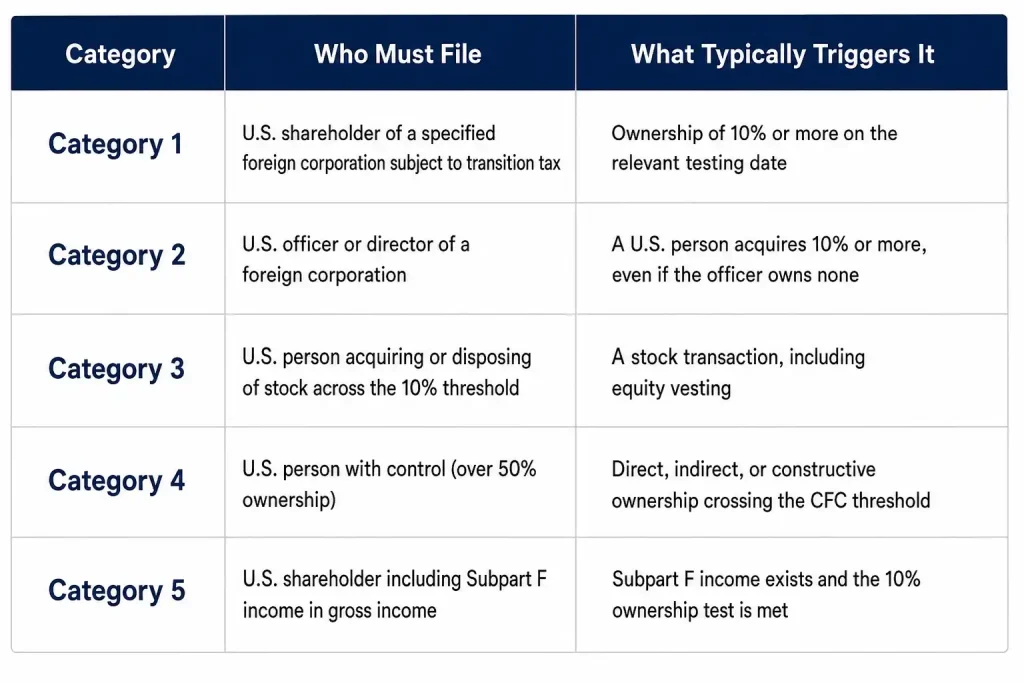
These categories extend the filing obligation to people, not only corporations. In one company, a vice president was issued stock options in a foreign subsidiary, and when they vested, attribution rules pulled him into Category 4 filer status, an obligation neither he nor human resources had anticipated.
The cost of missing a Form 5471 filing is not modest: an initial penalty near $10K applies per form per year, with additional penalties accruing at roughly $10K for every 30 days a failure continues after IRS notice, capped at $50K. Failing to generate income does not excuse the filing. The obligation attaches to ownership and control, not profitability, and treating a dormant entity as exempt is one of the more expensive assumptions a growing company can make.
Building a Governance Cadence Around Controlled Foreign Corporation Risk
Companies that manage CFC exposure well treat it as a quarterly question, not a year-end one. A workable review asks a short, specific set of questions:
- Has ownership in any foreign entity changed, through equity grants, share transfers, or new investor participation
- Has a foreign entity that was previously dormant or pre-revenue begun generating income
- Has any entity been recapitalized, dissolved, or restructured in a way that affects the ownership picture
- Are Earnings and Profits (E&P) schedules current for every foreign entity, not only the ones known to be profitable
That last question deserves attention. E&P tracking is the forensic input required to compute Subpart F income and prepare for repatriation, and it is the schedule most often neglected until an acquisition forces a scramble to reconstruct years of history. A mandate at a global medical device manufacturer with plants across Denmark, Cork, and Taiwan carried a similar lesson from standard costing discipline in a regulated environment: precision built in from day one is inexpensive, and precision reconstructed under audit scrutiny is not.
One rule of thumb, developed across companies with more than one foreign entity and more than three U.S. investors in governance, is to assume CFC analysis is required rather than wait for a triggering event to confirm it. A mission-driven education and research institution taught a related lesson: board reporting works because it happens on a schedule, not once a year when the auditors arrive.
From CFC Classification to GILTI: The Bigger Picture
CFC classification is the foundation for everything that follows, including exposure to Global Intangible Low-Taxed Income, or GILTI, which depends on how a company’s controlled foreign corporations are structured and what income they generate. A future article will take up GILTI directly; get the CFC classification wrong, and every downstream calculation, from foreign tax credit utilization to repatriation strategy, inherits the error.
Controlled foreign corporations rarely announce themselves the moment a company opens a foreign entity. They surface later, during consolidation or diligence, when a tax advisor reviews an ownership structure that quietly evolved past a threshold nobody was watching. Companies that treat this as governance, rather than a compliance surprise, walk into an acquisition or a public offering with a defensible answer already documented.
Three Key Takeaways
- CFC status is determined by constructive ownership under IRC §958 and §318, not only direct equity, so any company with more than one foreign entity should map attribution across related parties before assuming the 50 percent threshold has not been crossed.
- Subpart F income targets passive foreign base company income, including royalty arrangements structured for legitimate reasons, so efficient structures should be reviewed for CFC exposure before they are finalized.
- Form 5471 compliance depends on filer category, extends to individuals as much as corporations, and carries penalties beginning near $10K per form, so a quarterly foreign structure risk review is far cheaper than a retroactive reconstruction under audit.
Disclaimer: This article is intended for informational purposes only and does not constitute legal, tax, or accounting advice. You should consult your own tax advisor or counsel for advice tailored to your specific situation.
Hindol Datta is a four-time CFO and senior finance executive with over 25 years of leadership experience across cybersecurity, SaaS, gaming, logistics, digital marketing, medical devices, consumer products, and nonprofit organizations. He has led more than $120M in fundraising and over $150M in M&A transactions while building the financial and operational systems that let complex businesses scale with confidence. He is the author of seven books in the Systems CFO Series and holds active CPA, CMA, and CIA credentials.
AI-assisted insights, supplemented by 25 years of finance leadership experience.