
Executive Summary
A Key Performance Indicator looks simple on a dashboard. A number moves, a dot turns green, and a team feels reassured. But a KPI is never just a statistic. It is a decision machine, and what a company chooses to measure reveals what it actually intends to do.
This article answers what are KPIs in business at a practical level. It covers the KPI meaning in business beyond the textbook definition. It covers how the right metrics align an organization, and how the wrong ones mislead it. And it covers how to design a KPI set that drives execution, rather than just describing it.
What Is a KPI, Really?
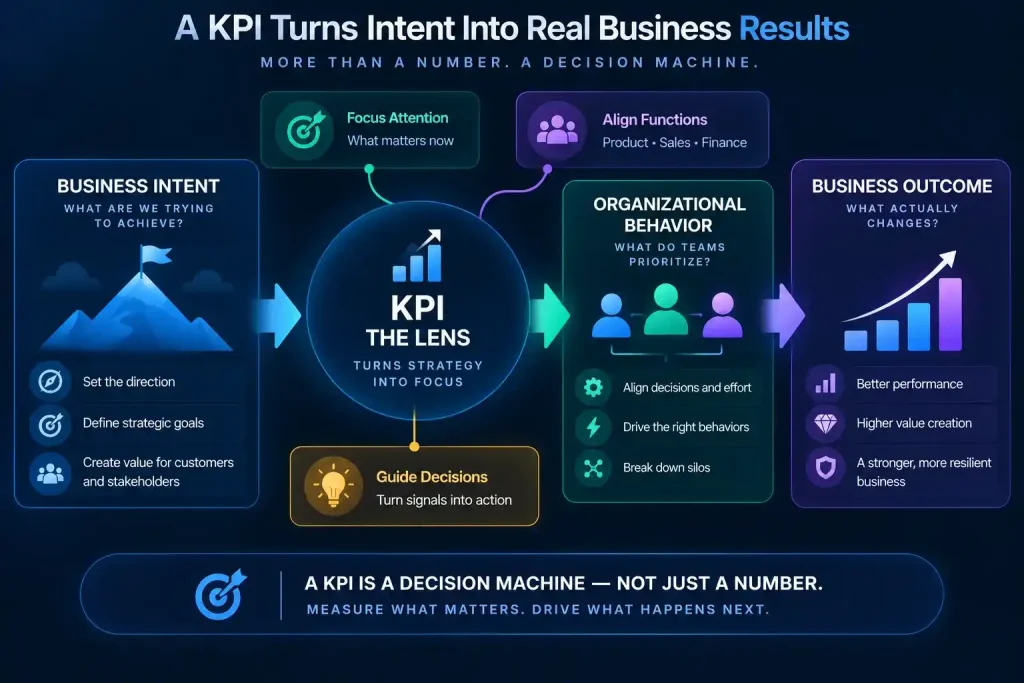
A KPI is a lens. It decides what a business pays attention to, and what it lets fade into the background. It is a proxy for value, chosen as much by context and intent as by mathematics.
That is why the KPI meaning in business shifts with the business itself. A pre-revenue biotech company and a mature logistics platform will never share a KPI set. Performance means something different at each stage, and the metric has to say so.
A KPI can also mislead by omission. A high Net Promoter Score does not confirm loyalty on its own. Low churn does not confirm security on its own. The most dangerous KPIs are rarely wrong. They are incomplete.
KPI Meaning in Business: A Lens, Not Just a Number
KPI selection works more like editing than arithmetic. What gets left off the dashboard matters as much as what makes it on. Each KPI elevates a specific story:
- Revenue per user pushes a company toward monetization.
- Daily active users pushes it toward engagement.
- Employee Net Promoter Score pushes it toward culture.
Certain KPIs have become canonical inside specific industries, though they work as ingredients, not blueprints.
- SaaS businesses track Net Revenue Retention, CAC payback, and the Rule of 40.
- Retail tracks same-store sales, basket size, and inventory turnover.
- Manufacturing tracks yield rates, OEE, and defect ratios.
Every company still has to compose its own set. The canonical list only works if it matches what that business is trying to become.
How KPIs Align Organizations Toward a Shared Goal
A KPI rarely needs to be shouted. Placed well, it becomes the compass an organization orients around without anyone issuing a command. Alignment here does not mean unanimity. It means coherence, the quiet handshake between product, sales, and finance that shows up when decisions start to rhyme.
Case: One Metric, Three Functions
A marketplace SaaS platform was preparing for a Series B. It built its board reporting around Net Revenue Retention as the core KPI. The shift changed behavior across the company. Product teams started tracking usage, not just signups. Sales began qualifying customers by fit, not just by willingness to buy. Customer success pushed for deeper integrations rather than faster ticket closure. No one declared a cultural shift. It happened because one KPI had clarified what winning meant.
Not every metric earns that kind of pull. A marketing team chasing top-of-funnel leads can hit its number while sales drowns in unqualified prospects. A support team rewarded for ticket-closure speed can start deflecting instead of resolving. The fix is not more metrics. It is the right ones, in the right sequence, with the right owners.
The Tyranny of the Metric: When KPIs Mislead
A KPI is a proxy, not a truth, and the danger starts the moment an organization forgets the difference. A few failure patterns show up again and again.
- Gaming the metric: A logo-churn KPI can quietly turn into a discount program that keeps unhappy customers on paper.
- Myopia: A team fixated on revenue can miss rising costs building underneath it.
- Lagging signals treated as leading ones: A KPI often reflects a decision made months earlier, yet teams react to it as if it describes the present.
- Cultural narrowing: When a team defines itself by the number it owns, collaboration tends to shrink along with it.
Case: Recalibrating a KPI Mid-Downturn
An early-stage digital marketing and community technology company had to prove this in reverse. Its growth-era KPI, monthly recurring revenue growth, stopped matching the moment. Burn needed to fall from $800K to $200K. The team replaced the old KPI with a burn-and-runway metric, tracked weekly instead of quarterly. The switch was not a retreat. It gave the team a clear definition of good, right when the old definition had stopped applying.
Designing KPIs That Actually Drive Execution
A KPI earns its place only when four disciplines hold.
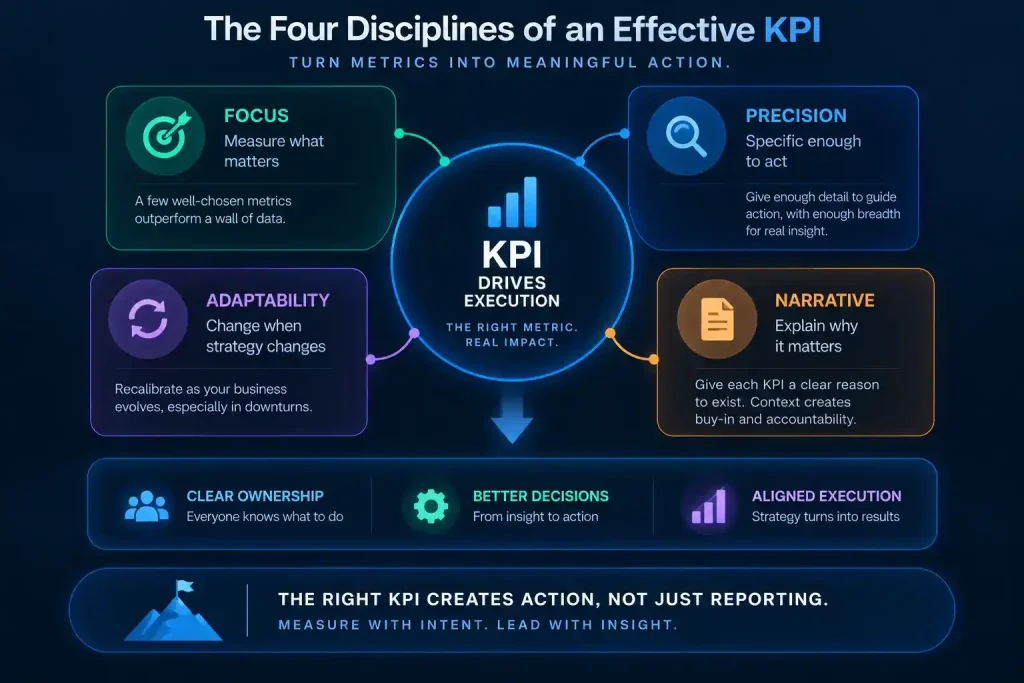
- Focus: A dashboard with dozens of “critical” metrics commands no belief at all. A handful of well-chosen numbers outperforms a wall of data every time.
- Precision: A metric needs enough specificity to guide action, and enough breadth to invite real interpretation. A professional services firm once tracked only top-line bookings. It gained far more clarity after adding engagement-level profitability. That single metric showed where margin was created and where it leaked.
- Adaptability: A KPI set built for a high-growth year can actively mislead during a downturn. The right response is recalibration, not attachment to the old number.
- Narrative: A KPI needs a stated reason to exist. Teams accept a constraint far more readily once they understand the tension it is meant to resolve.
When these four disciplines hold, a KPI stops being a dashboard reading. It becomes a shared language for ownership. It also gives teams a reason to stay curious about their own numbers, instead of just reporting them.
Three Key Takeaways
- What are KPIs in business, at their core? They are a lens, not a scoreboard. What a company chooses to measure says more about its intent than any single result does.
- A KPI aligns an organization only when it changes behavior across functions. It cannot just shift behavior inside the department that owns the number.
- A KPI that outlives its usefulness will start to mislead. Recalibrating the metric, not defending it, is what keeps a KPI honest as a business and its strategy evolve.
Disclaimer: This article is intended for informational purposes only and does not constitute legal, tax, or accounting advice. You should consult your own tax advisor or counsel for advice tailored to your specific situation.
Hindol Datta is a four-time CFO and senior finance executive with over 25 years of leadership experience across cybersecurity, SaaS, gaming, logistics, digital marketing, medical devices, consumer products, and nonprofit organizations. He has led more than $120M in fundraising and over $150M in M&A transactions while building the financial and operational systems that let complex businesses scale with confidence. He is the author of seven books in the Systems CFO Series and holds active CPA, CMA, and CIA credentials.
AI-assisted insights, supplemented by 25 years of finance leadership experience.