
Executive Summary
A warranty provision is rarely the marketing afterthought it appears to be in a sales deck. It is a financial commitment, a forward-looking obligation. Finance teams must measure it with the same discipline they apply to revenue or inventory. Yet in budget meetings, teams still treat warranty liabilities as a rounding error rather than a claim on future cash. That gap between a warranty provision on paper and in practice is where trouble begins.
This article walks through how GAAP treats assurance-type and service-type warranties. It covers how to estimate a warranty provision using real cost data rather than a flat percentage. It also explains how to record the warranty provision journal entry correctly. Handled well, warranty liabilities become a leading indicator of product and customer health, not a trailing accounting entry.
Why Warranty Liabilities Deserve a Seat at the Finance Table
Warranty accruals and embedded service obligations force a company to look past the current quarter. They demand a reasoned estimate about costs tied to revenue already booked. Done well, this work aligns margin reporting with the true economics of service. Done poorly, or simply ignored, it distorts the cost structure and invites audit risk along with a credibility problem that follows a company into its next board meeting.
In a high-growth cybersecurity and identity access management company generating roughly $30M in annual recurring revenue, the finance function rebuilt its ASC 606 revenue recognition framework from the ground up, and one of the quieter but more consequential outcomes was a controls environment that could withstand acquisition diligence without a single warranty or service obligation surfacing as a surprise. That is the standard worth aiming for: not a warranty provision that merely satisfies an auditor, but one that would survive a stranger reading the books for the first time.
GAAP Rules: Assurance-Type and Service-Type Warranty Provisions
Under ASC 460, which governs guarantees, and ASC 606, which governs embedded service obligations, a company must recognize a liability at the point of sale whenever it offers a warranty or service commitment beyond standard assurance. Whether that liability behaves as a cost accrual or a revenue deferral depends entirely on the facts of the arrangement.
Two Warranty Types, Two Accounting Treatments
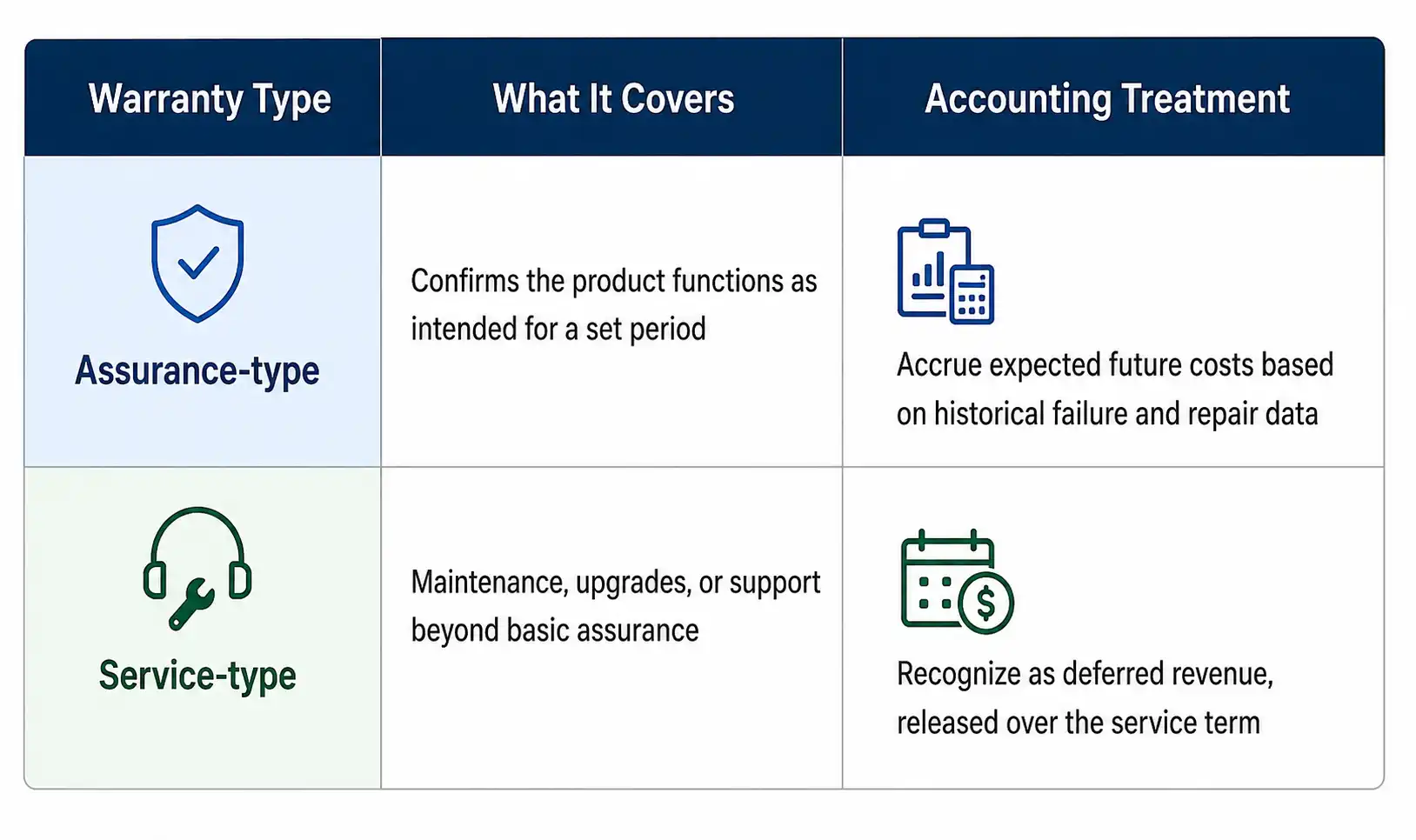
Hybrid contracts blur this line constantly. A three-year support plan bundled with a one-year standard warranty typically contains both an accrual and a deferral, and the accounting must reflect both elements rather than defaulting to whichever is easier to calculate.
Estimating the Warranty Provision: From Failure Rates to Cost Curves
Estimating a warranty provision is not a matter of applying a flat 2 percent against revenue and moving on. It requires modeling the actual cost curve using failure rates, return patterns, service labor, parts costs, and logistics expense.
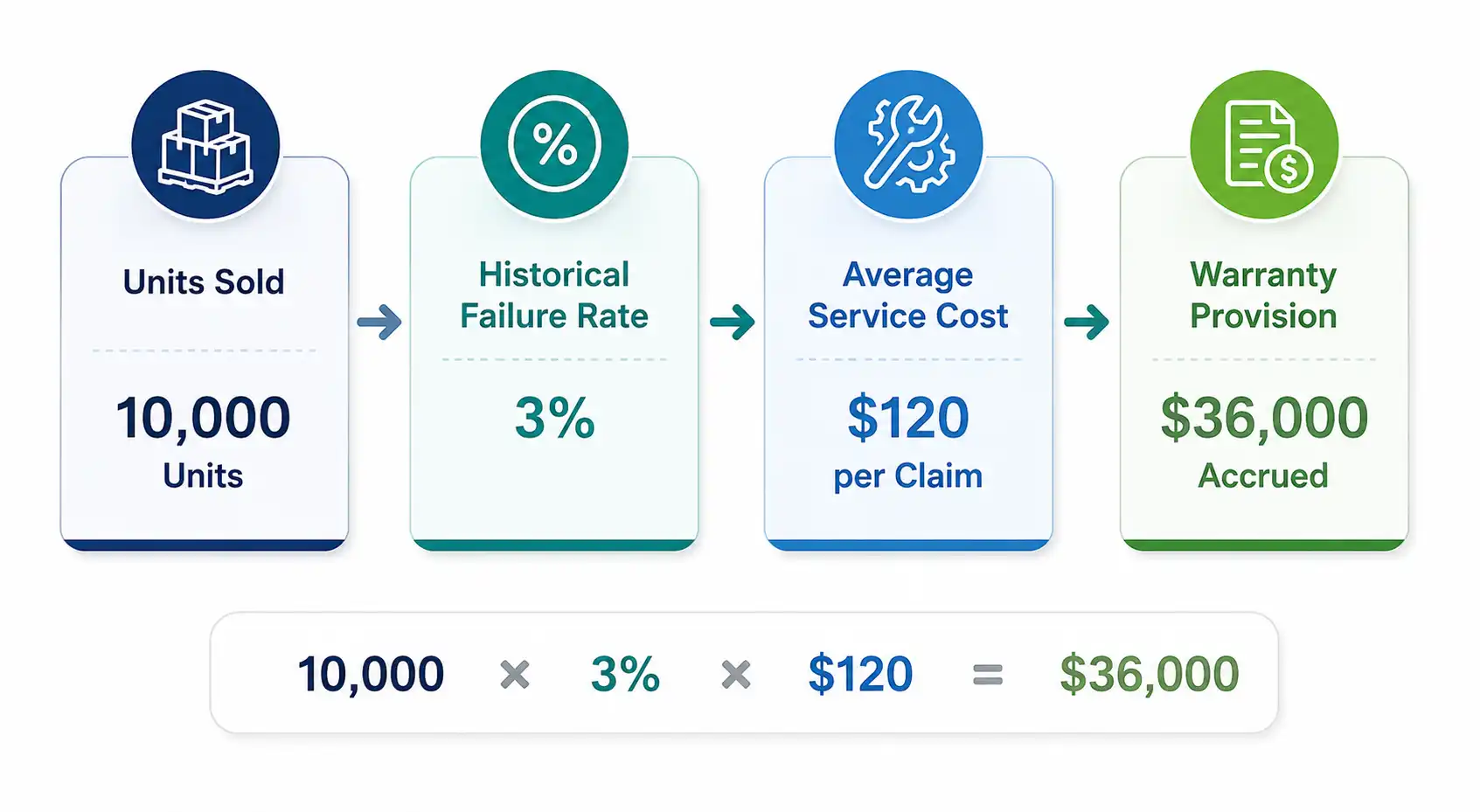
Consider a hardware company with a historical failure rate of 3 percent within 18 months of delivery and an average service cost of $120 per incident. Selling 10,000 units in a quarter obligates an accrual of $36,000 at the time of sale. If that same company shifts from in-house repairs to an outsourced warranty partner and per-incident cost rises to $180, the accrual requirement climbs by 50 percent, and that shift rarely shows up in a footnote until it has already reshaped the margin line.
In a $170M global medical device manufacturer operating regulated plants across Copenhagen, Cork, and Taiwan, the finance and operations team built standard costing and bill-of-materials management to withstand line-by-line audit scrutiny, precisely because getting a warranty provision wrong in a regulated industry costs far more than a line on the balance sheet.
Recording the Warranty Provision Journal Entry
The warranty provision journal entry follows the matching principle: the estimated cost of honoring a warranty is recognized in the same period as the related sale, not when a claim eventually arrives.
At the time of sale, the entry debits warranty expense and credits the warranty liability account, increasing both total expenses and total liabilities for the period.
| Account | Debit | Credit |
| Warranty Expense | $36,000 | |
| Warranty Liability (Provision) | $36,000 |
When a claim is honored, the warranty liability account is debited and reduced, with the offsetting credit going to inventory, cash, or accounts payable, depending on whether the company repairs, replaces, or reimburses.
| Account | Debit | Credit |
| Warranty Liability (Provision) | $12,000 | |
| Inventory or cash | $12,000 |
For service-type warranties, the initial entry debits cash or accounts receivable and credits deferred revenue rather than a liability account, and revenue is released over the service term as the obligation is fulfilled rather than at the moment of sale.
Embedded Service Clauses and the Revenue Side of Warranty Liabilities
Where warranties bundle with extended coverage, ongoing support, or software upgrades, ASC 606 requires the consideration to be bifurcated between product and service elements based on standalone selling price, with the service portion recognized over time. This matters most in SaaS-enabled hardware, where physical goods ship alongside multi-year service contracts and a failure to defer revenue properly front-loads earnings in a way that misstates profitability.
In one such engagement involving a global consumer products company with roughly $127M in revenue across DTC, Amazon, and wholesale channels, an unreviewed bundled maintenance arrangement was corrected by reallocating 20 percent of contract value to deferred revenue, which shifted gross margin by 600 basis points once the true service obligation was reflected. The correction changed the financial statements and, just as consequentially, changed what investors expected from the business going forward.
Building an Audit-Ready Warranty Liabilities Framework
Auditors scrutinize warranty provisions because the estimate carries inherent judgment, and judgment is where bias tends to hide. Optimistic assumptions shrink the liability and inflate margin; conservative ones protect credibility at the cost of near-term earnings. A defensible framework generally includes the following elements:
- Historical failure and repair data that is documented and traceable to the model
- Accrual calculations tied to product category, geography, or usage profile
- Deferred revenue schedules that align with the actual contractual service term
- Written justification for any change in estimate, such as a higher failure rate or a vendor price increase
- Accrual reversals supported by real cost data rather than by improved-looking performance on paper
Warranty Provision Management Across a Global Supply Chain
Warranty risk does not travel evenly across a global footprint. A low-cost component sourced in Shenzhen can cost several times more to service once it reaches a customer in Chicago, after shipping, labor, and customs are layered in. Outsourcing warranty management to a third-party change both the cost profile and the risk allocation, and consumer protection statutes in jurisdictions such as the EU can impose minimum warranty standards that diverge from the company’s own contract language. Finance, legal, and operations need a shared view of the obligation, because a warranty provision built on the contract alone, without accounting for local law, tends to understate the liability.
Warranty Liabilities as a Strategic Signal, Not Just a Compliance Task
Warranty data, read correctly, tells a story well beyond the general ledger:
- Elevated warranty costs often point to a design flaw or a supply chain quality issue rather than bad luck
- A sudden surge in claims can signal customer dissatisfaction or a breakdown in onboarding
- Persistently low service utilization can reveal an upsell opportunity for premium support tiers
Finance leaders who fold warranty data into product margin dashboards, customer lifetime value models, and renewal planning get more out of the number than a static reserve on the balance sheet. A practical starting sequence: audit the current accrual methodology against current cost structures and claim rates, partner with product and support teams to capture real-time failure and service-time data, set reserve policies by product family or geography and revisit them quarterly, confirm which service elements require ASC 606 bifurcation, and bring warranty reporting into board and investor materials so the numbers support the broader strategic narrative rather than sitting apart from it.
Three Key Takeaways
- A warranty provision is a forecast disguised as an accrual, and the quality of that forecast depends on real failure-rate and cost data rather than a flat percentage carried forward out of habit from a prior fiscal year.
- The warranty provision journal entry is only as reliable as the estimate behind it, so the debit to warranty expense and credit to warranty liability at the time of sale should be revisited whenever service costs, vendor terms, or failure patterns shift materially.
- Warranty liabilities managed with discipline become a source of product and customer insight, not merely a compliance obligation, and the finance function that treats them that way tends to catch design and quality problems well before they show up in a customer churn report.
Disclaimer: This article is intended for informational purposes only and does not constitute legal, tax, or accounting advice. You should consult your own tax advisor or counsel for advice tailored to your specific situation.
Hindol Datta is a four-time CFO and senior finance executive with over 25 years of leadership experience across cybersecurity, SaaS, gaming, logistics, digital marketing, medical devices, consumer products, and nonprofit organizations. He has led more than $120M in fundraising and over $150M in M&A transactions while building the financial and operational systems that let complex businesses scale with confidence. He is the author of seven books in the Systems CFO Series and holds active CPA, CMA, and CIA credentials.
AI-assisted insights, supplemented by 25 years of finance leadership experience.